2005 CHEVROLET BLAZER battery
[x] Cancel search: batteryPage 315 of 436
4. Open the hoods and locate the batteries. Find the
positive (+) and negative (−) terminal locations on
each vehicle. SeeEngine Compartment Overview
on page 5-12for more information on location.
{CAUTION:
Using a match near a battery can cause battery
gas to explode. People have been hurt doing
this, and some have been blinded. Use a
ashlight if you need more light.
Be sure the batteries have enough water. You
do not need to add water to the ACDelco
®
battery (or batteries) installed in your new
vehicle. But if a battery has ller caps, be sure
the right amount of uid is there. If it is low,
add water to take care of that rst. If you do
not, explosive gas could be present.
Battery uid contains acid that can burn you.
Do not get it on you. If you accidentally get it
in your eyes or on your skin, ush the place
with water and get medical help immediately.
{CAUTION:
Fans or other moving engine parts can injure
you badly. Keep your hands away from moving
parts once the engine is running.
5. Check that the jumper cables do not have loose or
missing insulation. If they do, you could get a
shock. The vehicles could be damaged too.
Before you connect the cables, here are some
basic things you should know. Positive (+) will go to
positive (+) or to a remote positive (+) terminal if
the vehicle has one. Negative (−) will go to a heavy,
unpainted metal engine part or to a remote
negative (−) terminal if the vehicle has one.
Do not connect positive (+) to negative (−)oryou
will get a short that would damage the battery
and maybe other parts too. And do not connect the
negative (−) cable to the negative (−) terminal on
the dead battery because this can cause sparks.
5-43
Page 316 of 436
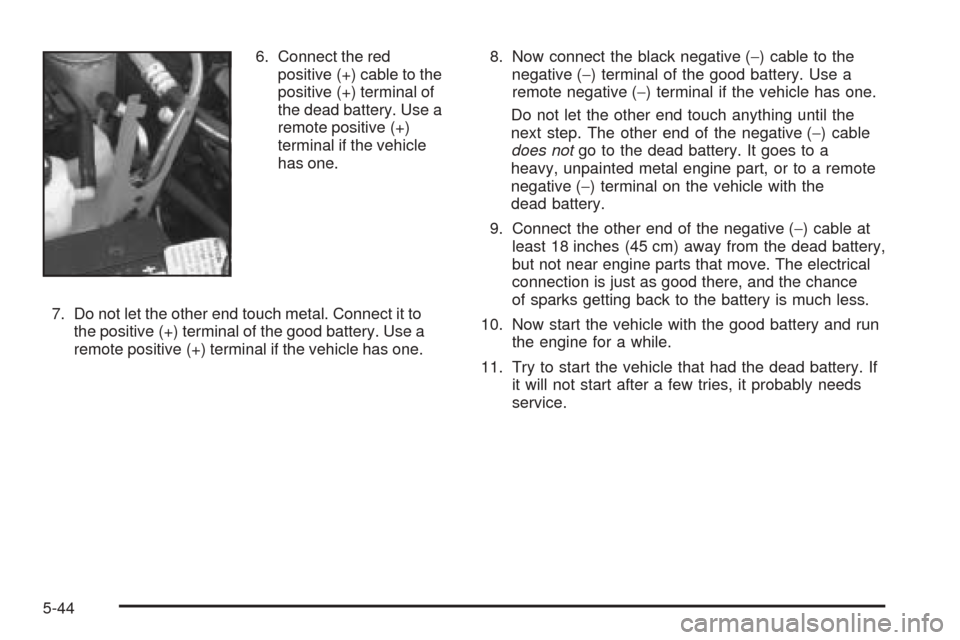
6. Connect the red
positive (+) cable to the
positive (+) terminal of
the dead battery. Use a
remote positive (+)
terminal if the vehicle
has one.
7. Do not let the other end touch metal. Connect it to
the positive (+) terminal of the good battery. Use a
remote positive (+) terminal if the vehicle has one.8. Now connect the black negative (−) cable to the
negative (−) terminal of the good battery. Use a
remote negative (−) terminal if the vehicle has one.
Do not let the other end touch anything until the
next step. The other end of the negative (−) cable
does notgo to the dead battery. It goes to a
heavy, unpainted metal engine part, or to a remote
negative (−) terminal on the vehicle with the
dead battery.
9. Connect the other end of the negative (−) cable at
least 18 inches (45 cm) away from the dead battery,
but not near engine parts that move. The electrical
connection is just as good there, and the chance
of sparks getting back to the battery is much less.
10. Now start the vehicle with the good battery and run
the engine for a while.
11. Try to start the vehicle that had the dead battery. If
it will not start after a few tries, it probably needs
service.
5-44
Page 317 of 436

Notice:If the jumper cables are removed in the
wrong order, electrical shorting may occur and
damage the vehicle. The repairs would not be
covered by your warranty. Remove the jumper
cables in the correct order, making sure that the
cables do not touch each other or other metal.
A. Heavy, Unpainted Metal Engine Part
B. Good Battery
C. Dead BatteryTo disconnect the jumper cables from both vehicles, do
the following:
1. Disconnect the black negative (−) cable from the
vehicle that had the dead battery.
2. Disconnect the black negative (−) cable from the
vehicle with the good battery.
3. Disconnect the red positive (+) cable from the
vehicle with the good battery.
4. Disconnect the red positive (+) cable from the other
vehicle.
Jumper Cable Removal
5-45
Page 371 of 436
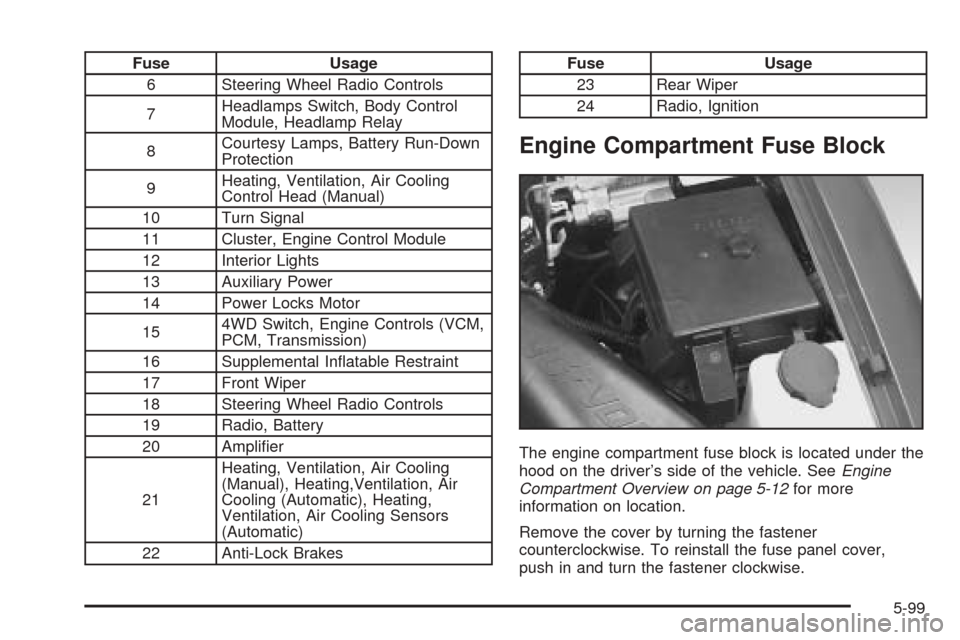
Fuse Usage
6 Steering Wheel Radio Controls
7Headlamps Switch, Body Control
Module, Headlamp Relay
8Courtesy Lamps, Battery Run-Down
Protection
9Heating, Ventilation, Air Cooling
Control Head (Manual)
10 Turn Signal
11 Cluster, Engine Control Module
12 Interior Lights
13 Auxiliary Power
14 Power Locks Motor
154WD Switch, Engine Controls (VCM,
PCM, Transmission)
16 Supplemental Inatable Restraint
17 Front Wiper
18 Steering Wheel Radio Controls
19 Radio, Battery
20 Amplier
21Heating, Ventilation, Air Cooling
(Manual), Heating,Ventilation, Air
Cooling (Automatic), Heating,
Ventilation, Air Cooling Sensors
(Automatic)
22 Anti-Lock BrakesFuse Usage
23 Rear Wiper
24 Radio, Ignition
Engine Compartment Fuse Block
The engine compartment fuse block is located under the
hood on the driver’s side of the vehicle. SeeEngine
Compartment Overview on page 5-12for more
information on location.
Remove the cover by turning the fastener
counterclockwise. To reinstall the fuse panel cover,
push in and turn the fastener clockwise.
5-99
Page 416 of 436
Roadside Assistance Program
As the owner of a new Chevrolet vehicle, you are
automatically enrolled in the Chevrolet Roadside
Assistance program. This value-added service is
intended to provide you with peace of mind as you drive
in the city or travel the open road. Call Chevrolet’s
Roadside Assistance at 1-800-CHEV-USA,
(1-800-243-8872) 24 hours a day, 365 days a year to
speak with a Chevrolet Roadside Assistance
representative.
We will provide the following services during the
Bumper-to-Bumper warranty period, at no expense
to you:
Fuel Delivery:Delivery of enough fuel
($5 maximum) for the customer to get to the
nearest service station.
Lock-out Service (identication required):
Replacement keys or locksmith service will
be covered at no charge if you are unable to gain
entry into your vehicle. Delivery of the replacement
key will be covered within 10 miles (16 km).
Emergency Tow:Tow to the nearest dealership for
warranty service or in the event of a
vehicle-disabling accident. Assistance provided
when the vehicle is mired in sand, mud, or snow.
Flat Tire Change:Installation of a spare tire will be
covered at no charge. The customer is responsible
for the repair or replacement of the tire if not
covered by a warrantable failure.
Jump Start:No-start occurrences which require a
battery jump start will be covered at no charge.
Dealer Locator Service
In many instances, mechanical failures are covered
under Chevrolet’s Bumper-to-Bumper warranty.
However, when other services are utilized, our Roadside
Assistance Representatives will explain any payment
obligations you might incur.
For prompt and efficient assistance when calling, please
provide the following to the Roadside Assistance
Representative:
Your name, home address, and home telephone
number.
Telephone number of your location.
Location of the vehicle.
Model, year, color, and license plate number.
Mileage, Vehicle Identication Number (VIN), and
delivery date of the vehicle.
Description of the problem.
7-6
Page 424 of 436
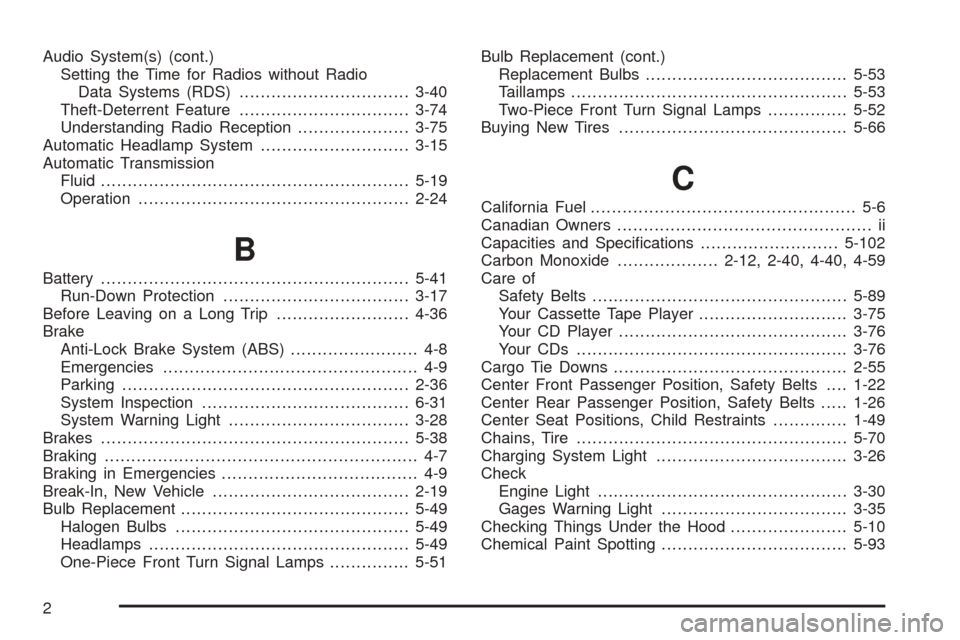
Audio System(s) (cont.)
Setting the Time for Radios without Radio
Data Systems (RDS)................................3-40
Theft-Deterrent Feature................................3-74
Understanding Radio Reception.....................3-75
Automatic Headlamp System............................3-15
Automatic Transmission
Fluid..........................................................5-19
Operation...................................................2-24
B
Battery..........................................................5-41
Run-Down Protection...................................3-17
Before Leaving on a Long Trip.........................4-36
Brake
Anti-Lock Brake System (ABS)........................ 4-8
Emergencies................................................ 4-9
Parking......................................................2-36
System Inspection.......................................6-31
System Warning Light..................................3-28
Brakes..........................................................5-38
Braking........................................................... 4-7
Braking in Emergencies..................................... 4-9
Break-In, New Vehicle.....................................2-19
Bulb Replacement...........................................5-49
Halogen Bulbs............................................5-49
Headlamps.................................................5-49
One-Piece Front Turn Signal Lamps...............5-51Bulb Replacement (cont.)
Replacement Bulbs......................................5-53
Taillamps....................................................5-53
Two-Piece Front Turn Signal Lamps...............5-52
Buying New Tires...........................................5-66
C
California Fuel.................................................. 5-6
Canadian Owners................................................ ii
Capacities and Specications..........................5-102
Carbon Monoxide...................2-12, 2-40, 4-40, 4-59
Care of
Safety Belts................................................5-89
Your Cassette Tape Player............................3-75
Your CD Player...........................................3-76
Your CDs ...................................................3-76
Cargo Tie Downs............................................2-55
Center Front Passenger Position, Safety Belts....1-22
Center Rear Passenger Position, Safety Belts.....1-26
Center Seat Positions, Child Restraints..............1-49
Chains, Tire...................................................5-70
Charging System Light....................................3-26
Check
Engine Light...............................................3-30
Gages Warning Light...................................3-35
Checking Things Under the Hood......................5-10
Chemical Paint Spotting...................................5-93
2
Page 426 of 436
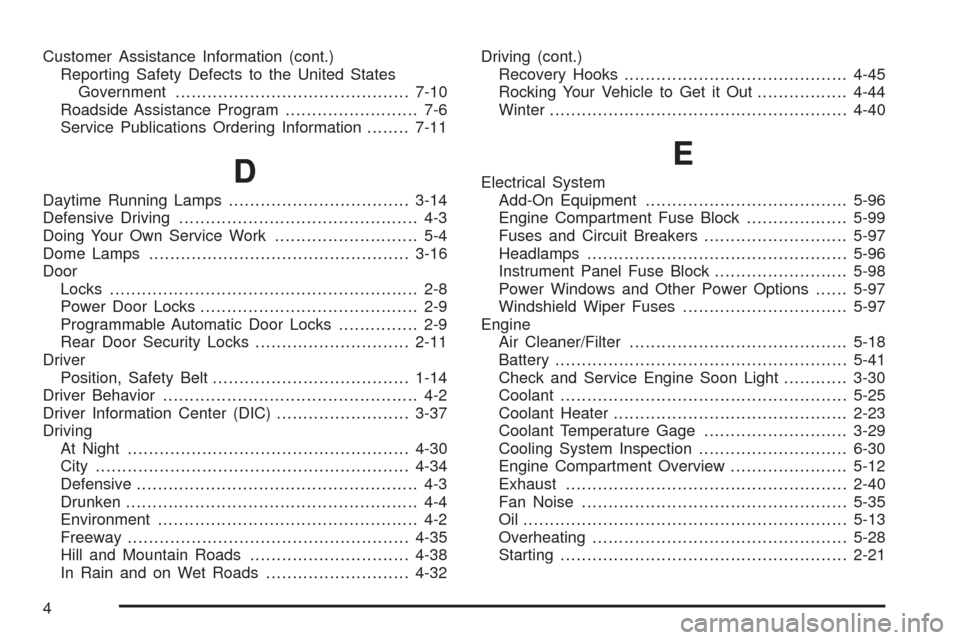
Customer Assistance Information (cont.)
Reporting Safety Defects to the United States
Government............................................7-10
Roadside Assistance Program......................... 7-6
Service Publications Ordering Information........7-11
D
Daytime Running Lamps..................................3-14
Defensive Driving............................................. 4-3
Doing Your Own Service Work........................... 5-4
Dome Lamps.................................................3-16
Door
Locks.......................................................... 2-8
Power Door Locks......................................... 2-9
Programmable Automatic Door Locks............... 2-9
Rear Door Security Locks.............................2-11
Driver
Position, Safety Belt.....................................1-14
Driver Behavior................................................ 4-2
Driver Information Center (DIC).........................3-37
Driving
At Night.....................................................4-30
City...........................................................4-34
Defensive..................................................... 4-3
Drunken....................................................... 4-4
Environment................................................. 4-2
Freeway.....................................................4-35
Hill and Mountain Roads..............................4-38
In Rain and on Wet Roads...........................4-32Driving (cont.)
Recovery Hooks..........................................4-45
Rocking Your Vehicle to Get it Out.................4-44
Winter........................................................4-40
E
Electrical System
Add-On Equipment......................................5-96
Engine Compartment Fuse Block...................5-99
Fuses and Circuit Breakers...........................5-97
Headlamps.................................................5-96
Instrument Panel Fuse Block.........................5-98
Power Windows and Other Power Options......5-97
Windshield Wiper Fuses...............................5-97
Engine
Air Cleaner/Filter.........................................5-18
Battery.......................................................5-41
Check and Service Engine Soon Light............3-30
Coolant......................................................5-25
Coolant Heater............................................2-23
Coolant Temperature Gage...........................3-29
Cooling System Inspection............................6-30
Engine Compartment Overview......................5-12
Exhaust.....................................................2-40
Fan Noise..................................................5-35
Oil .............................................................5-13
Overheating................................................5-28
Starting......................................................2-21
4
Page 429 of 436
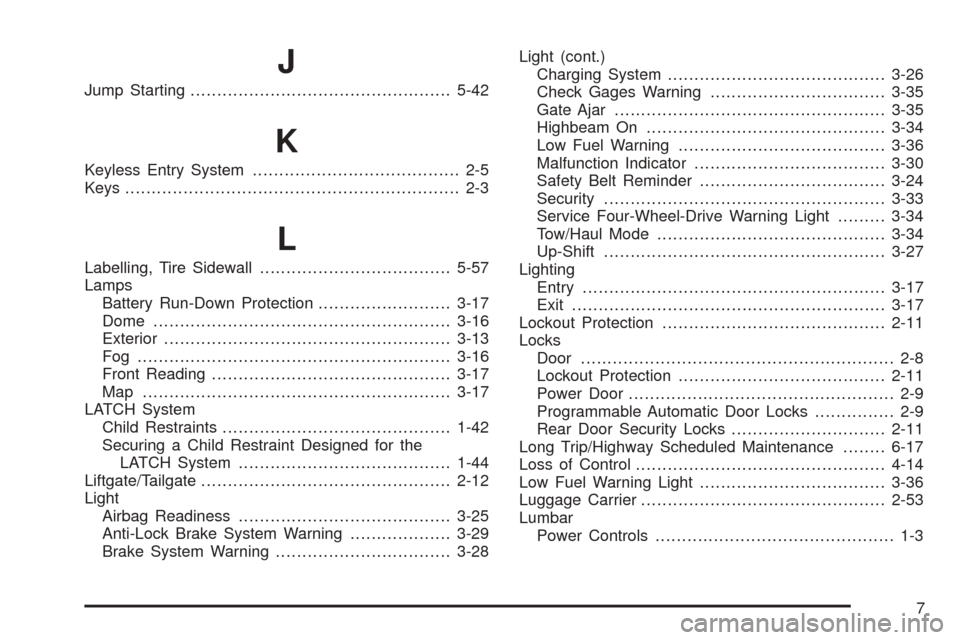
J
Jump Starting.................................................5-42
K
Keyless Entry System....................................... 2-5
Keys............................................................... 2-3
L
Labelling, Tire Sidewall....................................5-57
Lamps
Battery Run-Down Protection.........................3-17
Dome........................................................3-16
Exterior......................................................3-13
Fog ...........................................................3-16
Front Reading.............................................3-17
Map ..........................................................3-17
LATCH System
Child Restraints...........................................1-42
Securing a Child Restraint Designed for the
LATCH System........................................1-44
Liftgate/Tailgate...............................................2-12
Light
Airbag Readiness........................................3-25
Anti-Lock Brake System Warning...................3-29
Brake System Warning.................................3-28Light (cont.)
Charging System.........................................3-26
Check Gages Warning.................................3-35
Gate Ajar...................................................3-35
Highbeam On.............................................3-34
Low Fuel Warning.......................................3-36
Malfunction Indicator....................................3-30
Safety Belt Reminder...................................3-24
Security.....................................................3-33
Service Four-Wheel-Drive Warning Light.........3-34
Tow/Haul Mode...........................................3-34
Up-Shift.....................................................3-27
Lighting
Entry.........................................................3-17
Exit...........................................................3-17
Lockout Protection..........................................2-11
Locks
Door........................................................... 2-8
Lockout Protection.......................................2-11
Power Door.................................................. 2-9
Programmable Automatic Door Locks............... 2-9
Rear Door Security Locks.............................2-11
Long Trip/Highway Scheduled Maintenance........6-17
Loss of Control...............................................4-14
Low Fuel Warning Light...................................3-36
Luggage Carrier..............................................2-53
Lumbar
Power Controls............................................. 1-3
7