2005 CHEVROLET BLAZER seats
[x] Cancel search: seatsPage 147 of 436

Notice:Using a razor blade or sharp object to clear
the inside rear window may damage the rear
window defogger. Repairs would not be covered by
your warranty. Do not clear the inside of the rear
window with sharp objects.
Outlet Adjustment
Use the thumbwheels located in the center and on the
sides, to change the direction of the air owing
through the outlets.
Operation Tips
Clear away any ice, snow or leaves from the air
inlets at the base of the windshield that may
block the ow of air into your vehicle.
Use of non-GM approved hood deectors may
adversely affect the performance of the system.
Keep the path under the front seats clear of objects
to help circulate the air inside of your vehicle more
effectively.
Warning Lights, Gages, and
Indicators
This part describes the warning lights and gages that may
be on your vehicle. The pictures will help you locate them.
Warning lights and gages can signal that something is
wrong before it becomes serious enough to cause
an expensive repair or replacement. Paying attention to
your warning lights and gages could also save you
or others from injury.
Warning lights come on when there may be or is a
problem with one of your vehicle’s functions. As you will
see in the details on the next few pages, some
warning lights come on briey when you start the
engine just to let you know they’re working. If you are
familiar with this section, you should not be alarmed
when this happens.
Gages can indicate when there may be or is a problem
with one of your vehicle’s functions. Often gages
and warning lights work together to let you know when
there’s a problem with your vehicle.
When one of the warning lights comes on and stays on
when you are driving, or when one of the gages
shows there may be a problem, check the section that
tells you what to do about it. Please follow this
manual’s advice. Waiting to do repairs can be
costly–and even dangerous. So please get to know your
warning lights and gages. They’re a big help.
3-21
Page 252 of 436
Using heavier suspension components to get added
durability might not change your weight ratings. Ask your
dealer to help you load your vehicle the right way.
Notice:Overloading your vehicle may cause
damage. Repairs would not be covered by your
warranty. Do not overload your vehicle.
If you put things inside of your vehicle—like suitcases,
tools, packages, or anything else— they will go as
fast as the vehicle goes. If you have to stop or
turn quickly, or if there is a crash, they’ll keep going.
{CAUTION:
Things you put inside your vehicle can strike
and injure people in a sudden stop or turn, or
in a crash.
Put things in the cargo area of your
vehicle. Try to spread the weight evenly.
Never stack heavier things, like suitcases,
inside the vehicle so that some of them
are above the tops of the seats.
CAUTION: (Continued)
CAUTION: (Continued)
Do not leave an unsecured child restraint
in your vehicle.
When you carry something inside the
vehicle, secure it whenever you can.
Do not leave a seat folded down unless
you need to.
There’s also important loading information for off-road
driving in this manual. See“Loading Your Vehicle
for Off-Road Driving”underOff-Road Driving with Your
Four-Wheel-Drive Vehicle on page 4-15.
Add-On Equipment
When you carry removable items, you may need to put
a limit on how many people you carry inside your
vehicle. Be sure to weigh your vehicle before you buy
and install the new equipment.
Notice:Overloading your vehicle may cause
damage. Repairs would not be covered by your
warranty. Do not overload your vehicle.
4-50
Page 332 of 436
Tire Terminology and Denitions
Air Pressure:The amount of air inside the tire pressing
outward on each square inch of the tire. Air pressure
is expressed in pounds per square inch (psi) or
kiloPascal (kPa).
Accessory Weight:This means the combined weight
of optional accessories. Some examples of optional
accessories are, automatic transmission, power steering,
power brakes, power windows, power seats, and air
conditioning.
Aspect Ratio:The relationship of a tire’s height to
its width.
Belt:A rubber coated layer of cords that is located
between the plies and the tread. Cords may be made
from steel or other reinforcing materials.
Bead:The tire bead contains steel wires wrapped by
steel cords that hold the tire onto the rim.
Bias Ply Tire:A pneumatic tire in which the plies are
laid at alternate angles less than 90 degrees to the
centerline of the tread.
Cold Ination Pressure:The amount of air pressure in
a tire, measured in pounds per square inch (psi) or
kilopascals (kPa) before a tire has built up heat
from driving. SeeInation - Tire Pressure on page 5-62.Curb Weight:This means the weight of a motor
vehicle with standard and optional equipment including
the maximum capacity of fuel, oil and coolant, but
without passengers and cargo.
DOT Markings:A code molded into the sidewall of a
tire signifying that the tire is in compliance with the U.S.
Department of Transportation (DOT) motor vehicle
safety standards. The DOT code includes the Tire
Identication Number (TIN), an alphanumeric designator
which can also identify the tire manufacturer, production
plant, brand and date of production.
GVWR:Gross Vehicle Weight Rating, seeLoading
Your Vehicle on page 4-46.
GAWR FRT:Gross Axle Weight Rating for the front
axle, seeLoading Your Vehicle on page 4-46.
GAWR RR:Gross Axle Weight Rating for the rear axle,
seeLoading Your Vehicle on page 4-46.
Intended Outboard Sidewall:The side of an
asymmetrical tire, that must always face outward when
mounted on a vehicle.
KiloPascal (kPa):The metric unit for air pressure.
Light Truck (LT-Metric) Tire:A tire used on light duty
trucks and some multipurpose passenger vehicles.
5-60
Page 370 of 436
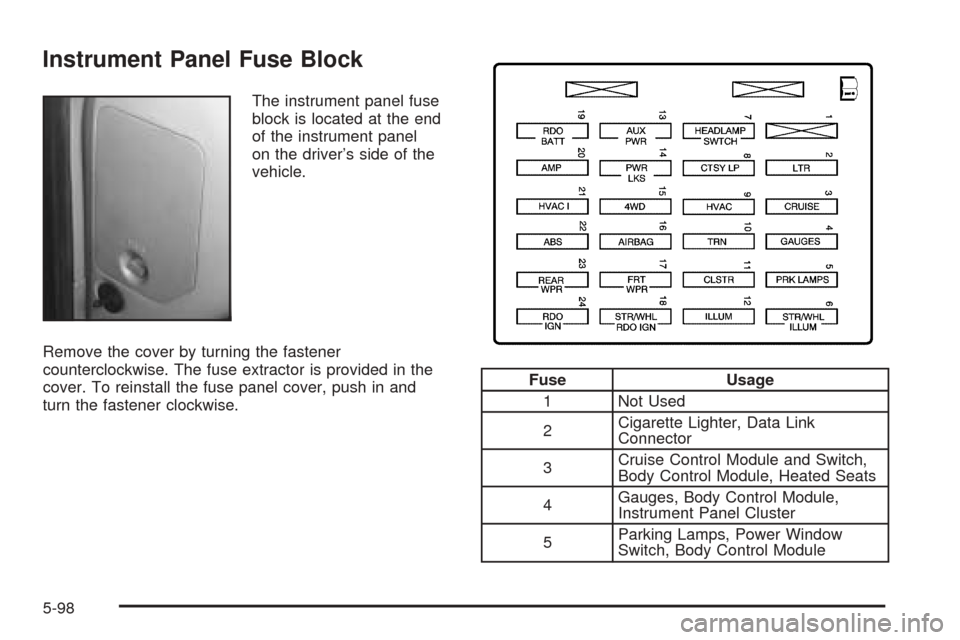
Instrument Panel Fuse Block
The instrument panel fuse
block is located at the end
of the instrument panel
on the driver’s side of the
vehicle.
Remove the cover by turning the fastener
counterclockwise. The fuse extractor is provided in the
cover. To reinstall the fuse panel cover, push in and
turn the fastener clockwise.
Fuse Usage
1 Not Used
2Cigarette Lighter, Data Link
Connector
3Cruise Control Module and Switch,
Body Control Module, Heated Seats
4Gauges, Body Control Module,
Instrument Panel Cluster
5Parking Lamps, Power Window
Switch, Body Control Module
5-98
Page 428 of 436
Gasoline
Octane........................................................ 5-5
Specications............................................... 5-5
Gate Ajar Light...............................................3-35
Glove Box.....................................................2-49
GM Mobility Reimbursement Program.................. 7-5
H
Hazard Warning Flashers................................... 3-5
Head Restraints............................................... 1-6
Headlamps....................................................5-49
Automatic Headlamp System.........................3-15
Bulb Replacement.......................................5-49
Daytime Running Lamps...............................3-14
Electrical System.........................................5-96
Flash-to-Pass............................................... 3-8
Halogen Bulbs............................................5-49
High/Low Beam Changer................................ 3-8
On Reminder..............................................3-13
One-Piece Front Turn Signal Lamps...............5-51
Two-Piece Front Turn Signal Lamps...............5-52
Heated Seats................................................... 1-4
Heater...........................................................3-19
Highbeam On Light.........................................3-34
Highway Hypnosis...........................................4-37
Hill and Mountain Roads..................................4-38
HomeLink
®Transmitter....................................2-44
HomeLink®Transmitter, Programming................2-46Hood
Checking Things Under................................5-10
Release.....................................................5-11
Horn............................................................... 3-6
How to Use This Manual...................................... ii
How to Wear Safety Belts Properly...................1-13
Hydraulic Clutch.............................................5-24
I
Ignition Positions.............................................2-20
Infants and Young Children, Restraints...............1-32
Ination -- Tire Pressure..................................5-62
Inspection
Brake System.............................................6-31
Engine Cooling System................................6-30
Exhaust System..........................................6-30
Fuel System...............................................6-30
Part C - Periodic Maintenance.......................6-30
Steering, Suspension and Front Drive Axle
Boot and Seal.........................................6-30
Throttle System...........................................6-31
Transfer Case and Front Axle
(Four-Wheel Drive)...................................6-31
Instrument Panel
Brightness..................................................3-16
Cluster.......................................................3-22
Overview..................................................... 3-4
6
Page 430 of 436
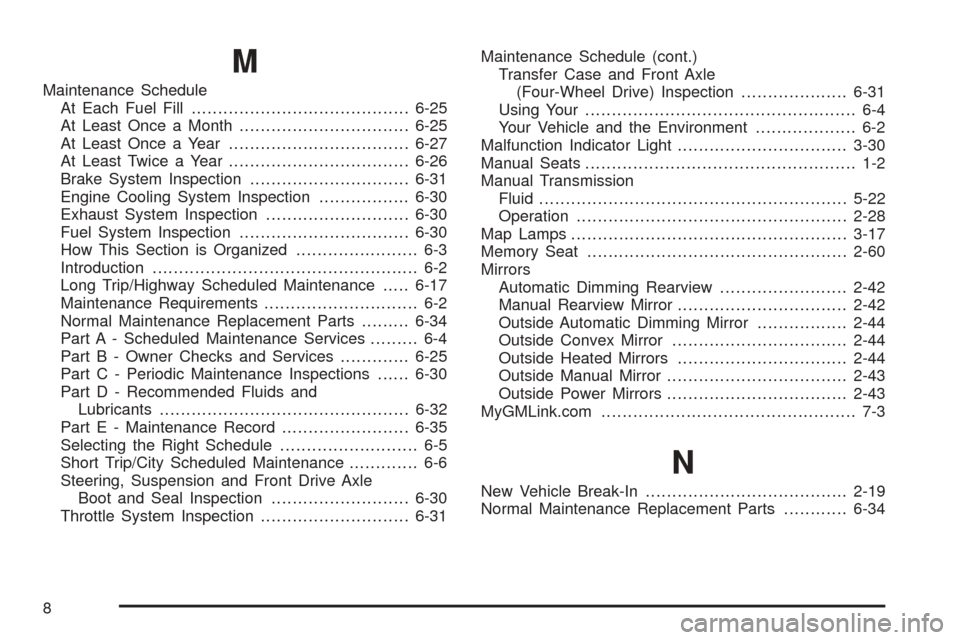
M
Maintenance Schedule
At Each Fuel Fill.........................................6-25
At Least Once a Month................................6-25
At Least Once a Year..................................6-27
At Least Twice a Year..................................6-26
Brake System Inspection..............................6-31
Engine Cooling System Inspection.................6-30
Exhaust System Inspection...........................6-30
Fuel System Inspection................................6-30
How This Section is Organized....................... 6-3
Introduction.................................................. 6-2
Long Trip/Highway Scheduled Maintenance.....6-17
Maintenance Requirements............................. 6-2
Normal Maintenance Replacement Parts.........6-34
Part A - Scheduled Maintenance Services......... 6-4
Part B - Owner Checks and Services.............6-25
Part C - Periodic Maintenance Inspections......6-30
Part D - Recommended Fluids and
Lubricants...............................................6-32
Part E - Maintenance Record........................6-35
Selecting the Right Schedule.......................... 6-5
Short Trip/City Scheduled Maintenance............. 6-6
Steering, Suspension and Front Drive Axle
Boot and Seal Inspection..........................6-30
Throttle System Inspection............................6-31Maintenance Schedule (cont.)
Transfer Case and Front Axle
(Four-Wheel Drive) Inspection....................6-31
Using Your................................................... 6-4
Your Vehicle and the Environment................... 6-2
Malfunction Indicator Light................................3-30
Manual Seats................................................... 1-2
Manual Transmission
Fluid..........................................................5-22
Operation...................................................2-28
Map Lamps....................................................3-17
Memory Seat.................................................2-60
Mirrors
Automatic Dimming Rearview........................2-42
Manual Rearview Mirror................................2-42
Outside Automatic Dimming Mirror.................2-44
Outside Convex Mirror.................................2-44
Outside Heated Mirrors................................2-44
Outside Manual Mirror..................................2-43
Outside Power Mirrors..................................2-43
MyGMLink.com................................................ 7-3
N
New Vehicle Break-In......................................2-19
Normal Maintenance Replacement Parts............6-34
8
Page 433 of 436
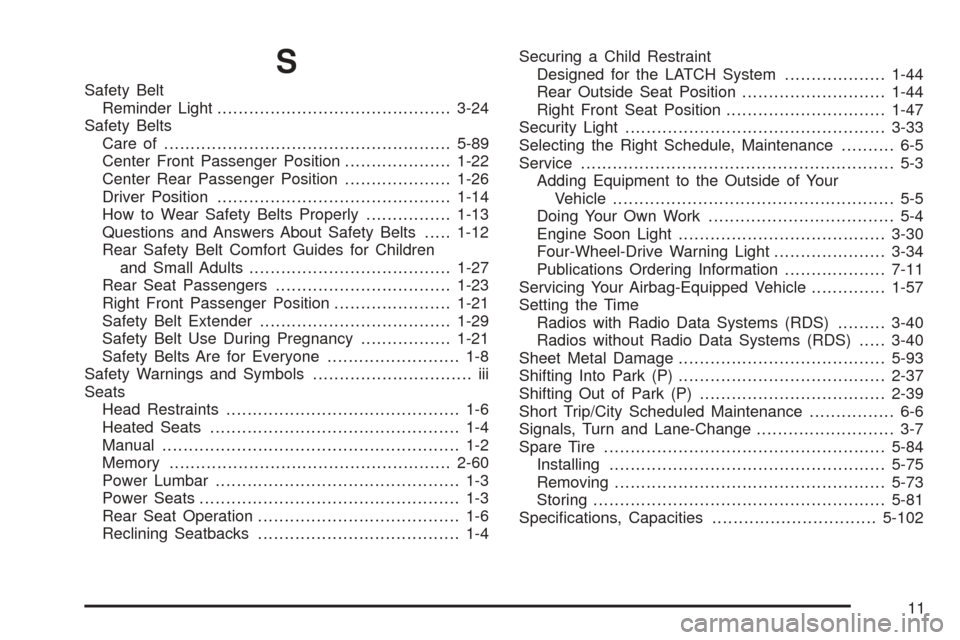
S
Safety Belt
Reminder Light............................................3-24
Safety Belts
Care of......................................................5-89
Center Front Passenger Position....................1-22
Center Rear Passenger Position....................1-26
Driver Position............................................1-14
How to Wear Safety Belts Properly................1-13
Questions and Answers About Safety Belts.....1-12
Rear Safety Belt Comfort Guides for Children
and Small Adults......................................1-27
Rear Seat Passengers.................................1-23
Right Front Passenger Position......................1-21
Safety Belt Extender....................................1-29
Safety Belt Use During Pregnancy.................1-21
Safety Belts Are for Everyone......................... 1-8
Safety Warnings and Symbols.............................. iii
Seats
Head Restraints............................................ 1-6
Heated Seats............................................... 1-4
Manual........................................................ 1-2
Memory.....................................................2-60
Power Lumbar.............................................. 1-3
Power Seats................................................. 1-3
Rear Seat Operation...................................... 1-6
Reclining Seatbacks...................................... 1-4Securing a Child Restraint
Designed for the LATCH System...................1-44
Rear Outside Seat Position...........................1-44
Right Front Seat Position..............................1-47
Security Light.................................................3-33
Selecting the Right Schedule, Maintenance.......... 6-5
Service........................................................... 5-3
Adding Equipment to the Outside of Your
Vehicle..................................................... 5-5
Doing Your Own Work................................... 5-4
Engine Soon Light.......................................3-30
Four-Wheel-Drive Warning Light.....................3-34
Publications Ordering Information...................7-11
Servicing Your Airbag-Equipped Vehicle..............1-57
Setting the Time
Radios with Radio Data Systems (RDS).........3-40
Radios without Radio Data Systems (RDS).....3-40
Sheet Metal Damage.......................................5-93
Shifting Into Park (P).......................................2-37
Shifting Out of Park (P)...................................2-39
Short Trip/City Scheduled Maintenance................ 6-6
Signals, Turn and Lane-Change.......................... 3-7
Spare Tire.....................................................5-84
Installing....................................................5-75
Removing...................................................5-73
Storing.......................................................5-81
Specications, Capacities...............................5-102
11