2005 CHEVROLET AVEO radio
[x] Cancel search: radioPage 214 of 316
Jump Starting
If your battery has run down, you may want to use
another vehicle and some jumper cables to start your
vehicle. Be sure to use the following steps to do it safely.
{CAUTION:
Batteries can hurt you. They can be dangerous
because:
They contain acid that can burn you.
They contain gas that can explode or
ignite.
They contain enough electricity to
burn you.
If you do not follow these steps exactly, some
or all of these things can hurt you.
Notice:Ignoring these steps could result in costly
damage to your vehicle that would not be covered
by your warranty.
Trying to start your vehicle by pushing or pulling it
will not work, and it could damage your vehicle.
1. Check the other vehicle. It must have a 12-volt
battery with a negative ground system.Notice:If the other vehicle’s system is not a 12-volt
system with a negative ground, both vehicles can
be damaged. Only use vehicles with 12-volt systems
with negative grounds to jump start your vehicle.
2. Get the vehicles close enough so the jumper cables
can reach, but be sure the vehicles are not touching
each other. If they are, it could cause a ground
connection you do not want. You would not be able
to start your vehicle, and the bad grounding
could damage the electrical systems.
To avoid the possibility of the vehicles rolling, set
the parking brake firmly on both vehicles involved
in the jump start procedure. Put an automatic
transaxle in PARK (P) or a manual transaxle in
NEUTRAL before setting the parking brake.
Notice:If you leave your radio or other accessories
on during the jump starting procedure, they could
be damaged. The repairs would not be covered
by your warranty. Always turn off your radio and
other accessories when jump starting your vehicle.
3. Turn off the ignition on both vehicles. Unplug
unnecessary accessories plugged into the cigarette
lighter or the accessory power outlet. Turn off
the radio and all lamps that are not needed. This
will avoid sparks and help save both batteries.
And it could save the radio!
5-36
Page 255 of 316
Headlamp Wiring
The headlamp wiring is protected by fuses, one for each
headlamp, in the fuse block. An electrical overload
will cause the lamps to turn off. If this happens, have
your headlamp wiring checked right away.
Windshield Wiper Fuses
The windshield wiper motor is protected by an internal
circuit breaker and a fuse. If the motor overheats due
to heavy snow, etc., the wiper will stop until the
motor cools. If the overload is caused by some electrical
problem and not snow, etc., be sure to get it fixed.
Power Windows and Other Power
Options
Circuit breakers in the fuse block protect the power
windows and other power accessories. When the
current load is too heavy, the circuit breaker opens and
closes, protecting the circuit until the problem is fixed
or goes away.
Fuses and Circuit Breakers
The wiring circuits in your vehicle are protected from
short circuits by a combination of fuses, circuit breakers
and fusible thermal links in the wiring itself.
Look at the silver-colored band inside the fuse. If the
band is broken or melted, replace the fuse. Be sure you
replace a bad fuse with a new one of the identical
size and rating.
There are spare fuses provided in the engine
compartment fuse block. If you ever have a problem
on the road and do not have a spare fuse, you
can borrow one that has the same amperage. Just
pick a feature of your vehicle that you can get along
without — like the radio or cigarette lighter — and use
its fuse, if it is the correct amperage. Replace it as
soon as you can.
There are two fuse blocks in your vehicle: the instrument
panel fuse block and the engine compartment fuse
block.
There is a fuse puller located on the engine
compartment fuse block. It can be used to easily
remove fuses from the fuse block.
5-77
Page 257 of 316
Fuses Usage
LTR Cigar Lighter
HORN,
REAR/FOGHorn, Rear Fog Lamps
RADIO, CLK Audio, Clock
STOP Stop Lamp
TRN/SIG Turn Signal
CLSTR,
HAZRDInstrument Panel Cluster,
Hazard Flasher
CLSTR, CLK Instrument Panel Cluster, Clock
DR/LCK Door Lock, Remote Keyless Entry
BCK/UP Back-Up Lamp
ECM, TCMEngine Control Module,
Transmission Control Module
ECM, TCMEngine Control Module,
Transmission Control Module
WPR, WSWA Wiper, Washer
DIS,
INJECTORDirect Ignition System, Injector
ENG FUSE Engine Fuse
AIRBAG Airbag
HVAC HVAC Blower
ABS Anti-lock Brake System
BLANK Not Used
BLANK Not Used
DIODE (ABS) Anti-lock Brake System DiodeFuses Usage
BLANK Not Used
BLANK Not Used
CLK, RADIO Clock, Audio
Engine Compartment Fuse Block
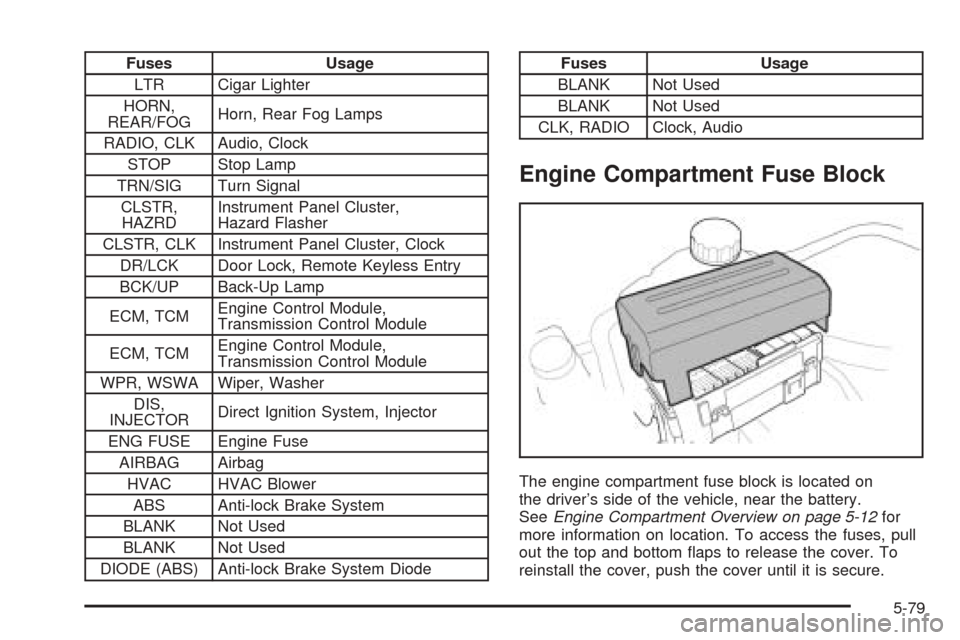
The engine compartment fuse block is located on
the driver’s side of the vehicle, near the battery.
SeeEngine Compartment Overview on page 5-12for
more information on location. To access the fuses, pull
out the top and bottom flaps to release the cover. To
reinstall the cover, push the cover until it is secure.
5-79
Page 305 of 316

A
Accessory Power Outlets.................................3-12
Additives, Fuel................................................. 5-6
Add-On Electrical Equipment............................5-76
Air Cleaner/Filter, Engine.................................5-17
Air Conditioning..............................................3-14
Airbag
Readiness Light..........................................3-26
Airbag Sensing and Diagnostic Module (SDM)...... 7-9
Airbag System................................................1-46
How Does an Airbag Restrain?......................1-51
Servicing Your Airbag-Equipped Vehicle..........1-52
What Makes an Airbag Inflate?......................1-50
What Will You See After an Airbag Inflates?....1-51
When Should an Airbag Inflate?....................1-50
Where Are the Airbags?...............................1-48
AM-FM Radio.................................................3-33
Antenna, Fixed Mast.......................................3-45
Anti-Lock Brake System (ABS)........................... 4-6
Anti-Lock Brake, System Warning Light..............3-28
Appearance Care............................................5-68
Aluminum Wheels........................................5-73
Care of Safety Belts....................................5-71
Chemical Paint Spotting...............................5-75
Cleaning Exterior Lamps/Lenses....................5-72Appearance Care (cont.)
Cleaning the Inside of Your Vehicle................5-69
Fabric/Carpet..............................................5-70
Finish Care.................................................5-72
Finish Damage............................................5-74
Instrument Panel, Vinyl, and Other Plastic
Surfaces.................................................5-71
Sheet Metal Damage...................................5-74
Tires..........................................................5-74
Underbody Maintenance...............................5-74
Vehicle Care/Appearance Materials................5-75
Washing Your Vehicle...................................5-72
Weatherstrips..............................................5-71
Windshield and Wiper Blades........................5-73
Ashtrays........................................................3-13
Audio System(s).............................................3-33
AM-FM Radio.............................................3-33
Care of Your CD Player...............................3-45
Care of Your CDs........................................3-45
Fixed Mast Antenna.....................................3-45
Radio with CD....................................3-35, 3-39
Understanding Radio Reception.....................3-45
Automatic Transaxle
Fluid..........................................................5-18
Operation...................................................2-21
1
Page 313 of 316
P
Park (P)
Shifting Into................................................2-27
Shifting Out of............................................2-28
Parking
Brake........................................................2-26
Over Things That Burn.................................2-30
Parking Your Vehicle.......................................2-29
Part A - Scheduled Maintenance Services............ 6-4
Part B - Owner Checks and Services.................6-18
Part C - Periodic Maintenance Inspections..........6-23
Part D - Recommended Fluids and Lubricants.....6-25
Part E - Maintenance Record............................6-27
Passenger Compartment Air Filter.....................3-18
Passing.........................................................4-11
Power
Accessory Outlets........................................3-12
Electrical System.........................................5-77
Steering Fluid.............................................5-30
Windows....................................................2-13
Pretensioners, Safety Belt................................1-26
Q
Questions and Answers About Safety Belts.........1-14
R
Radios..........................................................3-33
AM-FM Radio.............................................3-33
Care of Your CD Player...............................3-45
Care of Your CDs........................................3-45
Radio with CD....................................3-35, 3-39
Understanding Reception..............................3-45
Rear Door Security Locks.................................. 2-8
Rear Seat Operation...................................1-6, 1-7
Rear Seat Passengers, Safety Belts..................1-23
Rearview Mirrors.............................................2-32
Reclining Seatbacks.......................................... 1-3
Recreational Vehicle Towing.............................4-34
Remote Keyless Entry System............................ 2-4
Remote Keyless Entry System, Operation............ 2-5
Removing the Flat Tire and Installing the
Spare Tire..................................................5-63
Removing the Spare Tire and Tools...................5-62
Replacement Bulbs.........................................5-46
Reporting Safety Defects
Canadian Government..................................7-11
General Motors...........................................7-11
United States Government............................7-10
Restraint System Check
Checking the Restraint Systems....................1-53
Replacing Restraint System Parts
After a Crash..........................................1-53
Right Front Passenger Position, Safety Belts......1-23
9
Page 316 of 316
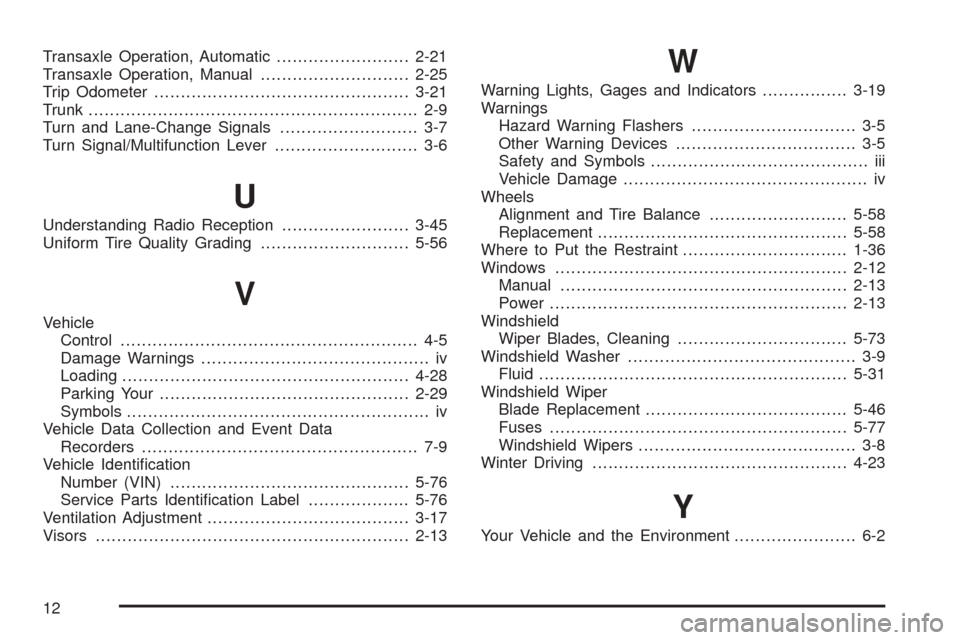
Transaxle Operation, Automatic.........................2-21
Transaxle Operation, Manual............................2-25
Trip Odometer................................................3-21
Trunk.............................................................. 2-9
Turn and Lane-Change Signals.......................... 3-7
Turn Signal/Multifunction Lever........................... 3-6
U
Understanding Radio Reception........................3-45
Uniform Tire Quality Grading............................5-56
V
Vehicle
Control........................................................ 4-5
Damage Warnings........................................... iv
Loading......................................................4-28
Parking Your...............................................2-29
Symbols......................................................... iv
Vehicle Data Collection and Event Data
Recorders.................................................... 7-9
Vehicle Identification
Number (VIN).............................................5-76
Service Parts Identification Label...................5-76
Ventilation Adjustment......................................3-17
Visors...........................................................2-13
W
Warning Lights, Gages and Indicators................3-19
Warnings
Hazard Warning Flashers............................... 3-5
Other Warning Devices.................................. 3-5
Safety and Symbols......................................... iii
Vehicle Damage.............................................. iv
Wheels
Alignment and Tire Balance..........................5-58
Replacement...............................................5-58
Where to Put the Restraint...............................1-36
Windows.......................................................2-12
Manual......................................................2-13
Power........................................................2-13
Windshield
Wiper Blades, Cleaning................................5-73
Windshield Washer........................................... 3-9
Fluid..........................................................5-31
Windshield Wiper
Blade Replacement......................................5-46
Fuses........................................................5-77
Windshield Wipers......................................... 3-8
Winter Driving................................................4-23
Y
Your Vehicle and the Environment....................... 6-2
12