Page 48 of 316
Securing a Child Restraint in a
Rear Seat Position
If your child restraint is equipped with the LATCH
system, seeLower Anchorages and Top Tethers for
Children (LATCH System) on page 1-39. SeeTop Strap
on page 1-37if the child restraint has one.
If your child restraint does not have the LATCH system,
you will be using the lap-shoulder belt to secure the
child restraint. Be sure to follow the instructions
that came with the child restraint. Secure the child in
the child restraint when and as the instructions say.
If you need to install more than one child restraint in the
rear seat, be sure to readWhere to Put the Restraint
on page 1-36. There is not room for three child restraints
in the rear seat, but you can install two child restraints,
one in each rear outside seating position.
1. Put the child restraint on the seat.
2. Pick up the latch plate, and run the lap and shoulder
portions of the vehicle’s safety belt through or
around the restraint. The child restraint instructions
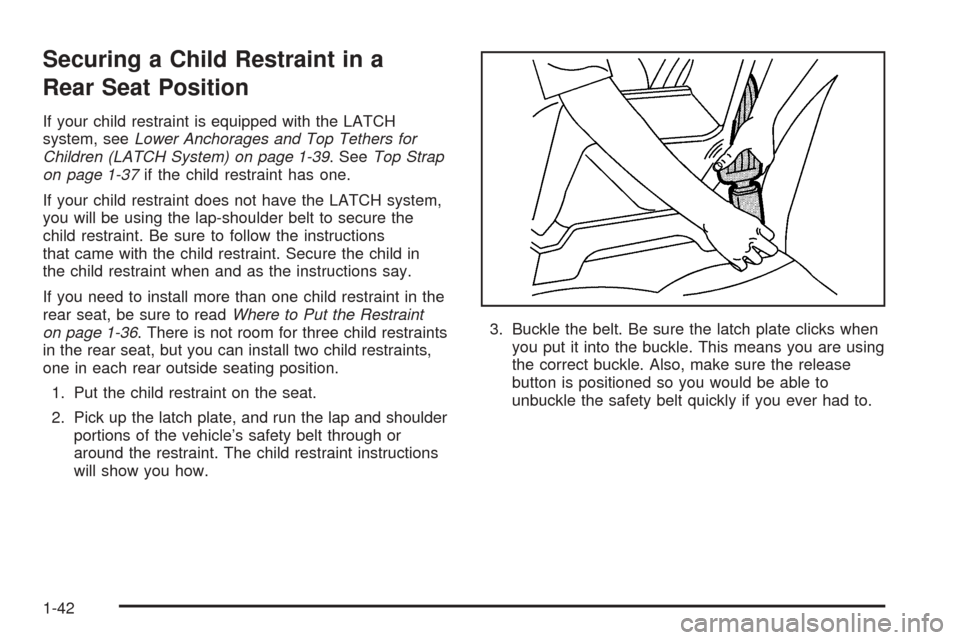
will show you how.3. Buckle the belt. Be sure the latch plate clicks when
you put it into the buckle. This means you are using
the correct buckle. Also, make sure the release
button is positioned so you would be able to
unbuckle the safety belt quickly if you ever had to.
1-42
Page 49 of 316
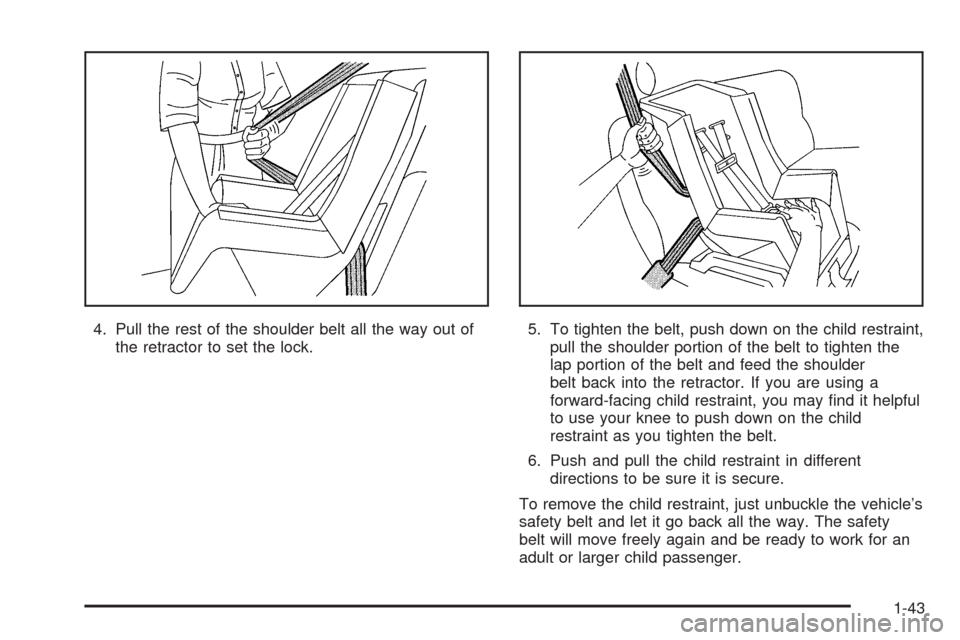
4. Pull the rest of the shoulder belt all the way out of
the retractor to set the lock.5. To tighten the belt, push down on the child restraint,
pull the shoulder portion of the belt to tighten the
lap portion of the belt and feed the shoulder
belt back into the retractor. If you are using a
forward-facing child restraint, you may find it helpful
to use your knee to push down on the child
restraint as you tighten the belt.
6. Push and pull the child restraint in different
directions to be sure it is secure.
To remove the child restraint, just unbuckle the vehicle’s
safety belt and let it go back all the way. The safety
belt will move freely again and be ready to work for an
adult or larger child passenger.
1-43
Page 50 of 316
Securing a Child Restraint in the
Right Front Seat Position
If your child restraint is equipped with the LATCH
system, seeLower Anchorages and Top Tethers for
Children (LATCH System) on page 1-39.
There is no top strap anchor in the right front
passenger’s position. Do not secure a child seat in
this position if a national or local law requires that
the top strap be anchored, or if the instructions that
come with the child restraint say that the top strap
must be anchored. SeeTop Strap on page 1-37
if the child restraint has one.Your vehicle has a right front passenger airbag.
Neverput a rear-facing child restraint in this seat.
Here is why:
{CAUTION:
A child in a rear-facing child restraint can be
seriously injured or killed if the right front
passenger’s airbag inates. This is because
the back of the rear-facing child restraint
would be very close to the inating airbag.
Always secure a rear-facing child restraint
in a rear seat.
A rear seat is a safer place to secure a forward-facing
child restraint. If you need to secure a forward-facing
child restraint in the right front seat, you will be using the
lap-shoulder belt to secure the child restraint. Be sure
to follow the instructions that came with the child
restraint. Secure the child in the child restraint when
and as the instructions say.
1. Because your vehicle has a right front passenger
airbag, always move the seat as far back as it will
go before securing a forward-facing child restraint.
SeeManual Seats on page 1-2.
1-44
Page 52 of 316
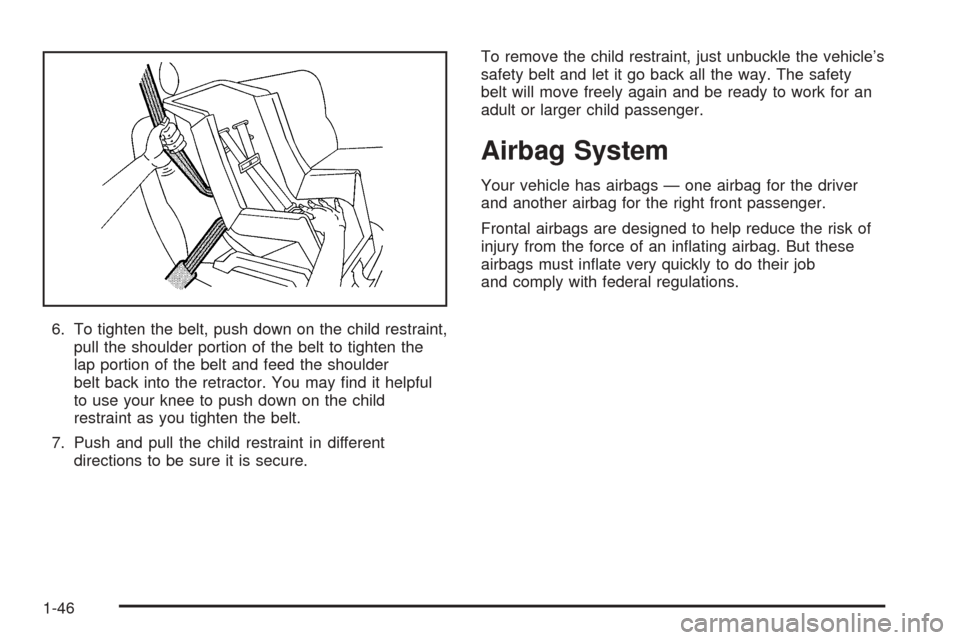
6. To tighten the belt, push down on the child restraint,
pull the shoulder portion of the belt to tighten the
lap portion of the belt and feed the shoulder
belt back into the retractor. You may find it helpful
to use your knee to push down on the child
restraint as you tighten the belt.
7. Push and pull the child restraint in different
directions to be sure it is secure.To remove the child restraint, just unbuckle the vehicle’s
safety belt and let it go back all the way. The safety
belt will move freely again and be ready to work for an
adult or larger child passenger.
Airbag System
Your vehicle has airbags — one airbag for the driver
and another airbag for the right front passenger.
Frontal airbags are designed to help reduce the risk of
injury from the force of an inflating airbag. But these
airbags must inflate very quickly to do their job
and comply with federal regulations.
1-46
Page 54 of 316
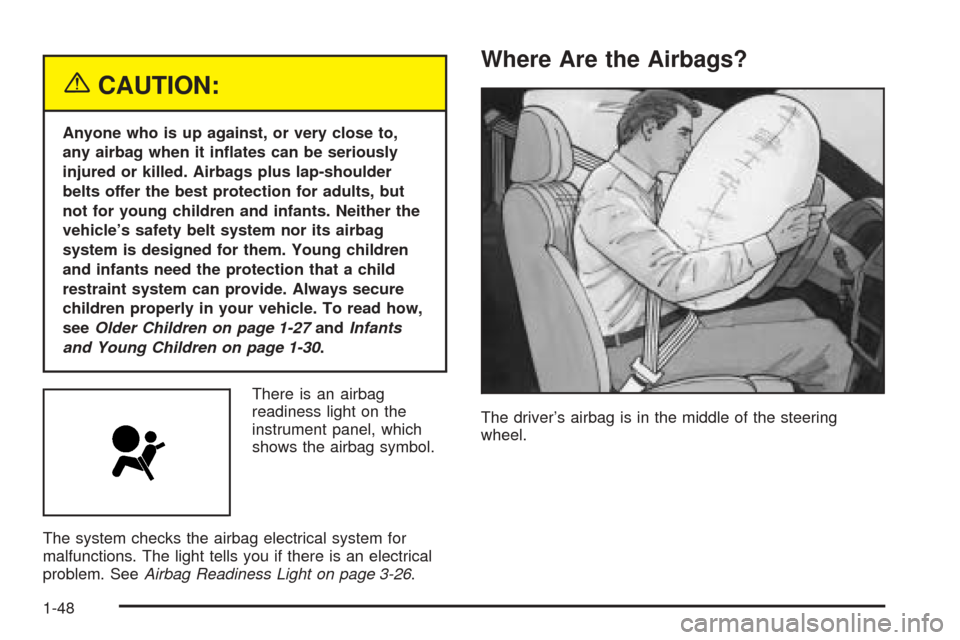
{CAUTION:
Anyone who is up against, or very close to,
any airbag when it inates can be seriously
injured or killed. Airbags plus lap-shoulder
belts offer the best protection for adults, but
not for young children and infants. Neither the
vehicle’s safety belt system nor its airbag
system is designed for them. Young children
and infants need the protection that a child
restraint system can provide. Always secure
children properly in your vehicle. To read how,
seeOlder Children on page 1-27andInfants
and Young Children on page 1-30.
There is an airbag
readiness light on the
instrument panel, which
shows the airbag symbol.
The system checks the airbag electrical system for
malfunctions. The light tells you if there is an electrical
problem. SeeAirbag Readiness Light on page 3-26.
Where Are the Airbags?
The driver’s airbag is in the middle of the steering
wheel.
1-48
Page 61 of 316
Keys...............................................................2-2
Remote Keyless Entry System.........................2-4
Remote Keyless Entry System Operation...........2-5
Doors and Locks.............................................2-7
Door Locks....................................................2-7
Central Door Unlocking System........................2-7
Door Ajar Reminder........................................2-8
Rear Door Security Locks................................2-8
Lockout Protection..........................................2-9
Trunk (Sedan)................................................2-9
Liftgate (Hatchback)......................................2-11
Windows........................................................2-12
Manual Windows..........................................2-13
Power Windows............................................2-13
Sun Visors...................................................2-13
Theft-Deterrent Systems..................................2-14
Theft-Deterrent System..................................2-14
Immobilizer..................................................2-16
Immobilizer Operation....................................2-16
Starting and Operating Your Vehicle................2-17
New Vehicle Break-In....................................2-17
Ignition Positions..........................................2-18Starting the Engine.......................................2-19
Engine Coolant Heater..................................2-20
Automatic Transaxle Operation.......................2-21
Manual Transaxle Operation...........................2-25
Parking Brake..............................................2-26
Shifting Into Park (P) (Automatic Transaxle)........2-27
Shifting Out of Park (P) (Automatic Transaxle).....2-28
Parking Your Vehicle (Manual Transaxle).........2-29
Parking Over Things That Burn.......................2-30
Engine Exhaust............................................2-30
Running the Engine While Parked...................2-31
Mirrors...........................................................2-32
Manual Rearview Mirror.................................2-32
Outside Manual Mirrors..................................2-32
Outside Power Mirror....................................2-33
Outside Convex Mirror...................................2-33
Outside Heated Mirrors..................................2-33
Storage Areas................................................2-34
Glove Box...................................................2-34
Cupholder(s)................................................2-34
Sunglasses Storage Compartment...................2-35
Sunroof.........................................................2-35
Section 2 Features and Controls
2-1
Page 63 of 316
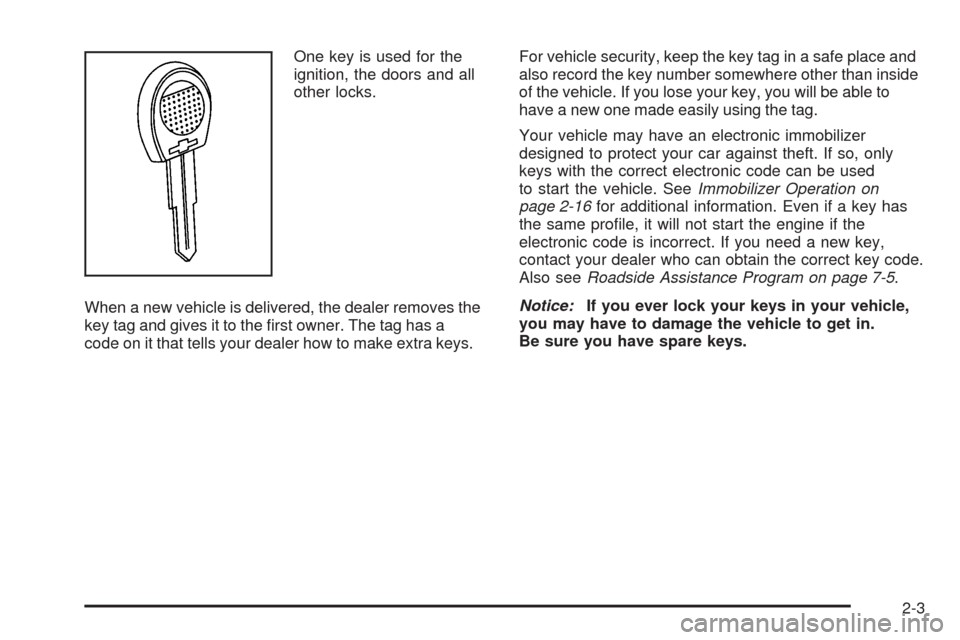
One key is used for the
ignition, the doors and all
other locks.
When a new vehicle is delivered, the dealer removes the
key tag and gives it to the first owner. The tag has a
code on it that tells your dealer how to make extra keys.For vehicle security, keep the key tag in a safe place and
also record the key number somewhere other than inside
of the vehicle. If you lose your key, you will be able to
have a new one made easily using the tag.
Your vehicle may have an electronic immobilizer
designed to protect your car against theft. If so, only
keys with the correct electronic code can be used
to start the vehicle. SeeImmobilizer Operation on
page 2-16for additional information. Even if a key has
the same profile, it will not start the engine if the
electronic code is incorrect. If you need a new key,
contact your dealer who can obtain the correct key code.
Also seeRoadside Assistance Program on page 7-5.
Notice:If you ever lock your keys in your vehicle,
you may have to damage the vehicle to get in.
Be sure you have spare keys.
2-3
Page 68 of 316
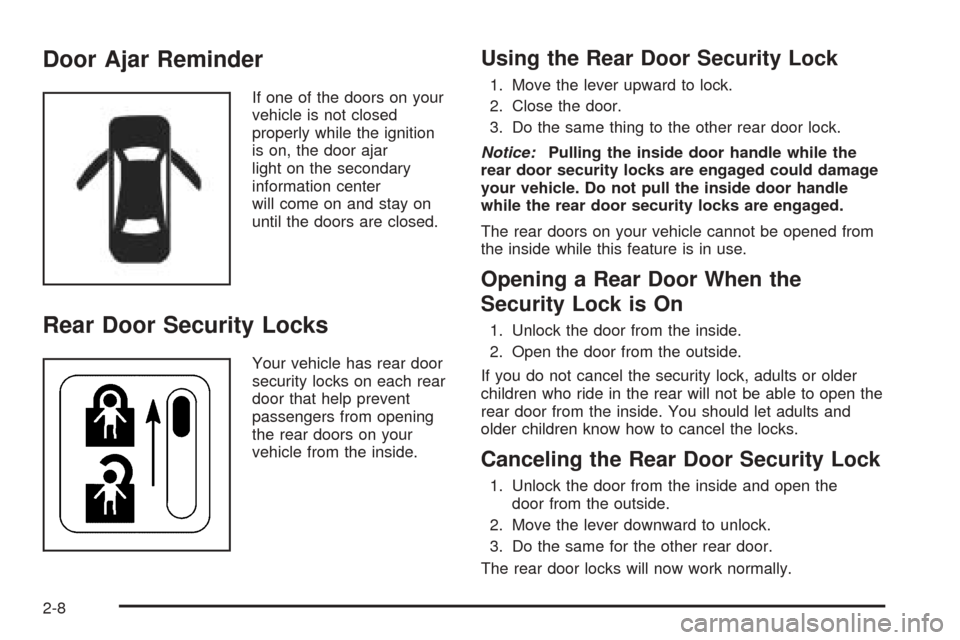
Door Ajar Reminder
If one of the doors on your
vehicle is not closed
properly while the ignition
is on, the door ajar
light on the secondary
information center
will come on and stay on
until the doors are closed.
Rear Door Security Locks
Your vehicle has rear door
security locks on each rear
door that help prevent
passengers from opening
the rear doors on your
vehicle from the inside.
Using the Rear Door Security Lock
1. Move the lever upward to lock.
2. Close the door.
3. Do the same thing to the other rear door lock.
Notice:Pulling the inside door handle while the
rear door security locks are engaged could damage
your vehicle. Do not pull the inside door handle
while the rear door security locks are engaged.
The rear doors on your vehicle cannot be opened from
the inside while this feature is in use.
Opening a Rear Door When the
Security Lock is On
1. Unlock the door from the inside.
2. Open the door from the outside.
If you do not cancel the security lock, adults or older
children who ride in the rear will not be able to open the
rear door from the inside. You should let adults and
older children know how to cancel the locks.
Canceling the Rear Door Security Lock
1. Unlock the door from the inside and open the
door from the outside.
2. Move the lever downward to unlock.
3. Do the same for the other rear door.
The rear door locks will now work normally.
2-8