2005 CHEVROLET AVALANCHE ignition
[x] Cancel search: ignitionPage 11 of 496
To heat the entire seat, press the horizontal button with
the heated seat symbol. Press the button to cycle
through the temperature settings of high, medium and
low and to turn the heated seat off. Indicator lights
will glow to designate the level of heat selected,
three for high, two for medium, and one for low.
The low setting warms the seatback and cushion until
the seat temperature is near body temperature. The
medium and high settings heat the seatback and seat
cushion to a slightly higher temperature. You will be able
to feel heat in about two minutes.
To heat only the seatback, press the vertical button with
the heated seatback symbol. An indicator light on the
seatback button will glow to designate that only the
seatback is being heated. Additional presses of
the seatback button will cycle through the heat levels for
the seatback only. Press the horizontal button again
to heat the whole seat.
The heated front seats will shut off automatically when
the ignition is turned off.Reclining Seatbacks
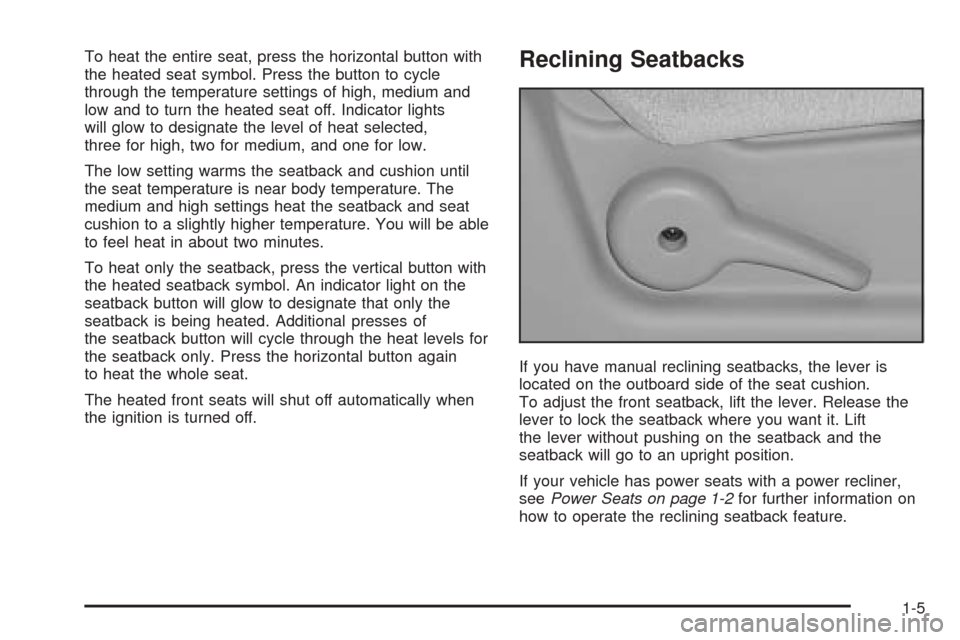
If you have manual reclining seatbacks, the lever is
located on the outboard side of the seat cushion.
To adjust the front seatback, lift the lever. Release the
lever to lock the seatback where you want it. Lift
the lever without pushing on the seatback and the
seatback will go to an upright position.
If your vehicle has power seats with a power recliner,
seePower Seats on page 1-2for further information on
how to operate the reclining seatback feature.
1-5
Page 54 of 496

You will be using the lap-shoulder belt to secure the
child restraint in this position. Be sure to follow the
instructions that came with the child restraint. Secure
the child in the child restraint when and as the
instructions say.
1. Your vehicle has a right front passenger’s frontal
airbag. SeePassenger Sensing System on
page 1-60. General Motors recommends that
rear-facing child restraints be secured in a rear seat,
even if the airbag is off. If your child restraint is
forward-facing, move the seat as far back as it will
go before securing the child restraint in this
seat. SeePower Seats on page 1-2orManual
Passenger Seat on page 1-2.
When the passenger sensing system has turned off
the right front passenger’s frontal airbag, the off
indicator in the passenger airbag status indicator
should light and stay lit when you turn the ignition to
RUN or START. SeePassenger Airbag Status
Indicator on page 3-32.
2. Put the child restraint on the seat.
3. Pick up the latch plate, and run the lap and shoulder
portions of the vehicle’s safety belt through or
around the restraint. The child restraint instructions
will show you how.4. Buckle the belt. Make sure the release button is
positioned so you would be able to unbuckle the
safety belt quickly if you ever had to.
1-48
Page 66 of 496

Passenger Sensing System
If your rearview mirror has one of the indicators pictured
in the following illustrations, your vehicle has a passenger
sensing system. The indicator will be visible when you
turn your ignition key to START or RUN. The words ON
and OFF or the symbol for on and off, will be visible on
the rearview mirror during the system check. When the
system check is complete, either the word ON or the word
OFF, or the symbol for on or the symbol for off will be
visible. SeePassenger Airbag Status Indicator on
page 3-32. If your rearview mirror does not have either of
the indicators pictured, then your vehicle does not have
the passenger sensing system.The passenger sensing system will turn off the right
front passenger’s frontal airbag under certain conditions.
The driver’s airbag and the side airbags are not part
of the passenger sensing system.
The passenger sensing system works with sensors that
are part of the right front passenger’s seat and safety
belt. The sensors are designed to detect the presence of
a properly-seated occupant and determine if the
passenger’s frontal airbag should be enabled (may
inate) or not.
Accident statistics show that children are safer if they
are restrained in the rear rather than the front seat.
General Motors recommends that child restraints
be secured in a rear seat, including an infant riding in a
rear-facing infant seat, a child riding in a forward-facing
child seat and an older child riding in a booster seat. Passenger Airbag Status Indicator – United States
Passenger Airbag Status Indicator – Canada
1-60
Page 70 of 496

Servicing Your Airbag-Equipped
Vehicle
Airbags affect how your vehicle should be serviced.
There are airbag system parts in several places around
your vehicle. You do not want the system to inate while
someone is working on your vehicle. Your dealer and the
service manual have information about servicing your
vehicle and the airbag system. To purchase a service
manual, seeService Publications Ordering Information
on page 7-11.
{CAUTION:
For up to 10 seconds after the ignition key is
turned off and the battery is disconnected, an
airbag can still inate during improper service.
You can be injured if you are close to an
airbag when it inates. Avoid yellow
connectors. They are probably part of the
airbag system. Be sure to follow proper
service procedures, and make sure the person
performing work for you is qualied to do so.
The airbag system does not need regular maintenance.
Adding Equipment to Your
Airbag-Equipped Vehicle
Q:Is there anything I might add to the front or
sides of the vehicle that could keep the
airbags from working properly?
A:Yes. If you add things that change your vehicle’s
frame, bumper system, front end or side sheet
metal or height, they may keep the airbag system
from working properly. Also, the airbag system may
not work properly if you relocate any of the airbag
sensors. If you have any questions about this,
you should contact Customer Assistance before you
modify your vehicle. The phone numbers and
addresses for Customer Assistance are in Step Two
of the Customer Satisfaction Procedure in this
manual. SeeCustomer Satisfaction Procedure on
page 7-2.
1-64
Page 73 of 496

Keys...............................................................2-3
Remote Keyless Entry System.........................2-4
Remote Keyless Entry System Operation...........2-5
Doors and Locks.............................................2-8
Door Locks....................................................2-8
Power Door Locks..........................................2-9
Delayed Locking.............................................2-9
Programmable Automatic Door Locks..............2-10
Rear Door Security Locks..............................2-10
Lockout Protection........................................2-11
Midgate.......................................................2-11
Tailgate.......................................................2-20
Windows........................................................2-22
Power Windows............................................2-23
Sun Visors...................................................2-23
Theft-Deterrent Systems..................................2-24
Content Theft-Deterrent.................................2-24
Passlock
®....................................................2-26
Starting and Operating Your Vehicle................2-26
New Vehicle Break-In....................................2-26
Ignition Positions..........................................2-27
Retained Accessory Power (RAP)...................2-27
Starting the Engine.......................................2-28
Adjustable Throttle and Brake Pedal................2-29Engine Coolant Heater..................................2-30
Automatic Transmission Operation...................2-31
Tow/Haul Mode............................................2-33
Four-Wheel Drive..........................................2-34
Parking Brake..............................................2-38
Shifting Into Park (P).....................................2-39
Shifting Out of Park (P).................................2-41
Parking Over Things That Burn.......................2-41
Engine Exhaust............................................2-42
Running the Engine While Parked...................2-42
Mirrors...........................................................2-43
Automatic Dimming Rearview Mirror with
OnStar
®, Compass and Temperature
Display....................................................2-43
Automatic Dimming Rearview Mirror with
Compass and Temperature Display..............2-46
Outside Camper-Type Mirrors.........................2-48
Outside Power Mirrors...................................2-49
Outside Convex Mirror...................................2-50
Outside Heated Mirrors..................................2-50
Outside Automatic Dimming Mirror with Curb
View Assist..............................................2-51
OnStar
®System.............................................2-51
Section 2 Features and Controls
2-1
Page 75 of 496

Keys
{CAUTION:
Leaving children in a vehicle with the ignition
key is dangerous for many reasons. They
could operate the power windows or other
controls or even make the vehicle move. The
children or others could be badly injured or
even killed. Do not leave the keys in a vehicle
with children.
2-3
Page 76 of 496

Your vehicle has one
double-sided key for the
ignition, all door locks,
tailgate and side storage
boxes.
If you ever lose your keys, your dealer will be able to
assist you with obtaining replacements.
In an emergency contact roadside assistance. See
Roadside Assistance Program on page 7-5for more
information.
If you ever lock your keys in your vehicle, you may be
able to have your doors unlocked automatically with the
OnStar
®system if you have an active OnStar®
subscription. For more information seeOnStar®System
on page 2-51.
Remote Keyless Entry System
Your keyless entry system operates on a radio
frequency subject to Federal Communications
Commission (FCC) Rules and with Industry Canada.
This device complies with Part 15 of the FCC Rules.
Operation is subject to the following two conditions:
1. This device may not cause interference.
2. This device must accept any interference received,
including interference that may cause undesired
operation of the device.
This device complies with RSS-210 of Industry Canada.
Operation is subject to the following two conditions:
1. This device may not cause interference.
2. This device must accept any interference received,
including interference that may cause undesired
operation of the device.
Changes or modications to this system by other than
an authorized service facility could void authorization to
use this equipment.
2-4
Page 81 of 496

Power Door Locks
The power door lock
switches are located on
the driver’s and front
passenger’s armrests.
Q(Lock):Remove the ignition key and press the lock
symbol to lock all of the doors.
If the delayed locking feature is on, the doors will not
lock until ve seconds after the last door is closed. Press
the lock symbol twice to override this feature and lock
all of the doors immediately. SeeDelayed Locking
on page 2-9for more information.
K(Unlock):To unlock the doors, press the
unlock symbol.
Delayed Locking
When locking the doors with the power lock switch or
the keyless entry transmitter and a door or the liftgate is
open, the delayed locking feature will delay locking
the doors until ve seconds after the last door is closed.
You will hear three chimes to signal that the delayed
locking feature is in use.
Pressing the power lock switch or the lock button on the
keyless entry transmitter twice will override the delayed
locking feature and immediately lock all the doors.
You can turn the delayed locking feature off or back on
again by doing the following:
1. Press and hold the power door lock switch in the
lock position.
2. Press unlock twice on the remote keyless entry
transmitter.
This feature will not operate if the key is in the ignition.
You can also program this feature using the Driver
Information Center (DIC). See “Door Lock Delay” under
DIC Vehicle Customization on page 3-58.
2-9