Page 408 of 496
If you replace your vehicle’s tires with those not having
a TPC Spec number, the tire pressure monitoring
system may give an inaccurate low pressure warning.
Non-TPC Spec tires may give a low pressure warning
that is higher or lower than the proper warning level you
would get with TPC Spec numbered tires.
{CAUTION:
Mixing tires could cause you to lose control
while driving. If you mix tires of different sizes
or types (radial and bias-belted tires), the
vehicle may not handle properly, and you
could have a crash. Using tires of different
sizes may also cause damage to your vehicle.
Be sure to use the same size and type tires on
all wheels.
CAUTION: (Continued)
CAUTION: (Continued)
Your vehicle may be equipped with a different
size spare than the road tires (those originally
installed on your vehicle). When new, your
vehicle included a spare tire and wheel
assembly with a similar overall diameter as
your vehicle’s road tires and wheels, so it is all
right to drive on it. Because this spare was
developed for use on your vehicle, it will not
affect vehicle handling.
{CAUTION:
If you use bias-ply tires on your vehicle, the
wheel rim anges could develop cracks after
many miles of driving. A tire and/or wheel
could fail suddenly, causing a crash. Use only
radial-ply tires with the wheels on your vehicle.
5-70
Page 412 of 496
Tire Chains
{CAUTION:
If your vehicle is a 1500 Series, don’t use tire
chains. They can damage your vehicle because
there’s not enough clearance. Tire chains used
on a vehicle without the proper amount of
clearance can cause damage to the brakes,
suspension or other vehicle parts. The area
damaged by the tire chains could cause you to
lose control of your vehicle and you or others
may be injured in a crash.
Use another type of traction device only if its
manufacturer recommends it for use on your
vehicle and tire size combination and road
conditions. Follow that manufacturer’s
instructions. To help avoid damage to your
vehicle, drive slowly, readjust or remove the
device if it’s contacting your vehicle, and don’t
spin your wheels.
If you do nd traction devices that will t,
install them on the rear tires.Notice:If your vehicle is a 2500 Series, use tire
chains only where legal and only when you must.
Use chains that are the proper size for your
tires. Install them on the tires of the rear axle. Don’t
use chains on the tires of the front axle. Tighten
them as tightly as possible with the ends securely
fastened. Drive slowly and follow the chain
manufacturer’s instructions. If you can hear the
chains contacting your vehicle, stop and retighten
them. If the contact continues, slow down until
it stops. Driving too fast or spinning the wheels with
chains on will damage your vehicle.
If a Tire Goes Flat
It is unusual for a tire to blowout while you’re driving,
especially if you maintain your tires properly. If air goes
out of a tire, it is much more likely to leak out slowly.
But if you should ever have a blowout, here are a
few tips about what to expect and what to do:
If a front tire fails, the at tire will create a drag that
pulls the vehicle toward that side. Take your foot off the
accelerator pedal and grip the steering wheel rmly.
Steer to maintain lane position, and then gently brake to
a stop well out of the traffic lane.
A rear blowout, particularly on a curve, acts much like a
skid and may require the same correction you would
use in a skid. In any rear blowout, remove your foot from
the accelerator pedal. Get the vehicle under control
5-74
Page 425 of 496
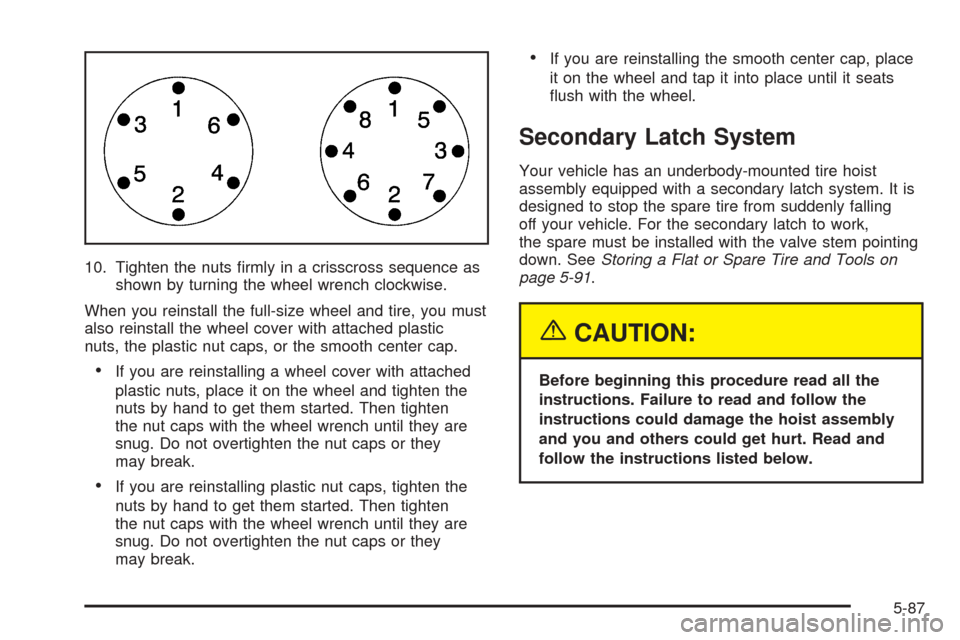
10. Tighten the nuts rmly in a crisscross sequence as
shown by turning the wheel wrench clockwise.
When you reinstall the full-size wheel and tire, you must
also reinstall the wheel cover with attached plastic
nuts, the plastic nut caps, or the smooth center cap.
If you are reinstalling a wheel cover with attached
plastic nuts, place it on the wheel and tighten the
nuts by hand to get them started. Then tighten
the nut caps with the wheel wrench until they are
snug. Do not overtighten the nut caps or they
may break.
If you are reinstalling plastic nut caps, tighten the
nuts by hand to get them started. Then tighten
the nut caps with the wheel wrench until they are
snug. Do not overtighten the nut caps or they
may break.
If you are reinstalling the smooth center cap, place
it on the wheel and tap it into place until it seats
ush with the wheel.
Secondary Latch System
Your vehicle has an underbody-mounted tire hoist
assembly equipped with a secondary latch system. It is
designed to stop the spare tire from suddenly falling
off your vehicle. For the secondary latch to work,
the spare must be installed with the valve stem pointing
down. SeeStoring a Flat or Spare Tire and Tools on
page 5-91.
{CAUTION:
Before beginning this procedure read all the
instructions. Failure to read and follow the
instructions could damage the hoist assembly
and you and others could get hurt. Read and
follow the instructions listed below.
5-87
Page 432 of 496
Your vehicle may have a different size spare tire than
the road tires-those originally installed on your vehicle.
This spare tire was developed for use on your
vehicle, so it is all right to drive on it. If your vehicle has
four-wheel drive and the smaller spare is installed,
keep the vehicle in two-wheel drive as much as possible.
If your vehicle has a spare tire that does not match
your vehicle’s original road tires and wheels in size and
type, do not include the spare in the tire rotation.
Appearance Care
Cleaning products can be hazardous. Some are toxic.
Other cleaning products can burst into ames if a match
is struck near them or if they get on a hot part of the
vehicle. Some are dangerous if their fumes are inhaled
in an enclosed space. When anything from a container
is used to clean the vehicle, be sure to follow the
manufacturer’s warnings and instructions. Always open
the doors or windows of the vehicle when cleaning
the inside.Never use these to clean the vehicle:
Benzene
Naphtha
Carbon Tetrachloride
Acetone
Paint Thinner
Turpentine
Lacquer Thinner
Nail Polish Remover
They can all be hazardous — some more than
others —and they can all damage the vehicle, too.
Do not use any of these products unless this manual
says you can. In many uses, these will damage
the vehicle:
Alcohol
Laundry Soap
Bleach
Reducing Agents
5-94