Page 214 of 376

Wheel Replacement......................................5-70
Tire Chains..................................................5-71
If a Tire Goes Flat........................................5-71
Changing a Flat Tire.....................................5-72
Removing the Spare Tire and Tools................5-73
Removing the Flat Tire and Installing
the Spare Tire..........................................5-76
Storing a Flat or Spare Tire and Tools............5-82
Compact Spare Tire......................................5-84
Appearance Care............................................5-84
Fabric/Carpet...............................................5-85
Vinyl...........................................................5-86
Leather.......................................................5-87
Instrument Panel..........................................5-87
Interior Plastic Components............................5-87
Glass Surfaces.............................................5-87
Care of Safety Belts......................................5-87
Weatherstrips...............................................5-88
Washing Your Vehicle...................................5-88
Cleaning Exterior Lamps/Lenses.....................5-88
Finish Care..................................................5-88
Windshield and Wiper Blades.........................5-89Aluminum Wheels.........................................5-90
Tires...........................................................5-90
Sheet Metal Damage.....................................5-91
Finish Damage.............................................5-91
Underbody Maintenance................................5-91
Chemical Paint Spotting.................................5-91
Vehicle Care/Appearance Materials..................5-92
Vehicle Identication......................................5-93
Vehicle Identication Number (VIN).................5-93
Service Parts Identication Label.....................5-93
Electrical System............................................5-94
Add-On Electrical Equipment..........................5-94
Headlamp Wiring..........................................5-94
Windshield Wiper Fuses................................5-94
Power Windows and Other Power Options.......5-94
Fuses and Circuit Breakers............................5-95
Instrument Panel Fuse Block..........................5-96
Underhood Fuse Block..................................5-98
Capacities and Specications........................5-101
Normal Maintenance Replacement Parts.........5-102
Section 5 Service and Appearance Care
5-2
Page 223 of 376
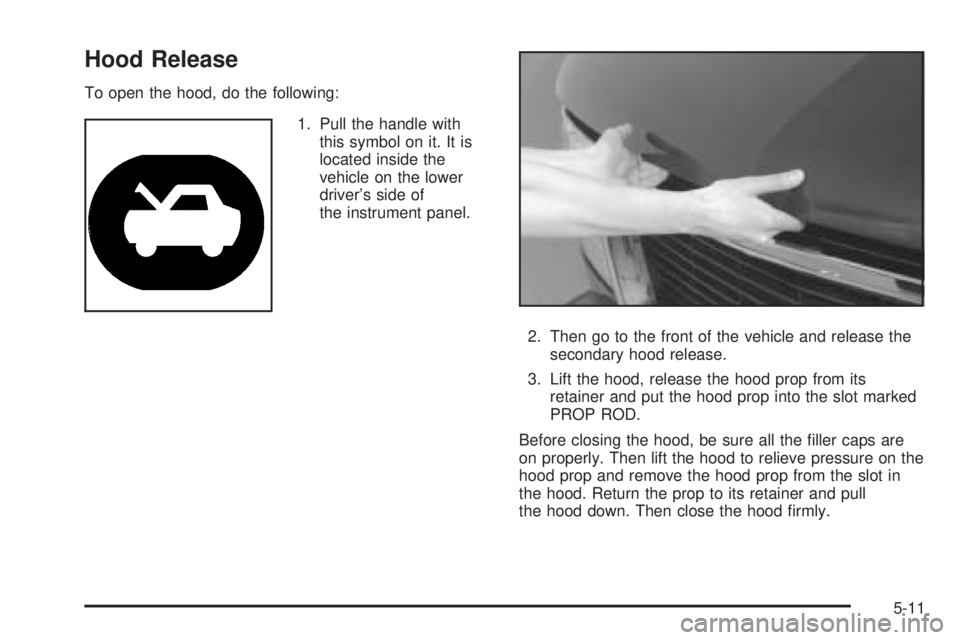
Hood Release
To open the hood, do the following:
1. Pull the handle with
this symbol on it. It is
located inside the
vehicle on the lower
driver’s side of
the instrument panel.
2. Then go to the front of the vehicle and release the
secondary hood release.
3. Lift the hood, release the hood prop from its
retainer and put the hood prop into the slot marked
PROP ROD.
Before closing the hood, be sure all the ller caps are
on properly. Then lift the hood to relieve pressure on the
hood prop and remove the hood prop from the slot in
the hood. Return the prop to its retainer and pull
the hood down. Then close the hood rmly.
5-11
Page 229 of 376
Engine Cover
Removing the Engine Cover
1. Move both front seats as far back as they will go.
2. Remove the instrument panel extension by
removing the two nuts that secure it in place. The
nuts are located at the bottom of the extension
on the driver’s and passenger’s side corners.
5-17
Page 231 of 376
5. Grasp the top of the heater duct and pull down
gently to remove it.6. Loosen the two bolts on the engine cover. The
bolts are not supposed to come out of the cover,
only from the front of the dash.
When removing the cover, be careful not to damage
the instrument panel or the trim.
7. Disconnect the AM radio ground strap.
5-19
Page 240 of 376

Adding Coolant
If you need more coolant, add the proper DEX-COOL®
coolant mixtureat the coolant recovery tank,but be
careful not to spill it.
{CAUTION:
Turning the radiator pressure cap when the
engine and radiator are hot can allow steam
and scalding liquids to blow out and burn you
badly. With the coolant recovery tank, you will
almost never have to add coolant at the
radiator. Never turn the radiator pressure
cap — even a little — when the engine and
radiator are hot.
{CAUTION:
You can be burned if you spill coolant on hot
engine parts. Coolant contains ethylene glycol,
and it will burn if the engine parts are hot
enough. Do not spill coolant on a hot engine.Occasionally check the coolant level in the radiator.
For information on how to add coolant to the radiator,
seeCooling System on page 5-30.
Radiator Pressure Cap
Notice:If the pressure cap is not tightly installed,
coolant loss and possible engine damage may occur.
Be sure the cap is properly and tightly secured.
The radiator pressure cap
is located in the engine
compartment on the
passenger’s side of the
vehicle. SeeEngine
Compartment Overview on
page 5-12for more
information on location.
Engine Overheating
You will nd an engine coolant temperature gage on
your vehicle’s instrument panel. SeeEngine Coolant
Temperature Gage on page 3-29.
5-28
Page 299 of 376
Leather
Use a soft cloth with lukewarm water and a mild soap or
saddle soap and wipe dry with a soft cloth. Then, let
the leather dry naturally. Do not use heat to dry.
For stubborn stains, use a leather cleaner.
Never use oils, varnishes, solvent-based or abrasive
cleaners, furniture polish, or shoe polish on leather.
Soiled or stained leather should be cleaned
immediately. If dirt is allowed to work into the nish,
it can harm the leather.
Instrument Panel
Use only mild soap and water to clean the top surfaces
of the instrument panel. Sprays containing silicones
or waxes may cause annoying reections in the
windshield and even make it difficult to see through
the windshield under certain conditions.
Interior Plastic Components
Use only a mild soap and water solution on a soft
cloth or sponge. Commercial cleaners may affect
the surface nish.
Glass Surfaces
Glass should be cleaned often. GM Glass Cleaner or
a liquid household glass cleaner will remove normal
tobacco smoke and dust lms on interior glass.
SeeVehicle Care/Appearance Materials on page 5-92.
Notice:If you use abrasive cleaners when
cleaning glass surfaces on your vehicle, you could
scratch the glass and/or cause damage to the
rear window defogger and the integrated radio
antenna. When cleaning the glass on your vehicle,
use only a soft cloth and glass cleaner.
Care of Safety Belts
Keep belts clean and dry.
{CAUTION:
Do not bleach or dye safety belts. If you do,
it may severely weaken them. In a crash,
they might not be able to provide adequate
protection. Clean safety belts only with mild
soap and lukewarm water.
5-87
Page 305 of 376
Vehicle Identication
Vehicle Identication Number (VIN)
This is the legal identier for your vehicle. It appears on
a plate in the front corner of the instrument panel, on
the driver’s side. You can see it if you look through the
windshield from outside your vehicle. The VIN also
appears on the Vehicle Certication and Service Parts
labels and the certicates of title and registration.
Engine Identication
The 8th character in your VIN is the engine code. This
code will help you identify your engine, specications
and replacement parts.
Service Parts Identication Label
You will nd this label on the front passenger door
frame. It is very helpful if you ever need to order parts.
On this label you will nd the following:
VIN
Model designation
Paint information
Production options and special equipment
Be sure that this label is not removed from the vehicle.
5-93
Page 308 of 376
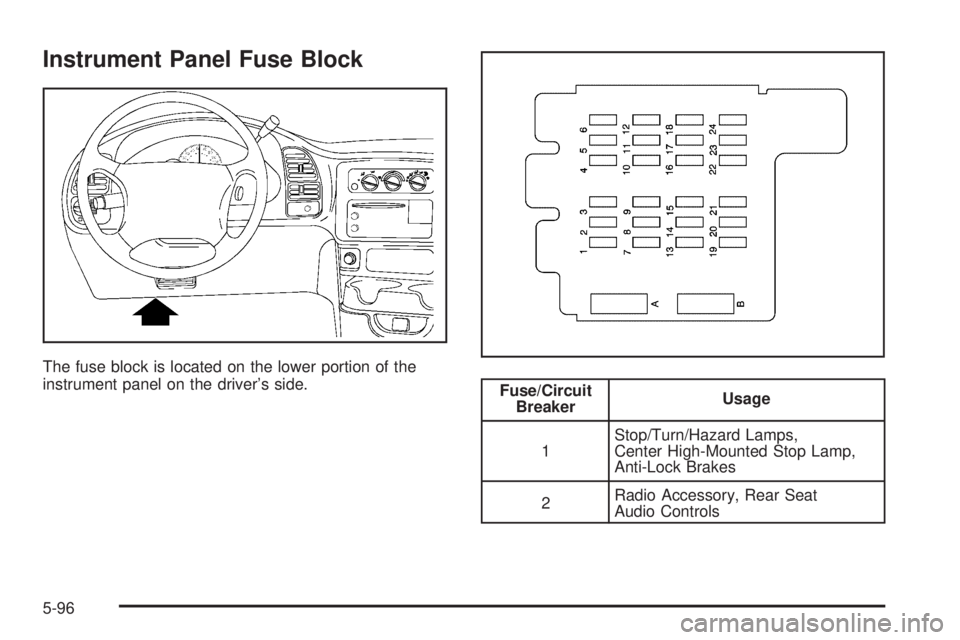
Instrument Panel Fuse Block
The fuse block is located on the lower portion of the
instrument panel on the driver’s side.
Fuse/Circuit
BreakerUsage
1Stop/Turn/Hazard Lamps,
Center High-Mounted Stop Lamp,
Anti-Lock Brakes
2Radio Accessory, Rear Seat
Audio Controls
5-96