2005 CHEVROLET ASTRO climate control
[x] Cancel search: climate controlPage 138 of 376
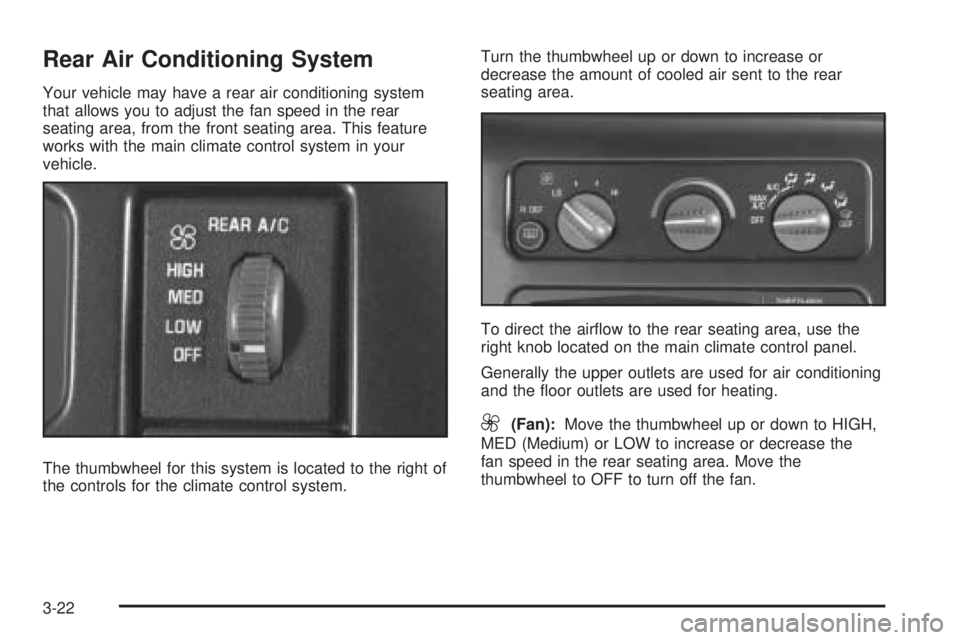
Rear Air Conditioning System
Your vehicle may have a rear air conditioning system
that allows you to adjust the fan speed in the rear
seating area, from the front seating area. This feature
works with the main climate control system in your
vehicle.
The thumbwheel for this system is located to the right of
the controls for the climate control system.Turn the thumbwheel up or down to increase or
decrease the amount of cooled air sent to the rear
seating area.
To direct the airow to the rear seating area, use the
right knob located on the main climate control panel.
Generally the upper outlets are used for air conditioning
and the oor outlets are used for heating.
9(Fan):Move the thumbwheel up or down to HIGH,
MED (Medium) or LOW to increase or decrease the
fan speed in the rear seating area. Move the
thumbwheel to OFF to turn off the fan.
3-22
Page 139 of 376

To increase or decrease the temperature for the entire
vehicle, use the center knob located on the main
climate control panel.
The air conditioning system on the main climate control
panel must be turned on to direct cooled air to the
rear of the vehicle. If it is not on, then the temperature
in the rear of the vehicle will remain at cabin
temperature.
Be sure to keep the area under the front seats clear of
any objects so that the air inside of your vehicle can
circulate effectively.
For information on how to use the main climate control
system, seeClimate Control System on page 3-19.
For information on ventilation, seeOutlet Adjustment
on page 3-21.
Warning Lights, Gages, and
Indicators
This part describes the warning lights and gages that
may be on your vehicle. The pictures will help you
locate them.Warning lights and gages can signal that something is
wrong before it becomes serious enough to cause
an expensive repair or replacement. Paying attention
to your warning lights and gages could also save you or
others from injury.
Warning lights come on when there may be or is a
problem with one of your vehicle’s functions. As you
will see in the details on the next few pages, some
warning lights come on briey when you start the engine
just to let you know they’re working. If you are familiar
with this section, you should not be alarmed when
this happens.
Gages can indicate when there may be or is a problem
with one of your vehicle’s functions. Often gages
and warning lights work together to let you know when
there’s a problem with your vehicle.
When one of the warning lights comes on and stays on
when you are driving, or when one of the gages shows
there may be a problem, check the section that tells
you what to do about it. Please follow this manual’s
advice. Waiting to do repairs can be costly – and even
dangerous. So please get to know your warning lights
and gages. They’re a big help.
3-23
Page 207 of 376

Driving with a Trailer
{CAUTION:
If you have a rear-most window open and
you pull a trailer with your vehicle, carbon
monoxide (CO) could come into your vehicle.
You can not see or smell CO. It can cause
unconsciousness or death. SeeEngine
Exhaust on page 2-26. To maximize your
safety when towing a trailer:
Have your exhaust system inspected for
leaks, and make necessary repairs before
starting on your trip.
Keep the rear-most windows closed.
If exhaust does come into your vehicle
through a window in the rear or another
opening, drive with your front, main
heating or cooling system on and with the
fan on any speed. This will bring fresh,
outside air into your vehicle. Do not use
the climate control setting for maximum air
because it only recirculates the air inside
your vehicle. See Climate Control System
in the Index.Towing a trailer requires a certain amount of experience.
Before setting out for the open road, you’ll want to get
to know your rig. Acquaint yourself with the feel of
handling and braking with the added weight of the trailer.
And always keep in mind that the vehicle you are
driving is now a good deal longer and not nearly as
responsive as your vehicle is by itself.
Before you start, check the trailer hitch and platform
(and attachments), safety chains, electrical connector,
lamps, tires and mirror adjustment. If the trailer has
electric brakes, start your vehicle and trailer moving and
then apply the trailer brake controller by hand to be
sure the brakes are working. This lets you check your
electrical connection at the same time.
During your trip, check occasionally to be sure that the
load is secure, and that the lamps and any trailer
brakes are still working.
4-41
Page 280 of 376

Uniform Tire Quality Grading
Quality grades can be found where applicable on the
tire sidewall between tread shoulder and maximum
section width. For example:
Treadwear 200 Traction AA Temperature A
The following information relates to the system
developed by the United States National Highway
Traffic Safety Administration, which grades tires by
treadwear, traction and temperature performance.
(This applies only to vehicles sold in the United States.)
The grades are molded on the sidewalls of most
passenger car tires. The Uniform Tire Quality Grading
system does not apply to deep tread, winter-type
snow tires, space-saver or temporary use spare tires,
tires with nominal rim diameters of 10 to 12 inches
(25 to 30 cm), or to some limited-production tires.
While the tires available on General Motors passenger
cars and light trucks may vary with respect to these
grades, they must also conform to federal safety
requirements and additional General Motors Tire
Performance Criteria (TPC) standards.
Treadwear
The treadwear grade is a comparative rating based on
the wear rate of the tire when tested under controlled
conditions on a specied government test course.
For example, a tire graded 150 would wear one and
a half (1.5) times as well on the government course as
a tire graded 100. The relative performance of tires
depends upon the actual conditions of their use,
however, and may depart signicantly from the norm
due to variations in driving habits, service practices and
differences in road characteristics and climate.
Traction – AA, A, B, C
The traction grades, from highest to lowest, are AA, A,
B, and C. Those grades represent the tire’s ability
to stop on wet pavement as measured under controlled
conditions on specied government test surfaces of
asphalt and concrete. A tire marked C may have poor
traction performance. Warning: The traction grade
assigned to this tire is based on straight-ahead braking
traction tests, and does not include acceleration,
cornering, hydroplaning, or peak traction characteristics.
5-68
Page 309 of 376

Fuse/Circuit
BreakerUsage
3Courtesy Lamps, Glove Box Lamp,
Dome Reading Lamps, Vanity Mirror
Lamps, Courtesy Lamps
4Daytime Running Lamps Relay,
Instrument Panel Cluster
5 Rear Defogger
6Cruise Module, Truck Body Control
Module, Instrument Panel Cluster,
Cruise Control Switch,
Electrochromic Mirror
7 Power Outlets, Subwoofer Amplier
8Crank Circuit Fuse, Park/Neutral
Switch, Starter Enabler Relay
9License Plate Lamp, Tailamps,
Parking Lamps, Ashtray Lamp,
Panel Lights, Trailer Taillamps,
Front and Rear Sidemarker Lamps,
Door Switch Illumination, Headlamp
Switch Illumination, Rear Seat
Audio Illumination, Truck Body
Control Module
10 Air Bag SystemFuse/Circuit
BreakerUsage
11 Not Used
12Blower Motor, Rear Air Conditioning
Relay Coil, Front Cont. Temp.
Door Motor, HI Blower Relay,
Defogger Timer Coil
13Cigarette Lighter, Door Lock
Switches, Dutch Door Release
Module
14Cluster Illumination, Climate
Controls, Chime Module, Radio
Illumination, Rear Heat Switch
Illumination, Rear Wiper/Washer
Switch Illumination, Rear Liftgate
Switch Illumination, Remote
Cassette Illumination, Overhead
Console, Truck Body Control
Illumination
15Truck Body Module,
Headlamp Relay
16Front Turn Signals, Rear Turn
Signals, Trailer Turn Signals,
Back-Up Lamps, Brake
Transmission Shift Interlock
Solenoid
5-97
Page 312 of 376

Fuse/Circuit
BreakerUsage
BLANK Not Used
BLANK Not Used
DIODE-1 Air Conditioning
BLANK Not Used
BLANK Not Used
BLANK Not Used
LIGHTINGCourtesy Fuse, Power Adjust
Mirrors Fuse, Truck Body Control
Battery Fuse
BATTPower Accessory Circuit Breaker,
Stop/Hazard Fuse, Auxiliary Power
Fuse, Cigarette Lighter Fuse,
Radio Battery Fuse
IGN A Starter Relay, Ignition Switch
IGN B Ignition Switch
ABSElectronic Brake
Control Module
BLANK Not Used
RAP Radio Accessory, Power Windows
HTD MIR/RR
DEFOGRear Window Defogger,
Climate Control HeadRelays Usage
A/C RELAY Rear/Heat and Air Conditioning
UPFITTER-
ACCY RELAYUptter Accessory
STARTER
ENABLE
RELAYStarter
A/C ENABLE
RELAYAir Conditioning
HEAD LAMPS
RELAYHeadlamps
FUEL PUMP
RELAYFuel Pump
Feed Usage
AUX B Uptter Battery Feed
AUX A Uptter Accessory Feed
5-100
Page 365 of 376

Child Restraints (cont.)
Lower Anchorages and Top Tethers for
Children (LATCH System)..........................1-54
Older Children.............................................1-38
Securing a Child Restraint Designed for
the LATCH System...................................1-56
Securing a Child Restraint in a
Center Rear Seat Position.........................1-58
Securing a Child Restraint in a
Rear Outside Seat Position........................1-57
Securing a Child Restraint in the
Right Front Seat Position..........................1-60
Top Strap...................................................1-50
Top Strap Anchor Location............................1-52
Where to Put the Restraint...........................1-49
Cigarette Lighter.............................................3-18
Cleaning
Aluminum Wheels........................................5-90
Exterior Lamps/Lenses.................................5-88
Fabric/Carpet..............................................5-85
Finish Care.................................................5-88
Glass Surfaces............................................5-87
Instrument Panel.........................................5-87
Interior Plastic Components...........................5-87
Leather......................................................5-87
Tires..........................................................5-90
Underbody Maintenance...............................5-91
Vinyl..........................................................5-86
Washing Your Vehicle...................................5-88Cleaning (cont.)
Weatherstrips..............................................5-88
Windshield and Wiper Blades........................5-89
Climate Control System...................................3-19
Outlet Adjustment........................................3-21
Rear Air Conditioning System........................3-22
Rear Heating System...................................3-21
Comfort Guides, Rear Safety Belt.....................1-35
Compact Spare Tire........................................5-84
Control of a Vehicle.......................................... 4-5
Convenience Net............................................2-38
Coolant
Engine Temperature Gage............................3-29
Heater, Engine............................................2-19
Cooling System..............................................5-30
Cruise Control Lever.......................................3-11
Customer Assistance Information
Courtesy Transportation.................................. 7-8
Customer Assistance for Text
Telephone (TTY) Users............................... 7-4
Customer Assistance Offices........................... 7-4
Customer Satisfaction Procedure..................... 7-2
GM Mobility Reimbursement Program............... 7-6
Reporting Safety Defects to
General Motors........................................7-12
Reporting Safety Defects to the
Canadian Government..............................7-11
Reporting Safety Defects to the
United States Government.........................7-11
3