2005 CADILLAC XLR seats
[x] Cancel search: seatsPage 24 of 438

Passenger Position
To learn how to wear the passenger’s safety belt
properly, seeDriver Position on page 1-10.
Safety Belt Pretensioners
Your vehicle has safety belt pretensioners. They are on
the buckle end of the safety belts for the driver and
right front passenger. They help the safety belts reduce
a person’s forward movement in a moderate to
severe frontal and near frontal crash.
Pretensioners work only once. If they activate in a
crash, you will need to get new ones, and probably other
new parts for your safety belt system. SeeReplacing
Restraint System Parts After a Crash on page 1-48.
Safety Belt Extender
If the vehicle’s safety belt will fasten around you, you
should use it.
But if a safety belt is not long enough, your dealer will
order you an extender. It is free. When you go in to
order it, take the heaviest coat you will wear, so
the extender will be long enough for you. To help avoid
personal injury, do not let someone else use it, and
use it only for the seat it is made to t. The extender has
been designed for adults. Never use it for securing
child seats. To wear it, just attach it to the regular safety
belt. For more information, see the instruction sheet
that comes with the extender.
1-18
Page 25 of 438
Child Restraints
Older Children
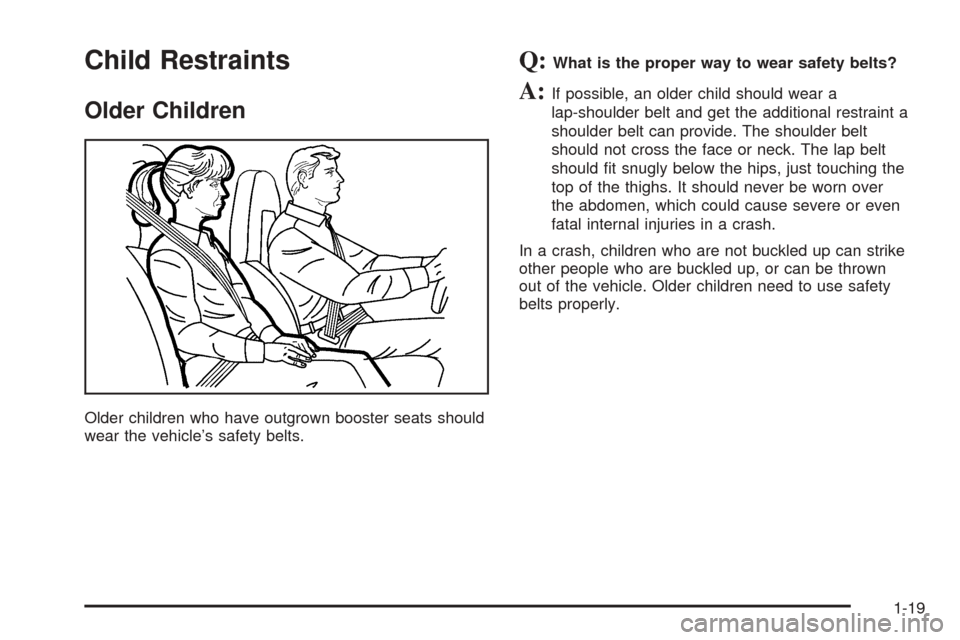
Older children who have outgrown booster seats should
wear the vehicle’s safety belts.
Q:What is the proper way to wear safety belts?
A:If possible, an older child should wear a
lap-shoulder belt and get the additional restraint a
shoulder belt can provide. The shoulder belt
should not cross the face or neck. The lap belt
should t snugly below the hips, just touching the
top of the thighs. It should never be worn over
the abdomen, which could cause severe or even
fatal internal injuries in a crash.
In a crash, children who are not buckled up can strike
other people who are buckled up, or can be thrown
out of the vehicle. Older children need to use safety
belts properly.
1-19
Page 31 of 438

A forward-facing child seat (C-E) provides restraint for
the child’s body with the harness and also sometimes
with surfaces such as T-shaped or shelf-like shields.A booster seat (F-G) is a child restraint designed to
improve the t of the vehicle’s safety belt system. Some
booster seats have a shoulder belt positioner, and some
high-back booster seats have a ve-point harness. A
booster seat can also help a child to see out the window.
1-25
Page 39 of 438

CAUTION: (Continued)
If you need to secure a forward-facing child
restraint in the passenger seat, always move
the passenger seat as far back as it will go.
{CAUTION:
If the airbag readiness light ever comes on
when you have turned off the airbags, it means
that something may be wrong with the airbag
system. The passenger’s airbags could inate
even though the switch is off. If this ever
happens, do not let anyone whom the national
government has identied as a member of a
passenger airbag risk group sit in the
passenger’s position (for example, do not
secure a rear-facing child restraint in your
vehicle) until you have your vehicle serviced.
SeeAirbag Off Switch on page 1-44.If your child restraint is equipped with the LATCH
system, seeLower Anchorages and Top Tethers for
Children (LATCH System) on page 1-28.
There are no top strap anchors in this vehicle. Do not
secure a child seat in this vehicle if a national or
local law requires that the top strap be anchored, or if
the instructions that come with the restraint say that the
top strap must be anchored. SeeTop Strap on
page 1-27if the child restraint has one.
If your child restraint does not have the latch system,
you will be using the lap-shoulder belt to secure the child
restraint in this position. Be sure to follow the
instructions that came with the child restraint. Secure
the child in the child restraint when and as the
instructions say.
1. Your vehicle has passenger’s airbags. If you need
to use a rear-facing child restraint in this seat, make
sure the airbags are turned off. SeeAirbag Off
Switch on page 1-44. If your child restraint is
forward-facing, always move the seat as far back
as it will go before securing it in this seat. See
Power Seats on page 1-2.
2. Put the child restraint on the seat.
3. Pick up the latch plate, and run the lap and shoulder
portions of the vehicle’s safety belt through or
around the restraint. The child restraint instructions
will show you how.
1-33
Page 48 of 438
Vehicles with dual stage airbags are also equipped with
seat position sensors which enable the sensing
system to monitor the position of the driver’s and
passenger’s seats. The seat position sensor provides
information which is used to determine if the airbags
should deploy at a reduced level or at full deployment.
In any particular crash, no one can say whether an
airbag should have inated simply because of the
damage to a vehicle or because of what the repair costs
were. For frontal airbags, ination is determined by
the angle of the impact and how quickly the vehicle
slows down in frontal and near-frontal impacts. For side
impact airbags, ination is determined by the location
and severity of the impact.
What Makes an Airbag Inate?
In an impact of sufficient severity, the airbag sensing
system detects that the vehicle is in a crash. For both
frontal and side impact airbags, the sensing system
triggers a release of gas from the inator, which inates
the airbag. The inator, the airbag and related hardware
are all part of the airbag modules inside the steering
wheel, the instrument panel, and the side of the front
seatbacks closest to the door.
How Does an Airbag Restrain?
In moderate to severe frontal or near frontal collisions,
even belted occupants can contact the steering wheel or
the instrument panel. In moderate to severe side
collisions, even belted occupants can contact the inside
of the vehicle. The airbag supplements the protection
provided by safety belts. Airbags distribute the force of
the impact more evenly over the occupant’s upper body,
stopping the occupant more gradually. But the frontal
airbags would not help you in many types of collisions,
including rollovers, rear impacts, and many side impacts,
primarily because an occupant’s motion is not toward the
airbag. Side impact airbags would not help you in many
types of collisions, including frontal or near frontal
collisions, rollovers, and rear impacts, primarily because
an occupant’s motion is not toward those airbags.
Airbags should never be regarded as anything more than
a supplement to safety belts, and then only in moderate
to severe frontal or near-frontal collisions for the driver’s
and passenger’s frontal airbags, and only in moderate to
severe side collisions for the driver’s and passenger’s
side impact airbag.
1-42
Page 98 of 438

Reprogramming a Single
HomeLink®Button
To program a device to HomeLink®using a HomeLink®
button previously trained, follow these steps:
1. Press and hold the desired HomeLink
®button.
Do not release the button.
2. The indicator light will begin to ash after
20 seconds. While still holding the HomeLink
®
button, proceed with Step 2 under “Programming
HomeLink®” shown earlier in this section.
Resetting Defaults
To reset HomeLink®to default settings do the following:
1. Hold down the two outside buttons for about
20 seconds until the indicator light begins to ash.
2. Continue to hold both buttons until the HomeLink
®
indicator light turns off.
3. Release both buttons.
For questions or comments, contact HomeLink
®
at 1-800-355-3515, or on the internet at
www.homelink.com.
Storage Areas
Glove Box
To open the glove box, lift up on the lever. The glove
box has a light inside.
Cupholder(s)
The cupholders are located under a lid in the front
console to the right of the shift lever. Press the left side
of the lid and it will open automatically.
Center Console Storage Area
There is a center console storage area located between
the seats. To open this storage area, pull up the lid
on the front edge of the console and swing it rearward.
There is also an upright center console storage area
between the seatbacks. To open the storage area, press
and release the button near the top so it extends out.
Then, turn the button in either direction to unlatch the lid
and pull the console lid down. After you close the lid,
press the release button back in.
2-42
Page 157 of 438

Outlet Adjustment
Use the thumbwheel to open or close the outlets.
Operation Tips
Clear away any ice, snow or leaves from the air
inlets at the base of the windshield that may
block the ow of air into your vehicle.
Use of non-GM approved hood deectors may
adversely affect the performance of the system.
Keep the area around the base of the instrument
panel console and air path under the seats clear
of objects to help circulate the air inside of
your vehicle more effectively.
Passenger Compartment Air Filter
The passenger compartment air lter removes certain
odor and particles from the air including pollen and dust
particles. Reductions in airow, which may occur
more often in dusty areas, indicate that the lter may
need to be replaced early.
The lter should be replaced as part of the routine
scheduled maintenance. SeeScheduled Maintenance
on page 7-4for more information.
The passenger compartment air lter is located on the
passenger’s side of the engine compartment near
the battery. SeeEngine Compartment Overview on
page 6-12for more information on location.
To check or replace the air lter, do the following:
1. With the hood open, unlatch and remove the
access panel.
2. Pull the old lter out of the housing.
3. Insert the new lter into the housing. The lter should
be fully inserted with the arrows pointing up.
4. Reinstall the air lter access panel.
3-45
Page 307 of 438

{CAUTION:
Things you put inside your vehicle can strike
and injure people in a sudden stop or turn, or
in a crash.
Put things in the rear area of your vehicle.
Try to spread the weight evenly.
Never stack heavier things, like suitcases,
inside the vehicle so that some of them
are above the tops of the seats.
Do not leave an unsecured child restraint
in your vehicle.
When you carry something inside the
vehicle, secure it whenever you can.
Towing
Towing Your Vehicle
Consult your dealer or a professional towing service if
you need to have your disabled vehicle towed. See
Roadside Service on page 8-6.
Recreational Vehicle Towing
Recreational vehicle towing means towing your vehicle
behind another vehicle — such as behind a motorhome.
The two most common types of recreational vehicle
towing are known as “dinghy towing” (towing your vehicle
with all four wheels on the ground) and “dolly towing”
(towing your vehicle with two wheels on the ground and
two wheels up on a device known as a “dolly”).
Your vehicle was not designed to be towed with any of
its wheels on the ground. If your vehicle must be
towed, see “Towing Your Vehicle” earlier in this section.
Towing a Trailer
Your XLR is neither designed nor intended to tow
a trailer.
5-35