Page 274 of 470

You can be temporarily blinded by approaching
headlamps. It can take a second or two, or even several
seconds, for your eyes to re-adjust to the dark. When
you are faced with severe glare, as from a driver
who does not lower the high beams, or a vehicle with
misaimed headlamps, slow down a little. Avoid
staring directly into the approaching headlamps.
Keep your windshield and all the glass on your vehicle
clean — inside and out. Glare at night is made much
worse by dirt on the glass. Even the inside of the glass
can build up a lm caused by dust. Dirty glass makes
lights dazzle and ash more than clean glass would,
making the pupils of your eyes contract repeatedly.
Remember that your headlamps light up far less of a
roadway when you are in a turn or curve. Keep
your eyes moving; that way, it is easier to pick out dimly
lighted objects. Just as your headlamps should be
checked regularly for proper aim, so should your eyes
be examined regularly. Some drivers suffer from
night blindness — the inability to see in dim light — and
are not even aware of it.Driving in Rain and on Wet Roads
Rain and wet roads can mean driving trouble. On a wet
road, you cannot stop, accelerate, or turn as well
because your tire-to-road traction is not as good as on
dry roads. And, if your tires do not have much tread
left, you will get even less traction. It is always wise to
go slower and be cautious if rain starts to fall while
you are driving. The surface may get wet suddenly when
your reexes are tuned for driving on dry pavement.
4-30
Page 276 of 470

Driving Through Deep Standing Water
Notice:If you drive too quickly through deep
puddles or standing water, water can come in
through your engine’s air intake and badly damage
your engine. Never drive through water that is
slightly lower than the underbody of your vehicle. If
you cannot avoid deep puddles or standing water,
drive through them very slowly.
Driving Through Flowing Water
{CAUTION:
Flowing or rushing water creates strong
forces. If you try to drive through owing
water, as you might at a low water crossing,
your vehicle can be carried away. As little as
six inches of owing water can carry away a
smaller vehicle. If this happens, you and
other vehicle occupants could drown. Do not
ignore police warning signs, and otherwise be
very cautious about trying to drive through
owing water.
Some Other Rainy Weather Tips
Turn on your low-beam headlamps — not just your
parking lamps — to help make you more visible
to others.
Besides slowing down, allow some extra following
distance. And be especially careful when you
pass another vehicle. Allow yourself more clear
room ahead, and be prepared to have your
view restricted by road spray.
Have good tires with proper tread depth. SeeTires
on page 5-59.
4-32
Page 354 of 470

Headlamp Aiming
Your vehicle has a visual optical headlamp aiming
system equipped with horizontal aim indicators. The aim
has been preset at the factory and should need no
further adjustment. This is true even though your
horizontal aim indicators may not fall exactly on
the “0” (zero) marks on their scales.
If your vehicle is damaged in an accident, the headlamp
aim may be affected. Aim adjustment to the low beam
may be necessary if it is difficult to see lane markers
(for horizontal aim), or if oncoming drivers ash
their high beams at you (for vertical aim).
If you believe your headlamps need to be re-aimed, we
recommend that you take your vehicle to your dealer
for service. However, it is possible for you to re-aim your
headlamps as described in the following procedure.Notice:To make sure your headlamps are aimed
properly, read all the instructions before beginning.
Failure to follow these instructions could cause
damage to headlamp parts.
The vehicle should be properly prepared as follows:
The vehicle should be placed so the headlamps are
25 ft (7.6 m) from a light colored wall or other at
surface.
The vehicle must have all four tires on a perfectly
level surface which is level all the way to the wall
or other at surface.
The vehicle should be placed so it is perpendicular
to the wall or other at surface.
The vehicle should not have any snow, ice or mud
attached to it.
The vehicle should be fully assembled and all other
work stopped while headlamp aiming is being done.
The vehicle should be normally loaded with a
full tank of fuel and one person or 160 lbs (75 kg) on
the driver’s seat.
Tires should be properly inated.
Start the vehicle and rock it to level the suspension.
Headlamp aiming is done with the vehicle low-beam
lamps. The high-beam lamps will be correctly aimed if
the low-beam lamps are aimed properly.
5-48
Page 356 of 470
Headlamp Vertical Aiming
Notice:Horizontal aiming must be performed
before making any adjustments to the vertical aim.
Adjusting the vertical aim rst will result in an
incorrect headlamp aim.
To adjust the headlamp veritcal aiming, do the following:
1. Find the aim dot on the lens of the low beam lamps.
2. Measure the distance from the ground to the aim
dot on each low beam lamp. Record this distance.3. At the wall or other at surface, measure from the
ground upward the recorded distance from Step 2
and draw or tape a horizontal line the width of
the vehicle.
4. Turn on the low-beam headlamps and place a
piece of cardboard or equivalent in front of the
headlamp not being aimed. This should allow only
the beam of light from the headlamp being
aimed to be seen on the at surface.
Notice:Do not cover a headlamp to improve beam
cut-off when aiming. Covering a headlamp may
cause excessive heat build-up which may cause
damage to the headlamp.
5-50
Page 357 of 470
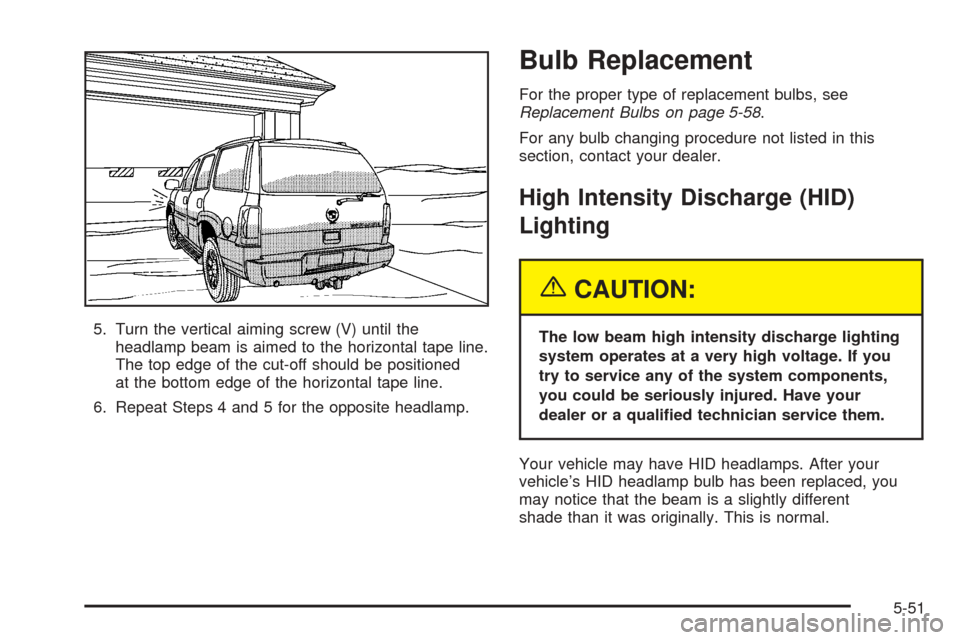
5. Turn the vertical aiming screw (V) until the
headlamp beam is aimed to the horizontal tape line.
The top edge of the cut-off should be positioned
at the bottom edge of the horizontal tape line.
6. Repeat Steps 4 and 5 for the opposite headlamp.
Bulb Replacement
For the proper type of replacement bulbs, see
Replacement Bulbs on page 5-58.
For any bulb changing procedure not listed in this
section, contact your dealer.
High Intensity Discharge (HID)
Lighting
{CAUTION:
The low beam high intensity discharge lighting
system operates at a very high voltage. If you
try to service any of the system components,
you could be seriously injured. Have your
dealer or a qualied technician service them.
Your vehicle may have HID headlamps. After your
vehicle’s HID headlamp bulb has been replaced, you
may notice that the beam is a slightly different
shade than it was originally. This is normal.
5-51
Page 358 of 470
Halogen Bulbs
{CAUTION:
Halogen bulbs have pressurized gas inside
and can burst if you drop or scratch the bulb.
You or others could be injured. Be sure to read
and follow the instructions on the bulb
package.
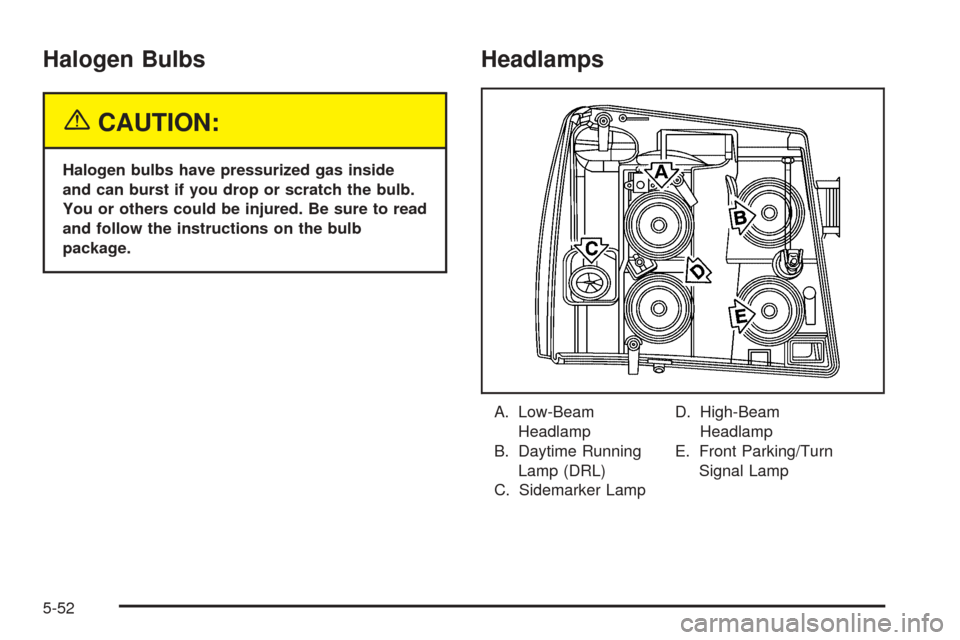
Headlamps
A. Low-Beam
Headlamp
B. Daytime Running
Lamp (DRL)
C. Sidemarker LampD. High-Beam
Headlamp
E. Front Parking/Turn
Signal Lamp
5-52
Page 362 of 470
Front Turn Signal, Sidemarker and
Daytime Running Lamps
A. Low-Beam
Headlamp
B. Daytime Running
Lamp (DRL)
C. Sidemarker LampD. High-Beam
Headlamp
E. Front Parking/Turn
Signal LampTo replace a front turn signal, sidemarker or DRL bulb,
do the following:
1. Remove the headlamp assembly as described
previously. SeeHeadlamps on page 5-52for
more information.
2. Remove the rubber, circular-shaped bulb cap for
the affected bulb from the headlamp assembly.
3. Press the locking release lever, turn the bulb
socket counterclockwise and remove it from
the headlamp assembly. (There is no lock for
the sidemarker lamp.)
4. Remove the old bulb from the bulb socket.
5. Put the new bulb into the bulb socket.
6. Put the bulb socket into the turn signal housing and
turn it clockwise until it locks. (There is no lock for
the sidemarker lamp.)
7. Reverse the steps to reinstall.
5-56
Page 364 of 470
Replacement Bulbs
Exterior Lamp Bulb Number
Back-up Lamp 3157K
Daytime Running Lamp (DRL) 4114K
Front Parking and Turn Signal
Lamps3157AK
High-Beam Headlamp 9005 or 9005 LL
Rear Turn Signal, Stoplamp and
Taillamp3157K
Sidemarker Lamp 194
For replacement bulbs not listed here, contact your
dealer.
Windshield Wiper Blade
Replacement
Windshield wiper blades should be inspected at least
twice a year for wear and cracking. SeeScheduled
Maintenance on page 6-5for more information.
Replacement blades come in different types and are
removed in different ways. For proper type and length,
seeNormal Maintenance Replacement Parts on
page 6-16.To replace the windshield wiper blade assembly do the
following:
1. Lift the wiper arm and turn the blade until it is
facing away from the windshield.
2. Push the release lever and slide the wiper assembly
toward the driver’s side of the vehicle.
3. Install a new blade by reversing Steps 1 and 2.
5-58