Page 289 of 410

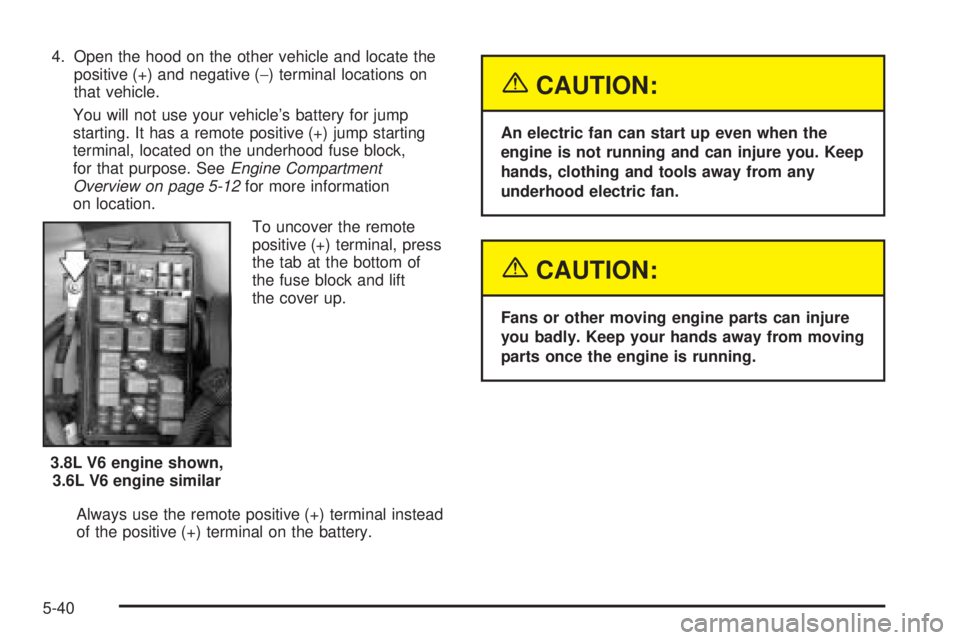
A. Windshield Washer Fluid Reservoir. See “Adding
Washer Fluid” underWindshield Washer Fluid
on page 5-34.
B. Battery. SeeBattery on page 5-38.
C. Remote Positive (+) Terminal. SeeJump Starting on
page 5-39.
D. Passenger Compartment Air Filter. SeePassenger
Compartment Air Filter on page 3-28.
E. Underhood Fuse Block. SeeUnderhood Fuse Block
on page 5-90.
F. Engine Coolant Surge Tank. SeeCooling System on
page 5-26.
G. Radiator Pressure Cap. SeeRadiator Pressure Cap
on page 5-24.
H. Power Steering Fluid Reservoir (Below Generator).
SeePower Steering Fluid on page 5-33.I. Electric Engine Cooling Fans. SeeCooling System
on page 5-26.
J. Engine Oil Dipstick. See “Checking Engine Oil”
underEngine Oil on page 5-15.
K. Engine Oil Fill Cap. See “When to Add Engine Oil”
underEngine Oil on page 5-15.
L. Automatic Transmission Fluid Dipstick. See
“Checking the Fluid Level” underAutomatic
Transmission Fluid on page 5-21.
M. Engine Coolant Bleed Valve. See “How to Add
Coolant to the Radiator” underCooling System on
page 5-26.
N. Brake Master Cylinder Reservoir. See “Brake Fluid”
underBrakes on page 5-35.
O. Engine Air Cleaner/Filter. SeeEngine Air
Cleaner/Filter on page 5-19.
5-13
Page 291 of 410

A. Windshield Washer Fluid Reservoir. See “Adding
Washer Fluid” underWindshield Washer Fluid
on page 5-34.
B. Battery. SeeBattery on page 5-38.
C. Remote Positive (+) Terminal. SeeJump Starting on
page 5-39.
D. Underhood Fuse Block. SeeUnderhood Fuse Block
on page 5-90.
E. Passenger Compartment Air Filter. SeePassenger
Compartment Air Filter on page 3-28.
F. Engine Coolant Surge Tank. SeeCooling System on
page 5-26.
G. Power Steering Fluid Reservoir. SeePower Steering
Fluid on page 5-33.
H. Radiator Pressure Cap. SeeRadiator Pressure Cap
on page 5-24.
I. Engine Oil Fill Cap. See “When to Add Engine Oil”
underEngine Oil on page 5-15.
J. Electric Engine Cooling Fans. SeeCooling System
on page 5-26.
K. Engine Oil Dipstick. See “Checking Engine Oil”
underEngine Oil on page 5-15.L. Automatic Transmission Fluid Dipstick. See
“Checking the Fluid Level” underAutomatic
Transmission Fluid on page 5-21.
M. Brake Master Cylinder Reservoir. See “Brake Fluid”
underBrakes on page 5-35.
N. Engine Air Cleaner/Filter. SeeEngine Air
Cleaner/Filter on page 5-19.
Engine Oil
Checking Engine Oil
It is a good idea to check your engine oil every time you
get fuel. In order to get an accurate reading, the oil
must be warm and the vehicle must be on level ground.
The engine oil dipstick handle is a yellow loop. See
Engine Compartment Overview on page 5-12for
the location of the engine oil dipstick.
1. Turn off the engine and give the oil several minutes
to drain back into the oil pan. If you do not do this,
the oil dipstick might not show the actual level.
2. Pull out the dipstick and clean it with a paper towel
or cloth, then push it back in all the way. Remove it
again, keeping the tip down, and check the level.
5-15
Page 316 of 410
4. Open the hood on the other vehicle and locate the
positive (+) and negative (−) terminal locations on
that vehicle.
You will not use your vehicle’s battery for jump
starting. It has a remote positive (+) jump starting
terminal, located on the underhood fuse block,
for that purpose. SeeEngine Compartment
Overview on page 5-12for more information
on location.
To uncover the remote
positive (+) terminal, press
the tab at the bottom of
the fuse block and lift
the cover up.
Always use the remote positive (+) terminal instead
of the positive (+) terminal on the battery.
{CAUTION:
An electric fan can start up even when the
engine is not running and can injure you. Keep
hands, clothing and tools away from any
underhood electric fan.
{CAUTION:
Fans or other moving engine parts can injure
you badly. Keep your hands away from moving
parts once the engine is running.
3.8L V6 engine shown,
3.6L V6 engine similar
5-40
Page 319 of 410
To disconnect the jumper cables from both vehicles, do
the following:
1. Disconnect the black negative (−) cable from the
vehicle that had the dead battery.
2. Disconnect the black negative (−) cable from the
vehicle with the good battery.
3. Disconnect the red positive (+) cable from the
vehicle with the good battery.
4. Disconnect the red positive (+) cable from the
other vehicle.
5. Return the fuse block cover to its original position.
Headlamp Aiming
The vehicle has a visual optical headlamp aiming
system. The aim has been preset at the factory and
should need no further adjustment
However, If the vehicle is damaged in an accident, the
headlamp aim may be affected and adjustment may
be necessary.
If oncoming vehicles ash their high beams at you, this
may also mean the vertical aim needs to be adjusted.
It is recommended that the vehicle is taken to your
dealer for service if the headlamps need to be re-aimed.
It is possible however, to re-aim the headlamps as
described in the following procedure.The vehicle should be properly prepared as follows:
The vehicle should be placed so the headlamps
are 25 ft. (7.6 m) from a light colored wall or
other at surface.
The vehicle must have all four tires on a perfectly
level surface which is level all the way to the wall
or other at surface.
The vehicle should be placed so it is perpendicular
to the wall or other at surface.
The vehicle should not have any snow, ice or
mud on it.
The vehicle should be fully assembled and all other
work stopped while headlamp aiming is being done.
The vehicle should be normally loaded with a
full tank of fuel and one person or 160 lbs (75 kg) on
the driver’s seat.
Tires should be properly inated.
Headlamp aiming is done with the vehicle’s low-beam
headlamps. The high-beam headlamps will be correctly
aimed if the low-beam headlamps are aimed properly.
The vertical headlamp aiming screws are located under
the hood near the headlamps.
5-43
Page 363 of 410
Electrical System
Add-On Electrical Equipment
Notice:Don’t add anything electrical to your
vehicle unless you check with your dealer rst.
Some electrical equipment can damage your vehicle
and the damage wouldn’t be covered by your
warranty. Some add-on electrical equipment can
keep other components from working as they
should.
Your vehicle has an airbag system. Before attempting to
add anything electrical to your vehicle, seeServicing
Your Airbag-Equipped Vehicle on page 1-64.
Headlamp Wiring
The headlamp wiring is protected by a circuit breaker in
the underhood fuse block. An electrical overload will
cause the headlamps to go on and off, or in some cases
to remain off. If this happens, have the headlamp
system checked right away.
Windshield Wiper Fuses
The windshield wiper motor is protected by a circuit
breaker and a fuse. If the motor overheats due to heavy
snow, etc., the wiper will stop until the motor cools. If
the overload is caused by some electrical problem, have
it xed.
5-87
Page 364 of 410
Power Windows and Other
Power Options
Circuit breakers in the instrument panel fuse block
protect the power windows and other power accessories.
When the current load is too heavy, the circuit breaker
opens and closes, protecting the circuit until the
problem is xed.
Fuses and Circuit Breakers
The wiring circuits in the vehicle are protected from
short circuits by a combination of fuses, circuit breakers
and in the fuse block wiring itself. This greatly reduces
the chance of res caused by electrical problems.
Look at the silver-colored band inside the fuse. If the
band is broken or melted, replace the fuse. Make sure a
bad fuse is replaced with a new one of the identical
size and rating.
Instrument Panel Fuse Block
The instrument panel fuse
block is located on the
passenger’s side of
the instrument panel. Pull
off the cover labeled
FUSES to expose the
fuse block.
5-88
Page 365 of 410
Fuses Usage
DR/LCK
TRUNKDoor Locks, Trunk
RFA/MOD Remote Keyless Entry
PRK/SWTCH Ignition Key Lock
CLSTR Cluster
STR/WHL/
ILLUMSteering Wheel Controls Illumination
Fuses Usage
ONSTAR/ALDL OnStar®, Data Link
INT/ILLUM Interior Lamps
PWR/SEAT Power Seat
S/ROOF Sunroof
CNSTR Canister Vent
HVAC Climate Control System
HAZRD Turn Signal, Hazard
PRK/LAMP Park Lamps
CHMSL/BKUPCenter-High-Mounted
Stoplamp/Back-up Lamps
PWR/MIR Power Mirrors
CRUISE Cruise Control
RDO/AMP Radio, Amplier
HTD/SEAT Heated Seats
HTD/MIR Heated Mirrors
PWR/WNDW Power Window
Relays Usage
RAP Retained Accessory Power
PRK/LAMP Park Lamp Relay
R/DEFOG Rear Defogger Relay
5-89
Page 366 of 410
Underhood Fuse Block
Some fuses and relays are located in the underhood
fuse block on the passenger’s side of the vehicle in the
engine compartment. SeeEngine Compartment
Overview on page 5-12for more information on location.
Mini-Fuses Usage
1 Left High Beam
2 Right High Beam
Mini-Fuses Usage
3 Left Low Beam
4 Right Low Beam
5 Windshield Wiper
6 Washer/Regulated Voltage Control
7 Fog Lamps
8 Transaxle Control Module
9 Supplemental Inatable Restraint
10 Auxiliary Power
11 Horn
12 Emission
13 Air Conditioner Clutch
14 Oxygen Sensor
15 Powertrain Control Module
16Powetrain Control Module,
Electronic Throttle Control
17 Electronic Throttle Control
18 Display
19 Anti-lock Brake Solenoid
20 Fuel Injector
21 Transmission Solenoid
22 Fuel Pump
23 Anti-lock Brake System
24 Ignition
5-90