2005 BMW Z4 ROADSTER 3.0I Light switch
[x] Cancel search: Light switchPage 65 of 120
Reference
At a glance
Controls
Driving tips
Mobility
63
By repeatedly pressing the button, you can
select one of three different operating modes.
>Indicator lamps off: outside air flows into the
vehicle
>Left-hand indicator lamp on, AUC mode:
the system detects pollutants in the outside
air and responds by deactivating the out-
side airflow as required. The system then
recirculates the air currently within the vehi-
cle. Depending on air quality requirements,
the system automatically switches between
outside air supply and recirculation of the air
already within the vehicle
>Right-hand indicator lamp on: the flow of
outside air is permanently blocked. The
system recirculates the air already within
the vehicle.
If the windows fog over in the recirculated
air mode, switch this mode off and
increase the air supply as required. Do not use
the recirculated-air mode continuously over a
long period of time as this would otherwise
reduce the air quality in the interior of the vehi-
cle.<
Rear window defroster
The indicator lamp lights up when
the rear window defroster is active.
The rear window defroster switches
off automatically.
Ventilation
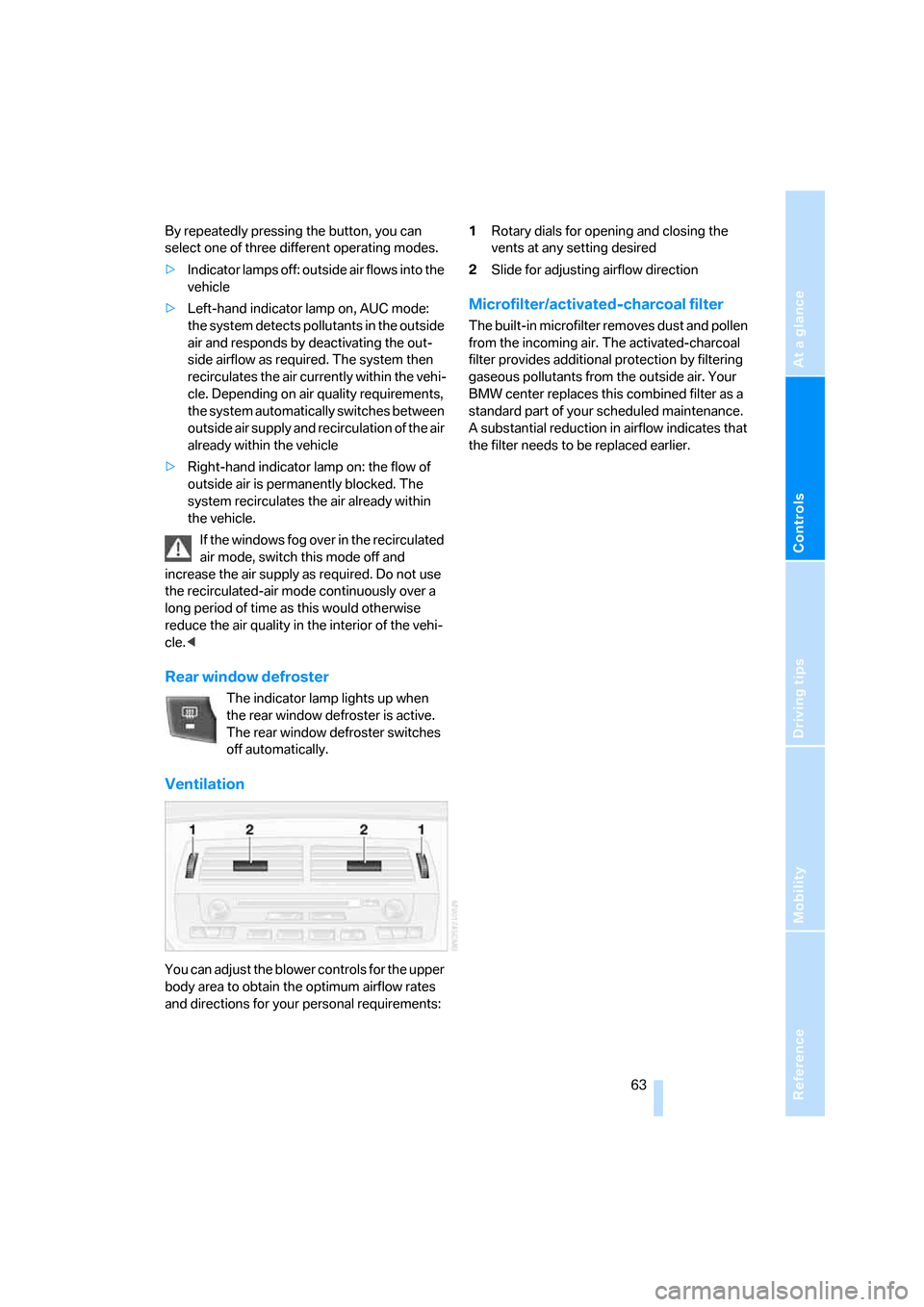
You can adjust the blower controls for the upper
body area to obtain the optimum airflow rates
and directions for your personal requirements:1Rotary dials for opening and closing the
vents at any setting desired
2Slide for adjusting airflow direction
Microfilter/activated-charcoal filter
The built-in microfilter removes dust and pollen
from the incoming air. The activated-charcoal
filter provides additional protection by filtering
gaseous pollutants from the outside air. Your
BMW center replaces this combined filter as a
standard part of your scheduled maintenance.
A substantial reduction in airflow indicates that
the filter needs to be replaced earlier.
Page 71 of 120

Reference
At a glance
Controls
Driving tips
Mobility
69
1.Close all windows
2.Increase the air supply from the air condi-
tioner or automatic climate control to a high
level. Refer to page58 or61.
Hot exhaust system
High temperatures occur with every vehi-
cle equipped with a catalytic converter.
Heat shields are installed adjacent to some sec-
tions of the exhaust system. Never remove
these shields; do not apply undercoating to
their surfaces. When driving, standing at idle
and parking the vehicle, take care to avoid con-
tact between the hot exhaust system and flam-
mable materials, e.g. hay, leaves, grass, etc.
Such contact could lead to a fire, resulting in
serious personal injury and property damage.<
Hydroplaning
When driving on wet or slushy roads,
reduce vehicle speed. If you do not, a
wedge of water may form between the tires and
the road surface. This phenomenon can lead to
partial or complete loss of traction, vehicle con-
trol and braking effectiveness.<
Driving through water
Do not drive through water on the road if it
is deeper than 1 ft/30 cm, and then only at
walking speed. Otherwise, the vehicle's engine,
the electrical systems and the transmission
may be damaged.<
Use the parking brake on inclines
On inclines, keep the vehicle from rolling
by using the parking brake rather than by
slipping the clutch, which would lead to a high
degree of clutch wear.<
Braking safely
Your BMW is equipped with ABS as a standard
feature. If you are in a situation which requires
full braking, it is best to brake using maximum
brake pressure: panic stop. Since the vehicle
maintains steering responsiveness, you can still
avoid possible obstacles with a minimum of
steering effort.Pulsation at the brake pedal combines with
sounds from the hydraulic circuits to indicate to
the driver that ABS is in its active mode.
Wet roads
If the roads are wet or if there is heavy rain, it is
advisable to gently press the brakes for a brief
moment every few miles/kilometers. Watch
traffic conditions to ensure that this maneuver
does not endanger other road users. The
resulting heat dries the brake rotors and brake
pads. Immediate braking force is then available
if necessary.
Inclines
To prevent overheating and, as a result,
diminished braking effectiveness, drive
down long or steep downhill grades in a gear
which requires the least braking. Otherwise,
even light but consistent pedal pressure can
lead to high temperatures, brake wear and pos-
sibly even brake failure.<
The braking power of the engine can be further
enhanced by downshifting the automatic trans-
mission in manual mode, if necessary, into first
gear; refer to pages39 and41. This prevents an
excessive load on the brakes.
Do not coast with the clutch depressed or
with the transmission or selector lever in
Neutral. Do not coast with the engine switched
off. Otherwise, the engine provides no braking
effect while the transmission is in idling posi-
tion, and there is no power-assist for braking or
steering when the engine is off.
Floor mats, floor carpets or other objects must
not be in the area near the brake or accelerator
pedal, as this could impair the movement of the
pedals.<
Corrosion on the brake rotors
Limited vehicle use, extended periods with the
vehicle parked or in storage, and operating con-
ditions in which braking is restricted to gentle,
low-pressure applications will all increase the
tendency for corrosion to form on the rotors and
contamination to accumulate on the brake
pads. This occurs because the minimal pres-
Page 88 of 120

In the engine compartment
86
Washer fluids for washer
systems
Headlamp* and windshield washer
system
Capacity of windshield washer system: approx.
3.2 quarts/3 liters.
Capacity when equipped with headlamp
washer system: approx. 5.3 quarts/5 liters.
Fill with water and, if required, with an antifreeze
agent according to the manufacturer's recom-
mendations.
We recommend that you mix the washer
fluid before adding it to the reservoir.<
Antifreeze agents for the washing sys-
tems are highly flammable. For this rea-
son, keep them away from sources of flame and
store them only in their original containers.
Store them so that they are inaccessible to chil-
dren. Comply with the instructions on the con-
tainers.<
Engine oil
Oil consumption is directly influenced by your
driving style and vehicle operating conditions.
Warning lamp
Engine oil pressure
The warning lamp lights up in red:
The engine oil pressure is too low.
Stop the vehicle immediately and
switch off the engine. Check the engine oil level
and top up if necessary. If the oil level is correct,
please contact the nearest BMW center.Do not continue driving, as the engine
could sustain serious damage from inad-
equate lubrication.<
Engine oil level
The warning lamp lights up in yellow
while driving:
The oil level is at the absolute mini-
mum; refill as soon as possible. Do not drive
more than 30 miles/50 km before refilling.
The warning lamp lights up in yellow
after the engine has been switched off:
Add engine oil at the earliest opportu-
nity, e.g. when you stop to refuel.
Engine oil sensor
The warning lamp lights up in yellow
within 20 seconds after the engine is
started:
The oil level sensor is defective. Please have it
checked by a BMW center.
Checking the oil level
1.With the vehicle's engine at normal operat-
ing temperature, i.e. after uninterrupted
driving for at least 6 miles/10 km, park the
vehicle on a level surface
2.Switch off the engine
3.After approx. 5 minutes, pull the dipstick
out and wipe it off with a clean lint-free
cloth, paper towel, or similar material
4.Carefully push the dipstick all the way into
the guide tube and pull it out again
5.The oil level should be between the two
marks on the dipstick
Page 94 of 120
Replacement procedures
92 1.Open the caps with a suitable object, e.g. a
coin or screwdriver
2.Fold up the protective cover in the wheel
well.
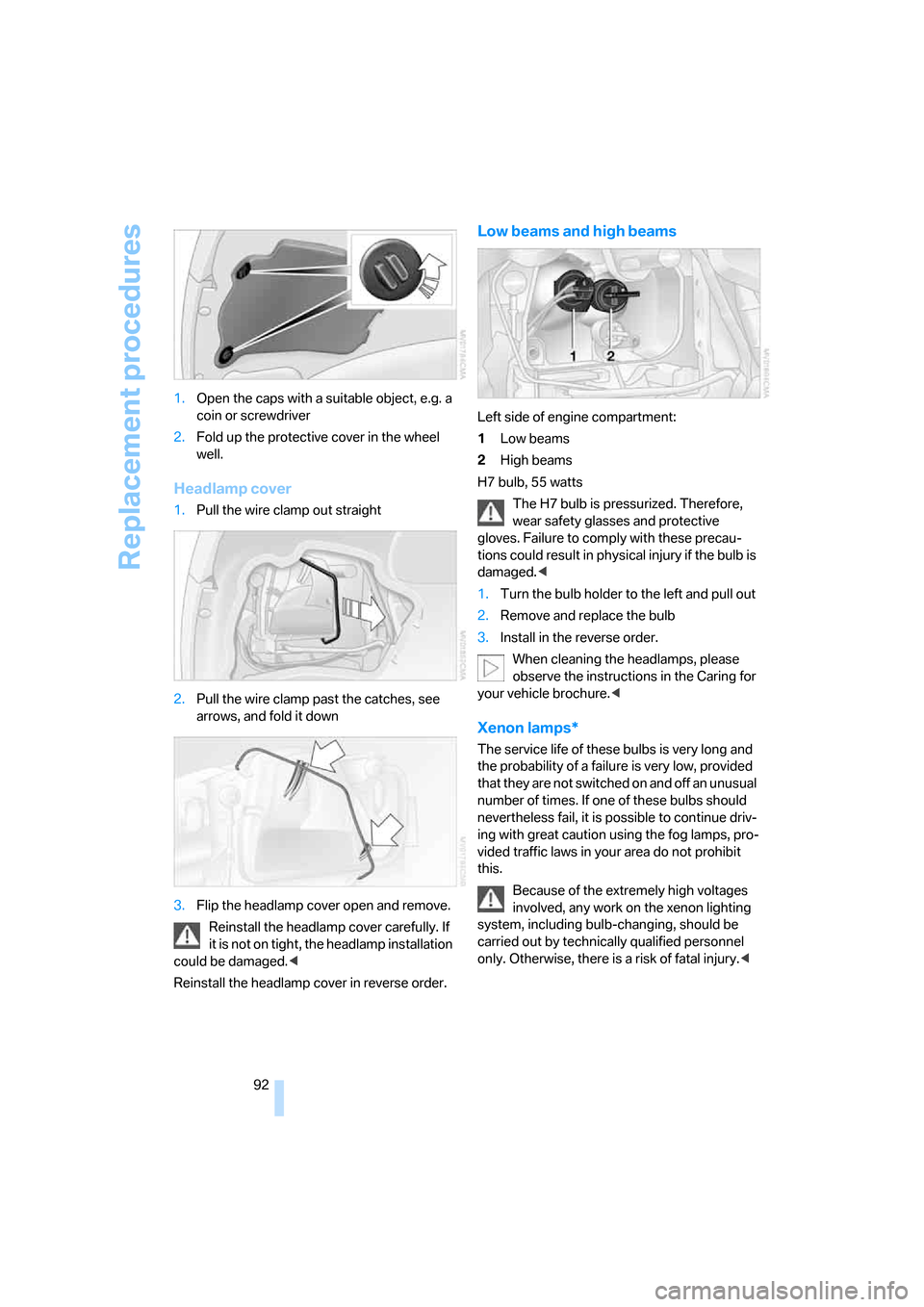
Headlamp cover
1.Pull the wire clamp out straight
2.Pull the wire clamp past the catches, see
arrows, and fold it down
3.Flip the headlamp cover open and remove.
Reinstall the headlamp cover carefully. If
it is not on tight, the headlamp installation
could be damaged.<
Reinstall the headlamp cover in reverse order.
Low beams and high beams
Left side of engine compartment:
1Low beams
2High beams
H7 bulb, 55 watts
The H7 bulb is pressurized. Therefore,
wear safety glasses and protective
gloves. Failure to comply with these precau-
tions could result in physical injury if the bulb is
damaged.<
1.Turn the bulb holder to the left and pull out
2.Remove and replace the bulb
3.Install in the reverse order.
When cleaning the headlamps, please
observe the instructions in the Caring for
your vehicle brochure.<
Xenon lamps*
The service life of these bulbs is very long and
the probability of a failure is very low, provided
that they are not switched on and off an unusual
number of times. If one of these bulbs should
nevertheless fail, it is possible to continue driv-
ing with great caution using the fog lamps, pro-
vided traffic laws in your area do not prohibit
this.
Because of the extremely high voltages
involved, any work on the xenon lighting
system, including bulb-changing, should be
carried out by technically qualified personnel
only. Otherwise, there is a risk of fatal injury.<
Page 96 of 120

Replacement procedures
94 Please contact a BMW center in case of a mal-
function.
License plate lamps
5 watt bulb
1.Push out the lamp with a suitable object and
remove it
2.Replace the bulb.
Snap the lamp back into place.
Light-emitting diodes LEDs
Control elements, display units and other inte-
rior equipment in your vehicle use a light-emit-
ting diode behind a cover as a light source.
These light-emitting diodes are similar to con-
ventional lasers.
Do not remove the covers, and do not
look directly at the unfiltered light for sev-
eral hours. Otherwise, it can lead to retinal irrita-
tion of the eye.<
Changing a wheel
Run Flat tires
Your BMW is equipped with Run Flat tires.
Therefore, the wheel no longer has to be
changed immediately in the event of a loss in
inflation pressure.
Run Flat tires are labeled on the sidewall with a
circular symbol containing the letters RSC.
Refer to page82.
BMW recommends that you consult your BMW
center if you wish to replace the tires of your
B MW , o r change from summe r to winter tire s o r
vice versa.
Your BMW center knows how to work with Run Flat tires and is equipped with the necessary
special tools.
When mounting or replacing summer
tires with winter tires, or vice versa, use
only Run Flat tires since no spare wheel is avail-
able in the event of a flat.<
Jacking points
The jacking points are located at the positions
indicated in the illustration.
Your BMW center can provide you with a
suitable jack as an accessory.<
Vehicle battery
Maintenance
The battery is completely maintenance-free.
This means that the original electrolyte will nor-
mally last for the service life of the battery under
moderate climatic conditions. Your BMW cen-
ter will be happy to advise you if you have any
questions concerning the battery.
Indicator lamp
The indicator lamp lights up:
The battery is no longer being charged.
The alternator drive belt is defective or
there is a malfunction in the charging circuit of
the alternator. Please contact the nearest BMW
center.
If the drive belt is defective, pull over and
switch off the engine immediately to pre-
vent overheating and serious engine damage.
If the onboard supply voltage drops to a very
low level, increased steering effort may also be
necessary.<
Page 113 of 120

Reference
At a glance
Controls
Driving tips
Mobility
111
Indicator/warning lamp
– airbags54
– alarm system26
– automatic transmission with
Steptronic39
– brakes13
– coolant temperature47
– DSC51
– engine temperature46
– Flat Tire Monitor53
– fog lamps57
– passenger airbags34
– please fasten safety belts30
– reserve46
– sequential manual gearbox
SMG41
Indicator and warning lamps,
overview12
Individual air
distribution59,62
Individual settings, refer to
Vehicle Memory,
Key Memory31
Inflation pressure, tires78
Inflation pressure monitoring,
refer to
– Flat Tire Monitor52
Inspection47
Instrument cluster12
Instrument lighting57
Instrument panel, refer to
Cockpit10
Interior lamps57
– remote control17
Interior motion sensor26
– deactivating26
Interior rearview mirror31
– automatic dimming
feature70
Interior temperature
adjusting59,62
Interlock, refer to
Steering lock36
Intermittent
– operation, wipers43
Interval
– display, service47J
Jack94
Jacking points94
Jets, refer to
Ventilation59,63
Jump-starting97
K
Key Memory31
Keys16
Key switch for passenger
airbags33
Kickdown39
Knock control76
L
Lamps and bulbs91
LATCH, child-restraint
mounting system35
Leather care, refer to the
Caring for your vehicle
brochure
LEDs Light-emitting
diodes94
Length, refer to
Dimensions104
License plate lamps, bulb
replacement94
Light-alloy wheels, care, refer
to the Caring for your vehicle
brochure
Light-emitting diodes
LEDs94
Lighter65
Lighting
of the instruments57
Lights, refer to Parking lamps/
Low beams56
LIGHTS ON warning56
Light switch56
Load, vehicle70
Loads, refer to Cargo
loading70
Loads, securing71
Lock buttons on doors,
refer to Locking18Locking the doors
– from inside18
– from outside17
Locking the vehicle
– from inside18
– from outside16
Low beams56
– automatic56
– bulb replacement92
– indicator lamp, defective
lamp13
Lug bolts, wrench91
Luggage compartment19
– capacity103
– floor panel91
– increasing capacity19
– opening/closing,
refer to Luggage
compartment lid18
– opening from inside the
vehicle19
– opening from the outside18
– opening with remote
control17
Luggage compartment lid18
– emergency operation19
– opening from inside the
vehicle19
– opening from the outside18
– remote control17
M
M+S tires, refer to Winter
tires82
Maintenance, refer to Service
interval display47,89
Maintenance System89
Making telephone calls, refer
to Owner's Manual for
Telephone
Malfunction
– convertible top23
– door lock18
– fuel filler door76
– storage compartments64
Malfunction of electrical
accessory95
Manual convertible top20