2005 BMW X5 3.0I roof
[x] Cancel search: roofPage 127 of 200
127n
OverviewControlsMaintenanceRepairsDataIndex
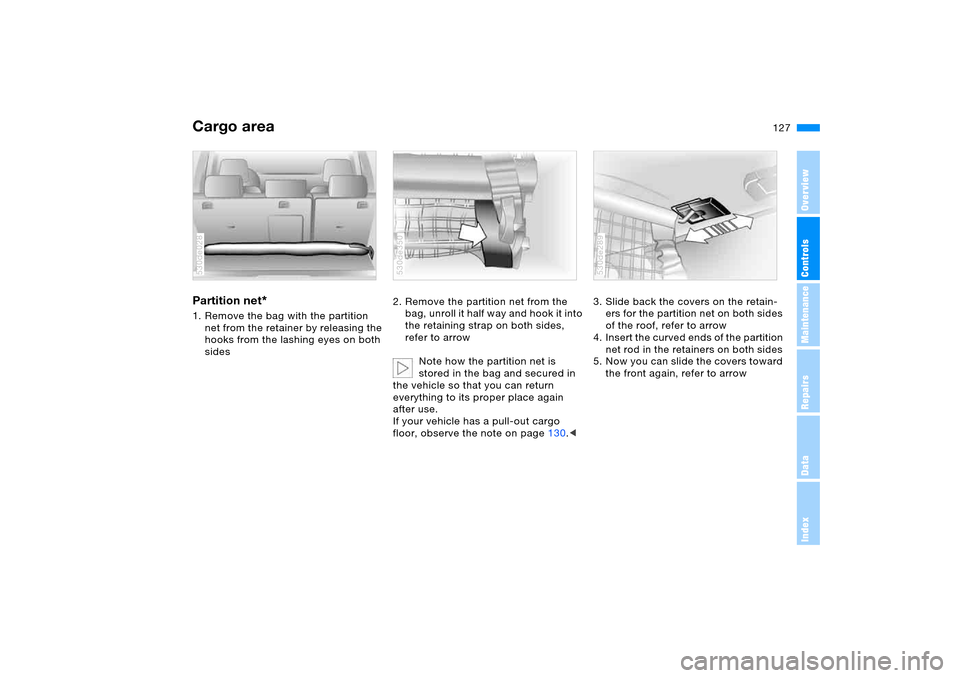
Cargo area Partition net
*
1. Remove the bag with the partition
net from the retainer by releasing the
hooks from the lashing eyes on both
sides530de028
2. Remove the partition net from the
bag, unroll it half way and hook it into
the retaining strap on both sides,
refer to arrow
Note how the partition net is
stored in the bag and secured in
the vehicle so that you can return
everything to its proper place again
after use.
If your vehicle has a pull-out cargo
floor, observe the note on page130.<530de350
3. Slide back the covers on the retain-
ers for the partition net on both sides
of the roof, refer to arrow
4. Insert the curved ends of the partition
net rod in the retainers on both sides
5. Now you can slide the covers toward
the front again, refer to arrow530de289
Page 128 of 200

128n
Cargo area 6. Pull down the partition net downward
on both sides by the loop, refer to
arrow, and hook the hook into the
eye on the backrest
The case with the roll-up cover is
not shown in the illustration. With
the case removed it is easier to hook
the hooks of the partition net onto the
backrest.<530de351
7. When the rear backrests are folded
down, you can unhook the partition
net from the retaining straps, com-
pletely unroll it, insert it in the front
retainers on the roof and attach the
three hooks into the eyes on the
backrests.
The illustration shows securing at the
bottom right as an example.530de352
Side covers Pull the handle to open the side covers.530de290
Page 133 of 200

133n
OverviewControlsMaintenanceRepairsDataIndex
Cargo loading Roof-mounted luggage rack
*
Always position and secure the
load as described above. If you do
not, it can even endanger the passen-
gers during braking or evasive maneu-
vers.
Do not exceed the permissible gross
vehicle weight and the permissible axle
loads, refer to page180. If you do, the
operating safety of the vehicle is no
longer ensured and you are in violation
of the law.
You should never transport heavy or
hard objects unsecured in the passen-
ger compartment, as they could fly
around and pose a safety hazard to the
vehicle's occupants even during abrupt
braking or evasive maneuvers.<
A special rack system is available as an
option for your BMW. Please comply
with the precautions included with the
installation instructions.Mounting pointsAccess to the mounting points:
To fold up the cover, refer to arrow,
please use the tool which is provided
with the rack system.530de293
Loading luggage rackRoof-mounted luggage racks raise the
center of gravity of the vehicle when
they are loaded. For this reason, they
exercise a major effect on the vehicle's
handling and steering response.
You should therefore always remember
not to exceed the approved roof weight,
the approved gross vehicle weight or
the axle loads when loading the rack.
You will find the specifications under
Technical data on page180.
Make sure that the load is distributed
evenly, and that it does not extend out-
ward to beyond the limits of the loading
surface. Always load the heaviest
pieces on the bottom. Be sure that ade-
quate clearance is maintained for rais-
ing the panorama glass sunroof, and
that objects do not project into the
opening path of the liftgate.
Always ensure that roof-mounted
loads are tightly secured, as loose
loads can shift or even fly off the roof,
posing a serious hazard for following
traffic.<
Drive smoothly. Avoid sudden accelera-
tion and braking maneuvers. Take cor-
ners gently.
Page 137 of 200

137n
OverviewControlsMaintenanceRepairsDataIndex
General driving notesClosing liftgate/tailgate
Operate the vehicle only when the
tailgate and liftgate are completely
closed. Otherwise, exhaust fumes
could enter into the passenger com-
partment.<
However, if special circumstances
should make it absolutely necessary
to operate the vehicle with the liftgate/
tailgate open:
1. Close all windows and the panorama
glass sunroof
2. Increase the air supply for the air
conditioner or automatic climate
control to a high level, refer to
page108 or112.
Hot exhaust system
Extreme temperatures occur at
the catalytic converter on this and
every catalyst-equipped vehicle. Do not
remove the heat shields installed adja-
cent to various sections of the exhaust
system, and never apply undercoating
to them. When driving, standing at idle
and while parking take care to avoid
possible contact between a hot exhaust
system and any highly flammable mate-
rials such as hay, leaves, grass etc.
Otherwise there is a danger of ignition
and of a fire with the risk of serious inju-
ries and damage.
mobile radio devices such as por-
table phones inside the vehicle unless
they are directly connected to the
external antenna. Otherwise, it is
impossible to prevent a mutual interfer-
ence of the vehicle electronics with the
portable phone device. Also, there is no
guarantee that the radiation generated
by the transmission will be conveyed
out from the interior of the vehicle.<
When vehicle is parked Condensation forms in the air condi-
tioner system during operation, and
then exits under the vehicle. Traces of
water on the ground are therefore nor-
mal.Brakes
Do not drive with your foot resting
on the brake pedal. Even light but
consistent pedal pressure can lead to
excessively high temperatures, brake
wear and possibly even brake failure.<
Road hazards
If road hazards, obstacles or curbs
are unavoidable, only drive over
them very slowly and carefully, as oth-
erwise the wheels and suspension
parts, especially on vehicles fitted with
low profile tires, can be damaged.<
For more information on wheels and
tires, refer to page144.
Before driving into a car washFold in the exterior mirrors, refer to
page54, as otherwise they could be
damaged due to the width of the vehi-
cle.Hydroplaning
When driving on wet or slushy
roads, reduce road speed. If you
do not, a wedge of water can form
between tires and road surface. This
state can cause a partial or total loss of
contact with the road surface, of brak-
ing control and of control over the vehi-
cle.<
Page 154 of 200

154n
The BMW Maintenance System helps
maintain the road and driving safety of
your BMW.
Please keep in mind that regular main-
tenance is not only necessary for the
safety of your vehicle, but also plays a
significant role in maintaining the resale
value of the vehicle.
Service Interval Display Conventional systems rely solely on
distance traveled to determine when
service is due. The BMW Maintenance
System, on the other hand, began many
years ago to take the actual conditions
under which the vehicle is driven into
consideration. After all, different drivers
can accumulate mileage in very differ-
ent ways.390us008
From the point of view of maintenance,
62,000 miles/100,000 km accumulated
in short-distance urban driving are not
the equivalent of the same distance
covered at moderate speeds in long-
distance highway travel.
The BMW Maintenance System
includes the Engine Oil Service and
Inspections I and II.
Determining the maintenance intervals
according to the actual loads on the
vehicle covers every kind of operating
situation. However, even those who
drive only short distances, significantly
less than 6,000 miles/10,000 km annu-
ally, should have the engine oil changed
at least every 2 years since oil deterio-
rates over time, regardless of use. Service and Warranty Information
Booklet for US models/
Warranty and Service Guide
Booklet for Canadian models For additional information on mainte-
nance intervals and procedures, please
refer to the Service and Warranty Infor-
mation Booklet for US models or the
Warranty and Service Guide Booklet for
Canadian models. As a precaution against corrosion, it is
advisable to have the body checked for
damage from rocks or gravel at the
same time, depending upon operating
conditions.
Have your BMW Sports Activity
Vehicle center do the mainte-
nance and repair.
Be sure that all maintenance work is
confirmed in the Service and Warranty
Information Booklet for US models or
the Warranty and Service Guide Book-
let for Canadian models.
These entries will constitute your proof
that the vehicle has received regular
maintenance. They are also required for
warranty claims.<
Car careFor all information on this subject, refer
to the Caring for your vehicle brochure.
The BMW Maintenance System
Page 179 of 200

179n
OverviewControlsMaintenanceRepairsDataIndex
Dimensions
530de210530de368
All dimensions are given in inches/mm. Height: with level control system: 67.2/1,707; without level control
system: 67.5/1,715. Height with roof-mounted luggage rack: with level control system: 68.5/1,740; without level
control system: 68.9/1,750. Track width: X5 3.0i: 62.0/1,576; X5 4.8is: front 61.7/1,566, rear 62.8/1,596.
Min. turning circle dia.: 39.7 ft/12.1 meters.
73.7/1,872
85.8/2,180
61.4/1,560
61.4/1,560
111.0/2,820183.7/4,667
67.2/1,707
81.7/2,076
Page 180 of 200

180n
Weights X5 3.0i X5 4.4i X5 4.8is
Curb weight
with manual transmission
with automatic transmission Ibs./kg
Ibs./kg4,652/2,110
4,696/2,130 –
4,927/2,235 –
5,016/2275
Approved gross vehicle weight
with manual transmission
with automatic transmission Ibs./kg
Ibs./kg6,008/2,725
6,008/2,725 –
6,008/2,725 –
6,008/2,725
Load
with manual transmission
with automatic transmissionIbs./kg
Ibs./kg1,356/615
1,312/595–
1,080/490–
992/450
Approved front axle load Ibs./kg 2,712/1,230 2,789/1,265 2,789/1,265
Approved rear axle load Ibs./kg 3,307/1,500 3,307/1,500 3,307/1,500
Approved roof load capacity Ibs./kg 220/100
Never exceed either the approved axle loads or the gross vehicle weight.
Cargo area capacity cu ft/l 16.4 – 54.4/465 – 1,540, according to DIN
69.04/1,955, according to SAE
Page 184 of 200

Everything from A to ZA
Ability to climb, refer to
Driving on poor roads138
ABS Antilock Brake
System94
warning lamp20
Accessories, refer to For
your own safety9
Accident, refer to
Emergency call170
Roadside Assistance170
Activated-charcoal filter115
Adaptive Head Light104
Adjusting cooling capacity of
rear climate control115
Adjusting seats44
electric46
electric comfort seat46
mechanical45
mechanical sports seat45
Air circulation, refer to
Recirculated-air mode108
Air conditioner107
Air conditioning
air conditioner108
automatic climate
control113
Air distribution
air conditioner108
automatic climate
control112
individual112Air outlets, refer to
Ventilation109,114
Air pressure, refer to Tire
inflation pressure141
Air recirculation, refer to
Automatic recirculated-air
control AUC113
Air supply
air conditioner108
automatic climate
control112
rear climate control114
Air vents, refer to
Ventilation107,110
Air, drying, refer to Air
conditioning108,113
Airbags57
sitting safely43
warning lamp21
Airing, refer to
Ventilation109,114
Alarm system38
avoiding unintentional
alarms39
All-season tires, refer to
Special features of winter
tires146
Antenna, refer to Caring for
your vehicle brochure
Antifreeze
coolant152
washer fluid150Antilock Brake System
ABS94
warning lamp20
Anti-theft alarm system30
refer to Alarm system38
Anti-trapping mechanism
panorama glass
sunroof42
power windows40
Armrest, refer to Storage
compartments120
Artificial leather, refer to
Caring for your vehicle
brochure
Artificial wood trim, refer to
Caring for your vehicle
brochure
Ashtray
front122
rear122
AUC Automatic recirculated-
air control113
AUTO program, refer to
Automatic air distribution
and air flow112
Automatic
air distribution112
air supply112
cruise control74
headlamp control103
steering wheel
adjustment53Automatic car wash, refer to
Caring for your vehicle
brochure
Automatic climate
control110
Automatic cruise control74
Automatic curb monitor51
Automatic headlamp
control103
Automatic rear window
washer73
Automatic recirculated-air
control AUC113
Automatic Soft Close
function, liftgate36
Automatic speed reduction
for descents, refer to HDC
Hill Descent Control97
Automatic transmission with
Steptronic67
interlock64
selector lever interlock68
shiftlock68
towing173
tow-starting173
warning lamp20,21
Average fuel
consumption83,90
Average speed83,91
Avoiding alarms39
Axle loads, refer to
Weights180