2005 BMW 330XI IDRIVE SEDAN inflation
[x] Cancel search: inflationPage 39 of 223
Adjustments
38
Adjustments
Sitting safely
The ideal sitting position can make a vital con-
tribution to relaxed, fatigue-free driving. In con-
junction with the safety belts, the head
restraints and the airbags, the seated position
has a major influence on your safety in the event
of an accident. To ensure that the safety sys-
tems operate with optimal efficiency, we
strongly urge you to observe the instructions
contained in the following section.
For additional information on transporting chil-
dren safely, refer to page46.
Airbags
Always maintain an adequate distance
between yourself and the airbags. Always
grip the steering wheel on the rim, with your
hands in the 3 o'clock and 9 o'clock positions,
to minimize the risk of injury to the hands or
arms in the event of the airbag being triggered
off.
No one and nothing is to come between the air-
bags and the seat occupant.
Do not use the cover of the front airbag on the
front passenger side as a storage area. Make
sure that the front passenger is sitting correctly
and does not rest feet or legs on the instrument
panel, otherwise leg injuries can occur if the
front airbag is triggered. Never let an occu-
pant's head rest near or on a side airbag
because the inflating airbag could cause a seri-
ous or fatal injury.<
Even if you adhere to all the instructions, inju-
ries resulting from contact with airbags cannot
be fully excluded, depending on the circum-
stances. The ignition and inflation noise may
provoke a mild hearing loss in extremely sensi-
tive individuals. This effect is usually only tem-
porary.
For airbag locations and additional information
on airbags, refer to page82.
Head restraint
A correctly adjusted head restraint reduces the
risk of neck injury in the event of an accident.
Adjust the head restraint in such a way
that its center is at approx. ear level. Oth-
erwise, there is a risk of injury should an acci-
dent occur.<
Safety belt
Before every drive, make sure that all occupants
wear their safety belts. Airbags complement the
safety belt as an additional safety device, but
they do not represent a substitute.
At all times, occupants should sit upright
and be properly restrained: infants and
small children in appropriate child-restraint sys-
tems; larger children and adults using the safety
belts. Never allow more than one person to
wear a single safety belt. Never allow infants or
small children to ride in a passenger's lap.
Expectant mothers should also wear the safety
belt, making sure that the strap in the pelvic
a r e a i s w e l l d o w n o n t h e h i p s a n d d o e s n o t p r e s s
against the abdominal region of the body.
Do not route the belt across your neck, or run it
across sharp edges. Be sure that the belt does
not become caught or jammed. The safety belt
should not be twisted and must be positioned
firmly over the pelvis and shoulder, as close to
the body as possible. It should not pass over
hard or fragile objects, otherwise the belt in the
pelvic area could slide over the hips in the event
of a head-on collision and injure the lower abdo-
men. Avoid wearing bulky clothing and regularly
pull the belt in the upper-body area taut, other-
wise its restraining effect could be impaired.<
Safety belts, refer to page43.
Page 81 of 223
Technology for driving comfort and safety
80 If the warning lamps for DSC come
on. DSC including DTC and DBC is
malfunctioning.
The stabilizing action and brake-
servo boost are no longer available. The vehicle
remains operational. Have the system checked
as soon as possible.
Drive-off assistant
The drive-off assistant enables you to drive off
smoothly on uphill gradients. It is not necessary
to use the handbrake for this.
1.Hold the car in place by pressing the brake
pedal.
2.Release the brake pedal and drive off with-
out delay.
The drive-off assistant holds the car in
place for approx. 2 seconds after the
brake pedal is released. Depending on vehicle
load, the car may roll backwards a little during
this time span. Drive off without delay after
releasing the brake pedal. Otherwise, the drive-
off assistant will no longer hold the car in place
after approx. 2 seconds and the car will start to
roll backwards.<
Malfunction
The warning lamps for the brake sys-
tem light up in yellow. The drive-off
assistant has failed. The car will not
be held in place after the brake pedal
is released. Have the system checked as soon
as possible.
Display of this malfunction on Cana-
dian models.
Flat Tire Monitor FTM
The concept
The Flat Tire Monitor monitors tire pressures
while the car is being driven. The system
reports any significant loss of pressure in one
tire in relation to another.If a tire loses pressure, its rolling radius
changes, and this in turn alters the speed of
rotation. This change is detected and is
reported as a flat tire.
Functional requirement
In order to assure the reliable reporting of a flat
tire, the system must be initialized for the cor-
rect tire inflation pressure.
The system must be reinitialized each
time a tire inflation pressure has been cor-
rected or a wheel or tire has been changed.<
System limitations
The Flat Tire Monitor is unable to warn
the driver of sudden, severe tire damage
caused by external factors, nor can it identify
the gradual loss of pressure that will inevitably
occur in all four tires over a lengthy period of
time.<
In the following situations, the system could be
delayed or malfunction:
>System has not been initialized
>Driving on snowy or slippery road surface
>Performance-oriented style of driving: slip
in the drive wheels, high lateral acceleration
>If snow chains are attached
Initializing the system
The initialization is completed during driv-
ing, which can be interrupted at any time.
When driving resumes, the initialization is con-
tinued automatically.
Do not initialize the system while snow chains
are attached.<
iDrive concept, refer to page16.
1.Press the button.
This opens the start menu.
2.Press the controller to open the menu.
3.Select "Vehicle settings" and press the
controller.
Page 171 of 223
Wheels and tires
170
Wheels and tires
Tire inflation pressure
Information for your safety
It is not merely the tires' service life, but also
driving comfort and, to a great extent, driving
safety that depend on the condition of the tires
and the maintenance of the specified tire pres-
sure.
Check the tire inflation pressure regularly
and correct it, if necessary: at least twice a
month and before starting long trips. If you fail
to observe this precaution you may be driving
on tires with incorrect tire pressures, a condi-
tion that can not only compromise your vehi-
cle's driving stability, but also lead to tire dam-
age and the risk of an accident. Do not drive
with deflated, i.e. flat tires, except when using
Run-Flat Tires. A flat tire will seriously impair
your vehicle's handling and braking response.
Attempts to drive on a flat tire can lead to loss of
control over the vehicle.<
Checking pressure
Only check tire inflation pressure when the
tires are cold. This means after a maximum of
1.25 miles/2 km driving or when the vehicle has
been parked for at least 2 hours. When tires are
warm, the tire inflation pressure is higher.
After correcting tire inflation pressures,
always reinitialize the Flat Tire Monitor,
refer to page80.<
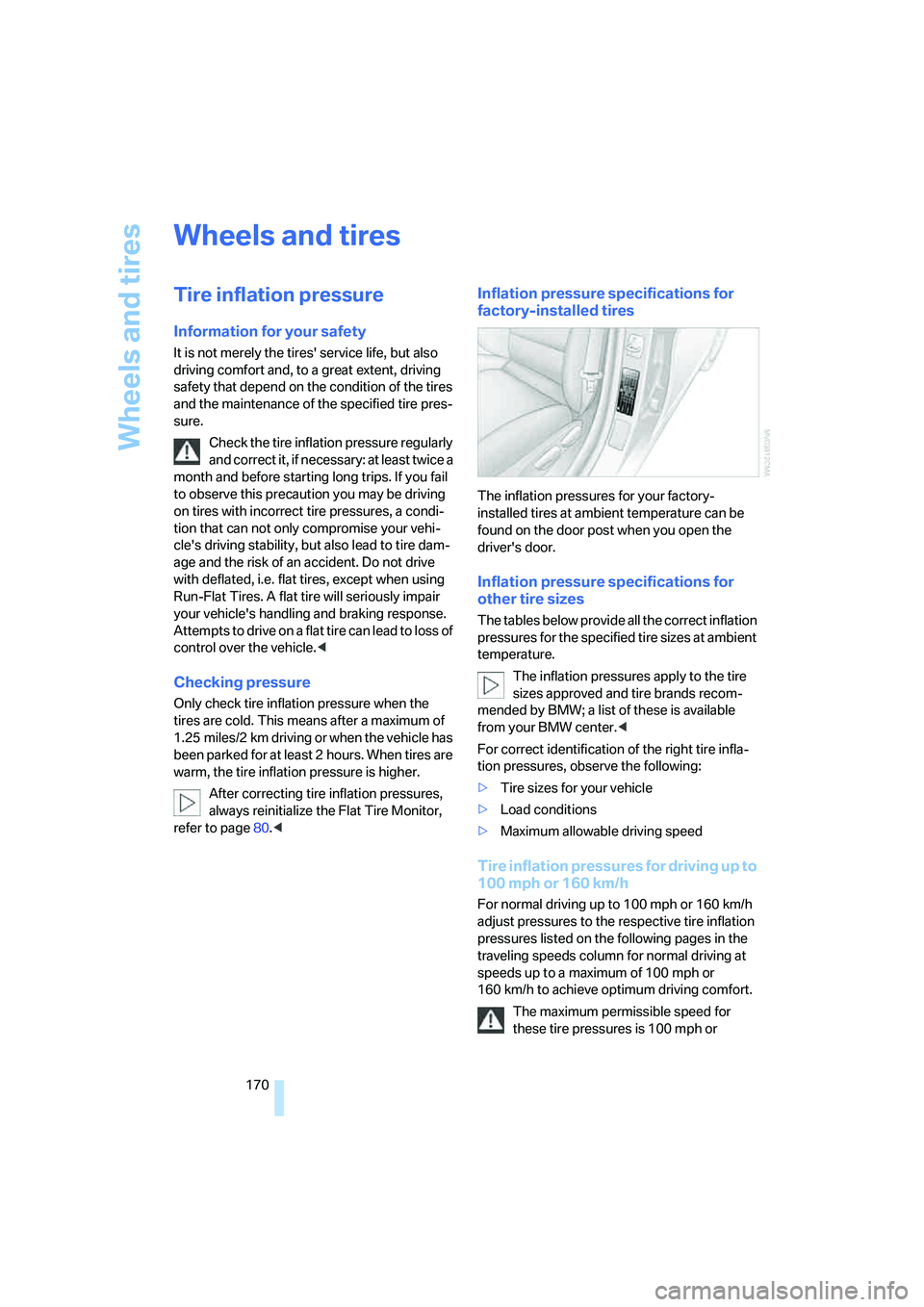
Inflation pressure specifications for
factory-installed tires
The inflation pressures for your factory-
installed tires at ambient temperature can be
found on the door post when you open the
driver's door.
Inflation pressure specifications for
other tire sizes
The tables below provide all the correct inflation
pressures for the specified tire sizes at ambient
temperature.
The inflation pressures apply to the tire
sizes approved and tire brands recom-
mended by BMW; a list of these is available
from your BMW center.<
For correct identification of the right tire infla-
tion pressures, observe the following:
>Tire sizes for your vehicle
>Load conditions
>Maximum allowable driving speed
Tire inflation pressures for driving up to
100 mph or 160 km/h
For normal driving up to 100 mph or 160 km/h
adjust pressures to the respective tire inflation
pressures listed on the following pages in the
traveling speeds column for normal driving at
speeds up to a maximum of 100 mph or
160 km/h to achieve optimum driving comfort.
The maximum permissible speed for
these tire pressures is 100 mph or
Page 172 of 223
Mobility
171Reference
At a glance
Controls
Driving tips
Communications
Navigation
Entertainment
160 km/h. Do not exceed this speed, otherwise
tire damage and accidents could occur.<
Tire inflation pressures for driving
above 100 mph or 160 km/h
In order to drive at maximum speeds in
excess of 100 mph or 160 km/h, please
observe, and, if necessary, adjust tire pressures
for speeds exceeding 100 mph or 160 km/h
from the relevant table on the following pages.
Otherwise tire damage and accidents could oc-
cur.<
Observe all national and local maximum speed
limits, otherwise violations of the laws could
occur.
Page 173 of 223
Wheels and tires
172
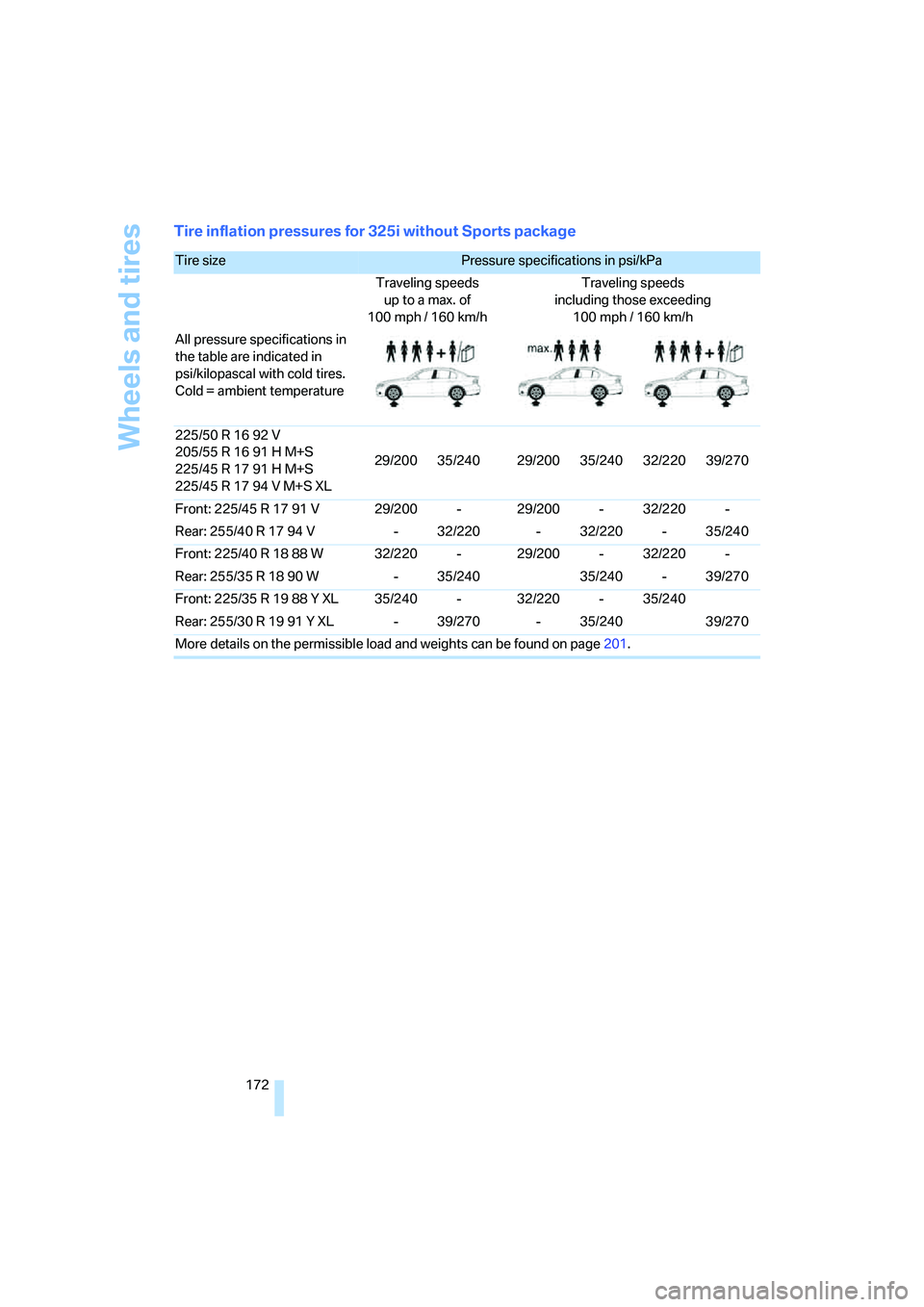
Tire inflation pressures for 325i without Sports package
Tire size Pressure specifications in psi/kPa
Traveling speeds
up to a max. of
100 mph / 160 km/hTraveling speeds
including those exceeding
100 mph / 160 km/h
All pressure specifications in
the table are indicated in
psi/kilopascal with cold tires.
Cold = ambient temperature
225/50 R 16 92 V
205/55 R 16 91 H M+S
225/45 R 17 91 H M+S
225/45 R 17 94 V M+S XL29/200 35/240 29/200 35/240 32/220 39/270
Front: 225/45 R 17 91 V 29/200 - 29/200 - 32/220 -
Rear: 255/40 R 17 94 V - 32/220 - 32/220 - 35/240
Front: 225/40 R 18 88 W 32/220 - 29/200 - 32/220 -
Rear: 255/35 R 18 90 W - 35/240 35/240 - 39/270
Front: 225/35 R 19 88 Y XL 35/240 - 32/220 - 35/240
Rear: 255/30 R 19 91 Y XL - 39/270 - 35/240 39/270
More details on the permissible load and weights can be found on page201.
Page 174 of 223
Mobility
173Reference
At a glance
Controls
Driving tips
Communications
Navigation
Entertainment
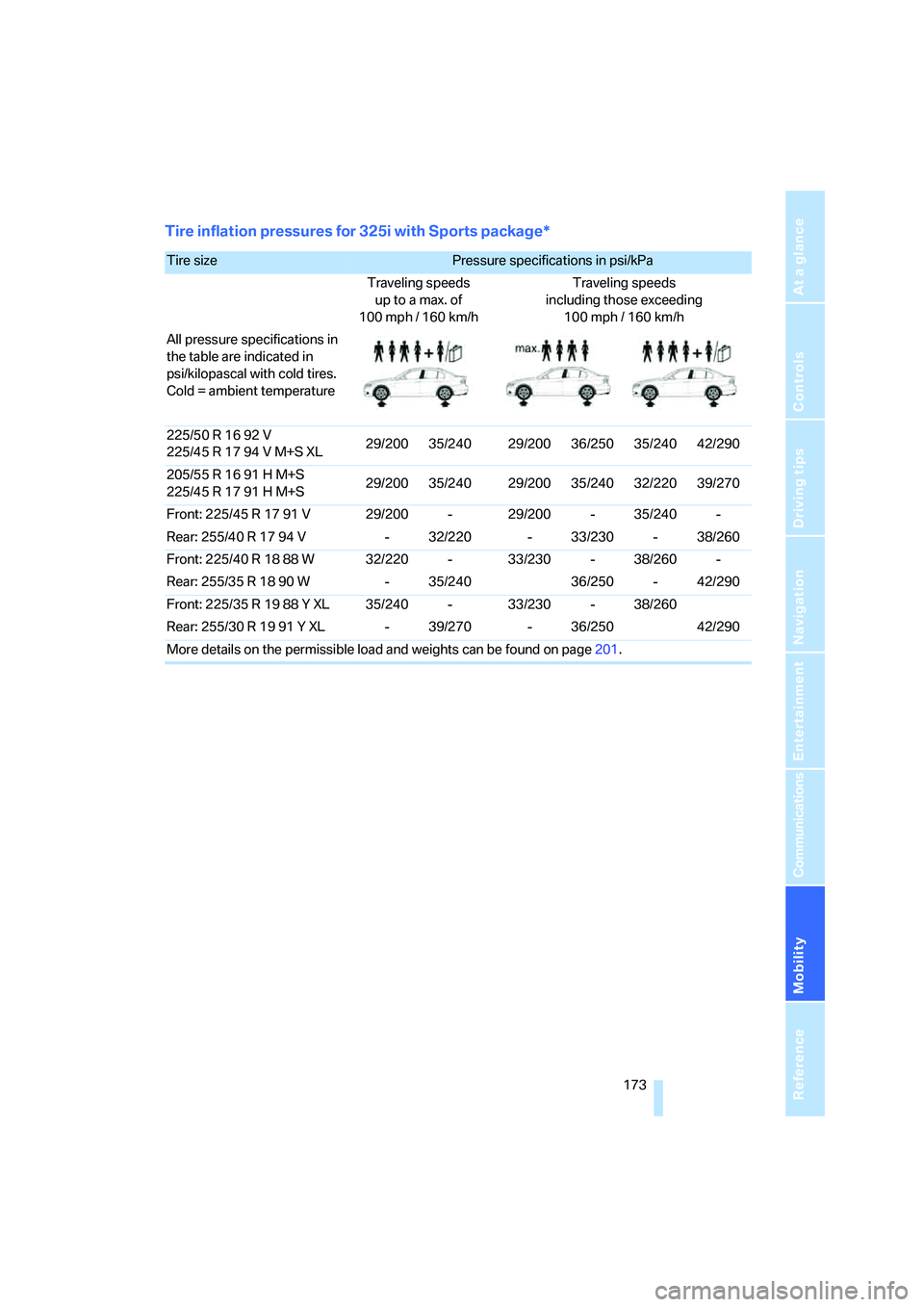
Tire inflation pressures for 325i with Sports package*
Tire size Pressure specifications in psi/kPa
Traveling speeds
up to a max. of
100 mph / 160 km/hTraveling speeds
including those exceeding
100 mph / 160 km/h
All pressure specifications in
the table are indicated in
psi/kilopascal with cold tires.
Cold = ambient temperature
225/50 R 16 92 V
225/45 R 17 94 V M+S XL29/200 35/240 29/200 36/250 35/240 42/290
205/55 R 16 91 H M+S
225/45 R 17 91 H M+S29/200 35/240 29/200 35/240 32/220 39/270
Front: 225/45 R 17 91 V 29/200 - 29/200 - 35/240 -
Rear: 255/40 R 17 94 V - 32/220 - 33/230 - 38/260
Front: 225/40 R 18 88 W 32/220 - 33/230 - 38/260 -
Rear: 255/35 R 18 90 W - 35/240 36/250 - 42/290
Front: 225/35 R 19 88 Y XL 35/240 - 33/230 - 38/260
Rear: 255/30 R 19 91 Y XL - 39/270 - 36/250 42/290
More details on the permissible load and weights can be found on page201.
Page 175 of 223
Wheels and tires
174
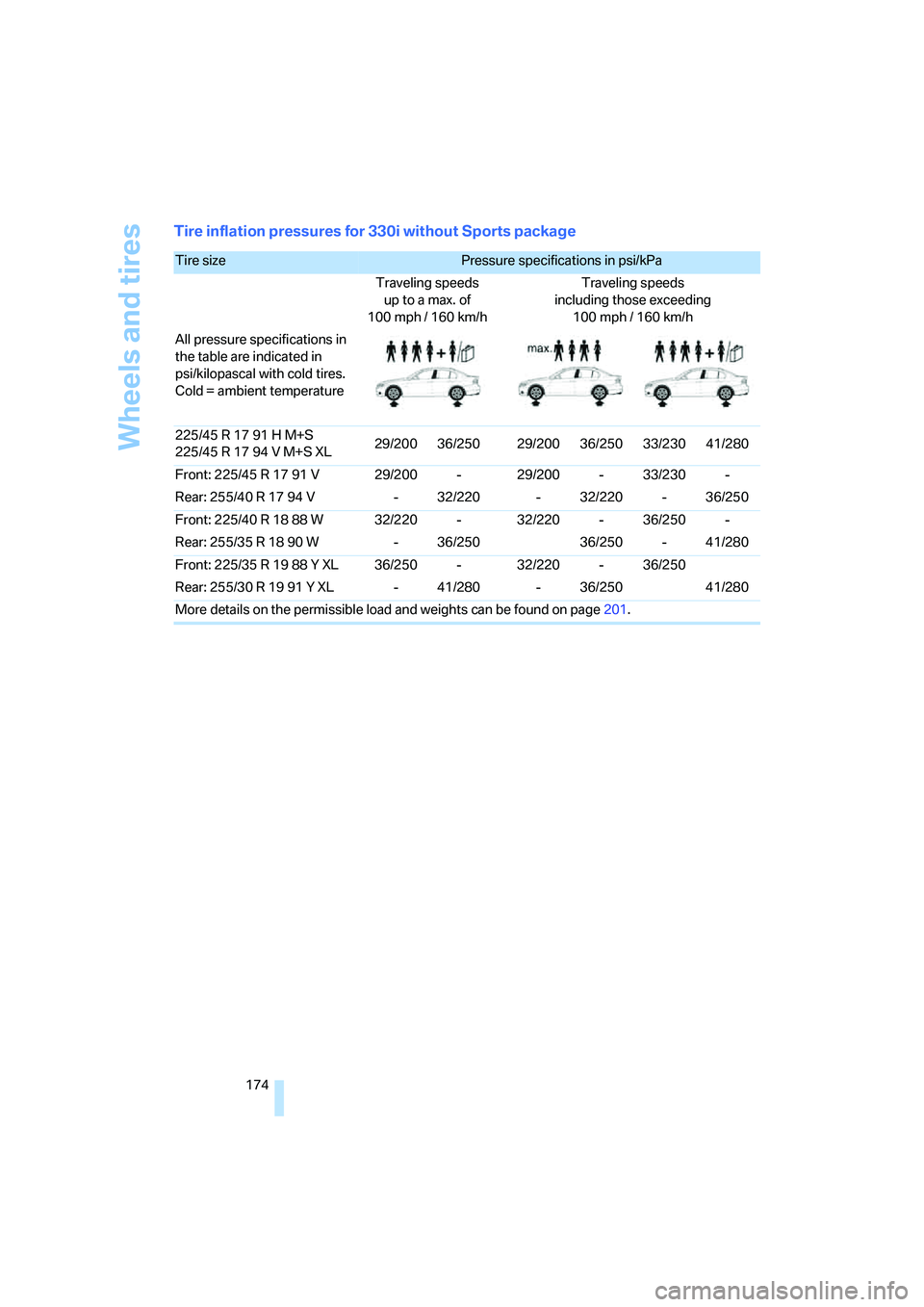
Tire inflation pressures for 330i without Sports package
Tire size Pressure specifications in psi/kPa
Traveling speeds
up to a max. of
100 mph / 160 km/hTraveling speeds
including those exceeding
100 mph / 160 km/h
All pressure specifications in
the table are indicated in
psi/kilopascal with cold tires.
Cold = ambient temperature
225/45 R 17 91 H M+S
225/45 R 17 94 V M+S XL29/200 36/250 29/200 36/250 33/230 41/280
Front: 225/45 R 17 91 V 29/200 - 29/200 - 33/230 -
Rear: 255/40 R 17 94 V - 32/220 - 32/220 - 36/250
Front: 225/40 R 18 88 W 32/220 - 32/220 - 36/250 -
Rear: 255/35 R 18 90 W - 36/250 36/250 - 41/280
Front: 225/35 R 19 88 Y XL 36/250 - 32/220 - 36/250
Rear: 255/30 R 19 91 Y XL - 41/280 - 36/250 41/280
More details on the permissible load and weights can be found on page201.
Page 176 of 223
Mobility
175Reference
At a glance
Controls
Driving tips
Communications
Navigation
Entertainment
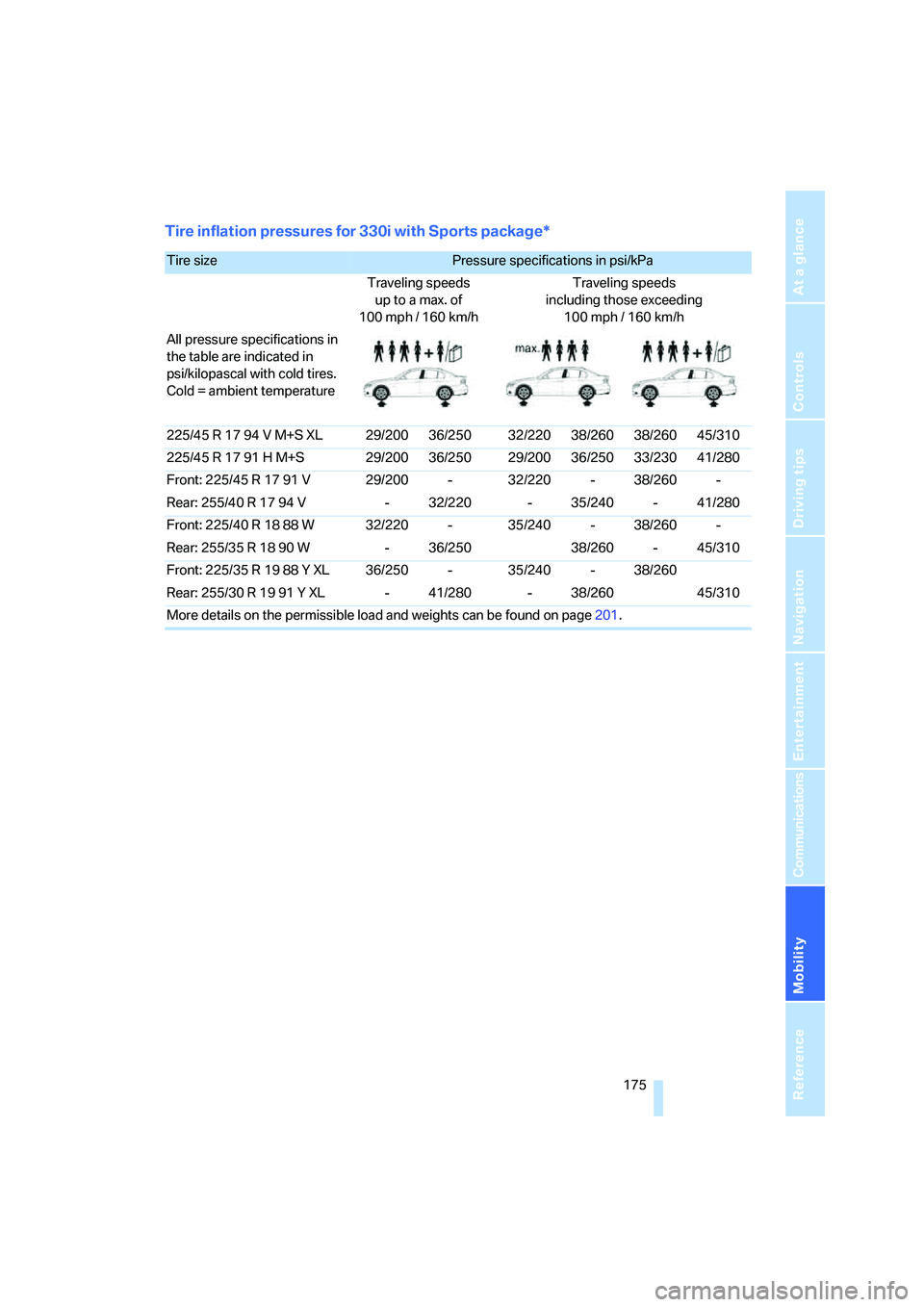
Tire inflation pressures for 330i with Sports package*
Tire size Pressure specifications in psi/kPa
Traveling speeds
up to a max. of
100 mph / 160 km/hTraveling speeds
including those exceeding
100 mph / 160 km/h
All pressure specifications in
the table are indicated in
psi/kilopascal with cold tires.
Cold = ambient temperature
225/45 R 17 94 V M+S XL 29/200 36/250 32/220 38/260 38/260 45/310
225/45 R 17 91 H M+S 29/200 36/250 29/200 36/250 33/230 41/280
Front: 225/45 R 17 91 V 29/200 - 32/220 - 38/260 -
Rear: 255/40 R 17 94 V - 32/220 - 35/240 - 41/280
Front: 225/40 R 18 88 W 32/220 - 35/240 - 38/260 -
Rear: 255/35 R 18 90 W - 36/250 38/260 - 45/310
Front: 225/35 R 19 88 Y XL 36/250 - 35/240 - 38/260
Rear: 255/30 R 19 91 Y XL - 41/280 - 38/260 45/310
More details on the permissible load and weights can be found on page201.