2005 BMW 325XI transmission
[x] Cancel search: transmissionPage 102 of 166
Things to remember when driving
100 You can increase the engine's braking effect by
shifting down, all the way to first gear if neces-
sary. This strategy helps you avoid placing
excessive loads on the brake system. Down-
shifting in manual mode of the automatic trans-
mission, refer to page48.
Never drive with the clutch held down,
with the transmission in idle or with the
engine switched off; otherwise, engine braking
action will not be present or there will be no
power assistance to the brakes or steering.
Never allow floor mats, carpets or any other
objects to protrude into the area around the
pedals, otherwise pedal function could be
impaired.<
Corrosion on brake rotors
When the vehicle is driven only occasionally,
during extended periods when the vehicle is not
used at all, and in operating conditions where
brake applications are less frequent, there is an
increased tendency for corrosion to form on
rotors, while contaminants accumulate on the
brake pads. This occurs because the minimum
pressure which must be exerted by the pads
during brake applications to clean the rotors is
not reached.
Should corrosion form on the brake rotors, the
brakes will tend to respond with a pulsating
effect that even extended application will fail to
cure.
When the vehicle is parked
Condensation forms while the automatic cli-
mate control is in operation, and then exits
under the vehicle. Traces of condensed water
under the vehicle are therefore normal.
Before driving into a car wash
For general information about taking care of
your BMW, refer to the Caring for your vehicle
brochure.
With convenient access and automatic
transmission
Insert the remote control into the ignition
switch.The engine can be switched off when the selec-
tor lever is in position N. Refer also to page27.
Cargo loading
To avoid loading the tires beyond their
approved carrying capacity, never over-
load the vehicle. Overloading can lead to over-
heating and increases the rate at which damage
develops inside the tires. The ultimate result
can assume the form of a sudden blow-out.<
Determining loading limit
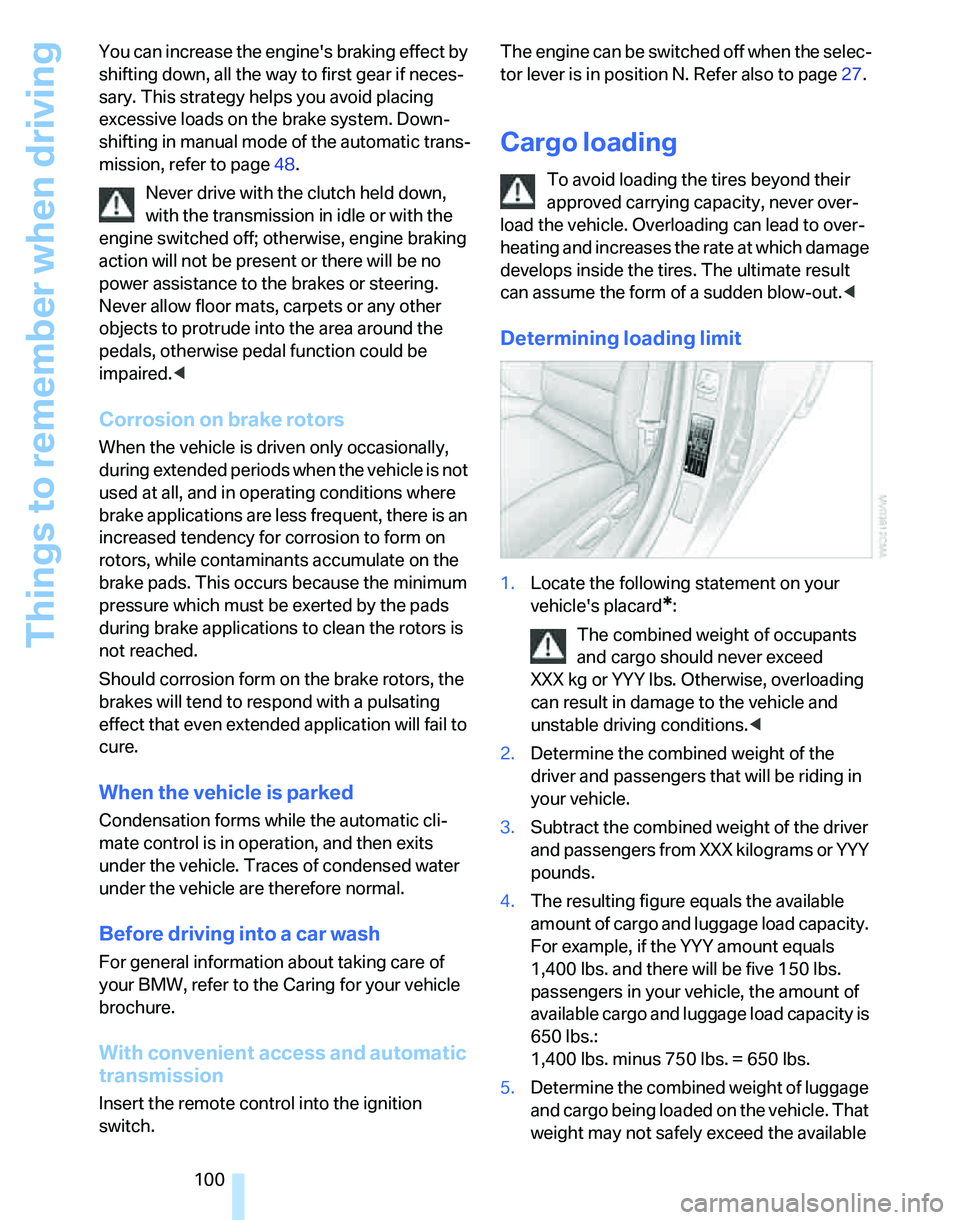
1.Locate the following statement on your
vehicle's placard
*:
The combined weight of occupants
and cargo should never exceed
XXX kg or YYY lbs. Otherwise, overloading
can result in damage to the vehicle and
unstable driving conditions.<
2.Determine the combined weight of the
driver and passengers that will be riding in
your vehicle.
3.Subtract the combined weight of the driver
and passengers from XXX kilograms or YYY
pounds.
4.The resulting figure equals the available
amount of cargo and luggage load capacity.
For example, if the YYY amount equals
1,400 lbs. and there will be five 150 lbs.
passengers in your vehicle, the amount of
available cargo and luggage load capacity is
650 lbs.:
1,400 lbs. minus 750 lbs. = 650 lbs.
5.Determine the combined weight of luggage
and cargo being loaded on the vehicle. That
weight may not safely exceed the available
Page 136 of 166
Giving and receiving assistance
134 gaged and the car is not steerable. Jump start-
ing, refer to page132.
Power steering assistance is not available when
the engine is not running. Thus, braking and
steering will require increased effort.<
Switch on the hazard warning flashers, depend-
ing on local regulations.
Manual transmission
Gearshift lever in idle position.
Automatic transmission
Selector lever in position N.
Changing selector lever positions, refer to
page47.
Do not exceed a towing speed of 45 mph
or 70 km/h and a towing distance of
90 miles/150 km, otherwise the automatic
transmission may be damaged.<
Sequential manual gearbox SMG
With the ignition switched on, engage selector
lever position N, and then switch the ignition
back off.
Towing with a tow bar
The towing vehicle must not be lighter
than the towed vehicle, otherwise it may
be impossible to maintain control.<
The tow fittings used should be on the same
side on both vehicles. Should it prove impossi-
ble to avoid mounting the tow bar at an angle,
please observe the following:
>Clearance and maneuvering capability will
be sharply limited during cornering.
>The tow bar will generate lateral forces if it is
attached offset.
Attach the tow bar to the tow fittings only,
as attaching it to other parts of the vehicle
could result in damage.<
Towing with a tow rope
When starting off in the towing vehicle, make
sure that the tow rope is taut.To avoid jerking and the associated
stresses on vehicle components when
towing, always use nylon ropes or nylon straps.
Attach the tow rope to the tow fittings only, as
attaching it to other parts of the vehicle could
result in damage.<
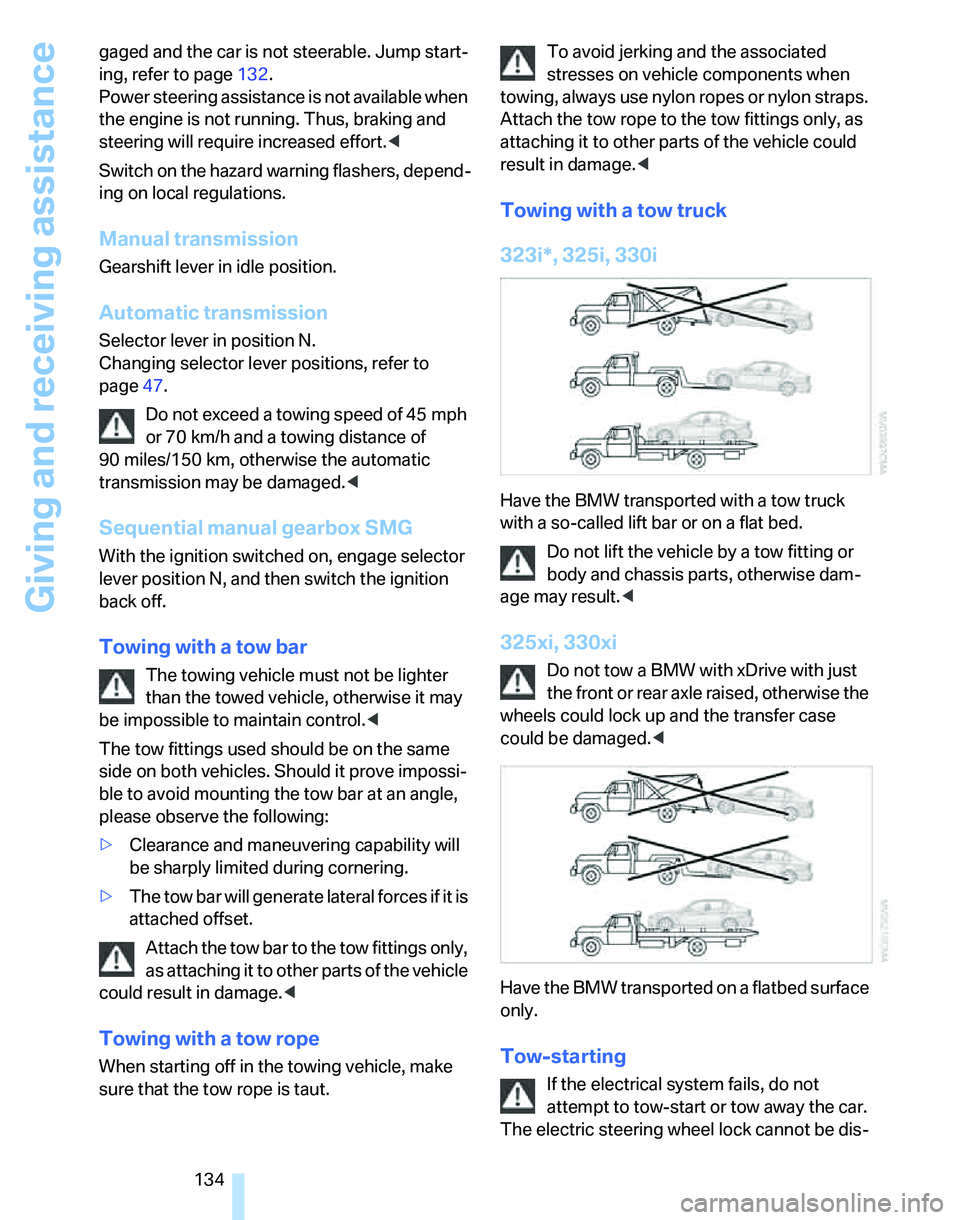
Towing with a tow truck
323i*, 325i, 330i
Have the BMW transported with a tow truck
with a so-called lift bar or on a flat bed.
Do not lift the vehicle by a tow fitting or
body and chassis parts, otherwise dam-
age may result.<
325xi, 330xi
Do not tow a BMW with xDrive with just
the front or rear axle raised, otherwise the
wheels could lock up and the transfer case
could be damaged.<
Have the BMW transported on a flatbed surface
only.
Tow-starting
If the electrical system fails, do not
attempt to tow-start or tow away the car.
The electric steering wheel lock cannot be dis-
Page 137 of 166

Reference
At a glance
Controls
Driving tips
Mobility
135
engaged and the car is not steerable. Jump
starting, refer to page132.<
Do not tow-start vehicles with an auto-
matic transmission. Only tow-start vehi-
cles with a catalytic converter with the engine
cold. It is better to jump start the engine, refer to
page132.<
1.Switch on the hazard warning flashers,
comply with local regulations.
2.Switch on the ignition, refer to page42.
3.Shift into 3rd gear. Vehicles with SMG, see
below.
4.Have the vehicle tow-started with the clutch
completely depressed and slowly release
the clutch. After the engine starts, immedi-
ately depress the clutch completely again.
5.Stop at a suitable location, remove the tow
bar or rope and switch off the hazard warn-
ing flashers.
6.Have the vehicle checked.
Vehicles with sequential manual gearbox SMG:
1.Have the vehicle tow-started with the selec-
tor lever in position N.
2.Select sequential mode. The correct gear is
automatically engaged.
325xi, 330xi: do not activate Hill Descent
Control HDC when the vehicle is being
tow-started, page69.<
Page 143 of 166
Reference
At a glance
Controls
Driving tips
Mobility
141
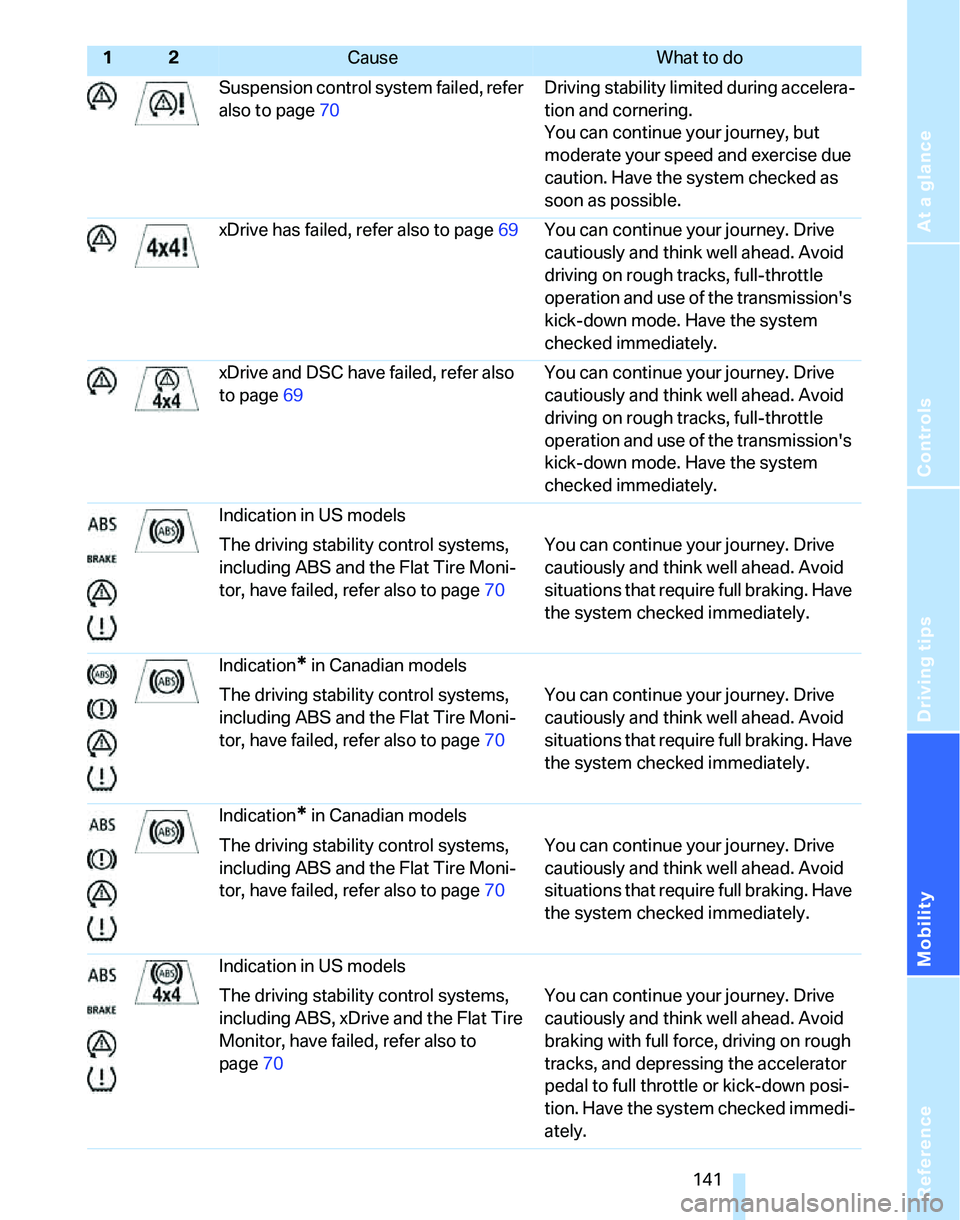
Suspension control system failed, refer
also to page70Driving stability limited during accelera-
tion and cornering.
You can continue your journey, but
moderate your speed and exercise due
caution. Have the system checked as
soon as possible.
xDrive has failed, refer also to page69You can continue your journey. Drive
cautiously and think well ahead. Avoid
driving on rough tracks, full-throttle
operation and use of the transmission's
kick-down mode. Have the system
checked immediately.
xDrive and DSC have failed, refer also
to page69You can continue your journey. Drive
cautiously and think well ahead. Avoid
driving on rough tracks, full-throttle
operation and use of the transmission's
kick-down mode. Have the system
checked immediately.
Indication in US models
The driving stability control systems,
including ABS and the Flat Tire Moni-
tor, have failed, refer also to page70You can continue your journey. Drive
cautiously and think well ahead. Avoid
situations that require full braking. Have
the system checked immediately.
Indication
* in Canadian models
The driving stability control systems,
including ABS and the Flat Tire Moni-
tor, have failed, refer also to page70You can continue your journey. Drive
cautiously and think well ahead. Avoid
situations that require full braking. Have
the system checked immediately.
Indication
* in Canadian models
The driving stability control systems,
including ABS and the Flat Tire Moni-
tor, have failed, refer also to page70You can continue your journey. Drive
cautiously and think well ahead. Avoid
situations that require full braking. Have
the system checked immediately.
Indication in US models
The driving stability control systems,
including ABS, xDrive and the Flat Tire
Monitor, have failed, refer also to
page70You can continue your journey. Drive
cautiously and think well ahead. Avoid
braking with full force, driving on rough
tracks, and depressing the accelerator
pedal to full throttle or kick-down posi-
tion. Have the system checked immedi-
ately.
12Cause What to do
Page 144 of 166
Indicator and warning lamps
142Indication
* in Canadian models
The driving stability control systems,
including ABS, xDrive and the Flat Tire
Monitor, have failed, refer also to
page70You can continue your journey. Drive
cautiously and think well ahead. Avoid
braking with full force, driving on rough
tracks, and depressing the accelerator
pedal to full throttle or kick-down posi-
tion. Have the system checked immedi-
ately.
Indication
* in Canadian models
The driving stability control systems,
including ABS, xDrive and the Flat Tire
Monitor, have failed, refer also to
page70You can continue your journey. Drive
cautiously and think well ahead. Avoid
braking with full force, driving on rough
tracks, and depressing the accelerator
pedal to full throttle or kick-down posi-
tion. Have the system checked immedi-
ately.
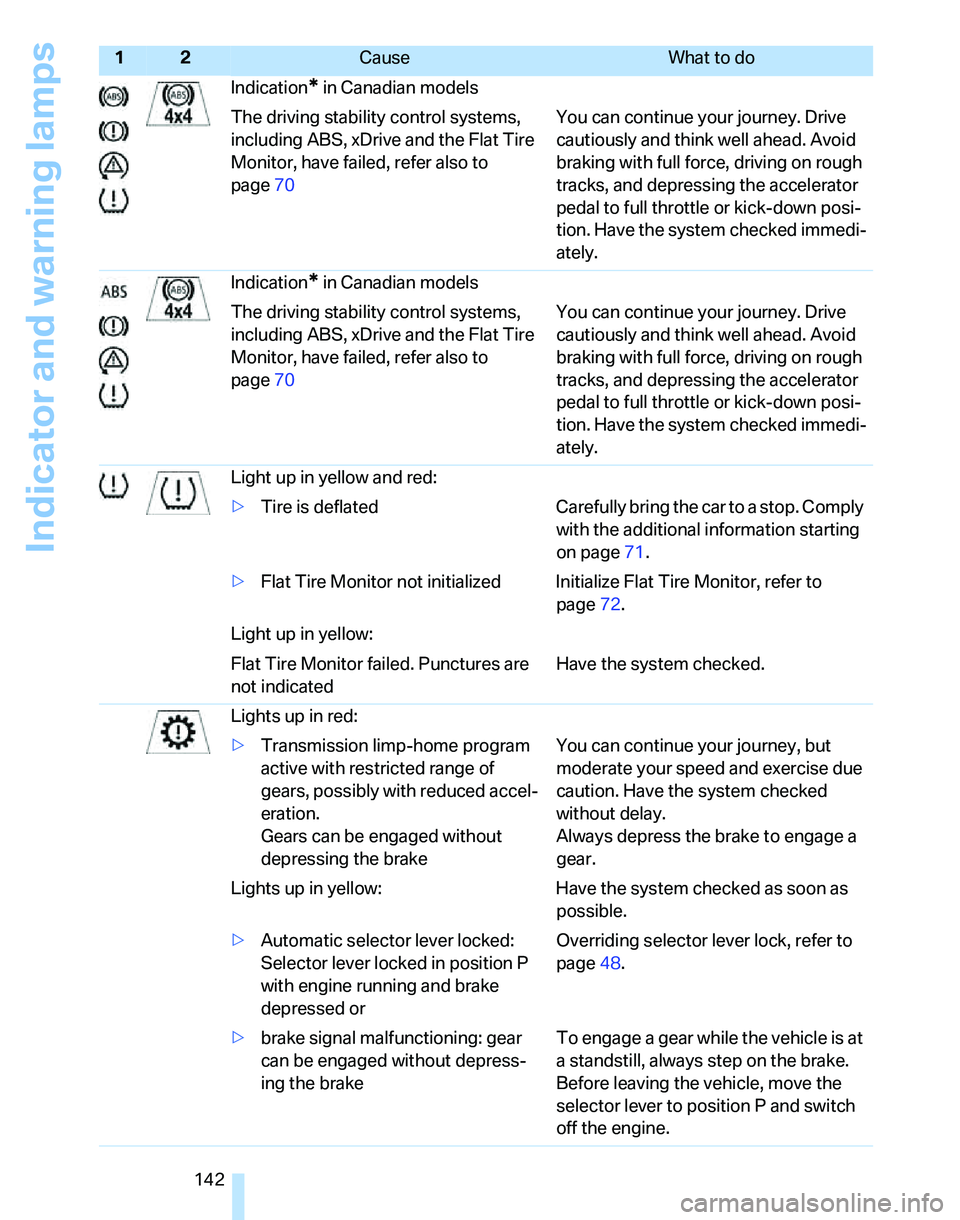
Light up in yellow and red:
>Tire is deflated Carefully bring the car to a stop. Comply
with the additional information starting
on page71.
>Flat Tire Monitor not initialized Initialize Flat Tire Monitor, refer to
page72.
Light up in yellow:
Flat Tire Monitor failed. Punctures are
not indicatedHave the system checked.
Lights up in red:
>Transmission limp-home program
active with restricted range of
gears, possibly with reduced accel-
eration.
Gears can be engaged without
depressing the brakeYou can continue your journey, but
moderate your speed and exercise due
caution. Have the system checked
without delay.
Always depress the brake to engage a
gear.
Lights up in yellow: Have the system checked as soon as
possible.
>Automatic selector lever locked:
Selector lever locked in position P
with engine running and brake
depressed orOverriding selector lever lock, refer to
page48.
>brake signal malfunctioning: gear
can be engaged without depress-
ing the brakeTo engage a gear while the vehicle is at
a standstill, always step on the brake.
Before leaving the vehicle, move the
selector lever to position P and switch
off the engine.
12Cause What to do
Page 145 of 166
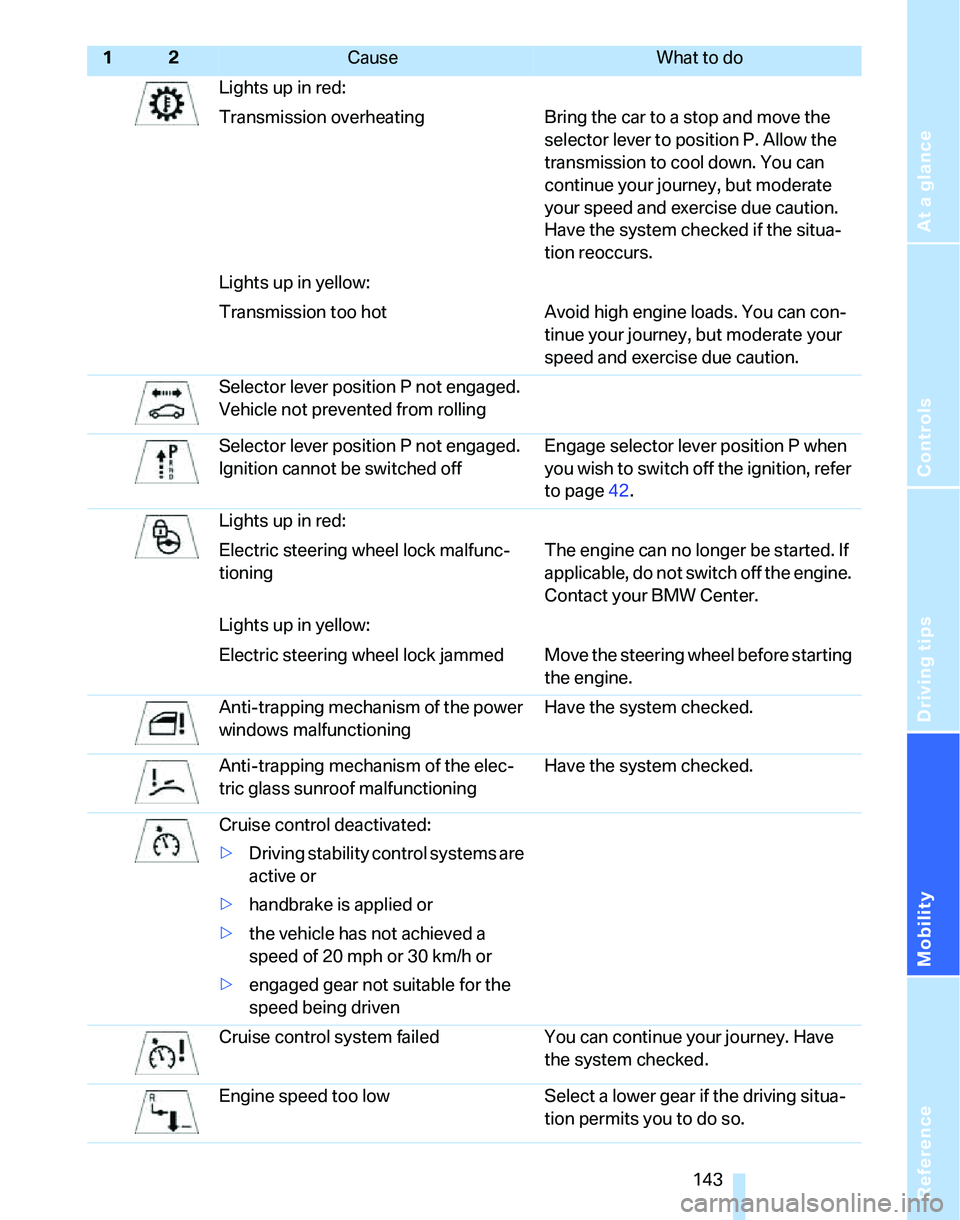
Reference
At a glance
Controls
Driving tips
Mobility
143
Lights up in red:
Transmission overheating Bring the car to a stop and move the
selector lever to position P. Allow the
transmission to cool down. You can
continue your journey, but moderate
your speed and exercise due caution.
Have the system checked if the situa-
tion reoccurs.
Lights up in yellow:
Transmission too hot Avoid high engine loads. You can con-
tinue your journey, but moderate your
speed and exercise due caution.
Selector lever position P not engaged.
Vehicle not prevented from rolling
Selector lever position P not engaged.
Ignition cannot be switched offEngage selector lever position P when
you wish to switch off the ignition, refer
to page42.
Lights up in red:
Electric steering wheel lock malfunc-
tioningThe engine can no longer be started. If
applicable, do not switch off the engine.
Contact your BMW Center.
Lights up in yellow:
Electric steering wheel lock jammed Move the steering wheel before starting
the engine.
Anti-trapping mechanism of the power
windows malfunctioningHave the system checked.
Anti-trapping mechanism of the elec-
tric glass sunroof malfunctioningHave the system checked.
Cruise control deactivated:
>Driving stability control systems are
active or
>handbrake is applied or
>the vehicle has not achieved a
speed of 20 mph or 30 km/h or
>engaged gear not suitable for the
speed being driven
Cruise control system failed You can continue your journey. Have
the system checked.
Engine speed too low Select a lower gear if the driving situa-
tion permits you to do so.
12Cause What to do
Page 152 of 166

Technical data
150
Weights
Never exceed either the approved axle loads or
the gross vehicle weight.
323i (Canada)325i325xi
Curb weight
>with manual transmission lbs/kg 3,274/1,485 3,285/1,490 3,560/1,615
>with automatic transmission lbs/kg 3,329/1,510 3,351/1,520 3,605/1,635
Approved gross weight
>with manual transmission lbs/kg 4,332/1,965 4,343/1,970 4,619/2,095
>with automatic transmission lbs/kg 4,387/1,990 4,409/2,000 4,663/2,115
Load lbs/kg 1,058/480 1,058/480 1,058/480
Approved front axle load lbs/kg 2,083/945 2,072/940 2,282/1,035
Approved rear axle load lbs/kg 2,403/1,090 2,425/1,100 2,480/1,125
Approved roof load capacity lbs/kg 165/75 165/75 165/75
Luggage compartment capacity cu ft/l 16.2/460 16.2/460 16.2/460
330i330xi
Curb weight
>with manual transmission lbs/kg 3,417/1,550 3,627/1,645
>with automatic transmission lbs/kg 3,450/1,565 3,671/1,665
Approved gross weight
>with manual transmission lbs/kg 4,475/2,030 4,685/2,125
> with automatic transmission lbs/kg 4,508/2,045 4,729/2,145
Load lbs/kg 1,058/480 1,058/480
Approved front axle load lbs/kg 2,138/970 2,315/1,050
Approved rear axle load lbs/kg 2,469/1,120 2,513/1,140
Approved roof load capacity lbs/kg 165/75 165/75
Luggage compartment capacity cu ft/l 16.2/460 16.2/460
Page 154 of 166

Everything from A to Z
152
Everything from A to Z
Index
A
ABS Antilock Brake
System68
ACC, refer to Active cruise
control53
Acceleration assistant with
the sequential manual
gearbox SMG47
Accessories, refer to The
individual vehicle5
Activated-charcoal filter for
automatic climate control85
Active cruise control53
– indicator lamps56
– malfunction57
– selecting distance55
– sensor56
Active steering73
– warning lamp73
Adapter for spare key18
Adaptive Head Light77
Additives
– coolant121
Adjusting temperature inside
the car, refer to Air
conditioner81
Adjusting temperature inside
the car, refer to Automatic
climate control83
Airbags74
– sitting safely31
– warning lamp75
Air conditioner80
Air conditioning mode
– air conditioner81
– automatic climate control83
– ventilation82,85
Air distribution
– automatic84
– individual81
– manual81
Air flow rate81,84Airing, refer to
Ventilation82,85
Air outlets, refer to Air
vents80
Air pressure, tires108
Air recirculation, refer to
Recirculated-air
mode81,84
Air supply
– air conditioner81
– automatic climate control83
– ventilation82,85
Air vents80
AKI, refer to Fuel
specifications
106
Alarm system24
– avoiding unintentional
alarms25
– interior motion sensor25
– switching off an alarm25
– tilt alarm sensor25
All-season tires, refer to
Winter tires117
Ambient air, refer to
Recirculated-air
mode81,84
Antifreeze
– coolant121
– washer fluid50
Anti-theft alarm system, refer
to Alarm system24
Anti-theft system19
Anti-trapping mechanism
– glass sunroof, electric29
– windows28
Approved axle loads, refer to
Weights150
Approved gross vehicle
weight, refer to Weights150
Armrest, refer to Center
armrest89Ashtray
– front91
– rear91
Assistance systems, refer to
Dynamic Stability Control
DSC68
AUC Automatic recirculated-
air control84
Audio device, external90
Automatic
– air distribution84
– air flow rate84
– cruise control51,53
– headlamp control76
Automatic climate control80
– automatic air distribution84
Automatic curb monitor37
Automatic recirculated-air
control AUC84
Automatic transmission with
Steptronic47
– interlock47
– overriding selector lever
lock48
– shiftlock47
– sport program48
AUTO program for automatic
climate control84
AUX-IN
– port90
Average fuel consumption60
– setting the units62
Average speed60
Avoiding unintentional
alarms25
Axle loads, refer to
Weights150
B
Backrests, refer to Seats31
Backrest width adjustment33