Page 210 of 416
7-37
With the engine idling, return the starter (choke) to
the closed position and shift the drive select lever
into the forward position, then release the parking
brake. Apply the throttle slowly and smoothly. The
centrifugal clutch will engage and you will start to
accelerate. If the throttle is applied too abruptly,
the front wheels may lift off the ground resulting in
a loss of directional control. Avoid higher speeds
until you are thoroughly familiar with the operation
of your ATV.
When slowing down or stopping, release the throt-
tle and apply the brakes smoothly and evenly. Im-
proper use of the brakes can cause the tires to
lose traction, reducing control and increasing the
possibility of an accident.
U5VH61.book Page 37 Friday, May 2, 2003 2:19 PM
Page 226 of 416
7-53
WARNING
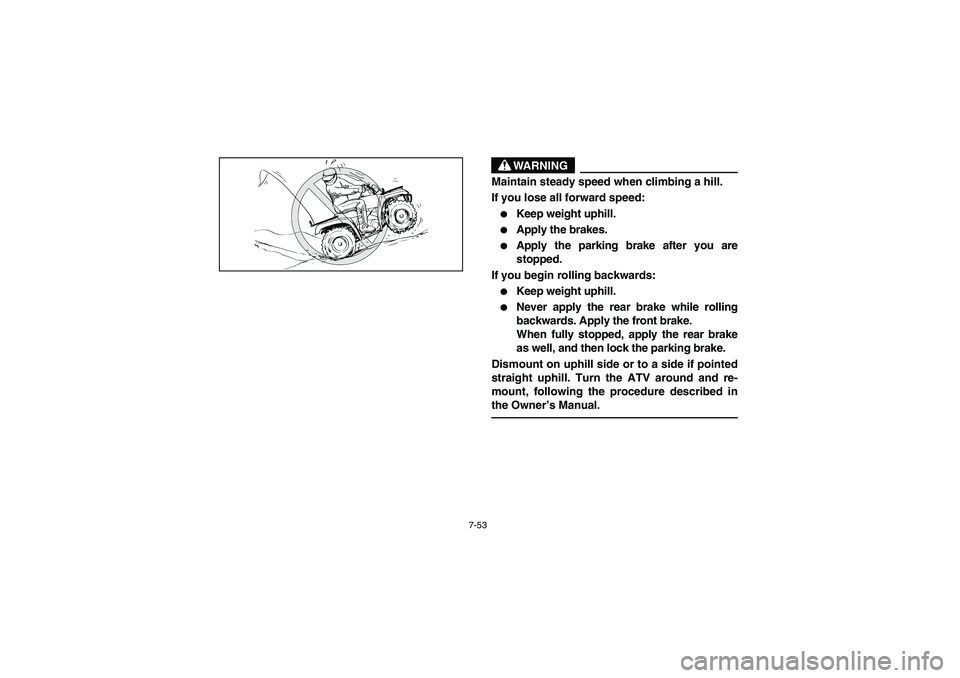
_ Maintain steady speed when climbing a hill.
If you lose all forward speed: �
Keep weight uphill.
�
Apply the brakes.
�
Apply the parking brake after you are
stopped.
If you begin rolling backwards:
�
Keep weight uphill.
�
Never apply the rear brake while rolling
backwards. Apply the front brake.
When fully stopped, apply the rear brake
as well, and then lock the parking brake.
Dismount on uphill side or to a side if pointed
straight uphill. Turn the ATV around and re-
mount, following the procedure described in
the Owner’s Manual.
_
U5VH61.book Page 53 Friday, May 2, 2003 2:19 PM
Page 236 of 416
7-63
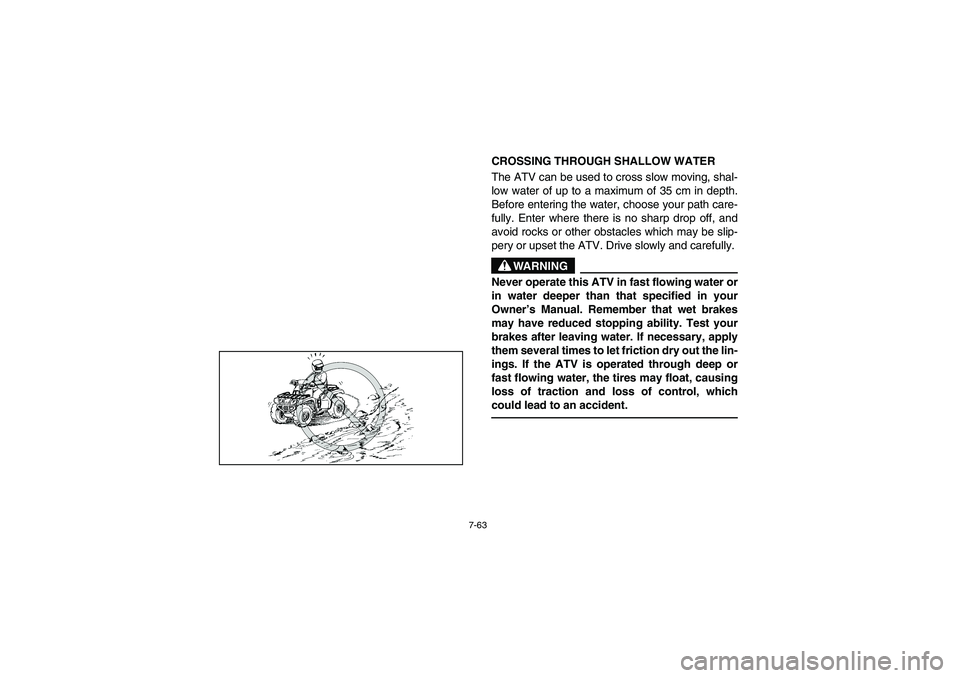
CROSSING THROUGH SHALLOW WATER
The ATV can be used to cross slow moving, shal-
low water of up to a maximum of 35 cm in depth.
Before entering the water, choose your path care-
fully. Enter where there is no sharp drop off, and
avoid rocks or other obstacles which may be slip-
pery or upset the ATV. Drive slowly and carefully.
WARNING
_ Never operate this ATV in fast flowing water or
in water deeper than that specified in your
Owner’s Manual. Remember that wet brakes
may have reduced stopping ability. Test your
brakes after leaving water. If necessary, apply
them several times to let friction dry out the lin-
ings. If the ATV is operated through deep or
fast flowing water, the tires may float, causing
loss of traction and loss of control, which
could lead to an accident. _
U5VH61.book Page 63 Friday, May 2, 2003 2:19 PM
Page 238 of 416
7-65
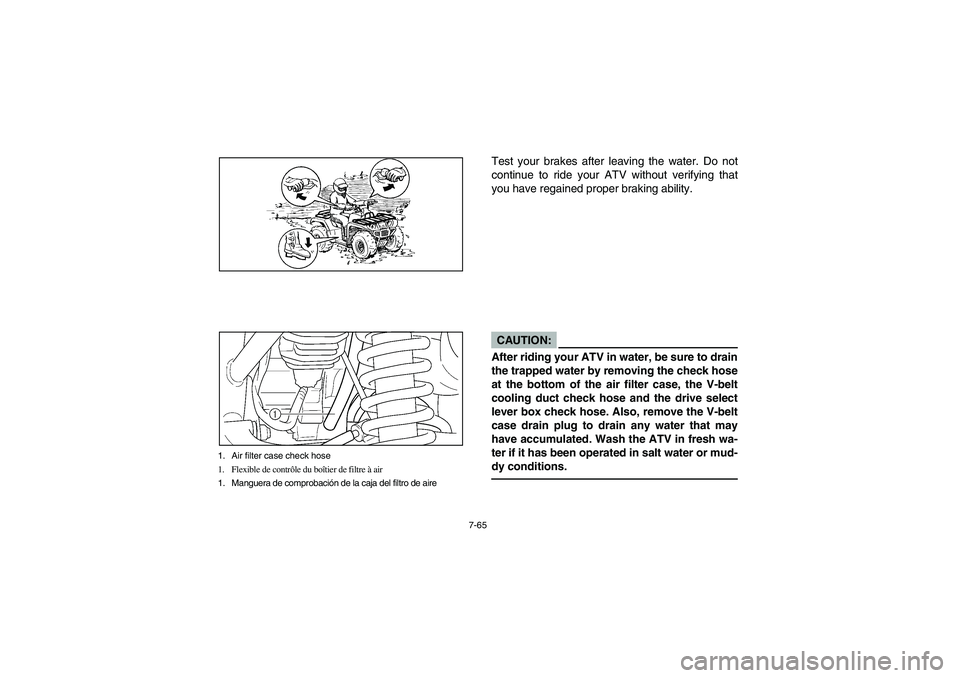
1. Air filter case check hose
1. Flexible de contrôle du boîtier de filtre à air
1. Manguera de comprobación de la caja del filtro de aire
Test your brakes after leaving the water. Do not
continue to ride your ATV without verifying that
you have regained proper braking ability.CAUTION:_ After riding your ATV in water, be sure to drain
the trapped water by removing the check hose
at the bottom of the air filter case, the V-belt
cooling duct check hose and the drive select
lever box check hose. Also, remove the V-belt
case drain plug to drain any water that may
have accumulated. Wash the ATV in fresh wa-
ter if it has been operated in salt water or mud-
dy conditions. _
U5VH61.book Page 65 Friday, May 2, 2003 2:19 PM
Page 244 of 416
7-71
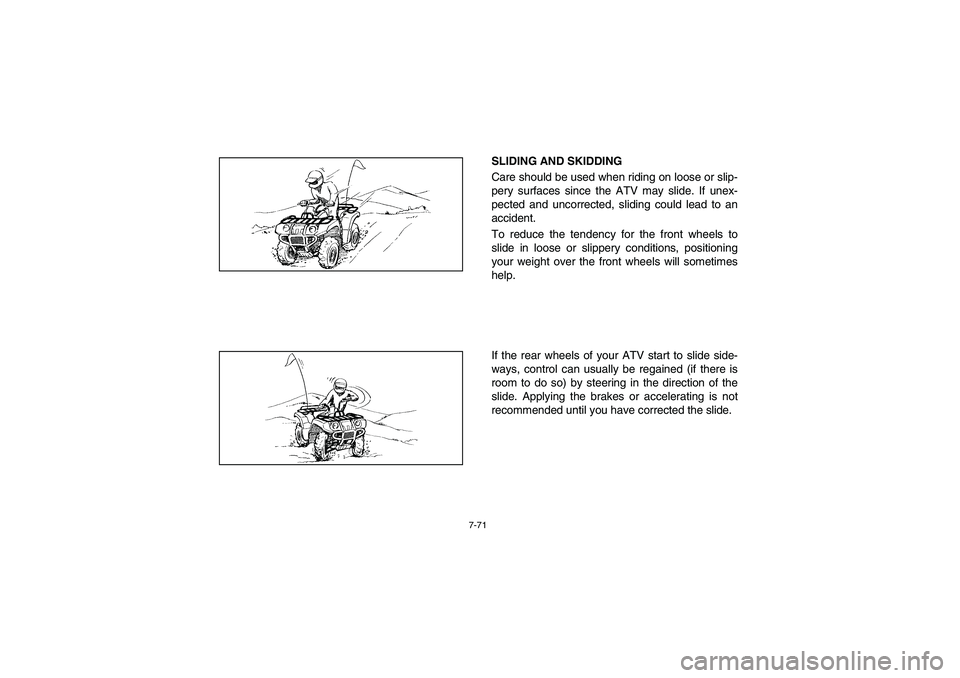
SLIDING AND SKIDDING
Care should be used when riding on loose or slip-
pery surfaces since the ATV may slide. If unex-
pected and uncorrected, sliding could lead to an
accident.
To reduce the tendency for the front wheels to
slide in loose or slippery conditions, positioning
your weight over the front wheels will sometimes
help.
If the rear wheels of your ATV start to slide side-
ways, control can usually be regained (if there is
room to do so) by steering in the direction of the
slide. Applying the brakes or accelerating is not
recommended until you have corrected the slide.
U5VH61.book Page 71 Friday, May 2, 2003 2:19 PM
Page 248 of 416
7-75
WHAT TO DO IF ...
This section is designed to be a reference guide
only. Be sure to read each section on riding tech-
niques completely.
WHAT TO DO ...�
If your ATV doesn’t turn when you want it to:
Bring the ATV to a stop and practice the turning
maneuvers again. Be sure you are putting your
weight on the footboard to the outside of the
turn. Position your weight over the front wheels
for better control. (See pages 7-39–7-43.)
�
If your ATV begins to tip while turning:
Lean more into the turn to regain balance. If
necessary, gradually let off the throttle and/or
steer to the outside of the turn. (See pages
7-39–7-43.)
�
If your ATV starts to slide sideways:
Steer in the direction of the slide if you have the
room. Applying the brakes or accelerating is
not recommended until you have corrected the
slide. (See pages 7-71–7-73.)
U5VH61.book Page 75 Friday, May 2, 2003 2:19 PM
Page 252 of 416
7-79�
If your ATV encounters shallow water:
Ride slowly and carefully through slow moving
water, watching for obstacles. Be sure to let
water drain from the ATV and CHECK YOUR
BRAKES FOR PROPER OPERATION when
you come out of the water. Do not continue to
ride your ATV until you have regained ade-
quate braking ability. (See pages 7-63–7-67.)
U5VH61.book Page 79 Friday, May 2, 2003 2:19 PM
Page 336 of 416
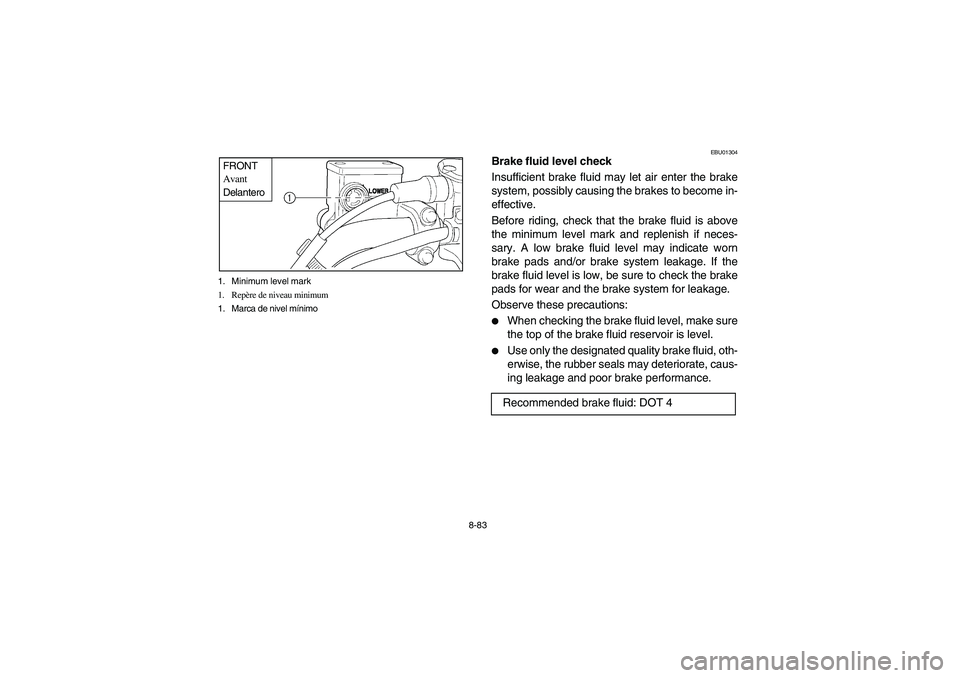
8-83 1. Minimum level mark
1. Repère de niveau minimum
1. Marca de nivel mínimo
FRONT
Avant
Delantero
EBU01304
Brake fluid level check
Insufficient brake fluid may let air enter the brake
system, possibly causing the brakes to become in-
effective.
Before riding, check that the brake fluid is above
the minimum level mark and replenish if neces-
sary. A low brake fluid level may indicate worn
brake pads and/or brake system leakage. If the
brake fluid level is low, be sure to check the brake
pads for wear and the brake system for leakage.
Observe these precautions:�
When checking the brake fluid level, make sure
the top of the brake fluid reservoir is level.
�
Use only the designated quality brake fluid, oth-
erwise, the rubber seals may deteriorate, caus-
ing leakage and poor brake performance.
Recommended brake fluid: DOT 4
U5VH61.book Page 83 Friday, May 2, 2003 2:19 PM