2004 VOLVO XC90 air condition
[x] Cancel search: air conditionPage 99 of 245
: Press this button when approaching the car at night to light up the
interior courtesy light, parking lights, license plate lights and the li\
ghts in th")
2004 VOLVO XC90
Button 3 (Approach lighting): Press this button when approaching the car at night to light up the
interior courtesy light, parking lights, license plate lights and the li\
ghts in the sideview mirrors.
Button 4 (Panic): See
page 78 for more information on this function.
Button 5 (Tailgate unlock): Press this button twice within 3 seconds to unlock the tailgate (witho\
ut
unlocking the other doors).
Button 6 (Unlock): Press this button once to unlock the driver's door only. Wait for at le\
ast 1 second
and press the button again (within 10 seconds) to unlock all doors, an\
d the tailgate.
NOTE:
l Airbag deployment will automatically unlock the doors.
l The keys may also be used to lock and unlock the doors, and to activate \
and deactivate the alarm
system.
l To avoid leaving your keys in the vehicle, make a habit of always lockin\
g the vehicle with the remote
control.
Automatic re-locking If the doors are unlocked, the locks will automatically reengage (re-l\
ock) and the
alarm will rearm after 2 minutes unless a door or the tailgate has been \
opened.
pg. 74 Locks and Alarms
l FCC ID:LQNP2T-APU This device complies with part 15 of the FCC rules. Op\
eration is subject to
the following conditions: (1) This device may not cause harmful interf\
erence, and (2) this device must
accept any interference received, including interference that may cause \
undesired operation.
l Canadian 2306104388 Model 504 2927 by Donnelly Operation is subject to t\
he following conditions:
(1) this device may not cause interference, and (2) this device must\
accept any interference, including
interference that may cause undesired operation of the device.
l Canadian 2306104388A Model 509 977 by Connaught Electronics Operation is\
subject to the
following conditions: (1) this device may not cause interference, and \
(2) this device must accept any
interference, including interference that may cause undesired operation \
of the device.
file:///K|/ownersdocs/2004/2004_XC90/04xc90_05.htm (5 of 12)12/30/2006\
4:35:20 PM
Page 114 of 245

2004 VOLVO XC90
Turn the steering wheel slightly to free the ignition key.
In order to help reduce vehicle theft, make sure the steering wheel lock\
is engaged before leaving
the vehicle.
WARNING!
Never switch off the ignition (turn the ignition key to position 0) or\
remove the key from the ignition
switch while the vehicle is in motion. This could cause the steering whe\
el to lock, which would make
the vehicle impossible to steer.
* The gear selector must be in the (P)ark position (automatic transmission).
** Please be aware that leaving the key in this position will increase b\
attery drain.
pg. 87 Starting and driving
General information
Economical driving conserves natural resources
Better driving economy may be obtained by thinking ahead, avoiding rapid\
starts and stops and
adjusting the speed of your vehicle to immediate traffic conditions. Obs\
erve the following rules:
l Bring the engine to normal operating temperature as soon as possible by \
driving with a light foot on
the accelerator pedal for the first few minutes of operation. A cold eng\
ine uses more fuel and is subject
to increased wear.
l Whenever possible, avoid using the vehicle for driving short distances. \
This does not allow the engine
to reach normal operating temperature.
l Drive carefully and avoid rapid acceleration and hard braking.
l Use the transmission's (D)rive position as often as possible and avoid using "kickdown" to help
improve fuel economy.
l Do not exceed posted speed limits.
l Avoid carrying unnecessary items (extra load) in the vehicle.
l Maintain correct tire pressure. Check tire pressure regularly (when tir\
es are cold).
l Remove snow tires when threat of snow or ice has ended.
l Note that roof racks, ski racks, etc, increase air resistance and also f\
uel consumption.
l At highway driving speeds, fuel consumption will be lower with the air c\
onditioning on and the
windows closed than with the air conditioning off and the windows open. \
l Using the onboard trip computer's fuel consumption modes can help you le\
arn how to drive more
economically.
Other factors that decrease gas mileage are:
file:///K|/ownersdocs/2004/2004_XC90/04xc90_06a.htm (8 of 15)12/30/200\
6 4:35:22 PM
Page 132 of 245

2004 VOLVO XC90
WARNING!
- Do not connect the jumper cable to any part of the fuel system or to a\
ny moving parts. Avoid
touching hot manifolds.
Never expose the battery to open flame or electric spark.
- Do not smoke near the battery.
- Batteries generate hydrogen gas, which is flammable and explosive.
- Battery fluid contains sulphuric acid. Do not allow battery fluid to c\
ontact eyes, skin, fabrics or
painted surfaces. If contact occurs, flush the affected area immediately\
with water. Obtain medical
help immediately if eyes are affected.
- Failure to follow the instructions for jump starting can lead to perso\
nal injury.
pg. 101 Starting and driving
Towing a trailer
Volvo recommends the use of Volvo trailer hitches that are specially des\
igned for the vehicle.
l Maximum trailer weights recommended by Volvo are:
All models - trailers without brakes: 1,650 lbs (750 kg)
Models with all wheel drive - trailers with brakes: 4,960 lbs (2250 kg)\
Models with front wheel drive - trailers with brakes: 3,970 lbs (1800 k\
g)
Observe the legal requirements of the state/province in which the vehicl\
es are registered.
l All Volvo models are equipped with energy-absorbing shock-mounted bumper\
s. Trailer hitch
installation should not interfere with the proper operation of this bump\
er system.
Trailer towing does not normally present any particular problems, but ta\
ke into consideration:
l Increase tire pressure to recommended full. See section "Wheels and tire\
s."
l When your vehicle is new, avoid towing heavy trailers during the first 6\
20 miles (1,000 km).
l Recommended hitch tongue load is: Trailer weights below 2,650 lbs (1,200 kg) - 110 lbs (50 kg)
Trailer weights above 2,650 lbs (1,200 kg) - 198 lbs (90 kg)
l Maximum speed when towing a trailer: 50 mph (80 km/h).
l Engine and transmission are subject to increased loads. Therefore, engin\
e coolant temperature should
be closely watched when driving in hot climates or hilly terrain. Use a \
lower gear and turn off the air
conditioner if the temperature gauge needle enters the red range.
l If the automatic transmission begins to overheat, a message will be disp\
layed in the text window.
l Avoid overload and other abusive operation.
file:///K|/ownersdocs/2004/2004_XC90/04xc90_06b.htm (11 of 17)12/30/20\
06 4:35:23 PM
Page 157 of 245
2004 VOLVO XC90
2 0 0 4
VOLVO XC90
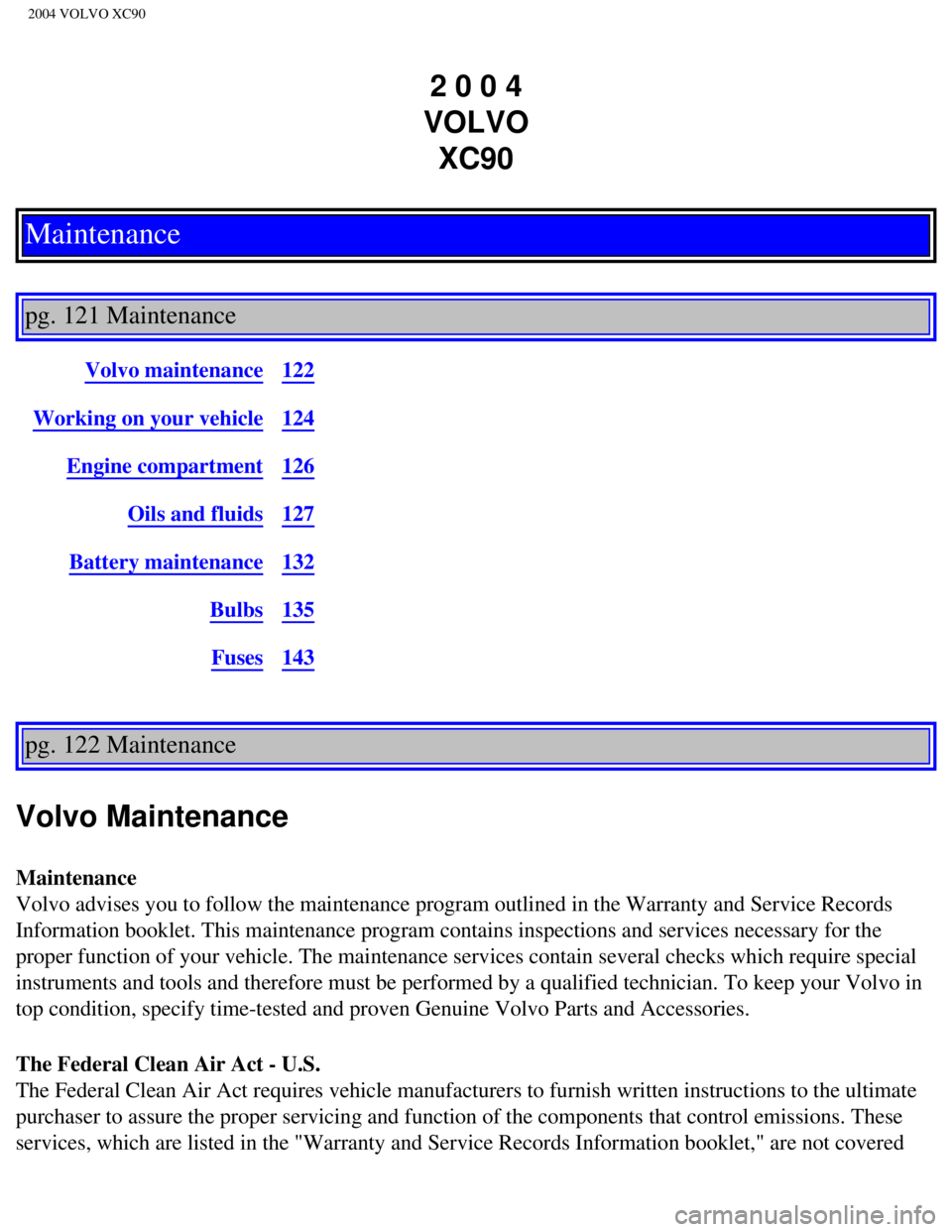
Maintenance
pg. 121 Maintenance
Volvo maintenance122
Working on your vehicle124
Engine compartment126
Oils and fluids127
Battery maintenance132
Bulbs135
Fuses143
pg. 122 Maintenance
Volvo Maintenance
Maintenance
Volvo advises you to follow the maintenance program outlined in the Warr\
anty and Service Records
Information booklet. This maintenance program contains inspections and s\
ervices necessary for the
proper function of your vehicle. The maintenance services contain severa\
l checks which require special
instruments and tools and therefore must be performed by a qualified tec\
hnician. To keep your Volvo in
top condition, specify time-tested and proven Genuine Volvo Parts and Ac\
cessories.
The Federal Clean Air Act - U.S.
The Federal Clean Air Act requires vehicle manufacturers to furnish writ\
ten instructions to the ultimate
purchaser to assure the proper servicing and function of the components \
that control emissions. These
services, which are listed in the "Warranty and Service Records Informat\
ion booklet," are not covered
file:///K|/ownersdocs/2004/2004_XC90/04xc90_09a.htm (1 of 14)12/30/200\
6 4:35:26 PM
Page 159 of 245
 of vehicle maintenance. The schedule includes components \
that affect v")
2004 VOLVO XC90
Information booklet provides a comprehensive periodic maintenance schedu\
le up to 150,000 miles
(240,000 km) of vehicle maintenance. The schedule includes components \
that affect vehicle emissions.
This page describes some of the emission-related components.
Engine air filter
The engine air filter cleans particles from air entering the engine. Rep\
lace the engine air filter cartridge
with a new one every 37,500 miles (60,000 km) under normal driving con\
ditions. Replace the cartridge
more often when the vehicle is driven under dirty and dusty conditions. \
The cartridge cannot be cleaned,
and should always be replaced with a new one.
Fuel filter
The fuel filter should be replaced at 120,000 miles (193,000 km). The \
filter is replaced as a complete
unit. Replace more frequently if contaminated fuel is introduced into th\
e tank, or if there is reason to
suspect that this has occurred.
Fuel system, including filler cap, tank, lines, and connections
The ability of the fuel system to contain hydrocarbons depends upon a le\
ak-free system. Inspect fuel
lines every 30,000 miles (48,000 km). Check for proper sealing of the \
fuel filler cap, which contains "O"
ring seals.
NOTE: If the fuel filler cap is not closed tightly or if the engine is running\
when the vehicle is refueled,
the Check Engine light (Malfunction Indicator) may indicate a fault. H\
owever, your vehicle's
performance will not be affected. Use only Volvo original or approved fu\
el filler caps.
Timing belt
For proper functioning of the engine and emission control systems, the t\
iming belt and belt pretensioner
must be replaced every 120,000 miles (193,000 km). Engine damage will \
occur if the belt fails.
PCV system
(on turbocharged models)
The nipple in the intake manifold and the filter at the end of the PCV h\
ose in the air cleaner should be
inspected and cleaned at 120,000 miles (193,000 km), and again at 150,\
000 miles (240,000 km).
Spark plugs
The spark plugs should be replaced every 60,000 miles (96,000 km) unde\
r normal driving conditions.
City driving or fast highway driving may necessitate replacement sooner.\
Under normal driving conditions, spark plugs require no maintenance betw\
een replacement intervals.
When installing new plugs, be sure to use the right type and to tighten \
them correctly. When changing
the plugs, clean the terminals and rubber seals. Also check that the sup\
pressor connectors are in good
condition. Cracked or damaged connectors should be replaced.
file:///K|/ownersdocs/2004/2004_XC90/04xc90_09a.htm (3 of 14)12/30/200\
6 4:35:26 PM
Page 161 of 245

2004 VOLVO XC90
WARNING!
The ignition system has very high voltage! The voltage in the ignition s\
ystem is dangerous!
Do not touch spark plugs, ignition cables or the ignition coil when the \
engine is running or the
ignition is switched on!
The ignition should be switched off when:
- Conducting engine tests.
- Replacing parts in the ignition system, such as spark plugs, ignition \
coil, distributor, ignition cables,
etc.
- Never try to repair any part of the SRS/SIPS/WHIPS/IC systems yourself\
. Any interference in the
system could cause malfunction and serious injury. Any work should only \
be performed by an
authorized Volvo workshop.
pg. 125 Maintenance
Belt check
Check the belt regularly to make sure it is in good condition and is cle\
an. A worn or dirty belt can cause
poor cooling and low alternator output as well as impair the operation o\
f the power steering and the air
conditioning unit.
NOTE: The drive belt is equipped with a self-tensioning mechanism and requires\
no adjustment
between changes.
WARNING!
The engine must not be running when this check is
performed.
Check coolant level
The cooling system must be filled with coolant and not leak to operate a\
t maximum efficiency. Check
the coolant level regularly. The level should be between the "MAX" and "\
MIN" marks on the expansion
tank. The check should be made with particular thoroughness when the eng\
ine is new or when the
cooling system has been drained.
Do not remove the filler cap other than for topping up with coolant. Fre\
quent removal may prevent
coolant circulation between the engine and the expansion tank during eng\
ine warm up and cooling.
Changing coolant
file:///K|/ownersdocs/2004/2004_XC90/04xc90_09a.htm (5 of 14)12/30/200\
6 4:35:26 PM
Page 199 of 245
2004 VOLVO XC90
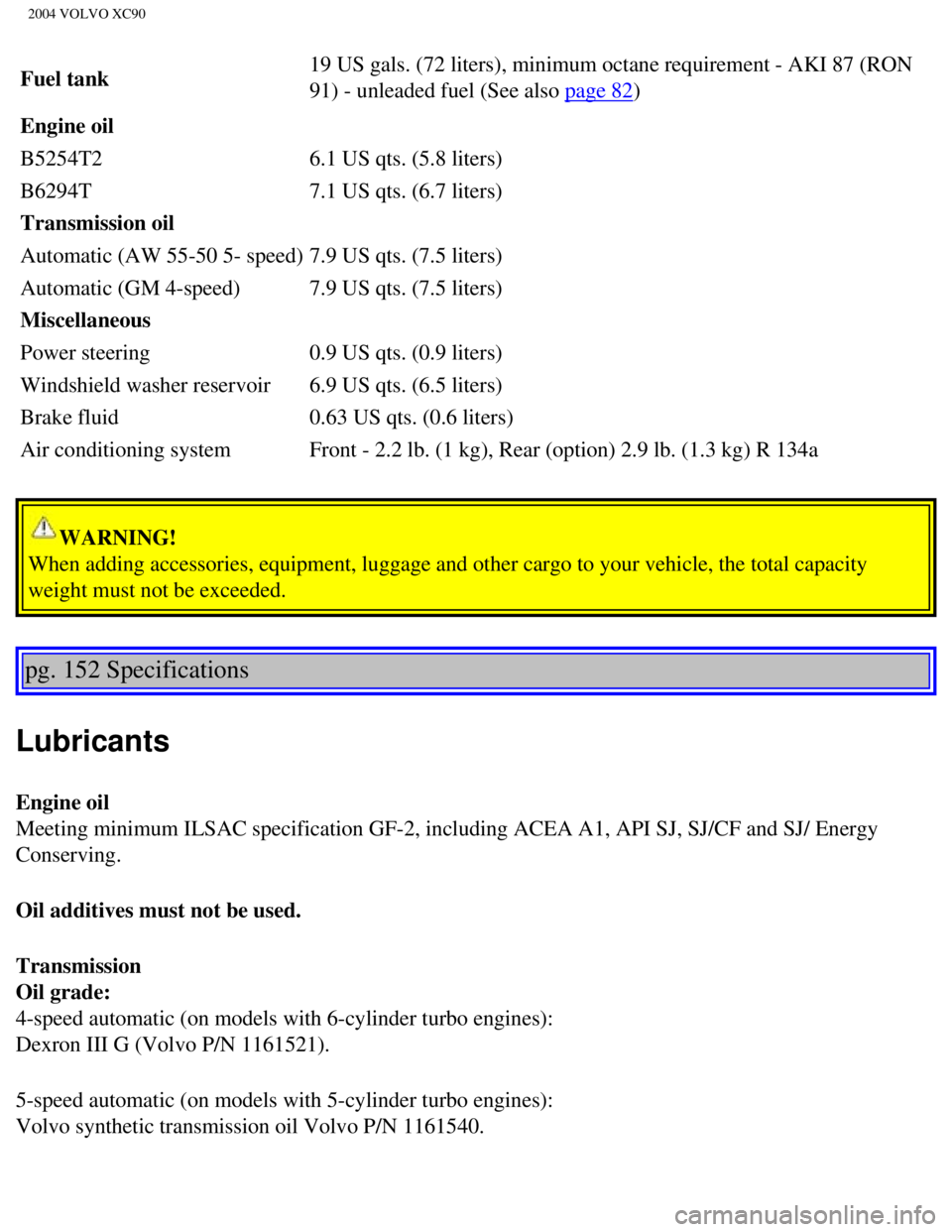
Fuel tank 19 US gals. (72 liters), minimum octane requirement - AKI 87 (RON
91) - unleaded fuel (See also page 82)
Engine oil
B5254T2 6.1 US qts. (5.8 liters)
B6294T 7.1 US qts. (6.7 liters)
Transmission oil
Automatic (AW 55-50 5- speed) 7.9 US qts. (7.5 liters)
Automatic (GM 4-speed) 7.9 US qts. (7.5 liters)
Miscellaneous
Power steering 0.9 US qts. (0.9 liters)
Windshield washer reservoir 6.9 US qts. (6.5 liters)
Brake fluid 0.63 US qts. (0.6 liters)
Air conditioning system Front - 2.2 lb. (1 kg), Rear (option) 2.9 lb. (1.3 kg) R 134a
WARNING!
When adding accessories, equipment, luggage and other cargo to your vehi\
cle, the total capacity
weight must not be exceeded.
pg. 152 Specifications
Lubricants
Engine oil
Meeting minimum ILSAC specification GF-2, including ACEA A1, API SJ, SJ/\
CF and SJ/ Energy
Conserving.
Oil additives must not be used.
Transmission
Oil grade:
4-speed automatic (on models with 6-cylinder turbo engines):
Dexron III G (Volvo P/N 1161521).
5-speed automatic (on models with 5-cylinder turbo engines):
Volvo synthetic transmission oil Volvo P/N 1161540.
file:///K|/ownersdocs/2004/2004_XC90/04xc90_10.htm (6 of 11)12/30/2006\
4:35:29 PM
Page 233 of 245
2004 VOLVO XC90
2 0 0 4
VOLVO XC90
Index
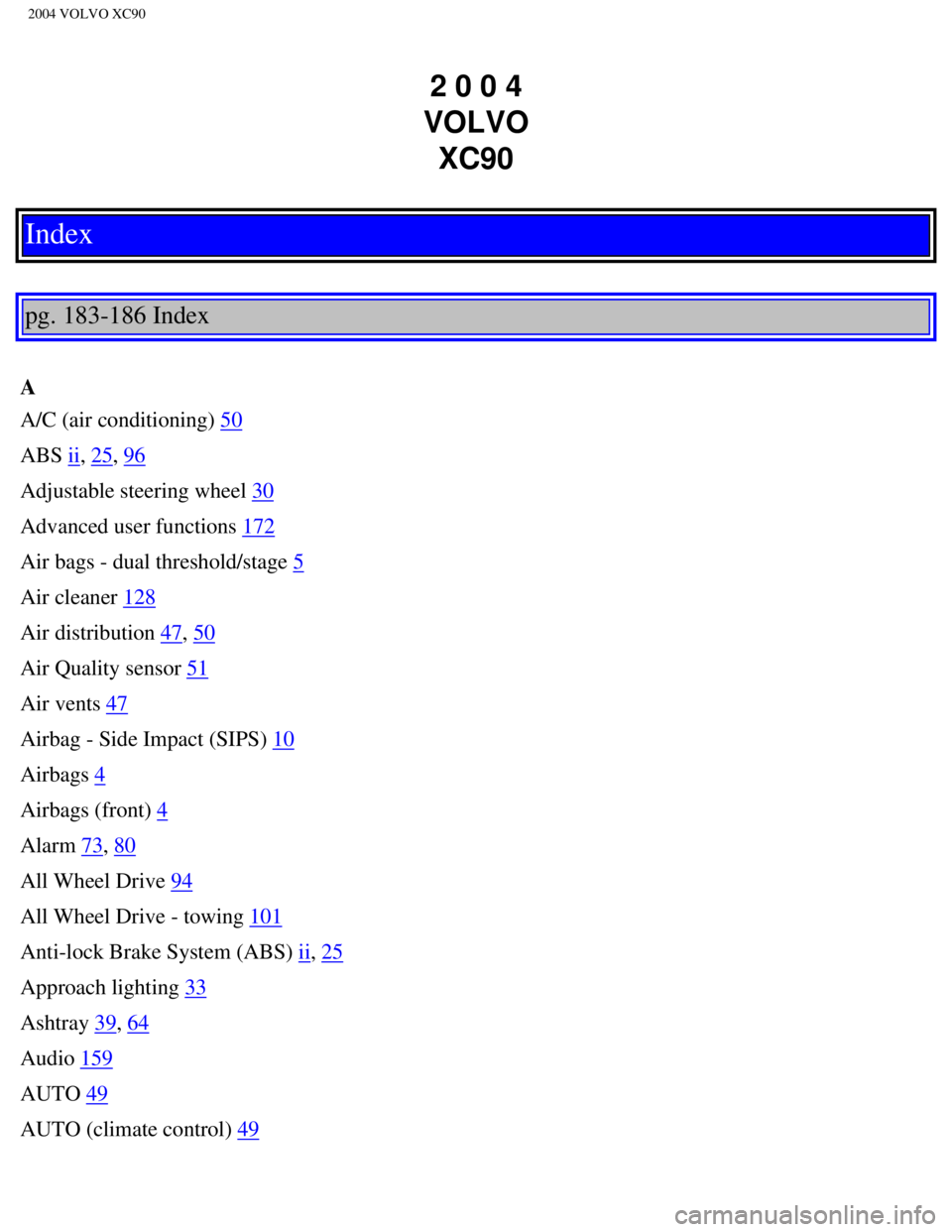
pg. 183-186 Index
A
A/C (air conditioning)
50
ABS
ii, 25, 96
Adjustable steering wheel
30
Advanced user functions
172
Air bags - dual threshold/stage
5
Air cleaner
128
Air distribution
47, 50
Air Quality sensor
51
Air vents
47
Airbag - Side Impact (SIPS)
10
Airbags
4
Airbags (front)
4
Alarm
73, 80
All Wheel Drive
94
All Wheel Drive - towing
101
Anti-lock Brake System (ABS)
ii, 25
Approach lighting
33
Ashtray
39, 64
Audio
159
AUTO
49
AUTO (climate control)
49
file:///K|/ownersdocs/2004/2004_XC90/04xc90_12.htm (1 of 13)12/30/2006\
4:35:33 PM