2004 VOLVO S60 automatic transmission
[x] Cancel search: automatic transmissionPage 57 of 113

Be careful to avoid inadvertently engaging reverse while moving forward.
pg. 86 Starting and driving
Automatic transmission (option)
Automatic transmission AW55- 50 (option)
P Park
Use this position when starting the engine or parking the car.
Never use P while the car is in motion.
The parking brake should be set whenever the car is parked.
The gear selector is mechanically locked in the P position (SHIFTLOCK). To release the gear selector from this
position, the engine must be running (or the ignition key must be in position II) and the brake pedal must be
depressed.
WARNING!
Never leave the car unattended when the engine is running. If, by mistake, the gear selector is moved from P , the car
may start moving.
R (Reverse)
Never engage R while the car is moving forward.
N (Neutral)
Neutral - no gear engaged. Use the parking brake.
D (Drive)
D is the normal driving position and should be used as often as possible to help improve fuel economy. The car should
not be moving when shifting from R to the D position.
4 (Intermediate gear)
The transmission will shift automatically between gears 4, 3, 2 or 1 from this position. The transmission cannot shift up
to ( D)rive from fourth gear.
3 (Intermediate gear)
The transmission will shift automatically between gears 3, 2 and 1 from this position. The transmission cannot shift up
to fourth gear or ( D)rive from third gear.
L (Low gears)
The transmission is locked in gears 1 and 2 when the selector is in this position.
ProCarManuals.com
Page 58 of 113

NOTE: Gears 4, 3, or L can be used if you are driving in a mountainous area, towing a trailer or to increase engine
braking effect.
The transmission has a built-in limiter designed to help prevent excessive engine speeds (high rpm) when gears 4, 3 or
L are selected.
pg. 87 Starting and driving
Automatic transmission (option) (contd)
W - Winter/Wet driving mode - enhanced vehicle traction
Mode W will only function if the gear selector is in the ( D)rive position.
Press the button at the base of the gear selector to engage/disengage this driving mode (see illustration).
When the W driving mode is engaged, this is displayed in the instrument panel (see page 22).
This mode may be selected for starting/moving off on slippery roads.
NOTE: R-models are not equipped with this button.
Automatic transmission AW55- 50 - shift gate positions
The gear selector can be moved freely between N and D.
Depressing the button on the front of the gear selector knob enables you to move the gear selector to positions P, R, N,
D, 4, 3 and L.
"Kickdown"
Automatic shift to a lower gear (kickdown) is achieved by depressing the accelerator pedal fully and briskly. An
upshift will occur when approaching the top speed for a particular gear or by releasing the accelerator pedal slightly.
Kickdown can be used for maximum acceleration or when passing at highway speeds.
Automatic transmission - adaptive system
ProCarManuals.com
Page 59 of 113

The automatic transmission is controlled by an adaptive control system that constantly monitors the way in which the
transmission functions. It senses and adapts each gear shift for optimal performance. The system also monitors your
particular driving style and adapts gear shifting accordingly.
Cold starts
When driving before the engine has reached its normal operating temperature, the transmission will shift up at a
slightly higher engine speeds to heat the three-way catalytic converter as quickly as possible.
pg. 88 Starting and driving
Geartronic (option)
P Park
Use this position when starting the engine or parking the car.
Never use P while the car is in motion.
The parking brake should also be set whenever the car is parked.
The gear selector is mechanically locked in the P position (SHIFTLOCK). To release the gear selector from this
position, the engine must be running (or the ignition key must be in position II) and the brake pedal must be
depressed.
WARNING!
Never leave the car unattended when the engine is running. If, by mistake, the gear selector is moved from P, the car
may start moving.
R (Reverse)
Never engage R while the car is moving forward.
N (Neutral)
Neutral - no gear engaged. Use the parking brake.
D (Drive)
D is the normal driving position and should be used as often as possible to help improve fuel economy. The car should
not be moving when shifting from R to the D position.
Automatic transmission - adaptive system
The automatic transmission is controlled by an adaptive control system that constantly monitors the way in which the
transmission functions. It senses and adapts each gear shift for optimal performance. The system also monitors your
ProCarManuals.com
Page 60 of 113

particular driving style and adapts gear shifting accordingly.
Automatic transmission - shift gate positions
You can move the gear selector freely between the (MAN)ual and ( D)rive positions while driving.
Depress the button on the front of the gear selector knob to move between the R, N, D, and P positions.
pg. 89 Starting and driving
Geartronic (option) (contd)
Manual shifting - Geartronic
You can move the gear selector freely between the ( MAN)ual and ( D)rive positions while driving. Gears 3, and 4
have a "lock -up" function which reduces engine speed and helps save fuel.
The currently selected gear will be displayed in the instrument panel (see page 22
).
To access the ( MAN)ual shifting position from ( D)rive, move the gear selector to the left to MAN .
To return to the (D)rive position from MAN , move the gear selector to the right.
While driving
If you select the ( MAN)ual position while driving, the gear that was being used in the ( D)rive position will also
initially be selected in ( MAN)ual position.
Move the gear selector forward (toward "+") to shift to a higher gear or rearward (toward "-") to shift to a lower
gear.
If you hold the gear selector toward "-", the transmission will downshift one gear and will utilize the braking power
of the engine. If the current speed is too high for using a lower gear, the downshift will not occur until the speed has
decreased enough to allow the lower gear to be used.
If you slow down to a very low speed, the transmission will automatically shift down.
When starting in the ( MAN)ual position, 3rd gear is the highest gear that may be selected.
NOTE: Kickdown does not function when the transmission is in the manual shift (Geartronic) mode.The gear selector
must be in the D(Drive) position.
Kickdown
Automatic shift to a lower gear (kickdown) is achieved by depressing the accelerator pedal fully and briskly. An
upshift will occur when approaching the top speed for a particular gear or by releasing the accelerator pedal slightly.
Kickdown can be used for maximum acceleration or when passing at highway speeds.
Kickdown does not function when the transmission is in the manual shift (Geartronic) mode.
ProCarManuals.com
Page 61 of 113
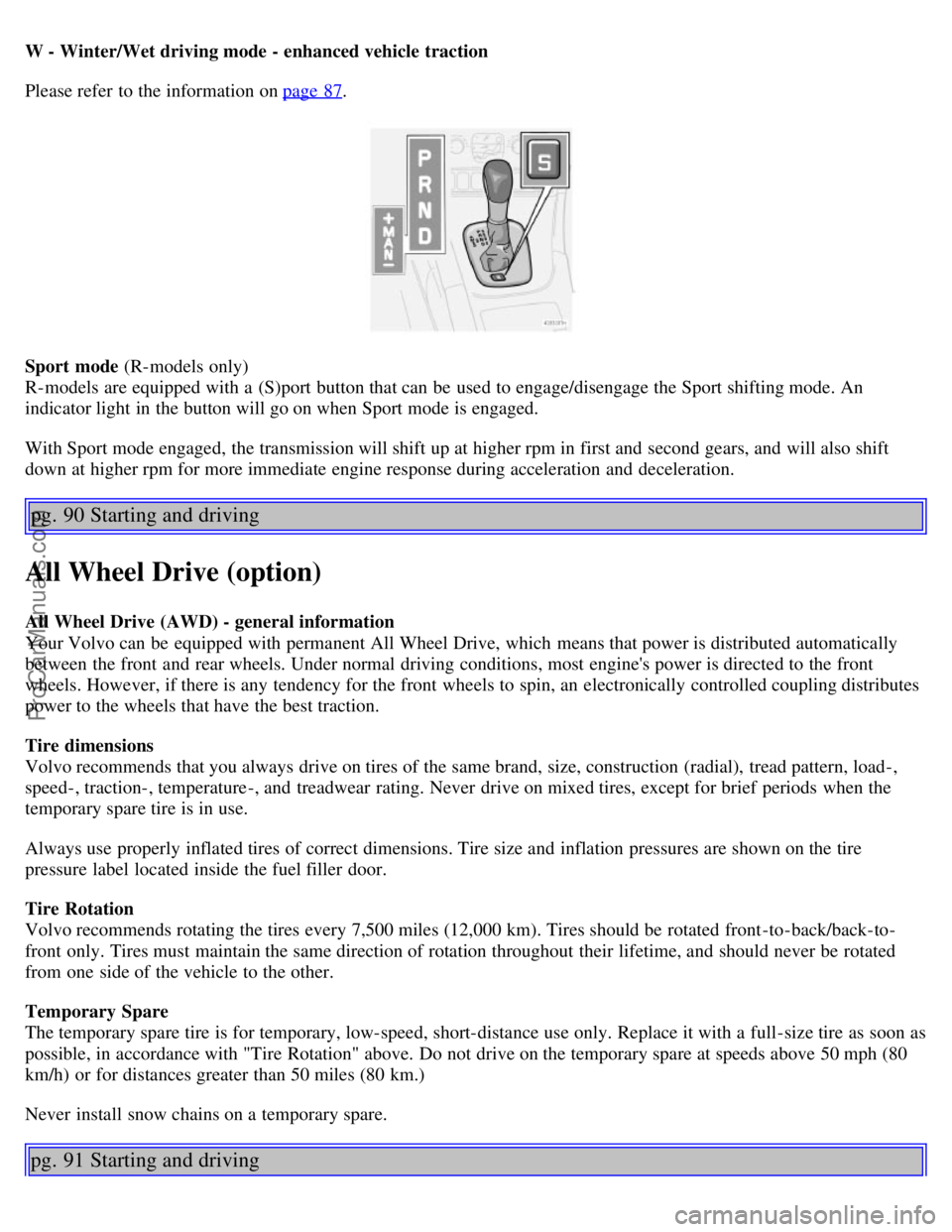
W - Winter/Wet driving mode - enhanced vehicle traction
Please refer to the information on page 87.
Sport mode (R-models only)
R-models are equipped with a (S)port button that can be used to engage/disengage the Sport shifting mode. An
indicator light in the button will go on when Sport mode is engaged.
With Sport mode engaged, the transmission will shift up at higher rpm in first and second gears, and will also shift
down at higher rpm for more immediate engine response during acceleration and deceleration.
pg. 90 Starting and driving
All Wheel Drive (option)
All Wheel Drive (AWD) - general information
Your Volvo can be equipped with permanent All Wheel Drive, which means that power is distributed automatically
between the front and rear wheels. Under normal driving conditions, most engine's power is directed to the front
wheels. However, if there is any tendency for the front wheels to spin, an electronically controlled coupling distributes
power to the wheels that have the best traction.
Tire dimensions
Volvo recommends that you always drive on tires of the same brand, size, construction (radial), tread pattern, load-,
speed-, traction-, temperature-, and treadwear rating. Never drive on mixed tires, except for brief periods when the
temporary spare tire is in use.
Always use properly inflated tires of correct dimensions. Tire size and inflation pressures are shown on the tire
pressure label located inside the fuel filler door.
Tire Rotation
Volvo recommends rotating the tires every 7,500 miles (12,000 km). Tires should be rotated front -to-back/back-to-
front only. Tires must maintain the same direction of rotation throughout their lifetime, and should never be rotated
from one side of the vehicle to the other.
Temporary Spare
The temporary spare tire is for temporary, low-speed, short-distance use only. Replace it with a full-size tire as soon as
possible, in accordance with "Tire Rotation" above. Do not drive on the temporary spare at speeds above 50 mph (80
km/h) or for distances greater than 50 miles (80 km.)
Never install snow chains on a temporary spare.
pg. 91 Starting and driving
ProCarManuals.com
Page 69 of 113

Tires with less than 1/16" (1.6 mm) tread have a very poor grip in rain or snow.
When replacing worn tires, it is recommended that the tire be identical in type (radial) and size as the one being
replaced. Using a tire of the same make (manufacturer) will prevent alteration of the driving characteristics of the
vehicle.
pg. 112 Wheels and tires
Changing wheels
Insert flat end of lug wrench and turn/pull straight out
Changing wheels
The spare wheel is located under the carpet on the trunk floor. The jack and crank are secured in the wheel recess.
There are two jack attachment points on each side of the car (see illustration on next page). To change a wheel:
Engage the parking brake.
Put the gear selector in (P)ark (automatic transmission) or reverse (manual transmission).
Loosen the wheel bolts
Remove the wheel cap (where applicable) using the lug wrench in the tool bag.
With the car still on the ground, use the lug wrench to loosen the wheel bolts 1/2 - 1 turn. Turn the bolts
counterclockwise to loosen.
CAUTION:
The car must not be driven with wheels of different dimensions or with a spare tire other than the one that came with
the car. The use of different size wheels can seriously damage your car's transmission.
ProCarManuals.com
Page 89 of 113

Capacities
Fuel tank 18/18.5/19 US gal. (68/70/72 liters)*
Engine oil
B5244S 5.8 US qts. (5.5 liters)
B5234T3 6.1 US qts. (5.8 liters)
B5244T3 6.1 US qts. (5.8 liters)
B5254T2 6.1 US qts. (5.8 liters)
B5254T4 5.5 US qts (5.2 liters)
Transmission oil
Manual (M 56) 2.2 US qts. (2.1 liters)
Manual (M 66) 2.1 US qts. (2.0 liters)
Automatic (AW 55-50) 7.6 US qts. (7.2 liters)
Miscellaneous
Power steering 0.9 US qts. (0.9 liters)
Windshield washer reservoir 4.8 US qts. (4.5 liters)
Brake and clutch fluid 0. 69 US qts. (0.65 liters)
Air conditioning system 2.2 lbs. (1 kg) R 134a
* 19 US gals (72 liters) on models equipped with All Wheel Drive.
18 US gal. (68 liters) on S60 R.
Minimum octane requirement - AKI 87 (RON 91) unleaded fuel (See also page 78
)
pg. 150 Specifications
Lubricants
Engine oil
Meeting minimum ILSAC specification GF-2, including ACEA A1, API SJ, SJ/ CF and SJ/Energy Conserving.
Oil additives must not be used.
Transmission
Oil grade:
Manual: Volvo synthetic transmission oil
Automatic: Volvo transmission oil 1161540-8
Different types of oil should never be mixed.
Power steering
Grade: ATF
Brake fluid
Fluid type: DOT 4+ boiling point > 536°F (280° C)
Cooling system
Type Positive pressure, closed system.
ProCarManuals.com
Page 92 of 113

Gap 0.028- 0.032 in. 0.7-0.8 mm
Tightening torque 22 ft. lbs. (30 Nm)
Firing order 1-2-4-5-3
WARNING!
The distributor ignition system operates at very high voltages. Special safety precautions must be followed to
prevent injury. Always turn the ignition off when:
-Replacing distributor ignition components e.g. plugs, coil, etc.
-Do not touch any part of the distributor ignition system while the engine is running. This may result in unintended
movements and body injury.
pg. 155 Specifications
Engine specifications
B5244S B5234T3B5244T3 B5254T2B5254T4
Output (kW/rps) 123/100184/87147/100 154/83220/92*
(hp/rpm) 165/6000247/5200197/6000 208/5000300/5500*
Torque (Nm/rps) 225/75330/42-87285/30-83 320/25-75400/31-95**
(ft. lbs./rpm) 166/4500243/2400-5200210/1800-5000 236/1500-4500295/1950-5250**
No. of cylinders 555 55
Bore (mm) 838183 8183
Stroke (mm) 909090 93.293.2
Cylinder
displacement,1 2.44 (148.6 cu.
in.)2.3 (141.5 cu.
in.)2.44 (148.6 cu.
in.) 2.52 (153.8 cu.
in.)2.52 (153.8 cu.
in.)
Compression ratio 10.3:18.5:19.0:1 9.0:18.5:1
Charge air cooler (Intercooler)
Turbocharged engines employ a turbo-compressor to force air into the engine inlet manifold and a charge air cooler to
cool the compressed inlet air. The resulting increase in air flow raises pressure in the intake manifold and increases
engine power over that developed by the normally-aspirated engine. The charge air cooler (which resembles a radiator)
is located between the turbo-compressor and inlet manifold.
Fuel system
The engine is equipped with a multiport fuel injection system.
* Automatic transmission: 220 kW at 100 rps, 300 hp at 6000 rpm
** Automatic transmission: 350Nm at 32-100 rps, 258 ft. lbs at 1850-6000 rpm
pg. 156 Specifications
Volvo On Call Roadside Assistance
Your new Volvo comes with a four year ON CALL roadside assistance. Additional information, features, and benefits
are described in a separate information package in your glove compartment.
If you have misplaced your package, dial:
In the U.S.A.
ProCarManuals.com