2004 VOLVO C70 service
[x] Cancel search: servicePage 29 of 99

transmitters, which will enable you to lock/unlock both doors and the trunk from a distance of 10-15 feet (3-5 meters).
On vehicles equipped with an alarm, the alarm will also be activated/deactivated by this system.
The car can also be locked/unlocked with the key.
As an extra security precaution in certain situations (valet parking, etc.), Volvo recommends that the transmitter not be
included when the keys are given to anyone. The service key can be used instead. If one of the transmitters is
misplaced, contact the nearest authorized Volvo retailer for assistance.
Using the remote control
Press the LOCK button once to lock both doors and the trunk.
Press the UNLOCK button once to unlock the driver's door only. Press this button again (within 10 seconds) to
unlock both doors and the trunk.
Press the OPEN trunk button twice within 3 seconds to pop open the trunk.
NOTE :
If only the driver's door is unlocked, the lock will automatically re-engage (re-lock) and the alarm will reset after 2
minutes unless the door has been opened.
The lock/unlock and alarm features can also be utilized by using the keys. See page 43.
If the alarm LED glows continuously for 5 seconds, this indicates a fault in the system or that a door is not properly
closed.
To avoid leaving your keys in the car, make a habit of always locking the car with the remote control.
WARNING!
Volvo does not recommend using the transmitter to lock the doors from inside the car. On cars equipped with an
alarm, the alarm would be activated and would sound when one of the doors is opened. The doors must not be
locked using the remote transmitter while the vehicle is occupied. In case of an accident, this may hinder rapid
access to the occupants of the vehicle. The alarm will also sound on models equipped with this feature.
This device complies with part 15 of the FCC rules. Operation is subject to the following conditions: (1) This device
may not cause harmful interference, and (2) this device must accept any interference received, including interference
that may cause undesired operation.
* See also page 45
.
pg. 45 Alarm (certain models)
ProCarManuals.com
Page 32 of 99

Battery
Each remote transmitter is powered by a three-volt battery, type CR 2016. If the range of the transmitter is noticeably
reduced, this indicates that the battery is weak and should be replaced.
Replacement: Remove the battery cover on the back of the transmitter with a coin. Replace the battery. Reinstall the
cover, making sure it is secured tightly to help protect the transmitter.
CAUTION: Do not attempt to service or repair any components of the alarm system yourself. This should only be
done by an authorized Volvo retailer.
pg. 47 Front seats
Electrically operated seats with memory function
1 Lumbar support
2 Strap for controlling front seat for rear seat passengers
3 Backrest release control lever
4 Power seat control panel
Power seat control panel
A-seat front (raise/lower), B -forward/rearward, C-seat rear (raise/lower), D -backrest tilt
WARNING!
ProCarManuals.com
Page 36 of 99

2 0 0 4
VOLVO C70
Chapter 4 - Starting and driving
pg. 59 Starting and driving
Page
Fuel requirements, Refueling 60
Driving economy63
Starting the engine64
Manual transmission65
Automatic transmission66
Points to remember68
Trunk -mounted luggage racks70
Emergency towing71
Vehicle towing information72
Jump starting73
Brake/Stability systems74
Trailer towing76
Winter driving77
pg. 60 Fuel requirements
NOTE - ENGINE OIL:
Although some oil consumption occurs during normal engine operation, more oil is consumed when the engine is new
as the internal parts generate higher friction while wearing in to each other. From the time the engine is new until
the first service is performed, the oil consumption could be higher than normal. For this reason, it is especially
important to check the oil every time you refuel your car during this period. See page 116-117.
In general, the rate of oil consumption depends on such factors as: engine temperature, length of trip, driving
conditions, oil viscosity and quality, engine speed and acceleration/deceleration.
Checking your engine oil level each time the car is refueled is one of the most important items you can perform to
help keep your car in good running order.
Manual transmission
ProCarManuals.com
Page 37 of 99

The following speeds should not be exceeded during the break-in period:Up to 600 miles
(1000 km) 600 - 1,200 miles
(1000 - 2000 km)
1st gear 20 mph (30 km/h) 25 mph (40 km/h)
2nd gear 30 mph (50 km/h) 40 mph (70 km/h)
3rd gear 45 mph (80 km/h) 65 mph (100 km/h)
4th gear 70 mph (110 km/h) 80 mph (130 km/h)
5th gear 80 mph (130 km/h) 95 mph (150 km/h)
Posted speed limits should not be exceeded.
Deposit control (detergent) gasoline
Volvo recommends the use of detergent gasoline to control engine deposits. Detergent gasoline is effective in keeping
injectors and intake valves clean. Consistent use of deposit control gasolines will help ensure good driveability and
fuel economy. If you are not sure whether the gasoline contains deposit control additives, check with the service
station operator.
Unleaded fuel
Each Volvo has a three-way catalytic converter and must use only unleaded gasoline. U.S. and Canadian regulations
require that pumps delivering unleaded gasoline be labelled "UNLEADED". Only these pumps have nozzles which fit
your car's filler inlet. It is unlawful to dispense leaded fuel into a vehicle labelled "unleaded gasoline only". Leaded
gasoline damages the three-way catalytic converter and the heated oxygen sensor system. Repeated use of leaded
gasoline will lessen the effectiveness of the emission control system and could result in loss of emission warranty
coverage. State and local vehicle inspection programs will make detection of misfueling easier, possibly resulting in
emission test failure for misfueled vehicles.
NOTE : Some U.S. and Canadian gasolines contain an octane enhancing additive called methyl-cyclopentadienyl
manganese tricarbonyl (MMT). If such fuels are used, your Emission Control System performance may be affected,
and the Malfunction Indicator Lamp located on your instrument panel may light. If this occurs, please return your
vehicle to an authorized Volvo retailer for service.
Octane rating
Volvo engines are designed for optimum performance on unleaded premium gasoline with an octane rating. AKI of 91,
or above. AKI (ANTI KNOCK INDEX) is an average of the Research Octane Number, RON, and the Motor Octane
Number, MON. (RON + MON/2).
The minimum octane requirement is AKI 87 (RON 91).
pg. 61 Fuel requirements
Fuel Formulations
ProCarManuals.com
Page 38 of 99
Do not use gasoline that contains lead as a knock inhibitor, and do not use lead additives. Besides damaging the
exhaust emission control systems on your car, lead has been strongly linked to certain forms of cancer.
Many fuels contain benzene as a solvent. Unburned benzene has been strongly linked to certain forms of cancer. If you
live in an area where you must fill your own gas tank, take precautions. These may include:
standing upwind away from the filler nozzle while refueling
refueling only at gas stations with vapor recovery systems that fully seal the mouth of the filler neck during refueling
wear neoprene gloves while handling a fuel filler nozzle.
Use of Additives
With the exception of gas line antifreeze during winter months, do not add solvents, thickeners, or other store -bought
additives to your car's fuel, cooling, or lubricating systems. Overuse may damage your engine, and some of these
additives contain organically volatile chemicals. Do not needlessly expose yourself to these chemicals.
Carbon Monoxide - Important Warning
Carbon monoxide is a poisonous, colorless, and odorless gas. It is present in all exhaust gases. If you ever smell
exhaust fumes inside the vehicle, make sure the passenger compartment is ventilated, and immediately return the
vehicle to your retailer for correction.
Gasoline containing alcohol and ethers
"Oxygenated fuels"
Some fuel suppliers sell gasoline containing "oxygenates" which are usually alcohols or ethers. In some areas, state or
local laws require that the service pump be marked indicating use of alcohols or ethers. However, there are areas in
which the pumps are unmarked. If you are not sure whether there is alcohol or ethers in the gasoline you buy, check
with the service station operator. To meet seasonal air quality standards, some areas require the use of "oxygenated"
fuel.
Volvo allows the use of the following "oxygenated" fuels; however, the octane ratings listed on this page must still be
met.
Alcohol — Ethanol
Fuels containing up to 10% ethanol by volume may be used.
Ethanol may also be referred to as Ethyl alcohol, or "Gasohol".
Ethers — MTBE
Fuels containing up to 15% MTBE may be used.
pg. 62 Fuel requirements, Refueling
ProCarManuals.com
Page 40 of 99

pedal for the first few minutes of operation. A cold engine uses more fuel and is subject to increased wear.
Whenever possible, avoid using the car for driving short distances. This does not allow the engine to reach normal
operating temperature.
Drive carefully and avoid rapid acceleration and hard braking.
Do not exceed speed limit.
Avoid carrying unnecessary items (extra load) in the car.
Maintain correct tire pressure. Check tire pressure regularly (check when tires are cold).
Remove snow tires when threat of snow or ice has ended.
Note that trunk-mounted luggage racks increase air resistance and thereby fuel consumption.
Avoid using automatic transmission kickdown feature unless necessary.
Avoid using the air conditioning when it is not required. When engaged, the air conditioner's compressor places an
additional load on the engine. However, please note that fuel consumption is lower with the air conditioning on than it
is when driving with the air conditioning switched off and the windows down.
If your car is equipped with the optional Trip Computer, utilizing the fuel consumption modes can help you "learn"
how to drive more economically.
Other factors which decrease gas mileage are:
Dirty air cleaner
Dirty engine oil and clogged oil filter
Dragging brakes
Incorrect front end alignment
Some of the above mentioned items and others are checked at the standard Maintenance Service intervals.
NOTE : (D)rive or 5th gear (manual transmissions) should be used as often as possible to help improve fuel economy.
pg. 64 Starting the Engine
Starting and stopping
1. Fasten the seat belt.
WARNING!
Before starting, check that the seat, steering wheel and mirrors are adjusted properly. Make sure the brake pedal can
be depressed completely. Move the seat closer if necessary. Refer to section "front seats".
2. Apply the parking brake, if not already set. The gear selector (automatic transmission) is locked in the (P)ark
position (SHIFT LOCK).
Manual transmission: the clutch must be fully depressed.
3. Without touching the accelerator pedal, turn the ignition key to the starting position*. Allow the starter to operate
for up to 10 seconds. Release the key as soon as the engine starts. If the engine fails to start, repeat step 3.
For cold starts at altitudes above 6000 ft (1800 meters), depress the accelerator pedal halfway and turn the key to the
starting position. Release the pedal slowly when the engine starts.
4. To release the gear selector from the (P)ark position (automatic transmission), the ignition key must be in position II
ProCarManuals.com
Page 48 of 99
and should never be rotated from one side of the vehicle to the other.
Vehicle loading
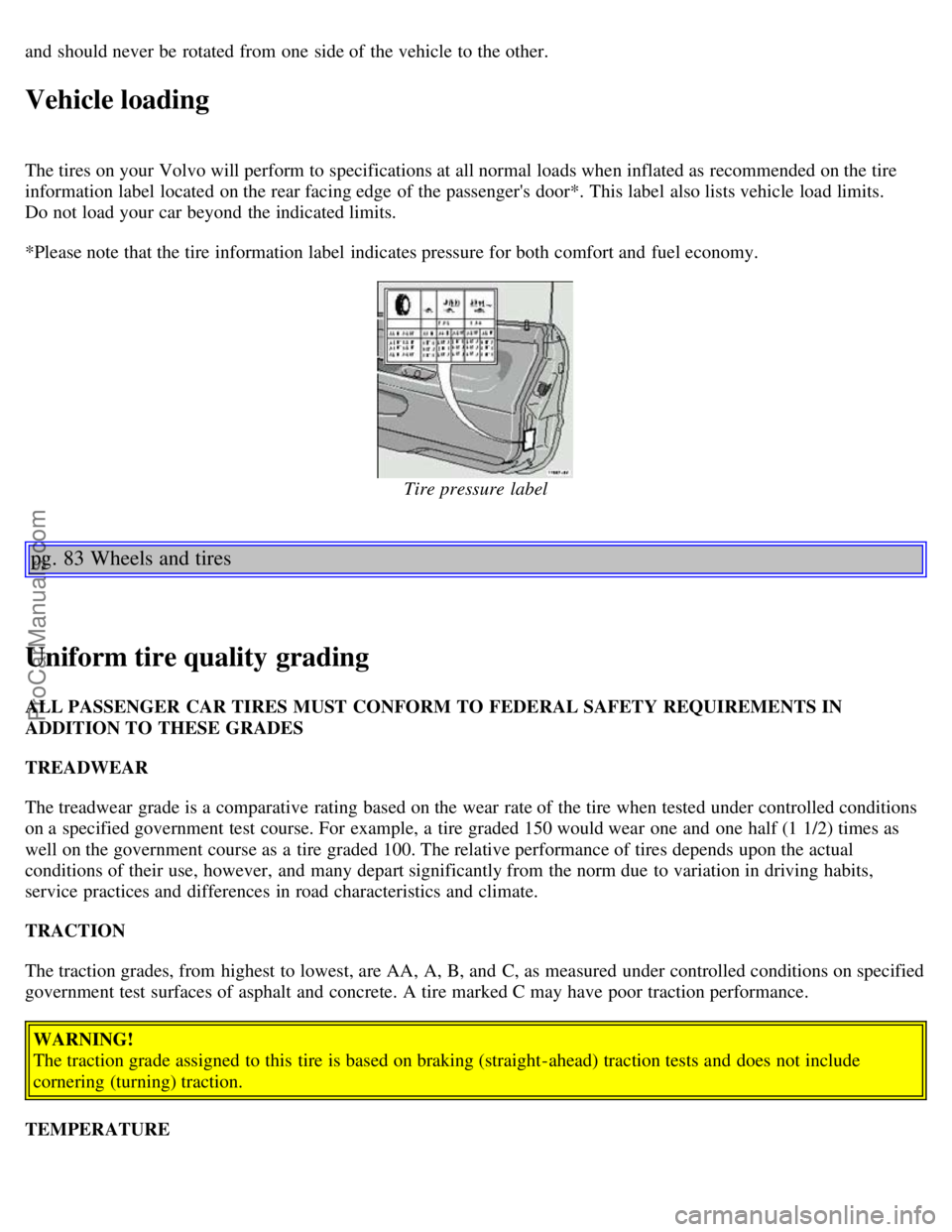
The tires on your Volvo will perform to specifications at all normal loads when inflated as recommended on the tire
information label located on the rear facing edge of the passenger's door*. This label also lists vehicle load limits.
Do not load your car beyond the indicated limits.
*Please note that the tire information label indicates pressure for both comfort and fuel economy.
Tire pressure label
pg. 83 Wheels and tires
Uniform tire quality grading
ALL PASSENGER CAR TIRES MUST CONFORM TO FEDERAL SAFETY REQUIREMENTS IN
ADDITION TO THESE GRADES
TREADWEAR
The treadwear grade is a comparative rating based on the wear rate of the tire when tested under controlled conditions
on a specified government test course. For example, a tire graded 150 would wear one and one half (1 1/2) times as
well on the government course as a tire graded 100. The relative performance of tires depends upon the actual
conditions of their use, however, and many depart significantly from the norm due to variation in driving habits,
service practices and differences in road characteristics and climate.
TRACTION
The traction grades, from highest to lowest, are AA, A, B, and C, as measured under controlled conditions on specified
government test surfaces of asphalt and concrete. A tire marked C may have poor traction performance.WARNING!
The traction grade assigned to this tire is based on braking (straight-ahead) traction tests and does not include
cornering (turning) traction.
TEMPERATURE
ProCarManuals.com
Page 64 of 99

2 0 0 4
VOLVO C70
Chapter 8 - Volvo Service
pg. 109 Volvo Service
Page
Label information 110
Maintenance service, Warranty111
Servicing112
Emissions maintenance113
Fuel/emissions systems114
Lubrication115
Engine oil116
Power steering fluid, Brake/clutch system fluid reservoir118
Washer fluid reservoir119
Coolant120
Engine compartment121
Battery maintenance/ Proposition 65 Warning122
Three-way catalytic converter123
pg. 110 Label information
1 Vehicle Emission Control Information
Your Volvo is designed to meet all applicable emission standards, as evidenced by the certification label on the
underside of the hood. For further information regarding these regulations, please consult your Volvo retailer.
2 Vacuum hose routing
(underside of hood)
3 Loads and Tire Pressures
(on rear edge of passenger's door)
4 Model plate
Vehicle Identification Number (VIN). Codes for color and upholstery, etc. This plate is located in the engine
compartment, on the inside of the left front fender.
5 Vehicle Identification Number (VIN) *
ProCarManuals.com