2004 VOLVO C70 automatic transmission
[x] Cancel search: automatic transmissionPage 41 of 99

and the brake pedal must be depressed. See page 101 for instructions on manually releasing the SHIFTLOCK
system.
NOTE: (Automatic transmission only)
Your car is equipped with a KEYLOCK system. When the engine is switched off, the gear selector must be in the
( P )ark position before the starting key can be removed from the ignition switch.
5. Select the desired gear. The gear engages after a slight delay (automatic transmission) which is especially noticeable
when selecting R.
CAUTION : (Automatic transmission only)
The engine should be idling; never accelerate until after you feel the gear engage! Too-rapid acceleration immediately
after selecting a gear will cause harsh engagement and premature transmission wear.
NOTE : Selecting P or N (automatic transmission) when idling at a standstill for prolonged periods of time will help
prevent overheating of transmission oil.
WARNING!
Always place the gear selector (automatic transmission) in Park and apply the parking brake before leaving the
vehicle. Never leave the car unattended with the engine running.
Always open the garage doors fully before starting the engine inside a garage to ensure adequate ventilation. The
exhaust gases contain carbon monoxide, which is invisible and odorless but very poisonous.
CAUTION: Never race the engine immediately after starting. Oil flow may not reach some lubricating points fast
enough to prevent engine damage.
Do not race the engine just prior to switching off!
* If the key is left in the Drive position (position II) for more than 30 seconds, it must be turned to position 0 and then
turned to the Start position (position III) again in order to start the car. See page 21
for ignition key positions.
pg. 65 Manual transmission
Shift positions
Depress the clutch pedal completely when changing gears*.
Remove your foot from the clutch pedal while driving.
ProCarManuals.com
Page 42 of 99

Overdrive (5th gear) should be used as often as possible to help improve fuel economy. This gear can be engaged at
speeds above approx. 50 mph (80 km/h).
CAUTION: Follow the shift pattern indicated on the gear shift knob when shifting up (e.g., do not shift directly from
2nd to 5th gear) to help avoid excessive wear on the transmission.
Engaging reverse gear
The gear lever must first be moved to neutral in order to engage reverse gear.
CAUTION: Be careful that you do not inadvertently engage reverse while moving forward.
* Clutch interlock (manual transmission only)
The clutch must be fully depressed before you can start your car. If the clutch is not depressed, it will not be possible
to start the engine.
pg. 66 Automatic transmission
P (Park)
Use this position when starting the engine or parking the car.
Never use P while the car is in motion.
The parking brake should be set whenever the car is parked.
ProCarManuals.com
Page 43 of 99

The gear selector is mechanically locked in the P position (SHIFTLOCK). To release the gear selector from this
position, the engine must be running (or the ignition key must be in position II) and the brake pedal must be
depressed.WARNING! Never leave the car unattended when the engine is running. If, by mistake, the gear selector is moved
from P, the car may start moving.
R (Reverse)
Never engage R while the car is moving forward.
N (Neutral)
Neutral - no gear engaged. Use the parking brake.
D (Drive)
D is the normal driving position and should be used as often as possible to help improve fuel economy. The car should
not be moving when shifting from R to the D position.
4 (Intermediate gear)
The transmission will shift automatically between gears 4, 3, 2 or 1 from this position. The transmission cannot shift
up to (D) from fourth gear.
3 (Intermediate gear)
The transmission will shift automatically between gears 3, 2 and 1 from this position. The transmission cannot shift
up to fourth gear of (D)rive from third gear.
L (Low gears)
The transmission is locked in gears 1 and 2 when the selector is in this position.
NOTE:
Gears 4, 3, or L can be used if you are driving in a mountainous area, towing a trailer or to increase engine braking
effect.
The transmission has a built-in limiter designed to help prevent excessive engine speeds (high rpm) when gears 4, 3
or L are selected.
Automatic transmission - adaptive system
The automatic transmission is controlled by an adaptive control system that constantly monitors the way in which the
transmission functions. It senses and adapts each gear shift for optimal performance. The system also monitors your
particular driving style and adapts gear shifting accordingly.
ProCarManuals.com
Page 51 of 99

illustration on the following page.
Jack attachment
There is a jack attachment located in the center on each side of the car. Position the jack on the bar in the attachment
as shown in illustration above and crank while simultaneously guiding the base of the jack to the ground. The base of
the jack must be flat on a level, firm, non-slippery surface. Before raising the car, check that the jack is still
correctly positioned in the attachment.
WARNING!
The jack's attachment must engage the bar in the jack attachment (see inset illustration above). The car's weight must
not rest on the jack attachment.
Raise the vehicle until both wheels on the side of the car where the jack is attached are lifted off the ground. Unscrew
the wheel bolts completely and carefully remove the wheel so as not to damage the thread on the studs.
NOTE: To avoid excessive wear and the necessity of rebalancing, mark and reinstall wheels in the same location and
position as before removal. To lessen the chance of imbalance, each wheel hub is equipped with a guide stud to ensure
that a removed wheel can be reinstalled in its original position (as when changing over to winter tires/wheels).
CAUTION: The car must not be driven with wheels of different dimensions or with a spare tire other than the one that
came with the car. The use of different size wheels can seriously damage your car's transmission.
pg. 87 Wheel changing
WARNING!
The jack's attachment must engage the bar in the jack attachment (see inset illustration in center column on the
previous page. The car's weight must not rest on the jack attachment.
Be sure the jack is on a firm, level, non-slippery surface.
Never allow any part of your body to be extended under a car supported by a jack.
Use the jack intended for the car when replacing a wheel. For any other job, use stands to support the side of the
car being worked on.
Apply the parking brake, select position P (automatic transmission) or Reverse gear (manual transmission).
Block the wheels standing on the ground, use rigid wooden blocks or large stones.
The jack should be kept well-greased.
Installing the wheel
ProCarManuals.com
Page 70 of 99

2 0 0 4
VOLVO C70
Chapter 9 - Specifications
pg. 125 Specifications
Page
Oil/fluids specifications 126
Engine specifications127
Cooling/fuel/distributor ignition systems128
Front/rear suspensions128
Transmission, Capacities, Vehicle loading129
Electrical system/bulbs130
Dimensions and weights131
On Call Roadside assistance132
pg. 126 Oil/fluid specifications
Engine Oil
Meeting or exceeding ILSAC specification GF-2, including ACEA A1, API SJ, SJ/CF, and SJ/Energy Conserving.
Oil additives must not be used.
Engine oil Quality:
Meeting API SJ, SJ/CF, and SJ/Energy
Conserving. Capacity (incl. filter)
: 6.2 US
qts. (5.8 liters)
Automatic
transmission fluid Quality:
AW5. Only Volvo gearbox oil (1161540-8). Do
not mix with other oils.. Capacity:
8 US qts. (7.5 liters)
Manual transmission
fluid Quality:
Volvo synthetic gearbox oil 1161423 Capacity: 2.2 US qts. (2.1 liters)
Power steering fluid Quality: ATF Capacity:
0.95 US qts. (0.9
liters)
Brake fluid Quality: DOT 4+ boiling point > 536°F (280°C), P/N
9437433 Capacity:
0.64 US qts. (0.6
liters)
All specifications are subject to change without notice.
ProCarManuals.com
Page 73 of 99

pg. 129 Specifications
Power transmission
Manual transmission: M 56 H
Single-disc dry plate clutch. All-synchromesh on all gears including reverse; integrated final drive. Operation via a
floor mounted gear lever.Final drive ratio 4.00:1
Reduction ratios
1st gear 3.07:1
2nd gear 1.77:1
3rd gear 1.19:1
4th gear 0.87:1
5th gear 0.70:1
Reverse 2.99:1
Automatic transmission: AW 55-50 LE
4 or 5-speed automatic electronically controlled gearbox comprising a hydraulic torque converter with a lockup
function; planetary gear, integrated final drive.
Operation via a floor mounted gear selector lever. Drive shafts with symmetrical joint location. Overdrive. Final drive ratio 2.44:1
Reduction ratios
1st gear 4.77:1
2nd gear 3.00:1
3rd gear 1.96:1
4th gear 1.32:1
5th gear 1.02:1
Reverse 3.23:1
Capacities
Fuel tank 18 US gals (68 liters)
Cooling system 7.4 US qts. (7.0 liters)
Engine oil (incl. filter) 6.1 US qts. (5.8 liters)
Automatic transmission 2 US gals (7.6 liters)
Manual transmission 2.2 US qts. (2.1 liters)
Power steering fluid 0.95 US qts (0.9 liters)
Washer fluid reservoir 4.7 US qts. (4.5 liters)
Brake/clutch system 0.6 US qts (0.6 liters)
ProCarManuals.com
Page 90 of 99
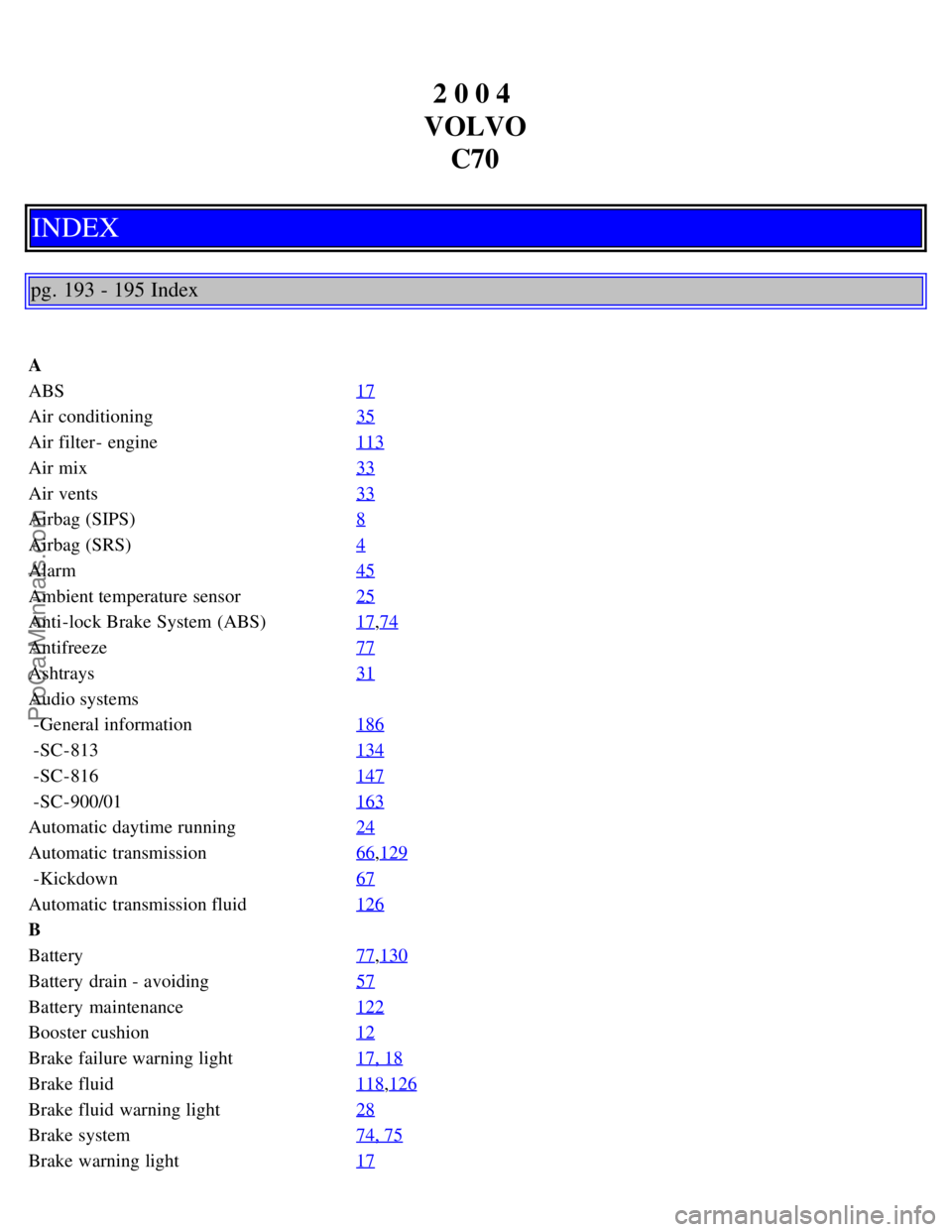
2 0 0 4
VOLVO C70
INDEX
pg. 193 - 195 Index
A
ABS 17
Air conditioning35
Air filter - engine113
Air mix33
Air vents33
Airbag (SIPS)8
Airbag (SRS)4
Alarm45
Ambient temperature sensor25
Anti-lock Brake System (ABS)17,74
Antifreeze77
Ashtrays31
Audio systems
-General information186
-SC-813134
-SC-816147
-SC-900/01163
Automatic daytime running24
Automatic transmission66,129
-Kickdown67
Automatic transmission fluid126
B
Battery77
,130
Battery drain - avoiding57
Battery maintenance122
Booster cushion12
Brake failure warning light17, 18
Brake fluid118,126
Brake fluid warning light28
Brake system74, 75
Brake warning light17
ProCarManuals.com