2004 VOLKSWAGEN GOLF wheel
[x] Cancel search: wheelPage 280 of 444
The Anti-Lock Brake System prevents the wheels from locking up when the brakes
are applied.
The is an
works only when the engin e is running.
How the ABS works
I f
one w hee l beg ins to turn too slow ly in relat ion to vehicle spee d and tends to lock up, the automati cally redu ces brak e pressure to pre vent
that w heel from lock ing up. When is doing its job you will notic e a slight vib ration through the brake ped a l a nd hear a noise to le t you know
that your speed must be adjusted to road, traffic and weather co ndition s. Thi s is a warni ng that one or more of th e whee ls is about to lock up and
that th e control function has intervened. In
thi s situati on it is important to keep th e br ake
peda l full y depressed so th e the
b rake ped al-cannot do its job if yo u do .
helps you to keep the vehicle under control
because it pr eve nts th e w hee ls from locking up w hen the brake s are a ppli ed. Thi s m ea ns th e hicle can still be s teered and is less likely to skid.
Th e
cannot necessarily shorte r
braking dis tances in con dition s. The brakin g
di stance ca n eve n be longer if you brake on gravel or on fres h snow c overing a slippery face.
If
i s not fun ctioning properly, a warning
light will co me pag e 5.
4 Smart technol .ogy
Always adjust your speed and driving style to
road, tra ffic and weather co nditions. Never let the ex tr a sa fety that
Alwa ys drive safely.
cannot change the laws of physics.
S lipp ery and wet roads are dangerous even
withABS!
cannot reduc e the risk of accidents,
for example if you drive too fast for the tions or if you do not keep your distance from the veh icle in front of you.
Always remember that vehicle alteration s or modifications can affect the function oft he
page 32, and te chnical modifications".
Changing the vehicle suspension or using unapproved tire
systems work and reduce their effectiveness.
The effec tive ness of is also determined
b y the tir es on your pag e 57 ,
Page 281 of 444
The wa rnin g light ABS does not light up w hen th e ignit io n is switched on .
T he wa rnin g lig ht does not turn off again afte r a few seco nds.
The wa rnin g light light s up whe n the vehicle
i s m ov ing.
Th e ve hicle can still be braked in the normal (except th at the is not active). dealer or a qualifie d works hop as soon as po ssible.
If a fault occurs in theABS. th e
sys te m warning lights BHAKE and/or , th e fective , but there is also possible malfun ction in th e brak e sys te m
Th ere may be a messag e in the in strumem cluster informing yo u or advis ing you of the
Before working in th e e ngin e ment, always read and h ee d all
Driv ing wi th bad brakes can cause a collisio n and seriou s perso nal injury .
If the does not go out, o r i f it up when dri vin g
th e brake fluid leve l in the reservoir is too low or there is a fault in the brake system. ately stop driving and
I f the brak e light s up at the same time warning light ABS or , th e may not be wo rkin g properly and the rear wheels could lo ck up first under hard braking. Hea r wheel brake lo ck-up ca n cause loss of ve hicl e control. If you b elieve that it is to do so, go ately at low sp ee d to the nearest authorized Volkswagen dealer or qualified workshop and have the brake sys te m inspected. Drive slow ly and avoid sudden, hard brake application .
out, or if it comes on while driv ing, the
w ill not have the protectio n provides. Con tact your rized Volkswagen deal e r o r qualified s hop as soon as possible.
Smart technology 5
Page 282 of 444
does th is by braking the whee l that h as lo st trac tion an d dis tributing more
driv ing force to the other driven wheel via the differen tial.
EDL i s active at speed s up to about mph
not that the EDL has been shut off.
EDL wi
ll automatically switch on again when the brake
Always adjust your speed and driving style to
road,
When accelerating on a slippery surface,
for example on ice and snow, press the accelerator carefully_ Despit e EDL, the wheels m ay
start t o spin leading to a loss of vehicle control.
Always remember that vehicle alterations or modifications can affect the function ofthe EDL and
page 32, and te chnical m odifications".
Changing the vehicl e s uspension or using unapproved tire rim combination can
change the way the EDL and systems work and reduce their e ff ectiveness_
6 Smart
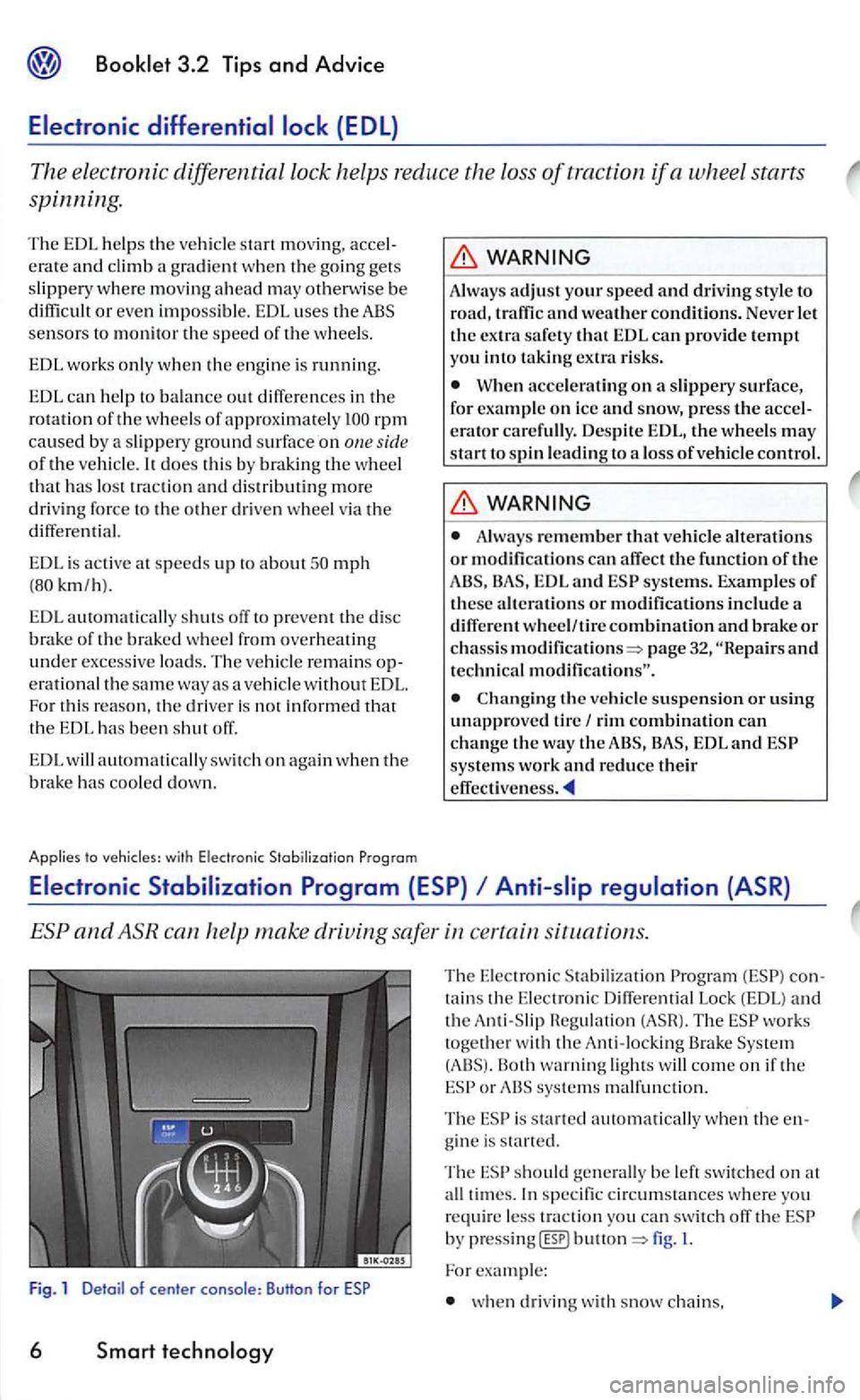
The E lectronic Stabilization con
tai ns the E lectronic Differential Lock (EDL) and the Anti- S lip Regulation (ASR). The
or sy s te m s malfunction.
The is sta rted automatically when the engine is started.
The should generall y be left switched on at
all times. In specific circumstances where yo u
requ ire less by l.
For exampl e:
whe n driv ing w ith snow chains,
Page 283 of 444
when dri ving in deep snow or on loose faces.
w he n r ocking the ve hicl e out.
Switch
ba ck on w he n yo u no longer need wheel s pin. The
remains switch ed oiT.
Ho w
works
The electroni c stab ilization progra m
helps to reduce the ris k of skiddin g braking th e w heels individually. works o nl y
w he n th e e ngine is ru nning.
The sys te m uses th e steering whee l an gle and road speed to calculate th e changes of tio n desired by the driver, and constantl y pares thi s informat ion with the actual behavior of the vehicl e. accurately ( for example if the hicle is beginni ng to skid ) tomatically by applyin g th e at the priate wheel.
The forces acti ng on the braked wheel help to
b rin g the vehicle back on course. th e ve hicl e is tending away at the rear, the brake
wide r dius in a curve. th e brake is mainly applied to the
in sid e wheel.
How the Anti-slip regulation
reduces engine powe r to he lp preven t the driven wheels of front-wheel d rive vehicles
losing traction during acceleration. The sys te m works in the entire speed ra nge in conjunctio n
with fails , the will a lso be out of action. h elp s the ve hicl e to moving. accele rat e and climb a grad ient in slipp ery d itions wh ere thi s may o therwise be diffi cult or even imposs ibl e.
When do the indicator light and the button come on or flash?
T he indicator light comes on for about
2 seconds as o perati o nal check when the
3.2 Tips and Advice
The indicator ligh t flashes while yo u are driv ing when the is wo rking.
They come on if there is a malfun ction in the
They come on when the
Th ey also come o n in the event of an malfunction because the system works in conjunction with the ABS.
the indicator light comes on immedia tel y
a fter the engine is started , th ere m ay be a
sys tem-controlled deactivation. You can vate the tion off and on agai n. th e in dicator ligh t
goes out , the sys te m is full y ope rational again.
the battery has been disconnected, th e
A lways adjust your speed and driving style to road, traffi c and weather conditions. Never le t the extra safety that can provide tempt you into taking extra risk s.
Alway s drive sa fe ly .
and
cannot reduc e the ris k of cident, for example if you drive too for conditions or if you do not keep your distance from the vehicle in front of yo u.
Although
Always remember that vehicle alterations or modificatio ns can affec t the functio n of the EDL and
different wheel/ tire combination and brake or chassis modifications=> page 32, and technical modifi cations".
Changing
EDL and sys te m s work and reduce their effecti veness.
Smart
Page 284 of 444
(continued)
T he effecti ve ness of is also d etermine d
b y the tires page 57, and
is very effec tive, always m ember that your veh icle's handling bility is limit ed b y tir e traction.
Note
I n
order to en sure th at an d ASR functio ns
correc tly, all four wheels must b e fitted with the same tire s. Any differences in the rolling radiu s of the tire s can cause the system to reduce gin e power-eve n when this is not th e best th in g
to do under t h e circumstances.
veh icles wit h powe r stee ring, th e amoun t of power ass istance is regula ted
chanical us ing an electr ic motor. The ad tages of thi s s teering system include the fact that n o hydra ulic components su ch as hoses . oil ta iners, filt ers or h ydraul ic flu id s are requir ed. Furt he rmo re, this is a conside rable decr ease in
e n ergy required . The elect romechan ical steering
system, in contrast to the hydraulic system (which requires a constant flow of fluid). only
co nsumes en ergy when the ve hicle is ac tually
b e in g s teered.
The f u e l consumption is reduced as a res ult.
If the
electromechanical power steering sys tem fails, the power ass is ted steer ing sys tem will still work. If th e engine is sw itched off, the power steering does not functio n and the steering
wheel is very hard to turn.
Indicator light
or comes on
The indi cator light comes o n for a few seconds when th e ignition is sw itched on.
If the indica tor light ( or does not go out or comes on while you are driving, th ere is a
prob le m in the ele ctro -mechanical steering. steering assis t may be reduced (light J or be lo st completely (li ght
swage n dealer. If th e yellow warning light stays
off after restart in g an d drivin g a short distanc e,
8 Smart
With th e en g in e not running (e.g. when the car is bei ng towed). there is a lso no power assist able.
Turning the s teerin g wheel i s ve ry difficult when th e power steering sys te m i s not wo rkin g and it is harde r t o control the ve hicl e.
Neve r let the vehicle coast w ith the en gi ne swit ch ed off.
If yo u d o no t pay att entio n to the warning lights w hich have com e o n, includin g th e
warnin g messages appearing in the d is play, this could lead t o personal injury or damage to
your vehicle .
Note
Do not keep the steering wheel turned the way to the le ft or righ t for more than 15 seco nd s
when th e e ngine is running. Doing so could damage th e powe r steering system.
If th e
Page 294 of 444
Booklet 3.2 Tip s and Advice
vehicl e handles diff ere ntl y wh en towin g a
tr ai ler because of the additional weigh t and weight distribution. Safe ty, pe rform ance and econo m y will greatl y depend on how carefull y
yo u load your trailer and op erat e your rig.
Before you actually to w your trail er, p ractic e
turning. stopping and b ack ing up in an area away from traffic until learn the feel of your vehicle and trail er unit.
Backing
up i s diffi cult and requi res practi ce.
Stee rin g whil e backing up is gen erall y opposite of that when backin g your vehicl e with out a
trailer.
Keep
more distance between your vehicl e and the one in front of yo u. will need more room to stop.
To compensate for the trail er. you will need a
larger than normal turning radius.
When passing, remember that you cannot erate as fast as you normally would because of the added load. Make sure yo u have enough
room to pass. After passing. allow plenty of room for you r trailer before c hanging lanes again.
Avoid je rk y s tart s, sharp turn s or rapid lan e changes.
Parking
After parking. always block th e wheels of both ve hicl e and trail er. Do not park with a traile r on a slope. If it cannot be a voided, do so only after doing th e follo wing:
Apply fo ot brake .
Have someone place chocks under both hicl e and trail er whee ls .
With the c hock s in place, s lo w ly re lease brak es until wheel blo cks absorb the load.
Turn w heels to curb (ve hicl e facing downhill)
o r to the stre et (when facing uphill).
Appl y parkin g brak e firmly.
automatic transmi ssion in
If you move the selecto r leve r of the automatic tran smission to
position.
Restarting
When restarting after parkin g on a slop e, reverse
the proc edure:
S tart the engine.
S hift transmission into gear.
le a se the parking brake and slowly move away from the wheel block s.
Stop and hav e someone re trie ve the wheel
b lock s.
Note
Neve r to w trailer during the break-in period of your vehicl e.
If yo u tow a trailer , yo ur Volksw age n m ay quire more frequent maimenance due to the
ext ra load.
Always check local reg ulations regardi ng
trailer to w in g.
Applies to vehicles: with anti-theft a larm system and a traile r towing set
Linking your trailer to the vehicle's anti-theft alarm system
The anti-theft alarm syste m will be triggere d as soon as the ele ctrical connec tion
between the trailer
and
or qualified
wo rkshop, if you want to inte grat e your trai le r to th e ve hicle's anti-theft a larm
Connecting your trailer to the anti-theft alarm syste m
If yo u ve hicle was built to include both the th eft al arm system and a trailer towin g th en t he trail er towing package (if available) is
in tegrated into the anti-theft alarm sys te m . Thi s
18 Driving and protecting the environment
Page 298 of 444
you h ave accessories on your vehicle. ch eck
w ith the car operator befo re washin g yo ur
ve hicle. fo ld the outsid e mi rro rs to avoid damage.
Vehicl e paint is durabl e e no ugh that the ve hicl e
can normall y be washed without p rob le m s in on the pa int mainly depends on the type of car the brushes used. the filterin g oft he was h water,
and th e typ e of detergent s wax solutions used, e tc.lfthe paint is sc rat ch ed or dull go ing through the car wash, imme di ately bring thi s to the atten tion of the car ator.
t h e ve hicle has been wa sh e d, th e discs and pad s will be wet (th ey could eve n icy in the winte r) and stoppin g will be
Washing by hand
- F irst s often the dirt w ith water a nd rinse
off.
-
in a
wa rd motio n usin g ge ntl e pressure.
- Rin
se out the sponge or was h glove
specia l on ly on h ard
move dirt or gr im e.
-
a second s ponge or was h glove to
w ip e down th e wheel rim s an d under th e
door
- R inse the thoroughl y w ith
water.
- Dry the painte d surfac es
and protection
lo nger. the brakes with several care ful brak e applicatio ns befo re driv ing
WARNING
Wet brakes or brakes coated with icc or road salt react slow er and need longer stopping tances .
Carefully apply brakes for a test.
Always dry brakes and clean otT icc ings and salt coatings with a few cautious brake applications.
Alwa ys read and heed all power a nd braki ng
- When it is cold outside, m ake sure yo u
w
ipe rubbe r seals and th eir contact
faces dry so that they do not freeze. a
s
ilicone s p ray to keep rubber seals pliable.
- Afte r was
hing you r
first by gen tly
WARNING
W et or brakes co ated w ith icc or road
s a lt reac t s lower and need lo n ge r stopping tances.
apply brakes for test.
Alwa ys dry brakes and clean otT ice in gs and salt coatin gs with a few cautious brake applications.
Always read an d heed all t3, power a nd bra kin g dis-
Page 299 of 444
edges under the vehicl e can cut exposed
ski n.
Alway s protect your hands and arms from cuts on sharp m etal edges when clea ning th e underbody, the inside of th e wheel housin gs
etc.
Never try to remov e mud or dust if the vehicle dry . a dry cloth or
sponge fo r cleaning could damage th e paint or
3.2 Tip s and Advice
glass on your vehicle . dirt . mud or dust with plent y of wate r before removing it.
When rinsing the vehicle. do no t let water ge t
int o th e lock cylinders or point the hose at gaps
around the doors. hood or tail gate. The water could freeze and make it difficult to open the hicle.
To he lp preve nt damage to th e pai nt, do not was h the vehicle in direct sunl ight.
F o r th e sake of environment
To protect the environme nt. wash the vehicle
only in specia l was h bays that c an handle oily
d irt that is wash ed off th e car.
- Do nor use a power washer to remove
ic e
or snow page 25.
- Neve r use concentrated jet nozzles or
so-called
- After ve hicl e has been washed, the
brake
dis cs and pads will be we t (they
could even be icy in the win te r) and
th e brakes with seve ra l care ful brake
application s before drivin g page 13.
WARNING
brakes or bra kes coa ted with ice or road salt react slower and n eed longer stoppin g tances.
Ca re full y apply brake s for a test.
1
l ap plicab le
Always dry and cl ean off ice ings and salt coatings with a few cautious brake applicati ons.
Always rea d and heed all power and braking
WARNING
Improper usc of powe r was he rs ca n cause rious , in vis ible and perm an ent tire damage leading to tire failur e an d loss of ve hicle trol.
Never wa sh tire s wi th the water out in a direc t stream even at
temperature sh o uld not be more than F
If yo u use power wash e r. be sure to keep it a
sa fe d istance from the sors' > in the front and rear bumpers . you h old
it too to the sensors, you could damage
them.
and protection 23