Page 383 of 420
04_SEQUOIA_U (L/O 0309)
375
2004 SEQUOIA from Sep. ’03 Prod. (OM34423U)
Clean all dirt from outside of the reservoir
tank and look at the fluid level. If the fluid
is cold, the level should be in the “COLD”
range. Similarly, if it is hot, the fluid level
should be in the “HOT” range. If the level
is at the low side of either range, add
automatic transmission fluid DEXRON�II
or III to bring the level within the range.
To remove the reservoir cap, turn it coun-
terclockwise and lift up. To reinstall it,
turn it clockwise. After replacing the reser-
voir cap, visually check the steering box
case, vane pump and hose connections
for leaks or damage.
CAUTION
The reservoir tank may be hot so be
careful not to burn yourself.
NOTICE
Avoid overfilling, or the power steer-
ing could be damaged.
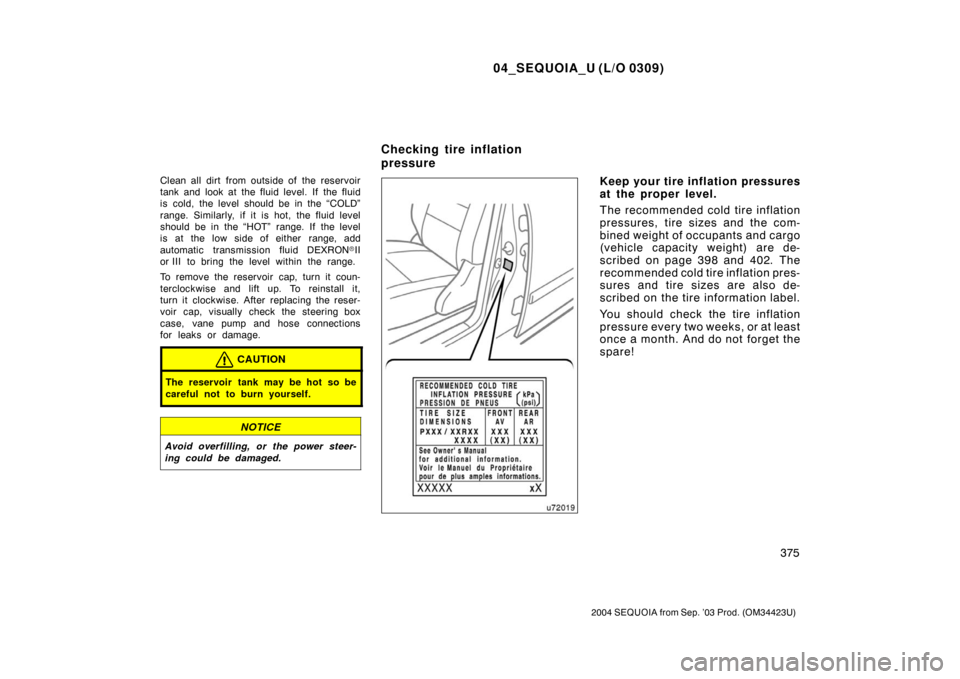
Keep your tire inflation pressures
at the proper level.
The recommended cold tire inflation
pressures, tire sizes and the com-
bined weight of occupants and cargo
(vehicle capacity weight) are de-
scribed on page 398 and 402. The
recommended cold tire inflation pres-
sures and tire si zes are also de-
scribed on the tire information label.
You should check the tire inflation
pressure every two weeks, or at least
once a month. And do not forget the
spare!
Checking tire inflation
pressure
Page 384 of 420

04_SEQUOIA_U (L/O 0309)
376
2004 SEQUOIA from Sep. ’03 Prod. (OM34423U)
The following instructions for
checking tire inflation pressure
should be observed:� The pressure s hould be
checked only when the tires are
cold. If your vehicle has been
parked for at least 3 hours and has
not been driven for more than 1.5
km or 1 mile since, you will get
an accurate cold tire inflation pres-
sure reading.
� Always use a tire pressure
gauge. The appearance of a tire
can be misleading. Besides, tire
inflation pressures that are even
just a few pounds off can degrade
ride and handling.
� Do not bleed or reduce tire
inflation pressure after driving.
It is normal for the tire inflation
pressure to be higher after driving.
� Never exceed the vehicle capac-
ity weight. The passenger and
luggage weight should be located
so that the vehicle is balanced.Tire pressure gauge
INSPECTION AND ADJUSTMENT
PROCEDURE 1. Remove the tire valve cap.
2. Press the tip of the tire pressure gauge to the tire valve.
3. Read the pressure using a gradua- tion of the gauge.
4. In case that the tire inflation pres- sure is not within the prescribed
range, insert the compressed air
from the valve. In case of applying
too much air, press the center of
t he valv e and releas e the air to ad-
just. 5. After completing the tire inflation
pressure measurement and ad-
justment, apply soap water to the
valve and check the leakage.
6. Install the tire valve cap.
If the gauge and the air pump are not
available, have your vehicle checked
by your Toyota dealer.
CAUTION
Be sure to reinstall the tire valve
caps. Without the valve caps, dirt
or moisture could get into the
valve core and cause air leakage.
If the caps have been lost, have
new ones put on as soon as pos-
sible.
Incorrect tire infl ation pressure may
waste fuel, reduce the comfort of driv-
ing, reduce tire life and make your ve-
hicle less safe to drive.
If a tire frequently needs refilling,
have it checked by your Toyota deal-
er.
Page 386 of 420

04_SEQUOIA_U (L/O 0309)
378
2004 SEQUOIA from Sep. ’03 Prod. (OM34423U)
The tires on your Toyota have built−in
tread wear indicators to help you
know when the tires need replace-
ment. When the tread depth wears to
1.6 mm (0.06 in.) or less, the indica-
tors will appear. If you can see the
indicators in two or more adjacent
grooves, the tire should be replaced.
The lower the tread, the higher the
risk of skidding.
The effectiveness of snow tires is
lost if the tread wears down below
4 mm (0.16 in.).
If you have tire damage such as
cuts, splits, cracks deep e nough to
expose the fabric, or bulges indi-
cating internal damage, the tire
should be repl aced.
If a tire often goes flat or cannot be
properly repaired due to the size or
location of a cut or other damage, it
should be replaced. If you are not
sure, consult with your Toyota dealer. If an air loss occurs while driving, do
not continue driving with a deflated
tire. Driving even a short distance can
damage a tire beyond repair.
An y ti res wh i ch are over 6 years
old must be checked by a qualified
technician even if damage is not
obvious.
Tires deteriorate with age even if they
have never or seldom been used.
This applies also to the spare tire and
tires stored for future use.
REPLACING YOUR TIRES
When replacing a tire, use a tire of
the same size and construction,
and the same or greater maximum
load as the originally installed
tires. Also, on fourwheel drive
models, all the tires must be the
same brand and have the same
tread patterns.
Using any other size or type of tire
may seriously affect handling, ride,
speedometer/odometer calibration,
ground clearance, and clearance be-
tween the body and tires or snow
chains.
Check that the maximum load of the
replaced tire is greater than 1/2 of the
Gross Axle Weight Ratings (GAWR)
of either the front axle or the rear
axle, whichever greater. As for the
maximum load of the tire, see the load
limit at maximum cold tire inflation
pressure mentioned on the sidewall
of the tire, and as for the Gross Axle
Weight Ratings (GAWR), see the Cer-
tification Label.
Page 391 of 420
04_SEQUOIA_U (L/O 0309)
383
2004 SEQUOIA from Sep. ’03 Prod. (OM34423U)
�When installing aluminum wheels,
check that the wheel nuts are tight
after driving your vehicle the first 1600
km (1000 miles).
�If you have rotated, repaired or
changed your tires, check that the
wheel nuts are still tight after driving
1600 km (1000 miles).
�When using tire chains, be careful not
to damage the aluminum wheels.
�Use only the Toyota wheel nuts and
wrench designed for your aluminum
wheels.
�When balancing your wheels, use only
Toyota balance weights or equivalent
and a plastic or rubber hammer.
�As with any wheel, periodically check
your aluminum wheels for damage. If
damaged, replace immediately.
Aluminum wheel precautions
Page 405 of 420
04_SEQUOIA_U (L/O 0309)
397
2004 SEQUOIA from Sep. ’03 Prod. (OM34423U)
SPECIFICATIONS
Specifications
Dimensions and weights398
. . . . . . . . . . . . . . . . . . . . . . . . . . . . . . . . . . . . \
Engine 399
. . . . . . . . . . . . . . . . . . . . . . . . . . . . . . . . . . . . \
. . . . . . . . . . . . . . . .
Fuel 399
. . . . . . . . . . . . . . . . . . . . . . . . . . . . . . . . . . . . \
. . . . . . . . . . . . . . . . . . .
Service specifications 399
. . . . . . . . . . . . . . . . . . . . . . . . . . . . . . . . . . . . \
. . .
Tires 402
. . . . . . . . . . . . . . . . . . . . . . . . . . . . . . . . . . . . \
. . . . . . . . . . . . . . . . . .
Fuses 402
. . . . . . . . . . . . . . . . . . . . . . . . . . . . . . . . . . . . \
. . . . . . . . . . . . . . . . .
SECTION 8
Page 406 of 420
04_SEQUOIA_U (L/O 0309)
398
2004 SEQUOIA from Sep. ’03 Prod. (OM34423U)
Overall lengthmm (in.)5180 (203.9)
Overall width mm (in.)1980 (78.0)∗
1
1940 (76.4)∗2
Overall height∗3mm (in.)
Tw o −wheel drive models
1860 (73.2)∗
4
1870 (73.6)∗5
1915 (75.4)∗6
1925 (75.8)∗7
Four −wheel drive models1880 (74.0)∗
5
1935 (76.2)∗7
Wheelbase mm (in.)3000 (118.1)
Front treadmm (in.)1675 (65.9)
Rear treadmm (in.)1680 (66.1)
Vehicle capacity weight (occupants � luggage) kg (lb.)567 (1250)
Towing capacity (trailer weight + cargo weight), kg (lb.):
Tw o −wheel drive models
Four −wheel drive models2948 (6500)
2812 (6200)
∗
1: With over fender∗2: With wheel arch moulding∗3: Unladen vehicle∗4: With P245/70R16 tires and without roof rails∗5: With P265/70R16 or P265/65R17 tires and without roof rails∗6: With P245/70R16 tires and with roof rails∗7: With P265/70R16 or P265/65R17 tires and with roof rails
Dimensions and weights
Page:
< prev 1-8 9-16 17-24