Page 336 of 420

04_SEQUOIA_U (L/O 0309)
328
2004 SEQUOIA from Sep. ’03 Prod. (OM34423U)
Before making these checks, make sure
you have followed the correct starting pro-
cedure given in “How to start the engine”
on page 310 in Section 3 and that you
have sufficient fuel. Also, check whether
the other keys will start the engine. If
they work, your key may be broken. Have
the key checked at your Toyota dealer. If
none of your keys work, there may be a
malfunction in the immobilizer system. Call
your Toyota dealer. (See “Keys” on page
10 in Section 1−2.)
If the engine is not turning over or is
turning over too slowly— 1. Check that the battery terminals are tight and clean.
2. If the battery terminals are O.K., switch on the interior light.
3. If the light is out, dim or goes out when the starter is cranked, the battery
is discharged. You may try jump start-
ing. See “(c) Jump starting” for further
instructions.
If the light is O.K., but the engine still will
not start, it needs adjustment or repair.
Call a Toyota dealer or qualified repair
shop.NOTICE
Do not pull or pushstart the ve-
hicle. It may damage the vehicle or
cause a collision when the engine
starts. Also the threeway catalytic
converter may overheat and become a
fire hazard.
If the engine turns over at its normal
speed but will not start—
1. Turn the ignition key to “ACC” or “LOCK” and try starting the engine
again.
2. If the engine will not start, the engine may be flooded because of repeated
cranking. See “(b) Starting a flooded
engine” for further instructions.
3. If the engine still will not start, it needs adjustment or repair. Call a Toyota
dealer or qualified repair shop. If the engine will not start, your engine
may be flooded because of repeated
cranking.
If this happens, turn the ignition key to
“START” with the accelerator pedal fully
depressed, and hold the key at this posi-
tion for about 30 seconds. Then the
cranking hold function stops cranking au-
tomatically, and you can try starting the
engine with your foot off the accelerator
pedal.
If the engine does not start, wait a few
minutes and try again.
If the engine still will not start, it needs
adjustment or repair. Call a Toyota dealer
or qualified repair shop for assistance.
If your vehicle will not start—
(a) Simple checks
(b) Starting a flooded engine
Page 339 of 420

04_SEQUOIA_U (L/O 0309)
331
2004 SEQUOIA from Sep. ’03 Prod. (OM34423U)
5. Start your engine in the normal way.After starting, run it at about 2000 rpm
for several minutes with the accelerator
pedal lightly depressed.
6. Carefully disconnect the cables in the exact reverse order: the negative cable
and then the positive cable.
7. Carefully dispose of the battery cover cloths—they may now contain sulfuric
acid.
8. If removed, replace all the battery vent plugs.
If the cause of your battery discharging is
not apparent (for example, lights left on),
you should have it checked at your Toyota
dealer. If your engine stalls while driving...
1. Reduce your speed gradually, keeping a straight line. Move cautiously off the
road to a safe place.
2. Turn on your emergency flashers.
3. Turn the ignition key to “ACC” or “LOCK”, and try starting the engine
again.
If the engine will not start, see “If your
vehicle will not start” on page 328 in this
Section.
CAUTION
If the engine is not running, the pow-
er assist for the brakes and steering
will not work so steering and braking
will be much harder than usual.
If the engine speed does not increase with
the accelerator pedal depressed down,
there may be a problem somewhere in
your electronic throttle control system.
At this time, vibration may occur. Howev-
er, if you depress the accelerator pedal
more firmly and slowly, you can drive your
vehicle at low speeds. Have your vehicle
checked by your Toyota dealer as soon as
possible.
Even if the abnormality of the electronic
throttle control system is corrected during
low speed driving, the system may not be
recovered until the engine is stopped and
the ignition key is turned to “ACC” or
“LOCK” position.
CAUTION
Be especially careful to prevent erro-
neous pedal operation.
If your engine stalls while
driving If you cannot incr
ease the
engine speed
Page 341 of 420

04_SEQUOIA_U (L/O 0309)
333
2004 SEQUOIA from Sep. ’03 Prod. (OM34423U)
1. Reduce your speed gradually,keeping a straight line. Move cau-
tiously off the road to a safe place
well away from the traffic. Avoid
stopping on the center divider of
a highway. Park on a level spot
with firm ground.
2. Stop the engine and turn on your emergency flashers.
3. Firmly set the parking brake and put the transmission in “P”.
4. Have everyone get out of the ve- hicle on the side away from traffic.
5. Read the following instructions thoroughly.CAUTION
When jacking, be sure to observe
the following to reduce the possi-
bility of personal injury:
�Follow jacking instructions.
� Do not put any part of your
body under the vehicle sup-
ported by the jack. Otherwise,
personal injury may occur.
� Do not start or run the engine
while your vehicle is supported
by the jack.
� Stop the vehicle on a level firm
ground, firmly set the parking
brake and put the transmission
in “P”. Block the wheel diago-
nally opposite to the one being
changed if necessary.
�Make sure to set the jack prop-
erly in the jack point. Raising
the vehicle with jack improper-
ly positioned will damage the
vehicle or may allow the ve-
hicle to fall off the jack and
cause personal injury.
� Never get under the vehicle
when the vehicle is supported
by the jack alone.
� Use the jack only for lifting
your vehicle during wheel
changing.
� Do not raise the vehicle with
someone in the vehicle.
� When raising the vehicle, do
not place any objects on top
of or underneath the jack.
� Raise the vehicle only high
enough to remove and change
the tire.
If you have a flat tire—
Page 343 of 420
04_SEQUOIA_U (L/O 0309)
335
2004 SEQUOIA from Sep. ’03 Prod. (OM34423U)
To remove the spare tire:1. Put a jack handle and jack handle extension together as shown in
the illustration.
1 Jack handle extension
2 Jack handle
NOTICE
Tighten all joints securely.
Otherwise, the extension may
come off and it may damage
the paint or vehicle body.
2. Insert the end of the jack handleextension into the lowering screw
and turn it counterclockwise with
the handle, making sure the han-
dle remains firmly fitted onto the
jack handle extension.
3. After the tire is lowered completely to the ground, remove the holding
bracket. When storing the spare tire, put it in
place with the outer side of the wheel
facing up. Then secure the tire, taking
care that the tire goes straight up
without catching on any other part, to
prevent it from flying forward during
a collision or sudden braking.
Page 344 of 420
04_SEQUOIA_U (L/O 0309)
336
2004 SEQUOIA from Sep. ’03 Prod. (OM34423U)
2. Block the wheel diagonally op-posite the flat tire to keep the
vehicle from rolling when it is
jacked up.
When blocking the wheel, place a
wheel block in front of one of the front
wheels or behind one of the rear
wheels.Ty p e A
Ty p e B 3. Remove the wheel ornament.
Pry off the wheel ornament, using the
beveled end of the wheel nut wrench
as shown.
Ty pe A only — To pr ot ec t the wheel
surface, place sufficient paper or cloth
between the wheel and wrench.
CAUTION
Do not try to pull off the orna-
ment by hand. Take due care in
handling the ornament to avoid
unexpected personal injury.
—Blocking the wheel —Removing wheel ornament
Page 345 of 420
04_SEQUOIA_U (L/O 0309)
337
2004 SEQUOIA from Sep. ’03 Prod. (OM34423U)
4. Loosen all the wheel nuts.
Always loosen the wheel nuts before
raising the vehicle.
Turn the wheel nuts counterclockwise
to loosen. To get maximum leverage,
fit the wrench to the nut so that the
handle is on the right side, as shown
above. Grab the wrench near the end
of the handle and pull up on the han-
dle. Be careful that the wrench does
not slip off the nut.
Do not remove the nuts yet—just un-
screw them about one −half turn.
CAUTION
Never use oil or grease on the
bolts or nuts. The nuts may loose
and the wheels may fall off,
which could cause a serious ac-
cident.
Front Rear
5. Position the jack at the correct jack point as shown.
Make sure the jack is positioned on
a level and solid place.
JACK POINTS:
Front—Under the frame side rail
Rear—Under the rear axle hous-
ing
—Loosening wheel nuts —Positioning the jack
Page 346 of 420
04_SEQUOIA_U (L/O 0309)
338
2004 SEQUOIA from Sep. ’03 Prod. (OM34423U)
Put a jack handle, jack handle exten-
sion and jack handle end together as
shown in the illustration.
1 Jack handle end
2 Jack handle extension
3 Jack handleNOTICE
Tighten all joints securely.
Otherwise, the extension may
come off and it may damage
the paint or vehicle body.
6. After making sure that no oneis in the vehicle, raise it high
enough so that the spare tire
can be installed.
Remember you will need more ground
clearance when putting on the spare
tire than when removing the flat tire. To raise the vehicl
e, insert the jack
handle extension in to the jack (it is
a loose fit) and turn it clockwise with
the handle, making sure the handle
remains firmly fitted onto the jack
handle extension. As the jack touches
the vehicle and begins to fit, double −
check that it is properly positioned.
CAUTION
Never get under the vehicle when
the vehicle is supported by the
jack alone.
—Raising your vehicle
Page 348 of 420
04_SEQUOIA_U (L/O 0309)
340
2004 SEQUOIA from Sep. ’03 Prod. (OM34423U)
CAUTION
Never use oil or grease on the
bolts or nuts. Doing so may lead
to overtightening the nuts and
damaging the bolts. The nuts
may loose and the wheels may
fall off, which could cause a seri-
ous accident. If there is oil or
grease on any bolt or nut, clean
it.
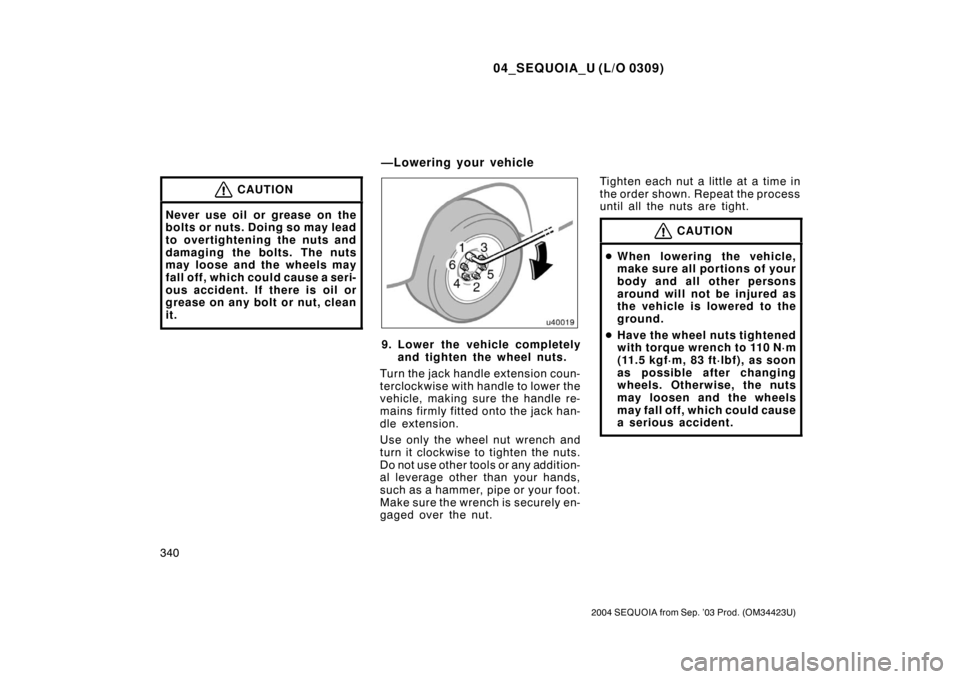
9. Lower the vehicle completelyand tighten the wheel nuts.
Turn the jack handle extension coun-
terclockwise with handle to lower the
vehicle, making sure the handle re-
mains firmly fitted onto the jack han-
dle extension.
Use only the wheel nut wrench and
turn it clockwise to tighten the nuts.
Do not use other tools or any addition-
al leverage other than your hands,
such as a hammer, pipe or your foot.
Make sure the wrench is securely en-
gaged over the nut. Tighten each nut a little at a time in
the order shown. Repeat the process
until all the nuts are tight.
CAUTION
�
When lowering the vehicle,
make sure all portions of your
body and all other persons
around will not be injured as
the vehicle is lowered to the
ground.
� Have the wheel nuts tightened
with torque wrench to 110 N·m
(11.5 kgf·m, 83 ft·lbf), as soon
as possible after changing
wheels. Otherwise, the nuts
may loosen and the wheels
may fall off, which could cause
a serious accident.
—Lowering your vehicle


