Page 256 of 333
256
CAUTION
Use extreme caution when towing ve-
hicles. Avoid sudden starts or erratic
driving maneuvers which would place
excessive stress on the emergency
towing eyelet and towing cable or
chain. The eyelet and towing cable or
chain may break and cause serious
injury or damage.
NOTICE
Use only a cable or chain specifically
intended for use in towing vehicles.
Securely fasten the cable or chain to
the towing eyelet provided.
Before towing, release the parking brake
and put the hybrid transaxle in “N”. The
hybrid system must be in the “IG−ON”
mode.
In the following cases, as the front wheels
might be locked by means of the parking
lock mechanism, your vehicle cannot be
towed by another vehicle using a rope.
Have your vehicle carried with the front
wheels or all the wheels raised.
�If the parking mechanism fails.
�If the auxiliary battery is discharged.
CAUTION
If the hybrid system is not running,
the power assist for the brakes and
steering will not work so steering and
braking will be much harder than usu-
al.
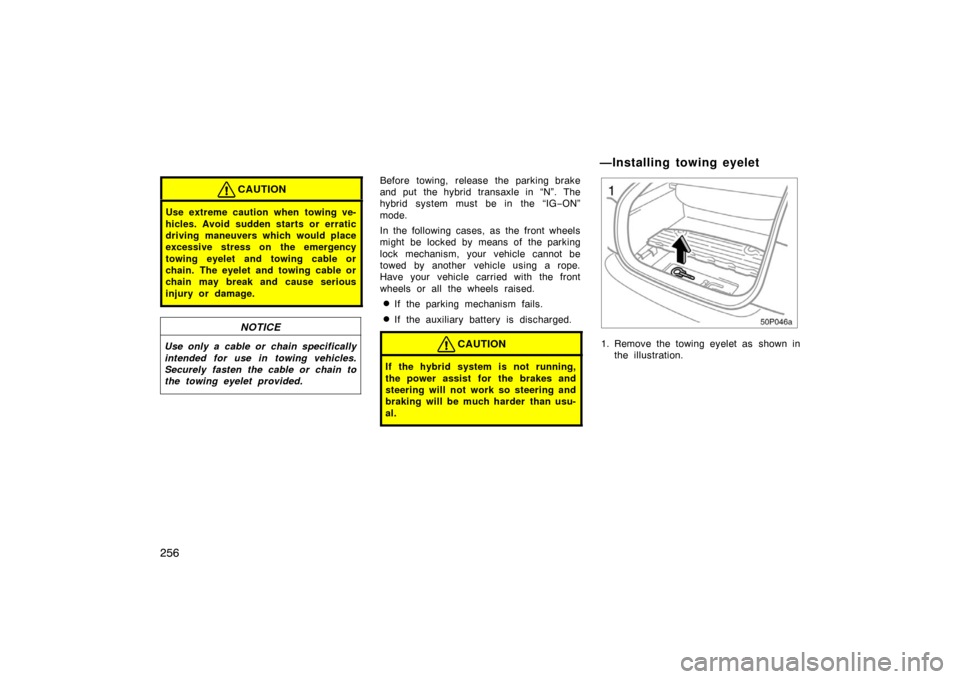
50p046a
1. Remove the towing eyelet as shown in the illustration.
—Installing towing eyelet
Page 270 of 333

270
INSIDE THE VEHICLE
Items listed below should be checked
regularly, e.g. while performing periodic
services, cleaning the vehicle, etc.
Lights
Make sure the headlights, stop lights, tail
lights, turn signal lights, and other lights
are all working. Check headlight aim.
Service reminder indicators and warning
buzzers
Check that all service reminder indicators
and warning buzzers function properly.
Steering wheel
Be alert for changes in steering condition,
such as hard steering or strange noise.
Seats
Check that all front seat controls such as
seat adjusters, seatback recliner, etc. op-
erate smoothly and that all latches lock
securely in any position. Check that the
head restraint move up and down smooth-
ly and that the locks hold securely in any
latched position.Seat belts
Check that the seat belt system such as
buckles, retractors and anchors operate
properly and smoothly. Make sure the belt
webbing is not cut, frayed, worn or dam-
aged.
Accelerator pedal
Check the pedal for smooth operation and
uneven pedal effort or catching.
Brake pedal
Check the pedal for smooth operation and
that the pedal has the proper clearance.
Check the brake booster function.
Brakes
In a safe place, check that the brakes do
not pull to one side when applied.
Parking brake
Check that the pedal has the proper travel
and that, on a safe incline, your vehicle
is held securely with only the parking
brake applied.
OUTSIDE THE VEHICLE
Items listed below should be performed
from time to time, unless otherwise
specified.
Fluid leaks
Check underneath for leaking fuel, oil, wa-
ter or other fluid after the vehicle has
been parked for a while. If you smell fuel
fumes or notice any leak, have the cause
found and corrected immediately.
Doors and engine hood
Check that all doors and trunk operate
smoothly and all latches lock securely.
Make sure the engine hood secondary
latch secures the hood from opening when
the primary latch is released.
Tire inflation pressure
Check the pressure with a gauge ev-
ery two weeks, or at least once a
month. See page 289 for additional
information.
Page 313 of 333

313
AUXILIARY BATTERY
Open voltage at 20�C (68 �F):
12.6 − 12.8 V Fully charged
12.2 − 12.4 V Half charged
11 . 5 − 11.9 V Discharged
[Voltage that is checked 20 minutes after
the key is removed with all the lights
turned off]
Charging rates: 3.5 A max.
HYBRID TRANSAXLE
Fluid capacity (drain and refill),
L (qt., Imp. qt.): 3.6 (3.8, 3.2)
Fluid type: “Toyota Genuine ATF WS” or
equivalent BRAKES
Minimum pedal clearance when depressed
with the force of 196 N (20 kgf, 44 lbf)
with the traction motor running, mm (in.):
101.0 (3.98)
Pedal free play, mm (in.): 1 − 4 (0.04 − 0.16)
Parking brake adjustment when depressed
with the force of 294 N (30 kgf, 66 lbf): 6 − 9 clicks
Fluid type: SAE J1703 or FMVSS No. 116 DOT 3
STEERING
Wheel free play: Less than 30 mm (1.2 in.)
Tires
Tire size and inflation pressure:
Tire size kPa (kgf/cm
2 or ba r, ps i )
Standard Front P185/65R15 86S
240 (2. 4, 35)
Rear
P185/65R15 86S 230 (2. 3, 33)
Spare T125/70D16 96M
420 (4. 2, 60)
Wheel size: Standard 15 x 6JJ
S par e 16 x 4T
Wheel nut torque, N·m (kgf·m,
ft·lbf): 103 (10.5, 76)
NOTE: For a complete information on tires (e.g. replacing tires
or replacing wheels), see
“Checking tire inflation pres-
sure” through “Aluminum
wheel precautions”, page
289 through 296.
Page:
< prev 1-8 9-16 17-24