Page 230 of 333
230
1. Check the area around the vehicle be-fore entering it.
2. Adjust seat position, seatback angle, head restraint height and steering
wheel angle.
3. Adjust the inside and outside rear view mirrors.
4. Lock all doors.
5. Fasten seat belts.
When you get in the vehicle, check
whether the “READY” light is on or
not.
CAUTION
Your vehicle does not produce any
noise or vibration when the vehicle is
ready to be driven with the “READY”
light on. Move your foot carefully
from the brake pedal to the accelera-
tion pedal when driving.
1. Apply the parking brake firmly.
2. Turn off unnecessary lights and acces- sories.
3. Depress the brake pedal and hold it to the floor until driving off.
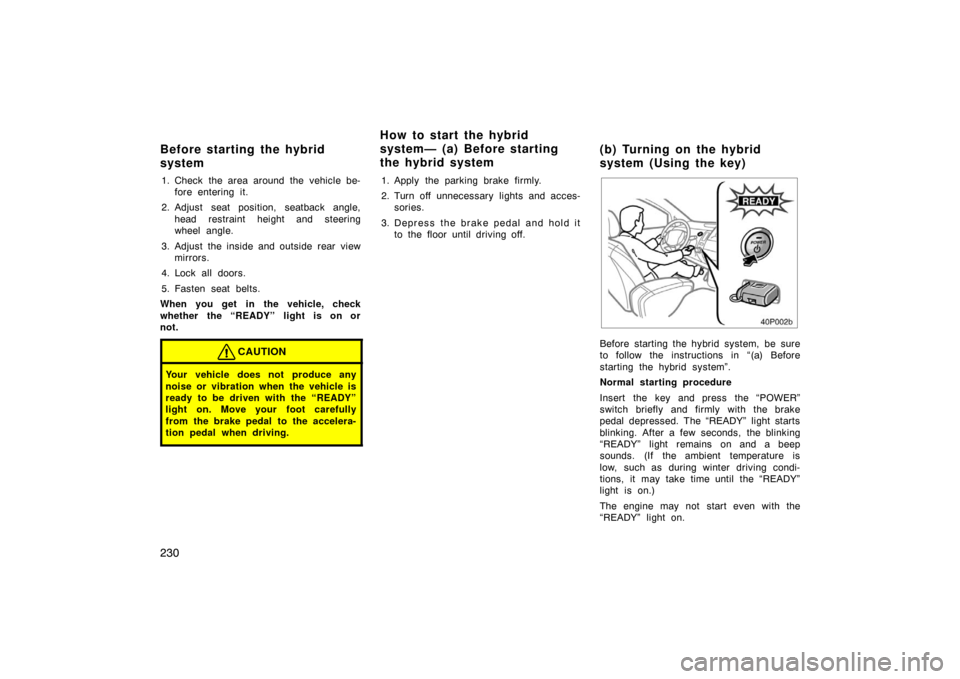
40p002b
Before starting the hybrid system, be sure
to follow the instructions in “(a) Before
starting the hybrid system”.
Normal starting procedure
Insert the key and press the “POWER”
switch briefly and firmly with the brake
pedal depressed. The “READY” light starts
blinking. After a few seconds, the blinking
“READY” light remains on and a beep
sounds. (If the ambient temperature is
low, such as during winter driving condi-
tions, it may take time until the “READY”
light is on.)
The engine may not start even with the
“READY” light on.
Before starting the hybrid
system How to start the hybrid
system— (a) Before starting
the hybrid system
( b ) Tu rn in g on th e hyb rid
system (Using the key)
Page 234 of 333
234
Check the condition of the auxiliary
battery and cables.
Cold temperatures reduce the capacity of
any auxiliary battery, so it must be in top
shape to provide enough power for winter
starting. Section 8−3 tells you how to
visually inspect the auxiliary battery. Your
Toyota dealer will be pleased to check the
level of charge.
Make sure the engine oil viscosity is
suitable for the cold weather.
See page 283 for recommended viscosity.
Leaving a heavy summer oil in your ve-
hicle during winter months may cause
harder starting. If you are not sure about
which oil to use, call your Toyota dealer.
Keep the door locks from freezing.
Squirt lock de −icer or glycerine into the
locks to keep them from freezing.
Use a washer fluid containing an anti
freeze solution.
This product is available at your Toyota
dealer and most auto parts stores. Follow
the manufacturer ’s directions for how
much to mix with water.NOTICE
Do not use engine antifreeze or any
other substitute as washer fluid be-
cause it may damage your vehicle’s
paint.
Do not use your parking brake when
there is a possibility it could freeze.
When parking, push the “P” position
switch and block the rear wheels. Do not
use the parking brake, for snow or water
accumulated in and around the parking
brake mechanism may freeze, making it
hard to release.
Keep ice and snow from accumulating
under the fenders.
Ice and snow built up under your fenders
can make steering difficult. During extreme
winter driving, stop and check under the
fenders occasionally.
Depending on where you are driving,
we recommend you carry some emer-
gency equipment.
Some of the things you might put in the
vehicle are tire chains, window scraper,
bag of sand or salt, flares, small shovel,
jumper cables, etc.
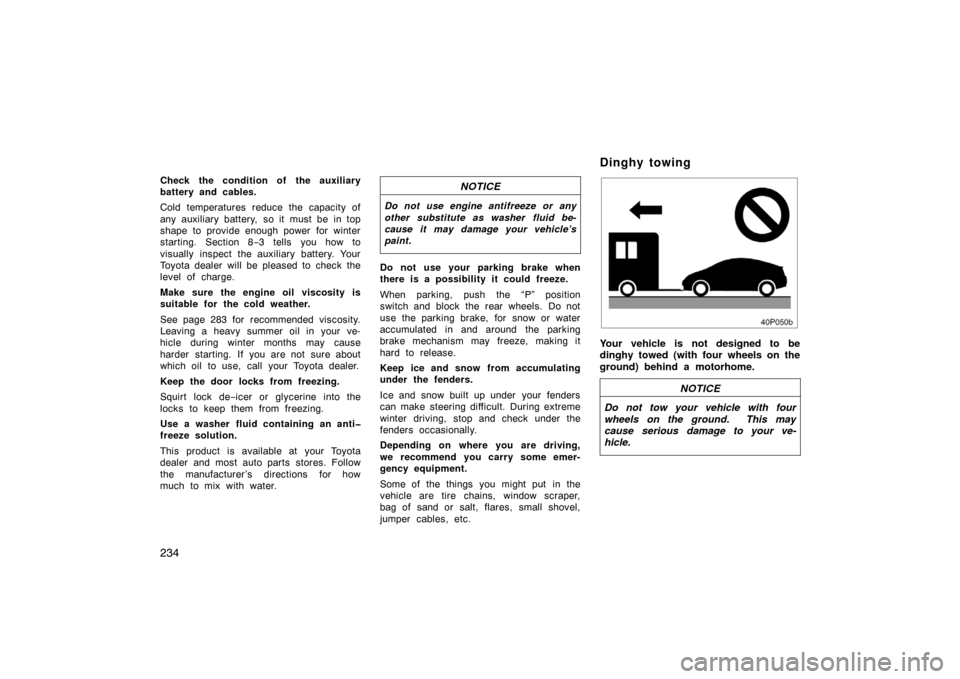
40p050b
Your vehicle is not designed to be
dinghy towed (with four wheels on the
ground) behind a motorhome.
NOTICE
Do not tow your vehicle with four
wheels on the ground. This may
cause serious damage to your ve-
hicle.
Dinghy towing
Page 236 of 333
236
CAUTION
Never turn off the hybrid system to
coast down hills. Your power steering
and brake booster will not function
without the hybrid system running.
Also, the emission control system op-
erates properly only when the hybrid
system is running.
Page 242 of 333
242
If your hybrid system stalls while driving...1. Reduce your speed gradually, keeping a straight line. Move cautiously off the
road to a safe place.
2. Turn on your emergency flashers.
3. Try starting the hybrid system again.
If the hybrid system will not start, see “If
your vehicle will not start” on page 238.
CAUTION
If the hybrid system is not operating,
the power assist for the brakes and
steering will not work so steering and
braking will be much harder than usu-
al.
If your high coolant temperature warn-
ing light comes on, if you experience a
loss of power, or if you hear a loud
knocking or pinging noise, the hybrid
system has probably overheated. You
should follow this procedure...
1. Pull safely off the road, stop the ve- hicle and turn on your emergency
flashers. Push the “P” position switch
and apply the parking brake. Turn off
the air conditioning if it is being used.
2. If coolant or steam is boiling out of the radiator or reservoir, stop the hybrid
system. Wait until the steam subsides
before opening the hood. If there is no
coolant boiling over or steam, leave the
hybrid system running and make sure
the electric cooling fan is operating. If
it is not, turn the ignition off.
CAUTION
To help avoid personal injury, keep
the hood closed until there is no
steam. Escaping steam or coolant is
a sign of very high pressure.
3. Look for obvious coolant leaks from theradiator, hoses, and under the vehicle.
However, note that water draining from
the air conditioning is normal if it has
been used.
CAUTION
When the hybrid system is running,
keep hands and clothing away from
the moving fan and engine drive
belts.
4. If the coolant is leaking, stop the hy-brid system immediately. Call a Toyota
dealer for assistance.
5. If there are no obvious leaks, check the coolant reservoir. If it is dry, add
coolant to the reservoir while the hy-
brid system is running. Fill it about half
full.
CAUTION
Do not attempt to remove the radiator
cap when the hybrid system and ra-
diator are hot. Serious injury could
result from scalding hot fluid and
steam blown out under pressure.
If your hybrid system stalls
while driving If your vehicle overheats
Page 256 of 333
256
CAUTION
Use extreme caution when towing ve-
hicles. Avoid sudden starts or erratic
driving maneuvers which would place
excessive stress on the emergency
towing eyelet and towing cable or
chain. The eyelet and towing cable or
chain may break and cause serious
injury or damage.
NOTICE
Use only a cable or chain specifically
intended for use in towing vehicles.
Securely fasten the cable or chain to
the towing eyelet provided.
Before towing, release the parking brake
and put the hybrid transaxle in “N”. The
hybrid system must be in the “IG−ON”
mode.
In the following cases, as the front wheels
might be locked by means of the parking
lock mechanism, your vehicle cannot be
towed by another vehicle using a rope.
Have your vehicle carried with the front
wheels or all the wheels raised.
�If the parking mechanism fails.
�If the auxiliary battery is discharged.
CAUTION
If the hybrid system is not running,
the power assist for the brakes and
steering will not work so steering and
braking will be much harder than usu-
al.
50p046a
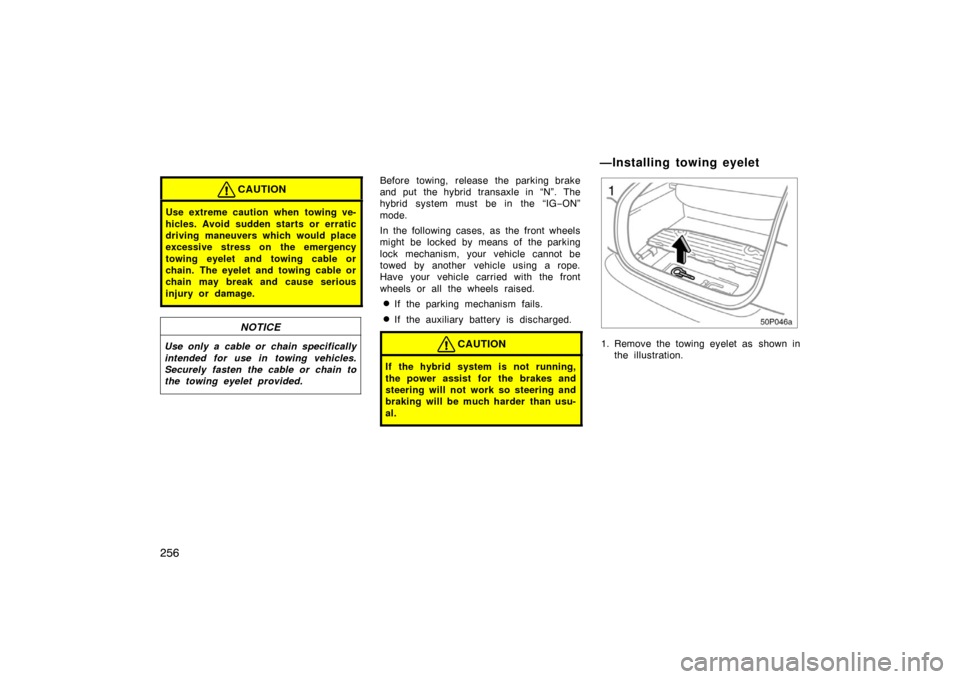
1. Remove the towing eyelet as shown in the illustration.
—Installing towing eyelet
Page 314 of 333
314
90p007b
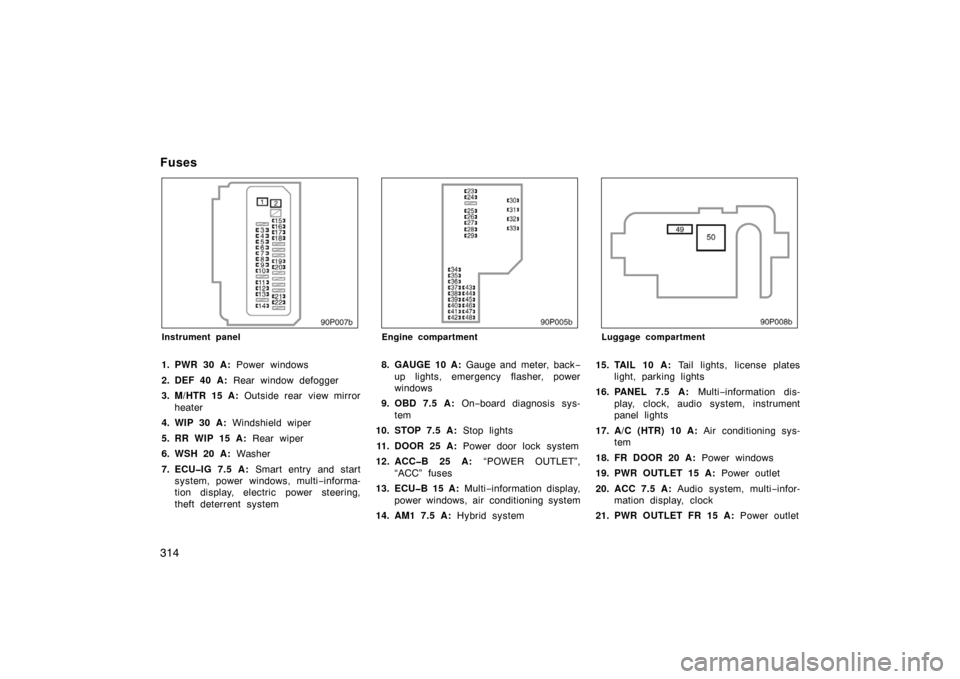
Instrument panel
1. PWR 30 A: Power windows
2. DEF 40 A: Rear window defogger
3. M/HTR 15 A: Outside rear view mirror
heater
4. WIP 30 A: Windshield wiper
5. RR WIP 15 A: Rear wiper
6. WSH 20 A: Washer
7. ECUIG 7.5 A: Smart entry and start
system, power wi ndows, multi−informa-
tion display, electric power steering,
theft deterrent system
90p005b
Engine compartment
8. GAUGE 10 A: Gauge and meter, back −
up lights, emergency flasher, power
windows
9. OBD 7.5 A: On−board diagnosis sys-
tem
10. STOP 7.5 A: Stop lights
11. DOOR 25 A: Power door lock system
12. ACCB 25 A: “POWER OUTLET”,
“ACC” fuses
13. ECUB 15 A: Multi−information display,
power windows, air conditioning system
14. AM1 7.5 A: Hybrid system
90p008b
Luggage compartment
15. TAIL 10 A: Tail lights, license plates
light, parking lights
16. PANEL 7.5 A: Multi−information dis-
play, clock, audio system, instrument
panel lights
17. A/C (HTR) 10 A: Air conditioning sys-
tem
18. FR DOOR 20 A: Power windows
19. PWR OUTLET 15 A: Power outlet
20. ACC 7.5 A: Audio system, multi −infor-
mation display, clock
21. PWR OUTLET FR 15 A: Power outlet
Fuses