Page 7 of 339
’04 AVALON U (L/O 0408)
vii
2004 AVALON from Aug. ’04 Prod. (OM41412U)
Tires and loading on yourTo y o t a
Underinflated or overinflated tire pressure and the
excess load may result in the deterioration of
steering ability and braking ability, leading to an
accident. Check the tire inflation pressure periodi-
cally and be sure to keep the load limits given in
this Owner ’s Manual. For details about tire inflation
pressure and load limits, see “Checking tire infla-
tion pressure” in Sectio n 72 and “Vehicle load
limits” in Section 2.
Scrapping of your Toyota
The SRS airbag and seat belt pretensioner devices in your
Toyota contain explosive chemicals. If the vehicle is
scrapped with the airbags and pretensioners left as they
are, this may cause an accident such as fire. Be sure to
have the systems of the SRS airbag and seat belt preten-
sioner removed and disposed of by the qualified service
shop or by your Toyota dealer before you dispose of your
vehicle.
Page 11 of 339
’04 AVALON U (L/O 0408)
3
2004 AVALON from Aug. ’04 Prod. (OM41412U)
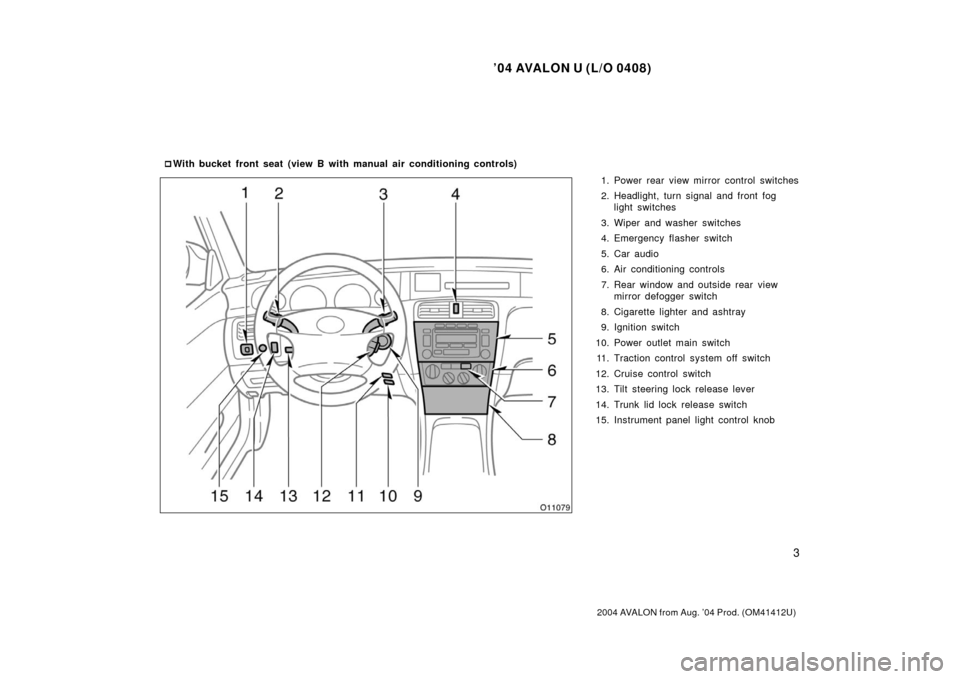
1. Power rear view mirror control switches
2. Headlight, turn signal and front foglight switches
3. Wiper and washer switches
4. Emergency flasher switch
5. Car audio
6. Air conditioning controls
7. Rear window and outside rear view mirror defogger switch
8. Cigarette lighter and ashtray
9. Ignition switch
10. Power outlet main switch 11. Traction control system off switch
12. Cruise control switch
13. Tilt steering lock release lever
14. Trunk lid lock release switch
15. Instrument panel light control knob
�
With bucket front seat (view B with manual air conditioning controls)
Page 12 of 339
’04 AVALON U (L/O 0408)
4
2004 AVALON from Aug. ’04 Prod. (OM41412U)
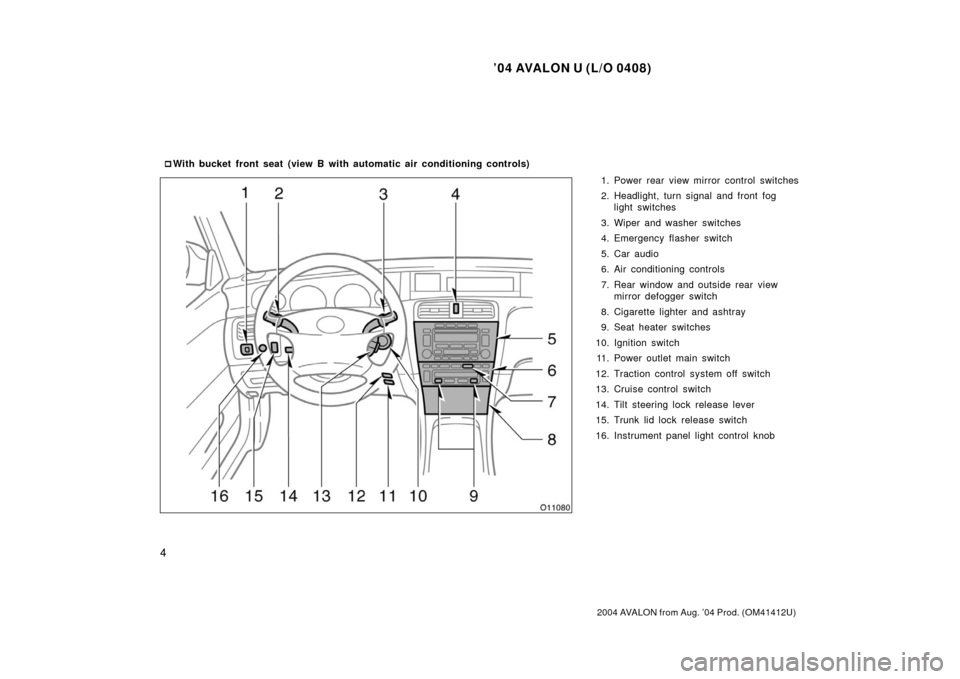
1. Power rear view mirror control switches
2. Headlight, turn signal and front foglight switches
3. Wiper and washer switches
4. Emergency flasher switch
5. Car audio
6. Air conditioning controls
7. Rear window and outside rear view mirror defogger switch
8. Cigarette lighter and ashtray
9. Seat heater switches
10. Ignition switch 11. Power outlet main switch
12. Traction control system off switch
13. Cruise control switch
14. Tilt steering lock release lever
15. Trunk lid lock release switch
16. Instrument panel light control knob
�
With bucket front seat (view B with automatic air conditioning controls)
Page 14 of 339
’04 AVALON U (L/O 0408)
6
2004 AVALON from Aug. ’04 Prod. (OM41412U)
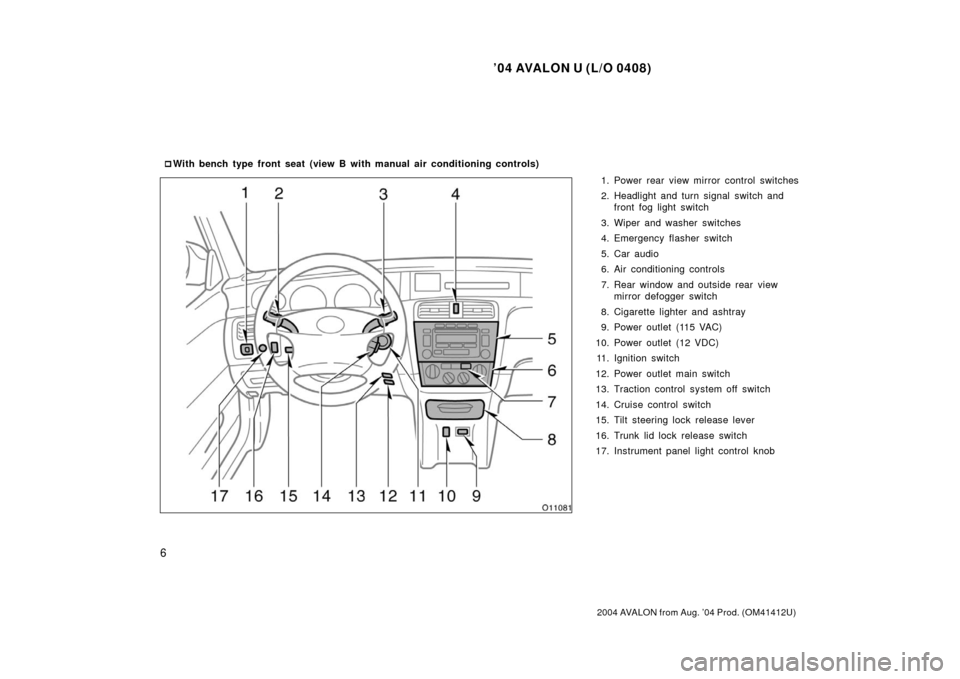
1. Power rear view mirror control switches
2. Headlight and turn signal switch andfront fog light switch
3. Wiper and washer switches
4. Emergency flasher switch
5. Car audio
6. Air conditioning controls
7. Rear window and outside rear view mirror defogger switch
8. Cigarette lighter and ashtray
9. Power outlet (115 VAC)
10. Power outlet (12 VDC) 11. Ignition switch
12. Power outlet main switch
13. Traction control system off switch
14. Cruise control switch
15. Tilt steering lock release lever
16. Trunk lid lock release switch
17. Instrument panel light control knob
�
With bench type front seat (view B with manual air conditioning controls)
Page 15 of 339
’04 AVALON U (L/O 0408)
7
2004 AVALON from Aug. ’04 Prod. (OM41412U)
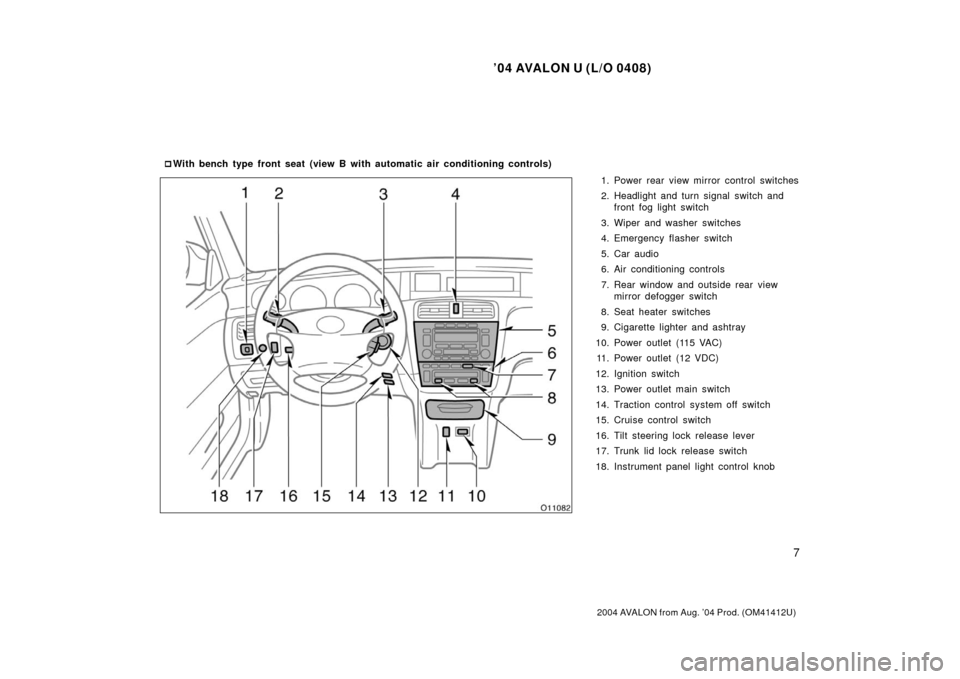
1. Power rear view mirror control switches
2. Headlight and turn signal switch andfront fog light switch
3. Wiper and washer switches
4. Emergency flasher switch
5. Car audio
6. Air conditioning controls
7. Rear window and outside rear view mirror defogger switch
8. Seat heater switches
9. Cigarette lighter and ashtray
10. Power outlet (115 VAC) 11. Power outlet (12 VDC)
12. Ignition switch
13. Power outlet main switch
14. Traction control system off switch
15. Cruise control switch
16. Tilt steering lock release lever
17. Trunk lid lock release switch
18. Instrument panel light control knob
�
With bench type front seat (view B with automatic air conditioning controls)
Page 50 of 339
’04 AVALON U (L/O 0408)
42
2004 AVALON from Aug. ’04 Prod. (OM41412U)
While the vehicle is being driven, all ve-
hicle occupants should have the seatback
upright, sit well back in the seat and prop-
erly wear the seat belts provided.
CAUTION
�Do not drive the vehicle unless the
occupants are properly seated. Do
not allow any passengers to sit on
top of a foldeddown seatback, or
in the luggage compartment or car-
go area. Persons not properly
seated and/or not properly re-
strained by seat belts can be se-
verely injured in the event of emer-
gency braking or a collision.
�During driving, do not allow any
passengers to stand up or move
around between seats. Otherwise,
severe injuries can occur in the
event of emergency braking or a
collision.
Driver seat
CAUTION
The SRS driver airbag deploys with
considerable force, and can cause
death or serious injury especially if
the driver is very close to the airbag.
The National Highway Traffic Safety
Administration (“NHTSA”) advises:
Since the risk zone for driver airbag
is the first 50—75 mm (2—3 in.) of
inflation, placing yourself 250 mm (10
in.) from your driver airbag provides
you with a clear margin of safety.
This distance is measured from the
center of the steering wheel to your
breastbone. If you sit less than 250
mm (10 in.) away now, you can
change your driving position in sever-
al ways:
�Move your seat to the rear as far
as you can while still reaching the
pedals comfortably.
�Slightly recline the back of the
seat. Although vehicle designs vary,
many drivers can achieve the 250
mm (10 in.) distance, even with the
driver seat all the way forward, sim-
ply by reclining the back of the
seat somewhat. If reclining the back
of your seat makes it hard to see
the road, raise yourself by using a
firm, nonslippery cushion, or raise
the seat if your vehicle has that
feature.
�If your steering wheel is adjustable,
tilt it downward. This points the air-
bag toward your chest instead of
your head and neck.
The seat should be adjusted as rec-
ommended by NHTSA above, while
still maintaining control of the foot
pedals, steering wheel, and your view
of the instrument panel controls.
Seats Front seats—
—Front seat precautions
Page 55 of 339

’04 AVALON U (L/O 0408)
47
2004 AVALON from Aug. ’04 Prod. (OM41412U)
RECALLING THE MEMORIZED POSITION
When you push button “1” or “2”, the
driving position will be automatically
adjusted to the position recorded for
that button.CONDITIONS FOR MEMORIZED
POSITION ACTIVATION
�Ignition key “ON” and shift lever in “P”
position
All parts of the memorized positions
can be activated. However, if the brake
pedal is being depressed, the seat
position will not change.
�Key not in ignition switch and within 30
seconds of opening driver ’s door
The memorized position can be acti-
vated.
If any driving position memory switch is
pushed while one of the memorized driv-
ing position profiles is being activated, the
operation will stop.
To reactivate the system, push the desired
button (“1” or “2”) again.
The driving position memory control sys-
tem cannot be operated while the vehicle
is moving.
If the vehicle’s battery is disconnected,
the computer’s memory will be erased and
the memorized position will have to be set
again.
CAUTION
�Do not start the vehicle while the
adjustment are being made.
�Take care not to select the wrong
button, or the seat could strike the
rear passenger or hit your body
against the steering wheel. If this
happens, you can stop the move-
ment by pressing another driving
position memory switch, or de-
pressing the brake pedal.
Page 72 of 339
’04 AVALON U (L/O 0408)
64
2004 AVALON from Aug. ’04 Prod. (OM41412U)
Deployment of the airbags happens in a
fraction of a second, so the airbags must
inflate with considerable force. While the
system is designed to reduce serious inju-
ries, primarily to the head and chest, it
may also cause other, less severe injuries
to the face, chest, arms and hands. These
are usually in the nature of minor burns
or abrasions and swelling, but the force of
a deploying airbag can cause more seri-
ous injuries, especially if an occupant’s
hands, arms, chest or head is in close
proximity to the airbag module at the time
of deployment. This is why it is important
for the occupant to: avoid placing any
object or part of the body between the
occupant and the airbag module; sit
straight and well back into the seat; wear
the available seat belt properly; and sit as
far as possible from the airbag module,
while still maintaining control of the ve-
hicle.
Parts of the airbag module (steering wheel
hub, airbag cover and inflator) may be hot
for several minutes after deployment, so
do not touch! The airbags inflate only
once. The windshield may be damaged by
absorbing some of the force of the inflat-
ing airbag.CAUTION
The driver or front passenger who is
too close to the steering wheel or
dashboard during airbag deployment
can be killed or seriously injured.
Toyota strongly recommends that:
�The driver sit as far back as pos-
sible from the steering wheel while
still maintaining control of the ve-
hicle.
�The front passenger sit as far back
as possible from the dashboard.
�All vehicle occupants be properly
restrained using the available seat
belts.
�If the seat belt extender has been
connected to the driver ’s seat belt
buckle without wearing the seat belt
when using the extender in the
driver ’s seat, the SRS driver ’s air-
bag system will judge that the driv-
er wears the seat belt even if not
wearing it. In this case, the driver ’s
airbag may not activate correctly,
causing death or serious injury in
the event of collision. Be sure to
wear the seat belt with the seat belt
extender.
For instructions and precautions con-
cerning the seating position, see
“—Front seat precautions” in this
Section.