2004 SUBARU IMPREZA oil
[x] Cancel search: oilPage 160 of 491
3-23
Instruments and controls
– CONTINUED –
tires are not all the same size and brand, the rear
differential will be heavily loaded when the vehicle
is driven, resulting in an abnormally high oil tem-
perature. "The rear differential oil will deteriorate if its tem-
perature increases enough for the rear differential
oil temperature warning light to come on. It is ad-
visable to have the rear differential oil replaced as
soon as possible. ! ABS warning light
The ABS warning light comes on when the ignition
switch is turned to the “ON” position and goes out after
about two seconds.
This is an indication that the ABS system is working
properly.
If the warning light behaves as follows, the ABS
system may not work properly.
When the warning light is on, the ABS function
shuts down; however, the conventional brake
system continues to operate normally." The warning light does not come on when the
ignition switch is turned to the “ON” position." The warning light comes on when the ignition switch is turned to the “ON” position, but it
does not go out even when the vehicle speed
exceeds approximately 8 mph (12 km/h)."
The warning light comes on during driving.
If these occur, have the ABS system repaired at
the first available opportunity by your SUBARU
dealer.
With a vehicle equipped with an EBD system, the ABS
warning light comes on together with the brake system
warning light if the EBD system becomes faulty. For
further details of the EBD system fault warning, refer to “Brake system warning light”.
NOTE
If the warning light behavior is as described be-
low, the ABS system may be considered normal." The warning light comes on right after the en-
gine is started but goes out immediately, remain-
ing off." The warning light remains on after the engine
has been started, but it goes out when the vehicle
speed reaches about 8 mph (12 km/h)." The warning light comes on during driving, but
it goes out immediately and remains off.
When driving with an insufficient battery voltage such
(U.S.) (Canada)
Page 190 of 491

4-1
4
Climate control
Ventilator ....................................................... 4-2 Air flow selection .............................................. 4-2
Center and side ventilators .............................. 4-3
Manual climate control system (if equipped) 4-4 Control panel ..................................................... 4-4
Heater operation ............................................... 4-6
Air conditioner operation (if equipped) .......... 4-9
Semi-automatic climate control system (if equipped) ............................................... 4-11Control panel ..................................................... 4-11
Operating method ............................................. 4-14
Temperature sensors ....................................... 4-18
Operating tips for heater and air conditioner 4-19 Cleaning ventilation grille ................................ 4-19
Efficient cooling after parking in direct sunlight ........................................................... 4-19
Lubrication oil circulation in the refrigerant
circuit .............................................................. 4-19
Checking air conditioning system before summer season .............................................. 4-19
Cooling and dehumidifying in high humidity and low temperature weather conditions .... 4-20
Air conditioner compressor shut-off when
engine is heavily loaded ................................ 4-20
Refrigerant for your climate control system .. 4-20
Air filtration system (if equipped) ................ 4-20 Replacing an air filter ....................................... 4-21
Page 208 of 491
4-19
Climate control
– CONTINUED –
Operating tips for heater and air con-
ditioner !Cleaning ventilation grille
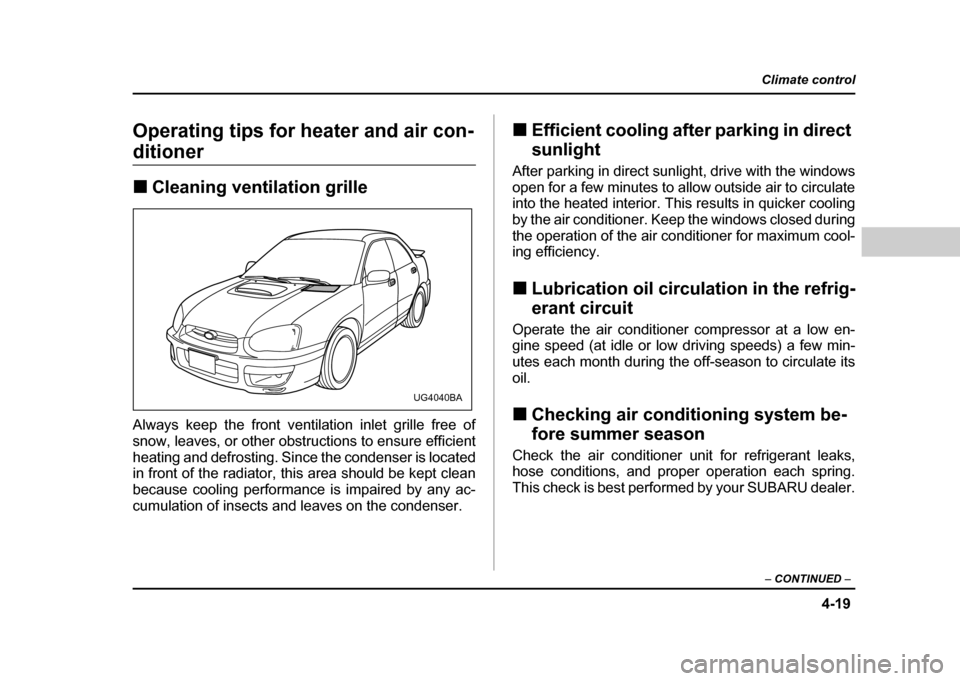
Always keep the front ventilation inlet grille free of
snow, leaves, or other obstructions to ensure efficient
heating and defrosting. Since the condenser is located
in front of the radiator, this area should be kept clean
because cooling performance is impaired by any ac-
cumulation of insects and leaves on the condenser. !
Efficient cooling after parking in direct
sunlight
After parking in direct sunlight, drive with the windows
open for a few minutes to allow outside air to circulate
into the heated interior. This results in quicker cooling
by the air conditioner. Keep the windows closed during
the operation of the air conditioner for maximum cool-
ing efficiency. ! Lubrication oil circulation in the refrig- erant circuit
Operate the air conditioner compressor at a low en-
gine speed (at idle or low driving speeds) a few min-
utes each month during the off-season to circulate its
oil. ! Checking air conditioning system be-
fore summer season
Check the air conditioner unit for refrigerant leaks,
hose conditions, and proper operation each spring.
This check is best performed by your SUBARU dealer.
UG4040BA
Page 258 of 491
6-9
Interior equipment
– CONTINUED –
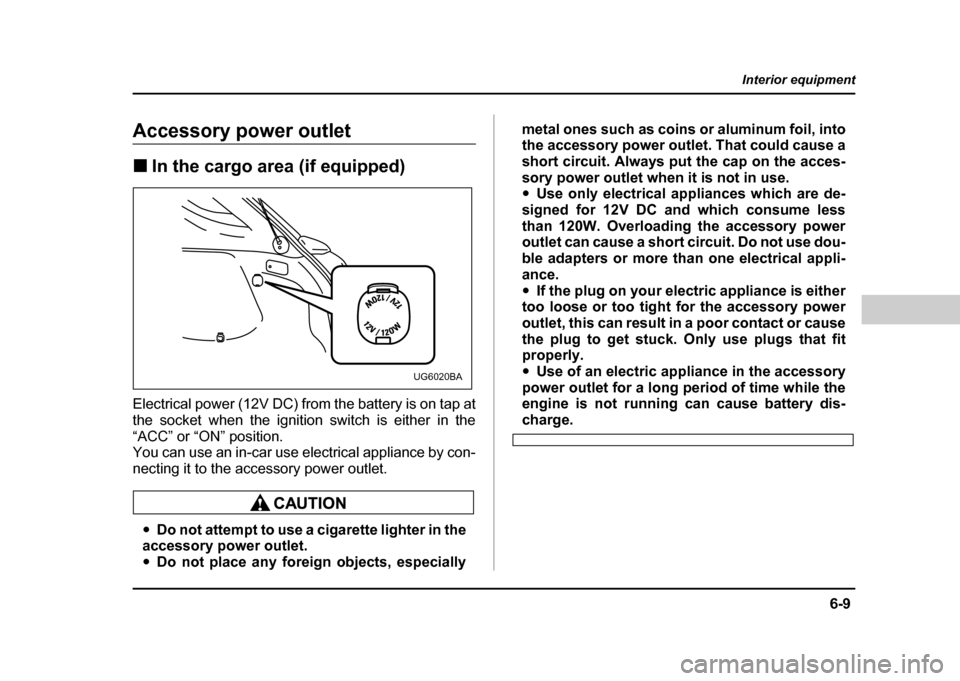
Accessory power outlet !In the cargo area (if equipped)
Electrical power (12V DC) from the battery is on tap at
the socket when the ignition switch is either in the
“ACC” or “ON” position.
You can use an in-car use electrical appliance by con-
necting it to the accessory power outlet.
" Do not attempt to use a cigarette lighter in the
accessory power outlet. " Do not place any foreign objects, especially metal ones such as coins or aluminum foil, into
the accessory power outlet. That could cause a
short circuit. Always put the cap on the acces-
sory power outlet when it is not in use. "
Use only electrical appliances which are de-
signed for 12V DC and which consume less
than 120W. Overloading the accessory power
outlet can cause a short circuit. Do not use dou-
ble adapters or more than one electrical appli-
ance." If the plug on your electric appliance is either
too loose or too tight for the accessory power
outlet, this can result in a poor contact or cause
the plug to get stuck. Only use plugs that fit
properly. " Use of an electric appliance in the accessory
power outlet for a long period of time while the
engine is not running can cause battery dis-
charge.
UG6020BA
Page 259 of 491
6-10
Interior equipment
Cigarette lighter socket
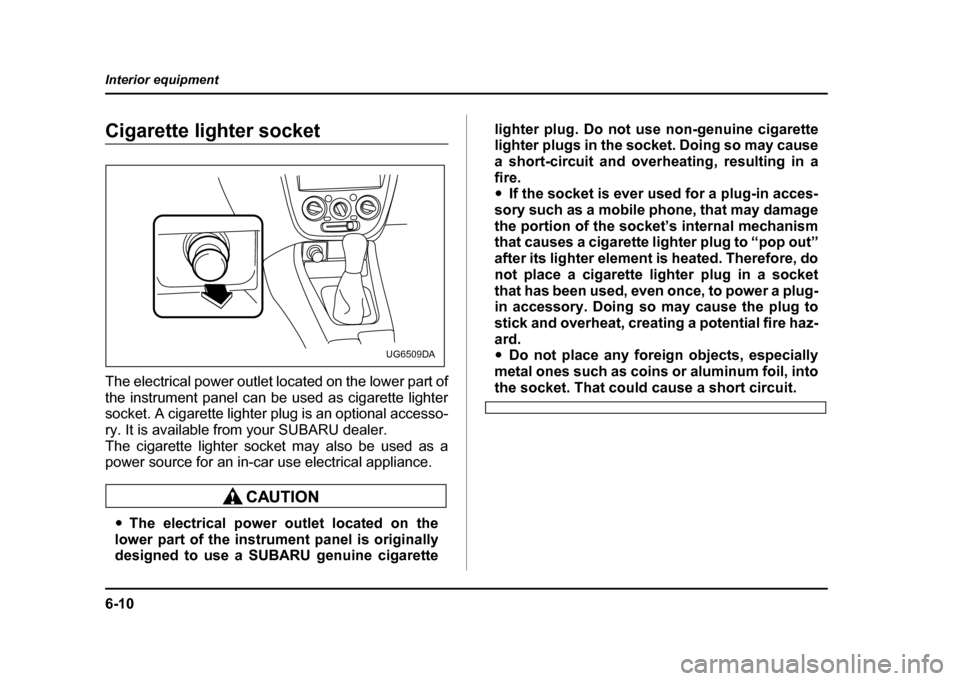
The electrical power outlet located on the lower part of
the instrument panel can be used as cigarette lighter
socket. A cigarette lighter plug is an optional accesso-
ry. It is available from your SUBARU dealer.
The cigarette lighter socket may also be used as a
power source for an in-car use electrical appliance.
"
The electrical power outlet located on the
lower part of the instrument panel is originally
designed to use a SUBARU genuine cigarette lighter plug. Do not use non-genuine cigarette
lighter plugs in the socket. Doing so may cause
a short-circuit and overheating, resulting in afire. "
If the socket is ever used for a plug-in acces-
sory such as a mobile phone, that may damage
the portion of the socket’s internal mechanism
that causes a cigarette lighter plug to “pop out”
after its lighter element is heated. Therefore, do
not place a cigarette lighter plug in a socket
that has been used, even once, to power a plug-
in accessory. Doing so may cause the plug to
stick and overheat, creating a potential fire haz-
ard. " Do not place any foreign objects, especially
metal ones such as coins or aluminum foil, into
the socket. That could cause a short circuit.
UG6509DA
Page 278 of 491
7-9
Starting and operating
– CONTINUED –
Preparing to drive
You should perform the following checks and adjust-
ments every day before you start driving.
1. Check that all windows, mirrors, and lights are
clean and unobstructed.
2. Check the appearance and condition of the tires.
Also check tires for proper inflation.
3. Look under the vehicle for any sign of leaks.
4. Check that the hood, trunk and rear gate are fully
closed.
5. Check the adjustment of the seat.
6. Check the adjustment of the inside and outside mir-
rors.
7. Fasten your seatbelt. Check that your passengers
have fastened their seatbelts.
8. Check the operation of the warning and indicator
lights when the ignition switch is turned to the “ON” po-sition.
9. Check the gauges, indicator and warning lights af-
ter starting the engine.
NOTE
Engine oil, engine coolant, brake fluid, washer flu-
id and other fluid levels should be checked daily,
weekly or at fuel stops.
Starting the engine
Do not operate the starter motor continuously
for more than ten seconds. If the engine fails to
start after operating the starter for five to ten
seconds, wait for ten seconds or more before
trying again.
! Manual transmission vehicle
1. Apply the parking brake.
2. Turn off unnecessary lights and accessories.
3. Press the clutch pedal to the floor and shift the shift
lever into neutral. Hold the clutch pedal to the floor
while starting the engine.
The starter motor will only operate when the clutch
pedal is pressed fully to the floor.
4. Turn the ignition switch to the “ON” position and
check the operation of the warning and indicator lights.
Refer to the “Warning and indicator lights” section (chapter 3).
5. Turn the ignition switch to the “START” position
without depressing the accelerator pedal. Release
the key immediately after the engine has started.
Page 305 of 491
7-36
Starting and operating
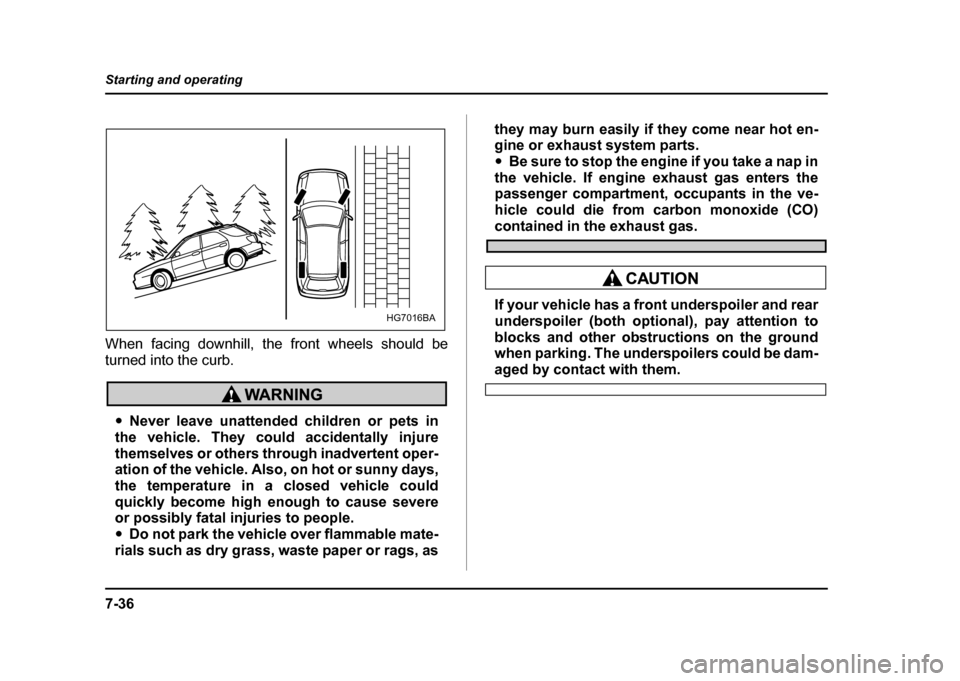
When facing downhill, the front wheels should be
turned into the curb.
"
Never leave unattended children or pets in
the vehicle. They could accidentally injure
themselves or others through inadvertent oper-
ation of the vehicle. Also, on hot or sunny days,
the temperature in a closed vehicle could
quickly become high enough to cause severe
or possibly fatal injuries to people. " Do not park the vehicle over flammable mate-
rials such as dry grass, waste paper or rags, as they may burn easily if they come near hot en-
gine or exhaust system parts. "
Be sure to stop the engine if you take a nap in
the vehicle. If engine exhaust gas enters the
passenger compartment, occupants in the ve-
hicle could die from carbon monoxide (CO)
contained in the exhaust gas.
If your vehicle has a front underspoiler and rear
underspoiler (both optional), pay attention to
blocks and other obstructions on the ground
when parking. The underspoilers could be dam-
aged by contact with them.
HG7016BA
Page 321 of 491

8-10
Driving tips
shallow streams, first check the depth of the water and
the bottom of the stream bed for firmness and ensure
that the bed of the stream is flat. Drive slowly and com-
pletely through the stream. The water should be shal-
low enough that it does not reach the vehicle’s under-
carriage. Water entering the engine air intake or the
exhaust pipe or water splashing onto electrical parts
may damage your vehicle and may cause it to stall.
Never attempt to drive through rushing water; regard-
less of its depth, it can wash away the ground from un-
der your tires, resulting in possible loss of traction and
even vehicle rollover. "
Always check your brakes for effectiveness immedi-
ately after driving in sand, mud or water. Do this by
driving slowly and stepping on the brake pedal. Re-
peat that process several times to dry out the brake
discs and brake pads. " Do not drive or park over or near flammable materi-
als such as dry grass or fallen leaves, as they may
burn easily. The exhaust system is very hot while the
engine is running and right after the engine stops. This
could create a fire hazard." After driving through tall grass, mud, rocks, sand,
rivers, etc., check that there is no grass, bush, paper,
rags, stones, sand, etc. adhering to or trapped on the
underbody. Clear off any such matter from the under-
body. If the vehicle is used with these materials trapped or adhering to the underbody, a mechanical
breakdown or fire could occur. "
Secure all cargo carried inside the vehicle and make
certain that it is not piled higher than the seatbacks.
During sudden stops or jolts, unsecured cargo could
be thrown around in the vehicle and cause injury. Do
not pile heavy loads on the roof. Those loads raise the
vehicle’s center of gravity and make it more prone to
tip over." If you must rock the vehicle to free it from sand or
mud, depress the accelerator pedal slightly and move
the selector lever back and forth between “D” and “R”
repeatedly. Do not race the engine. For the best pos-
sible traction, avoid spinning the wheels when trying to
free the vehicle.
When the road surface is extremely slippery, you can
obtain better traction by starting the vehicle with the
transmission in 2nd than 1st (both for MT and AT). " Never equip your vehicle with tires larger than those
specified in this manual. " Frequent driving of an AWD vehicle under hard-driv-
ing conditions such as rough roads or off roads will ne-
cessitate more frequent replacement of engine oil,
brake fluid and transmission oil than that specified in
the maintenance schedule described in the “Warranty
and Maintenance Booklet”.
Remember that damage done to your Subaru while