2004 SUBARU IMPREZA check oil
[x] Cancel search: check oilPage 322 of 491
8-11
Driving tips
– CONTINUED –
operating it off-road and not using common sense pre-
cautions such as those listed above is not eligible for
warranty coverage."Wash the vehicle’s underbody after off-road driving.
Suspension components are particularly prone to dirt
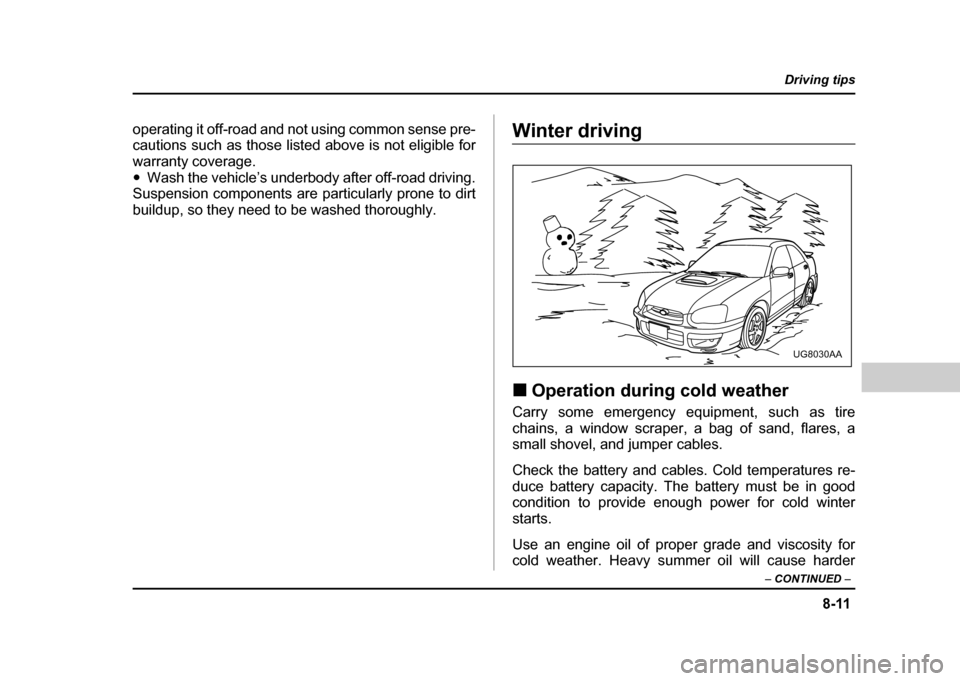
buildup, so they need to be washed thoroughly.Winter driving ! Operation during cold weather
Carry some emergency equipment, such as tire
chains, a window scraper, a bag of sand, flares, a
small shovel, and jumper cables.
Check the battery and cables. Cold temperatures re-
duce battery capacity. The battery must be in good
condition to provide enough power for cold winter starts.
Use an engine oil of proper grade and viscosity for
cold weather. Heavy summer oil will cause harder
UG8030AA
Page 363 of 491
9-12
In case of emergency
surface of the wheel and hub with a cloth.
12.Put on the spare tire. Replace the wheel nuts.
Tighten them by hand.
Do not use oil or grease on the wheel studs or
nuts when the spare tire is installed. This could
cause the nuts to become loose and lead to an
accident.
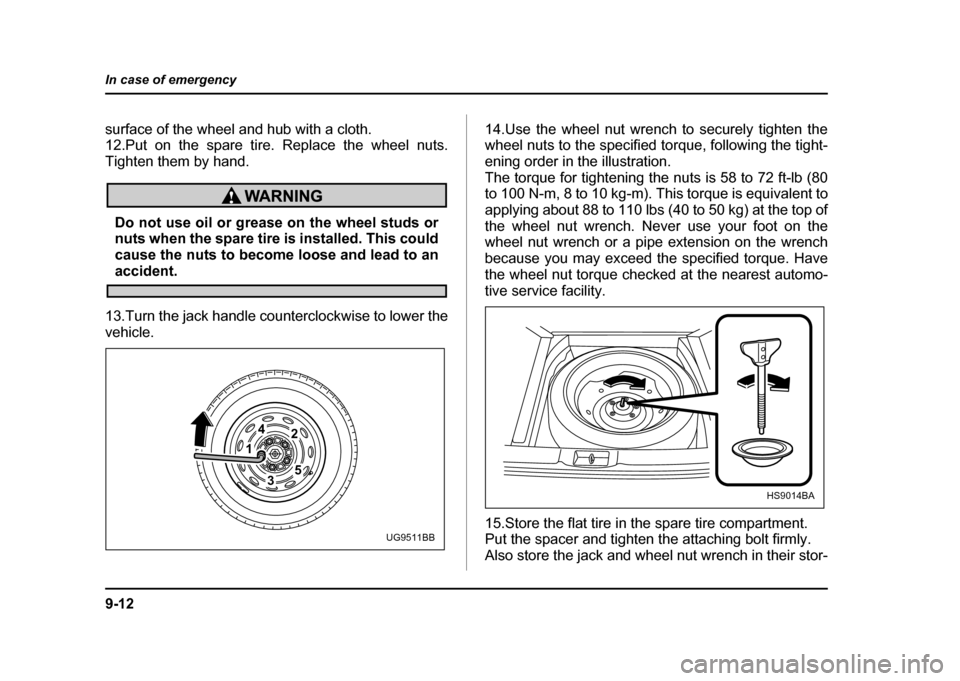
13.Turn the jack handle counterclockwise to lower the
vehicle. 14.Use the wheel nut wrench to securely tighten the
wheel nuts to the specified torque, following the tight-
ening order in the illustration.
The torque for tightening the nuts is 58 to 72 ft-lb (80
to 100 N-m, 8 to 10 kg-m). This torque is equivalent to
applying about 88 to 110 lbs (40 to 50 kg) at the top of
the wheel nut wrench. Never use your foot on the
wheel nut wrench or a pipe extension on the wrench
because you may exceed the specified torque. Have
the wheel nut torque checked at the nearest automo-
tive service facility.
15.Store the flat tire in the spare tire compartment.
Put the spacer and tighten the attaching bolt firmly.
Also store the jack and wheel nut wrench in their stor-
1
42
53
UG9511BB
HS9014BA
Page 372 of 491
9-21
In case of emergency
– CONTINUED –
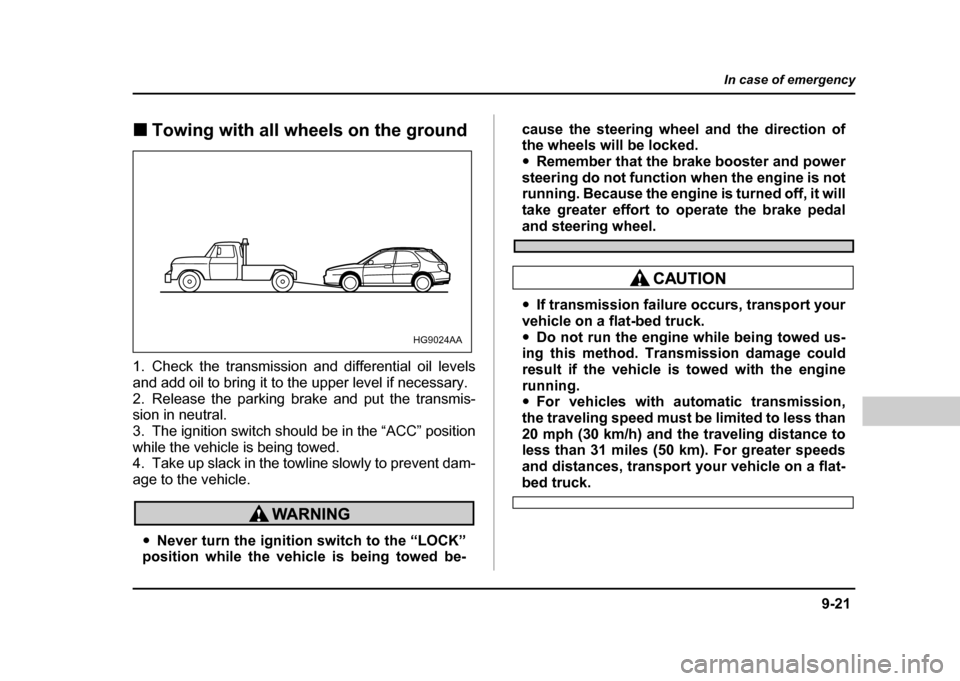
!Towing with all wheels on the ground
1. Check the transmission and differential oil levels
and add oil to bring it to the upper level if necessary.
2. Release the parking brake and put the transmis-
sion in neutral.
3. The ignition switch should be in the “ACC” position
while the vehicle is being towed.
4. Take up slack in the towline slowly to prevent dam-
age to the vehicle.
" Never turn the ignition switch to the “LOCK”
position while the vehicle is being towed be- cause the steering wheel and the direction of
the wheels will be locked. "
Remember that the brake booster and power
steering do not function when the engine is not
running. Because the engine is turned off, it will
take greater effort to operate the brake pedal
and steering wheel.
" If transmission failure occurs, transport your
vehicle on a flat-bed truck. " Do not run the engine while being towed us-
ing this method. Transmission damage could
result if the vehicle is towed with the engine
running. " For vehicles with automatic transmission,
the traveling speed must be limited to less than
20 mph (30 km/h) and the traveling distance to
less than 31 miles (50 km). For greater speeds
and distances, transport your vehicle on a flat-
bed truck.
HG9024AA
Page 386 of 491

11 - 1
11
Maintenance and service
Maintenance schedule ................................. 11-3
Maintenance precautions ............................ 11-3 Before checking or servicing in the engine compartment .................................................. 11-4
When you do checking or servicing in the engine compartment while the engine is
running ............................................................ 11-5
Engine hood .................................................. 11-5
Engine compartment overview ................... 11-8 2.5 liter model .................................................... 11-8
2.0 liter (Turbo) model ...................................... 11-9
2.5 liter (Turbo) model ...................................... 11-10
Engine oil ...................................................... 11-11 Checking the oil level ....................................... 11-11
Changing the oil and oil filter .......................... 11-12
Recommended grade and viscosity ................ 11-16
Recommended grade and viscosity under severe driving conditions .............................. 11-18
Synthetic oil ....................................................... 11-18
Cooling system ............................................. 11-18 Cooling fan, hose and connections ................ 11-19
Engine coolant .................................................. 11-19
Air cleaner element ...................................... 11-23 Replacing the air cleaner element ................... 11-23
Spark plugs ................................................... 11-26 Recommended spark plugs ............................. 11-27
Drive belts ..................................................... 11-27
Manual transmission oil ............................... 11-28 Checking the oil level ....................................... 11-28
Recommended grade and viscosity ................ 11-30 Automatic transmission fluid ...................... 11-31
Checking the fluid level .................................... 11-31
Recommended fluid ......................................... 11-32
Front differential gear oil (AT vehicles) ...... 11-33 Checking the oil level ....................................... 11-33
Recommended grade and viscosity ............... 11-33
Rear differential gear oil ............................... 11-34 Checking the gear oil level .............................. 11-34
Recommended grade and viscosity ............... 11-35
Power steering fluid ...................................... 11-36 Checking the fluid level .................................... 11-36
Recommended fluid ......................................... 11-37
Brake fluid ..................................................... 11-37 Checking the fluid level .................................... 11-37
Recommended brake fluid ............................... 11-38
Clutch fluid (MT vehicles) ............................ 11-38 Checking the fluid level .................................... 11-38
Recommended clutch fluid .............................. 11-39
Brake booster ................................................ 11-40
Brake pedal .................................................... 11-40 Checking the brake pedal free play ................ 11-40
Checking the brake pedal reserve distance ... 11-41
Clutch pedal (MT vehicles) ........................... 11-41 Checking the clutch function .......................... 11-41
Checking the clutch pedal free play ............... 11-42
Replacement of brake pad and lining ......... 11-42 Breaking-in of new brake pads and linings .... 11-43
Parking brake stroke .................................... 11-44
Tires and wheels ........................................... 11-44
Page 389 of 491
11 - 4
Maintenance and service
the materials in the vehicle may be hazardous if
improperly used or handled, for example, bat- tery acid."
Your vehicle should only be serviced by per-
sons fully competent to do so. Serious person-
al injury may result to persons not experienced
in servicing vehicles. " Always use the proper tools and make certain
that they are well maintained. " Never get under the vehicle supported only
by a jack. Always use a safety stands to sup-
port the vehicle. " Never keep the engine running in a poorly
ventilated area, such as a garage or other
closed areas. " Do not smoke or allow open flames around
the fuel or battery. This will cause a fire. " Because the fuel system is under pressure,
replacement of the fuel filter should be per-
formed only by your SUBARU dealer. " Wear adequate eye protection to guard
against getting oil or fluids in your eyes. If
something does get in your eyes, thoroughly
wash them out with clean water. " Do not tamper with the wiring of the SRS air-
bag system or seatbelt pretensioner system, or
attempt to take its connectors apart, as that may activate the system or it can render it inop-
erative. The wiring and connectors of these
systems are yellow for easy identification. NEV-
ER use a circuit tester for these wiring.
If your SRS airbag or seatbelt pretensioner
needs service, consult your nearest SUBARU
dealer.
! Before checking or servicing in the en-
gine compartment
"Always stop the engine and set the parking
brake firmly to prevent the vehicle from mov-
ing. " Always let the engine cool down. Engine
parts become very hot when the engine is run-
ning and remain hot for some time after the en-
gine is stopped. " Do not spill engine oil, engine coolant, brake
fluid or any other fluid on hot engine compo-
nents. This may cause a fire. " Always remove the key from the ignition
switch. When the ignition switch is in the “ON”
position, the cooling fan may operate suddenly
Page 396 of 491
11-11
Maintenance and service
– CONTINUED –
Engine oil !Checking the oil level
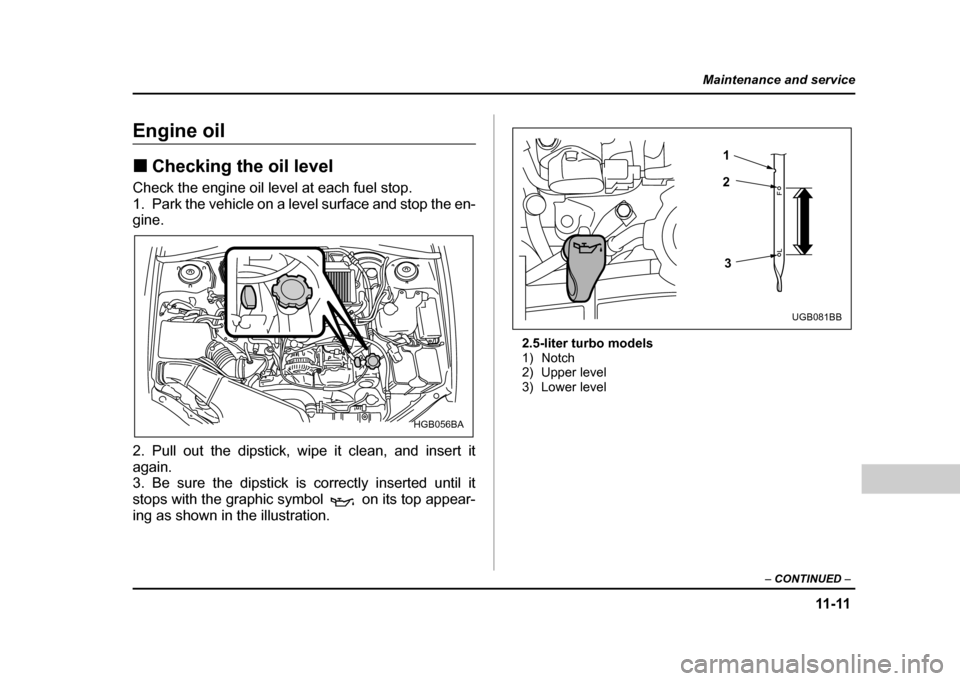
Check the engine oil level at each fuel stop.
1. Park the vehicle on a level surface and stop the en-
gine.
2. Pull out the dipstick, wipe it clean, and insert it
again.
3. Be sure the dipstick is correctly inserted until it
stops with the graphic symbol on its top appear-
ing as shown in the illustration. 2.5-liter turbo models
1) Notch
2) Upper level
3) Lower level
HGB056BA
1 2
3
UGB081BB
Page 397 of 491
11 - 1 2
Maintenance and service
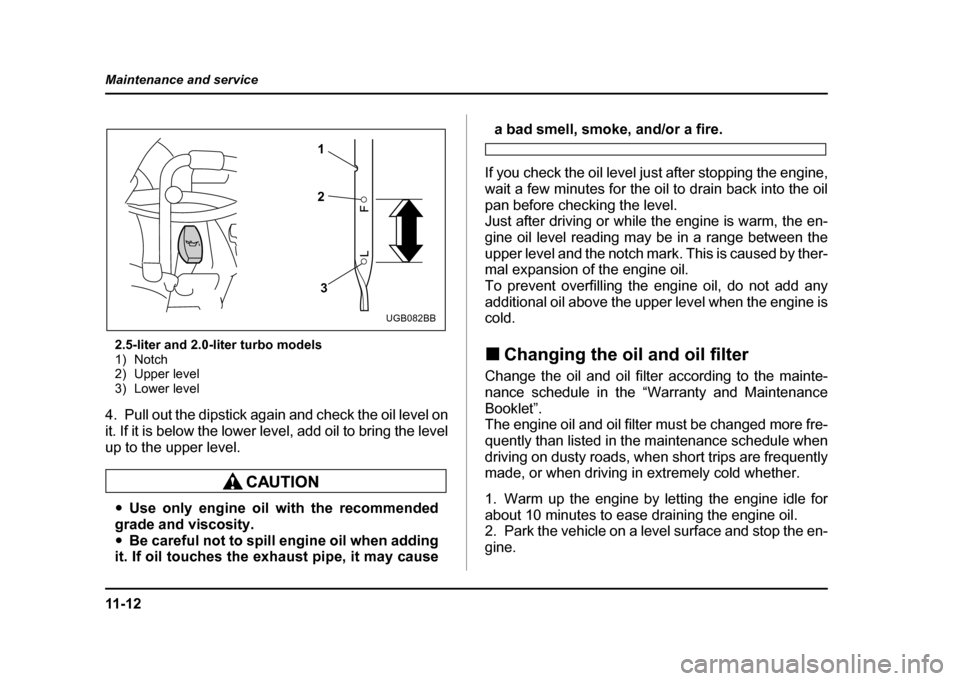
2.5-liter and 2.0-liter turbo models
1) Notch
2) Upper level
3) Lower level
4. Pull out the dipstick again and check the oil level on
it. If it is below the lower level, add oil to bring the level
up to the upper level.
" Use only engine oil with the recommended
grade and viscosity. " Be careful not to spill engine oil when adding
it. If oil touches the exhaust pipe, it may cause
a bad smell, smoke, and/or a fire.
If you check the oil level just after stopping the engine,
wait a few minutes for the oil to drain back into the oil
pan before checking the level.
Just after driving or while the engine is warm, the en-
gine oil level reading may be in a range between the
upper level and the notch mark. This is caused by ther-
mal expansion of the engine oil.
To prevent overfilling the engine oil, do not add any
additional oil above the upper level when the engine iscold. ! Changing the oil and oil filter
Change the oil and oil filter according to the mainte-
nance schedule in the “Warranty and Maintenance Booklet”.
The engine oil and oil filter must be changed more fre-
quently than listed in the maintenance schedule when
driving on dusty roads, when short trips are frequently
made, or when driving in extremely cold whether.
1. Warm up the engine by letting the engine idle for
about 10 minutes to ease draining the engine oil.
2. Park the vehicle on a level surface and stop the en-
gine.
1 2
3
UGB082BB
Page 400 of 491
11 -1 5
Maintenance and service
– CONTINUED –
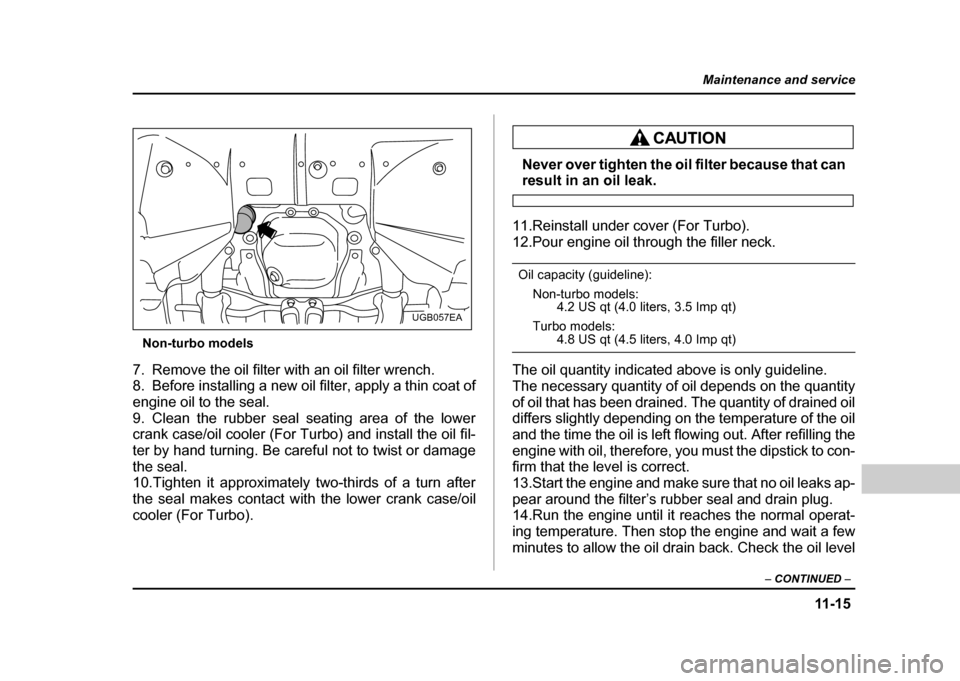
Non-turbo models
7. Remove the oil filter with an oil filter wrench.
8. Before installing a new oil filter, apply a thin coat of
engine oil to the seal.
9. Clean the rubber seal seating area of the lower
crank case/oil cooler (For Turbo) and install the oil fil-
ter by hand turning. Be careful not to twist or damage
the seal.
10.Tighten it approximately two-thirds of a turn after
the seal makes contact with the lower crank case/oil
cooler (For Turbo).
Never over tighten the oil filter because that canresult in an oil leak.
11.Reinstall under cover (For Turbo).
12.Pour engine oil through the filler neck.
Oil capacity (guideline): Non-turbo models: 4.2 US qt (4.0 liters, 3.5 Imp qt)
Turbo models:
4.8 US qt (4.5 liters, 4.0 Imp qt)
The oil quantity indicated above is only guideline.
The necessary quantity of oil depends on the quantity
of oil that has been drained. The quantity of drained oil
differs slightly depending on the temperature of the oil
and the time the oil is left flowing out. After refilling the
engine with oil, therefore, you must the dipstick to con-
firm that the level is correct.
13.Start the engine and make sure that no oil leaks ap-
pear around the filter’s rubber seal and drain plug.
14.Run the engine until it reaches the normal operat-
ing temperature. Then stop the engine and wait a few
minutes to allow the oil drain back. Check the oil level
UGB057EA