2004 SKODA SUPERB fuel
[x] Cancel search: fuelPage 213 of 270

Inspecting and Replenishing
212
Note
•Before a long drive we recommend that you purchase and carry with
you engine oil which complies with the specification for your vehicle.
Consequently, you will always have the correct engine oil for refilling.
•We recommend using a preservative from the Škoda original accesso-
ries offered by your Škoda dealer.
•For further information - see Service Schedule.
Inspecting the engine oil level
The dipstick indicates the level of oil in the engine.
Checking the oil level
– Park the vehicle on a horizontal surface.
– Switch the engine off. – Open the bonnet
⇒ in “Working in the engine compart-
ment” on page 209.
– Wait a few minutes and pull out the oil dipstick.
– Wipe off the dipstick with a clean cloth and insert it again fully.
– After this, once again withdraw the dipstick and read off the oil level ⇒fig. 161 .
Oil level within range
– You must not top up the oil.
Oil level within range
–You may top up the oil. It is possible that the oil level may then
be within range after doing this.
Oil level within range
–You must top up the oil ⇒page 213. It is sufficient, once this
is done, to keep the oil level is within range .
It is normal for the engine to consume oil. The oil consumption may be as
much as 0.5 l/1 000 km depending on your style of driving and the condi-
tions under which you operate your vehicle. The oil consumption may be
slightly higher than this during the first 5 000 kilometres.
One should therefore check the oil level at regular intervals, preferably
every time after the fuel tank is filled or after driving for long stretches.
We recommend maintaining the oil level within the range if the engine
has been operating at high loads, for example during a lengthy motorway
trip during the summer months, towing a trailer or negotiating a high
mountain pass, but not above this.
Fig. 161 Dipstick
Aa
Ab
Aa
Ac
Ab
Aa
Page 226 of 270

Wheels and Tyres225
Using the systemSafetyDriving TipsGeneral MaintenanceBreakdown assistanceTechnical Data
Wheels and Tyres
Wheels
General comments
•New tyres do not offer optimal grip at first and should therefore be run
in for about 500 km at a moderate speed and an appropriately cautious
style of driving. You will also profit from longer tyre life.
•The tread depth of new tyres may differ because of design features
and the configuration of the tread (depending on the type of tyre and the
manufacturer).
•Drive over curbs on the side of the road and other such obstacles
slowly and, where possible, at a right angles in order to avoid damage to
tyres and wheel trims.
•Inspect your tyres from time to time for damage (punctures, cuts, splits
and bulges). Remove foreign bodies from the tyre profile.
•Damage to tyres and wheels is frequently not visible. Unusual vibra-
tions or pulling of the vehicle to one side could be a sign of tyre damage.
Please reduce your speed immediately and stop if you suspect that
a wheel is damaged. Inspect the tyres for signs of damage (bulges,
splits, etc.) If no visible damage is present, please drive at an appropri-
ately slow speed and carefully to the nearest Škoda dealer in order to
have your vehicle inspected.
•Also protect your tyres from contact with oil, grease and fuel.
•Immediately replace any dust caps of the valves which have got lost.
•Mark wheels before removing them so that their previous direction of
running can be maintained when mounted them again.
•Always store wheels or tyres which been removed in a cool, dry and,
where possible, dark place. Tyres which are not fixed to a wheel trim
should be stored upright. Unidirectional tyres*
The direction of rotation of the tyres is marked by arrows on the wall of the
tyre. This indicates the direction of rotation of the tyre, and it is essential
that the tyres are fitted on to run in this direction. Only then are the tyres
able to provide the optimal properties in terms of grip, low noise, wear-
and-tear and aquaplaning.
Further information concerning the use of unidirectional tyres
⇒
page 231.
WARNING
•New tyres during the first 500 km do not offer optimal grip and
should therefore be run approp riately - risk of accident!
•Never drive with damaged tyres - risk of accident!
Note
Please observe the various differing legal requirements regarding tyres.
Page 227 of 270

Wheels and Tyres
226
Tyre life
The life of your tyres very much depends on the following points: Tyre pressure
The working life of tyres will be shortened considerably if the tyres are
insufficiently or over-inflated and this will have an adverse effect on the
handling of your vehicle.
Check the inflation pressure of the tyres at least once a month. The tyre
inflation pressures for summer tyres
are indicated on the inside of the
fuel filler flap ⇒ fig. 169. The inflation pressures for winter tyres are
20 kPa (0.2 bar) higher than those for summer tyres ⇒page 230.
Correctly inflated tyres are of particular importance when travelling at high
speeds . It is therefore good to check the pressure at least once a month
and also before setting off on a long trip. Please do not forget the spare
wheel when checking the tyres.
The tyre pressure should be at the highest pressure specified for your
vehicle at all times.
On cars with full wheel trim, valve extensions are fitted in place of dust
caps ⇒fig. 170 . It is not necessary to unscrew the valve extensions in
order to check and alter the inflation pressure of the tyre.
Always check the inflation pressure of tyres when cold. Do not reduce the
higher pressure of warm tyres. Adapt the inflation pressure of the tyres
accordingly if your vehicle is carrying a significantly higher payload.
Driving style
Fast cornering, sharp acceleration and braking (squealing tyres) increase
wear-and-tear on your tyres.
Balancing wheels
The wheels of a new vehicle are balanced. There are a wide range of influ-
ences when driving which may result in an imbalance and which makes
themselves felt through vibration in the steering.
You should have the wheels rebalanced since any imbalance increases
wear-and-tear on the steering, the suspension and tyres. A wheel must
Fig. 169 An opened
fuel filler flap with the
tyre inflation pressure
table
Fig. 170 Wheel with
full trim and extended
valve
Page 228 of 270

Wheels and Tyres227
Using the systemSafetyDriving TipsGeneral MaintenanceBreakdown assistanceTechnical Data
also be rebalanced when a new tyre is fitted and each time a tyre is
repaired.
Wheel alignment errors
Incorrect wheel alignment at the front and rear will not only increase wear-
and-tear on the tyres but will also has an adverse effect on vehicle safety.
Contact your Škoda dealer if you notice any unusual tyre wear.
WARNING
•If the inflation pressure is too low, the tyre must perform a
greater flexing work. At higher speeds the tyre will warm up as a
result of this. This can result in tread separation and even a tyre
blowout.
•Immediately replace the damaged rims or tyres.
For the sake of the environment
Tyres which are insufficiently inflated increase your fuel consumption.
Wear indicators
The base of the tread of the original tyres has wear indicators 1.6 mm
high, installed at right angles to the direction of travel. These wear indica-
tors are located at 6 to 8 points depending on the make and are evenly
spaced around the circumference of the tyre ⇒fig. 171 . Markings on the
walls of the tyres through the letters “TWI”, triangular symbols or other
symbols identify the position of the wear indicators.
A remaining tread of just 1.6 mm, measured in the grooves of the tread
next to the wear indicators, means that your tyres have reached their
legally permissible minimum tread depth.
WARNING
•You must have your tyres replaced with new ones at the latest
when the wear indicators have been worn down. The legally
permissible minimum tread depth should be observed.
•Worn tyres do not provide the necessary adhesion to the road
surface at high speeds on wet roads. One could experience “aqua-
Fig. 171 Tyre tread
with wear indicators
Page 232 of 270

Wheels and Tyres231
Using the systemSafetyDriving TipsGeneral MaintenanceBreakdown assistanceTechnical Data
You can also fit so-called “all-weather tyres” instead of winter tyres.
Please contact your Škoda dealer If there are any points which are not
clear who will be able to provide you with information regarding the
maximum speed fo
r your tyres.
WARNING
You must on no account drive your car at more than the permis-
sible maximum speed for your winter tyres - risk of an accident
resulting from tyre damage and loss of control over your car.
For the sake of the environment
Fit your summer tyres on again in good time since summer tyres offer you
better grip and handling on roads which are free of snow and ice as well
as ar temperatures below 7 °C - the braking distance is shorter, there is
less tyre noise, tyre wear is reduced and fuel consumption is reduced.
Note
Please observe the various differing legal requirements regarding tyres.
Unidirectional tyres*
The direction of rotation of the tyres is marked by arrows on the wall of
the tyre . This indicates the direction of rotation of the tyre, and it is essen-
tial that the tyres are fitted on to run in this direction. Only then are the
tyres able to provide the optimal properties in terms of grip, low noise,
wear-and-tear and aquaplaning.
Should it be necessary to fit on a spare wheel in exceptional cases with a
tyre not dedicated to the running direction or in opposite running direction,
please adopt a cautious style of driving as the tyre is no longer able to provide optimal grip and handling in such a situation. This particularly
important on wet roads. Please refer to the notes
⇒page 237, “Spare
wheel”.
You should have the defective tyre replaced as soon as possible and
restore the correct direction of rotation on all tyres
Snow chains
Snow chains can be used only for wheel sizes 6J x 16 ET 40 or 6J x 16
ET 37. Your Škoda Dealer can provide you with more detailed information.
Snow chains must only be mounted on the front wheels.
When driving on wintry roads, snow chains improve not only traction, but
also the braking performance.
Only use fine-link snow chains . They must not project more than 15 mm
- including the chain lock.
Remove the full wheel trim if you wish to fit snow chains to the wheels.
Observe the national legal requirements relating to the maximum vehicle
speed with snow chains.
WARNING
Please pay attention to the information in the supplied fitting
instructions of the snow chain manufacturer.
Caution
You must take the chains off as soon as you drive on roads which are free
of snow. They adversely affect the handling of your vehicle, damage the
tyres and are rapidly destroyed.
Page 238 of 270
Breakdown assistance237
Using the systemSafetyDriving TipsGeneral MaintenanceBreakdown assistanceTechnical Data
•Hook for pulling off a full wheel trim
•Plastic clip for a wheel bolt cover
•Wheel wrench
•Assembly pin for changing wheel
•Screwdriver with reversible blade
•10 x 13 open-end wrench
•Adapter for the wheel bolts lock
After using the lifting jack, screw in the arm of the lifting jack fully before
placing it back in its stowage area.
WARNING
•The hexagon socket in the handle of the screwdriver should
only be used to fit on the wheel bolts. Never use the hexagon
socket of the screwdriver for tightening the wheel bolts because
you will not be able to achieve the necessary tightening torque with
the hexagon socket - risk of accident!
•The factory-supplied lifting jack is only intended for your model
of vehicle. On no account attempt to lift a heavier vehicle or other
loads - risk of injury!
•Ensure that the vehicle tool kit is safely attached in the luggage
compartment.
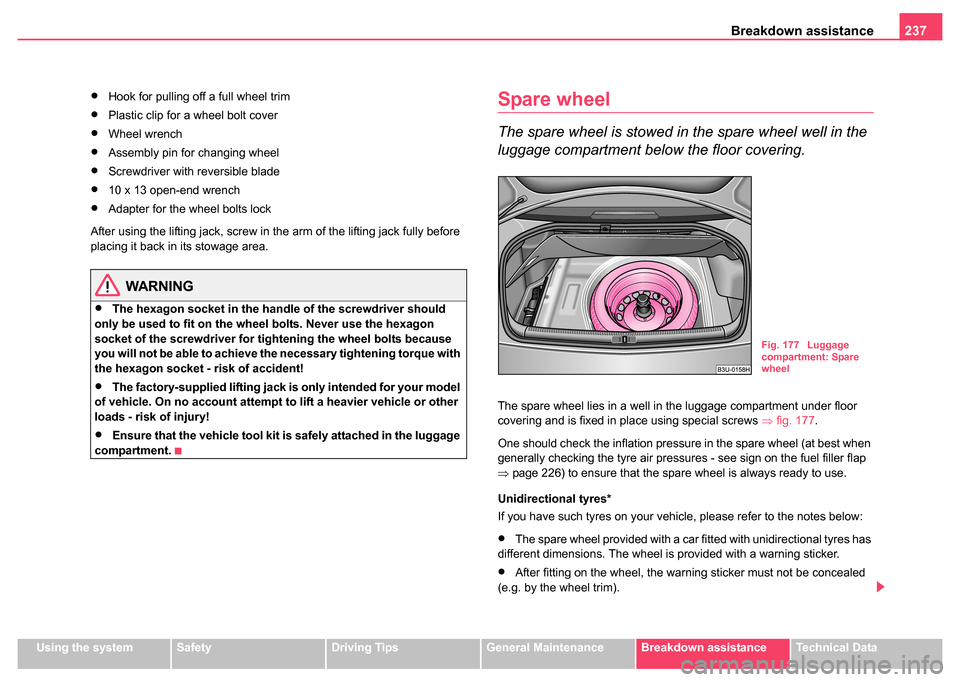
Spare wheel
The spare wheel is stowed in the spare wheel well in the
luggage compartment below the floor covering.
The spare wheel lies in a well in the luggage compartment under floor
covering and is fixed in place using special screws ⇒fig. 177 .
One should check the inflation pressure in the spare wheel (at best when
generally checking the tyre air pressures - see sign on the fuel filler flap
⇒ page 226) to ensure that the spare wheel is always ready to use.
Unidirectional tyres*
If you have such tyres on your vehicle, please refer to the notes below:
•The spare wheel provided with a car fitted with unidirectional tyres has
different dimensions. The wheel is provided with a warning sticker.
•After fitting on the wheel, the warning sticker must not be concealed
(e.g. by the wheel trim).
Fig. 177 Luggage
compartment: Spare
wheel
Page 248 of 270

Breakdown assistance247
Using the systemSafetyDriving TipsGeneral MaintenanceBreakdown assistanceTechnical Data
out the battery being ignited by the strong spark which results from
the engine being started.
•Do not affix the cable end to parts of the fuel and brake
system.
•Run the jump-start cables so that they cannot be caught by any
rotating parts in the engine compartment.
•Do not bend over the batteries - risk of caustic burns!
•The vent screws of the battery cells must be tightened firmly.
•Keep any sources of ignition (naked flame, smouldering ciga-
rettes etc.) away from the battery - risk of an explosion!
Tow-starting and towing vehicle
General
Please pay attention to the following instructions if you are going
to use a tow rope:
Driver of the towing vehicle
– Do not drive off until the tow rope is taught.
– Release the clutch particularly gently when starting off or depress the accelerator particularly gently if your vehicle is
fitted with an automatic gearbox. Driver of the towed vehicle
– Switch the ignition on so that the steering wheel is not blocked
and you can also operate the turn signal lights, the headlight
flasher, the windscreen wipers and windscreen washer
system.
– Take the vehicle out of gear or move the selector lever into position N if your vehicle is fitted with an automatic gearbox.
– Note that the brake servo unit and power steering only operate if the engine is running. You will require significantly greater
physical force to depress the brake pedal and to steer the
vehicle if the engine is not running.
– Ensure that the tow rope is always kept taught.
Tow rope or tow bar
A tow bar is safest way of towing a vehicle and also minimizes any
shocks. You can use a tow rope only if a suitable tow bar is not available.
The tow rope must be elastic to protect the vehicle. Thus one should only
use plastic fibre rope or a rope made out of a similarly elastic material.
Attach the tow rope or the tow bar only to the towing eyes provided for
this purpose ⇒page 248, “Front towing eye” and ⇒page 248, “Rear
towing eye”.
Driving style
Towing another vehicle requires a certain amount of practice. Both drivers
should be familiar with the particular points about towing a vehicle.
Unskilled drivers should not attempt to tow in another vehicle or to be
towed in.
One should be constantly vigilant not to allow impermissibly high towing
forces or jerky loadings. There is always a risk of excessive stresses and
WARNING (continued)
A4
Page 250 of 270

Breakdown assistance249
Using the systemSafetyDriving TipsGeneral MaintenanceBreakdown assistanceTechnical Data
For technical reasons it is not possible to tow-start a car fitted with an
automatic gearbox
.
WARNING
There is high risk of having an accident when tow-starting a
vehicle, when for example the towe d vehicle runs into the towing
vehicle.
Caution
Vehicles which are fitted with a catalytic converter should not be tow-
started over a distance of more than 50 metres. Unburnt fuel may get into
the catalytic converter and damage it.
Towing in a vehicle fitted with a manual gearbox
Please refer to the notes ⇒page 247.
The car can be towed in with a tow bar or a tow rope or with the front or
rear wheels raised. The maximum towing speed is 50 km/h.
Towing of a vehicle with an automatic gearbox
Please refer to the notes ⇒page 247.
The car can be towed in with a tow bar or a tow rope. Refer at the same
time to the following guidelines:
•Move selector lever into N .
•The maximum towing speed is 50 km/h.
•The maximum permissible towing distance is 50 km. The gear oil
pump does not operate when the engine is not running and the gear would
not be adequately lubricated at higher speeds and over longer towing
distance.
Caution
If the vehicle is towed in by a recovery vehicle, it should only be towed in
with the front wheels raised. If the vehicle is raised at rear, the automatic
gearbox is damaged!
Note
The vehicle must be transported on a special vehicle or trailer if it is not
possible to tow in the vehicle in the way described or if the towing distance
is greater than 50 km.