2004 SKODA SUPERB lights
[x] Cancel search: lightsPage 36 of 270

Instruments and Indicator/Warning Lights35
Using the systemSafetyDriving TipsGeneral MaintenanceBreakdown assistanceTechnical Data
The warning light comes on for a few seconds after the ignition has been
switched on or when starting the engine. The warning light goes out after
an automatic check sequence has been completed.
A fault in the ABS
The system is not functioning properly if the warning light
does not go
out within a few seconds after switching on the ignition, does not light up
at all or lights up while driving. The vehicle will only be braked by the
normal brake system without the effect of the ABS function. Visit a Škoda
dealer as quickly as possible and adjust your style of driving in the mean-
time since you will not know how great the damage is.
Three additional warning tones will sound if there is a major fault in the
ABS.
Further information about ABS ⇒page 179, “Antilock brake system
(ABS)”.
A fault in the entire brake system
If the ABS warning light
comes on together with the brake system
warning light (handbrake must be released), there is a fault not only in
the ABS but also in another part of the brake system ⇒ .
The following text will be displayed in the information display*: STOP BRAKE FAULT SERVICE MANUAL
Electronic Differential Lock (EDL)
The EDL is a part of the ABS. A fault in the EDL is indicated by the ABS
warning light
in the instrument cluster. Have the vehicle inspected
without delay by a Škoda dealer. Further information on the
EDL ⇒page 177.
WARNING
•If the brake system warning light comes on together with the
ABS warning light stop the vehicle immediately and check the brake fluid level in the reservoir⇒
page 217, “Brake fluid” . If the
brake fluid level has dropped below the MIN marking, do not drive
any further - risk of accident! Contact a Škoda dealer to obtain
professional assistance.
•Pay attention to the following instructions ⇒page 209,
“Working in the engine compartment” before checking the brake
fluid level and opening the bonnet.
Electronic immobiliser
Data is compared between the ignition key and the control unit when
switching on the ignition. The indicator light will light up for a few
seconds when ignition key authorisation is confirmed.
The warning light will start flashing continuously if a non-authorised igni-
tion key (for example the wrong ignition key) has been used. The engine
cannot be started ⇒page 40.
It is only possible to start the engine of the vehicle with a Genuine Škoda
key with the matching code.
Brake system
The warning light flashes or comes on if the brake fluid level is too low,
if there is a fault in the ABS or if the handbrake is applied.
If the warning light
flashes (handbrake is not applied), stop and check
the brake fluid level ⇒.
WARNING (continued)
Page 37 of 270

Instruments and Indicator/Warning Lights
36
The following text will be displayed in the information display*:
STOP BRAKE FLUID SERVICE MANUAL
If there is a fault in the ABS which also influences the function of the
normal brake system (e.g. distribution of brake pressure), the ABS
warning light
comes on together with the brake system warning light . Be aware that not only the ABS but also another part of th brake
system is defective ⇒.
3 peeps sound as an additional warning signal.
One should get used to high pedal forces, long braking distances and long
free play of the brake pedal when driving to the next Škoda dealer.
The following text will be displayed in the information display*: STOP BRAKE FAULT SERVICE MANUAL
For further information on the brake system ⇒page 178, “Brakes”
Handbrake applied
The warning light
also comes on if the handbrake is applied. An audible
warning is also given if you drive the vehicle for at least 3 seconds at a
speed of more than 6 km/h.
The following text will be displayed in the information display*:
HANDBRAKE ON
WARNING
•Pay attention to the following instructions ⇒page 209,
“Working in the engine compartment”before checking the brake
fluid level and opening the bonnet.
•If the brake system warning light does not go out a few
seconds after switching on the ignition or comes on when driving,
stop immediately and check the brake fluid in the
reservoir ⇒page 217, “Brake fluid”. If the fluid level has dropped below the MIN marking, do not drive any further - risk of accident!
Contact a Škoda dealer to obtain professional assistance.
Dynamo
The warning light comes on after the ignition has been switched on. It
should go out after the engine has started.
If the warning light does not go out after the engine has started, or comes
on when driving, drive to the nearest Škoda Dealer. The vehicle battery
will be discharged in this case so switch off all non-essential electrical
components.
The following text will be displayed in the information display*:
ALTERNATOR WORKSHOP!
Caution
If the warning light comes on when driving and in addition the warning
light (cooling system fault) also comes on in display, you must then
stop the car immediately and switch the engine off - risk of engine
damage!
Seat belt warning light
The warning light comes on for a few seconds after the ignition is
switched on as a reminder to fasten the seat belt.
If you do not fasten the seat belt, a long warning signal sounds for 6
seconds.
WARNING (continued)
Page 38 of 270

Instruments and Indicator/Warning Lights37
Using the systemSafetyDriving TipsGeneral MaintenanceBreakdown assistanceTechnical Data
For further information on the seat belts
⇒page 145.
The following text will be displayed in the information display*:
FASTEN SEATBELT
For further information on the seat belts ⇒page 145, “Seat belts”.
Page 44 of 270
Unlocking and locking43
Using the systemSafetyDriving TipsGeneral MaintenanceBreakdown assistanceTechnical Data
Note
The anti-theft alarm system is also armed when the car is closed without
activating the safe securing system. In this case, always switch off the
interior monitoring sensor* ⇒page 49 first of all to avoid an alarm being
triggered unintentionally.
Unlocking the vehicle using the key
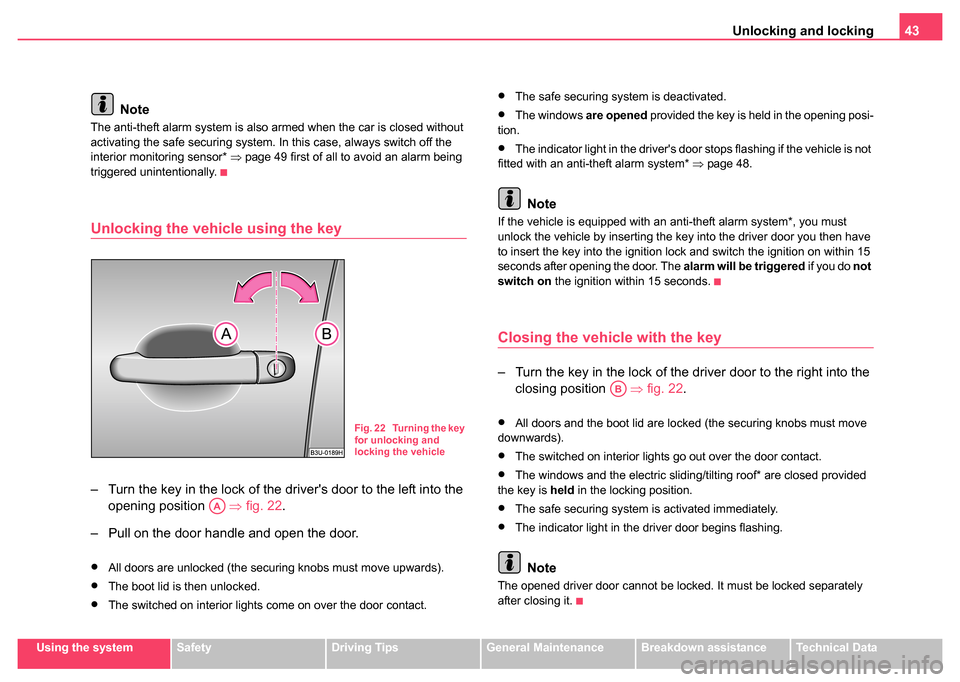
– Turn the key in the lock of the driver's door to the left into the opening position ⇒fig. 22 .
– Pull on the door handle and open the door.
•All doors are unlocked (the securing knobs must move upwards).
•The boot lid is then unlocked.
•The switched on interior lights come on over the door contact.
•The safe securing system is deactivated.
•The windows are opened provided the key is held in the opening posi-
tion.
•The indicator light in the driver's door stops flashing if the vehicle is not
fitted with an anti-theft alarm system* ⇒ page 48.
Note
If the vehicle is equipped with an anti-theft alarm system*, you must
unlock the vehicle by inserting the key into the driver door you then have
to insert the key into the ignition lock and switch the ignition on within 15
seconds after opening the door. The alarm will be triggered if you do not
switch on the ignition within 15 seconds.
Closing the vehicle with the key
– Turn the key in the lock of the driver door to the right into the
closing position ⇒fig. 22.
•All doors and the boot lid are locked (the securing knobs must move
downwards).
•The switched on interior lights go out over the door contact.
•The windows and the electric sliding/tilting roof* are closed provided
the key is held in the locking position.
•The safe securing system is activated immediately.
•The indicator light in the driver door begins flashing.
Note
The opened driver door cannot be locked. It must be locked separately
after closing it.
Fig. 22 Turning the key
for unlocking and
locking the vehicle
AA
AB
Page 45 of 270

Unlocking and locking
44
Buttons for central locking
All the doors ar unlocked or locked using the buttons and .
The buttons also operate if the ignition is switched off, but not if
the vehicle was locked from outside. Locking all doors and the boot lid
– Press button
⇒fig. 23.
Unlocking all door s and the boot lid
– Press button ⇒fig. 23. If the boot lid has been set to the
permanent locking mode, it is then not unlocked ⇒page 45
when the button is pressed.
Unlocking fuel filler flap
– Pull the switch ⇒fig. 24.
Unlocking the boot lid
– Pull the switch ⇒fig. 24.
Blocking boot lid remote release button
– Turn the master key in the lock in direction of arrow ⇒fig. 24.
– The boot lid is unlocked by turning the key in the opposite direction of the arrow.
Lock the boot lid from outside the vehicle ⇒page 45.
The following applies if you have locked your vehicle using the central
locking system ⇒fig. 23:
•It is not possible to open the doors or the boot lid from the outside
(safety feature, e.g. when stopping at traffic lights etc.).
•You can unlock the doors individually from the inside and open them
by pulling the door opening lever.
•Once the driver door is opened it cannot be locked again (after oper-
ating the lock function in the button for the central locking switch) in order
to avoid inadvertently being locked out of the vehicle. You then have to
lock a door separately after closing it.
Fig. 23 Inner part of
driver door: Buttons for
central locking
Fig. 24 Inner part of
driver door: Switches
for opening fuel filler
flap and boot lid
AAAB
AA
AB
AB
AC
AD
AA
Page 48 of 270

Unlocking and locking47
Using the systemSafetyDriving TipsGeneral MaintenanceBreakdown assistanceTechnical Data
Note
•The remote control is automatically deactivated when the ignition is
switched on.
•The operation of the remote control may temporarily be affected by
interference from transmitters close to the car and which operate in the
same frequency range (e.g. mobile phone, TV transmitter).
•The battery must be replaced, ideally by the Škoda dealer, if the
central locking or anti-theft alarm system does react to the remote control
at less than 3 metres away.
Unlocking and locking car
Unlocking the vehicle
– Press button ⇒fig. 27 for about 1 second. Locking the vehicle
– Press button for about 1 second.
Boot lid remote release
– Press button for about 1 second.
Deactivating safe securing system
– Press button zwice in 2 seconds. Further information
⇒page 42.
The turn signal lights flash twice as confirmation that the vehicle has been
unlocked. If you unlock the car with button but do not open a door or
the boot lid within the next 30 seconds, the car locks again automatically.
This function is intended to prevent the car being unlocked unintentionally.
The safe securing system along with the anti-theft alarm system* are,
however, deactivated during these 30 seconds.
If the single door opening function has been activated on your car, you
unlock only the driver door by pressing button once and the complete
vehicle by pressing the button twice ⇒page 41.
In addition, when the car is unlocked, the power seats and exterior mirrors
move into the position assigned to this key. The stored setting of driver
seat and exterior mirrors is retrieved automatically.
When the vehicle is unlocked or locked, the interior lights in the door
contact are automatically switched on or off.
The turn signal lights flash once to confirm that the vehicle has been
correctly locked. If the turn signal lights do not flash, check the doors,
bonnet and boot lid again to ensure that they are closed. If the doors, the
bonnet or the boot lid remain open when the anti-theft alarm system is
activated, the turn signal lights do not flash until after they have been
closed.
Fig. 27 Key: Assign-
ment of buttons
AA
AB
AC
AB
AA
AA
Page 57 of 270

Lights and Visibility
56
Lights and Visibility
Lights
Switching lights on and off
Switching on side lights
– Turn the light switch ⇒fig. 34 into position
.
Switching on the low beam and main beam
– Turn the light switch into position .
– Press the main beam lever forward in order to switch on the main beam ⇒page 59, fig. 38 . Switching off all lights
– Turn the light switch into position O.
Low beam comes on only if the ignition is switched on. The low beam is
switched off automatically when the engine is started and after switching
the ignition off; only the side lights come on.
On models fitted with
right-hand steering* the position of the switches
differs from that shown in ⇒fig. 34 . The symbols which mark the switch
positions are identical, however.
In certain countries, the low beam is on a reduced brightness as well as
the side lights, when the ignition is switched on.
WARNING
Never drive with side lights on - ri sk of accident! The side lights are
not bright enough to light up the road sufficiently in front of you or
to be seen by other oncoming traffic. In this case, always switch on
the low beam when it is dark or if visibilty is poor.
Note
•An audible warning will sound if you withdraw the ignition key and open
the driver's door when the vehicle lights are still on.
•The acoustic warning signal is switched off over the door contact when
the driver's door is closed (ignition off). The vehicle can be parked with the
side lights on.
•If you park the car for a lengthy period, we recommend switching off all
lights, or leaving only the side lights switched on.
Fig. 34 Dash panel:
Light switch
Page 58 of 270

Lights and Visibility57
Using the systemSafetyDriving TipsGeneral MaintenanceBreakdown assistanceTechnical Data
•The switching on of the described lights should only be undertaken in
accordance with the legal requirements.
Fog lights
Switching on the fog lights
– First of all turn the light switch ⇒page 56, fig. 34 into position
or .
– Pull the light switch out to the first detent .
The rear fog light warning light ⇒ page 31 lights up in the instrument
cluster when the fog light is switched off.
The rear fog light
Switching on the rear fog light
– First of all turn the light switch ⇒page 56, fig. 34 into position
or .
– Pull the light switch out to the second detent .
The rear fog light warning light ⇒ page 31 lights up in the instrument
cluster when the fog light is switched off.
Only the rear fog light of the trailer lights up automatically when you are
towing a trailer using a factory-fitted towing device which is fitted with
the rear fog light .
Caution
The rear fog light should only be switched on if visibility is particularly poor
(conform with any varying legal provisions) to avoid dazzling vehicles
behind your vehicle.
Instrument lighting
You can adjust the brightness of the instrument lighting.
– Switch on the light.
– Turn the control dial ⇒fig. 35 to the desired intensity of the
instrument lighting.
A1
A2
Fig. 35 Dash panel:
Instrument lighting