2004 SKODA SUPERB roof
[x] Cancel search: roofPage 56 of 270
Unlocking and locking55
Using the systemSafetyDriving TipsGeneral MaintenanceBreakdown assistanceTechnical Data
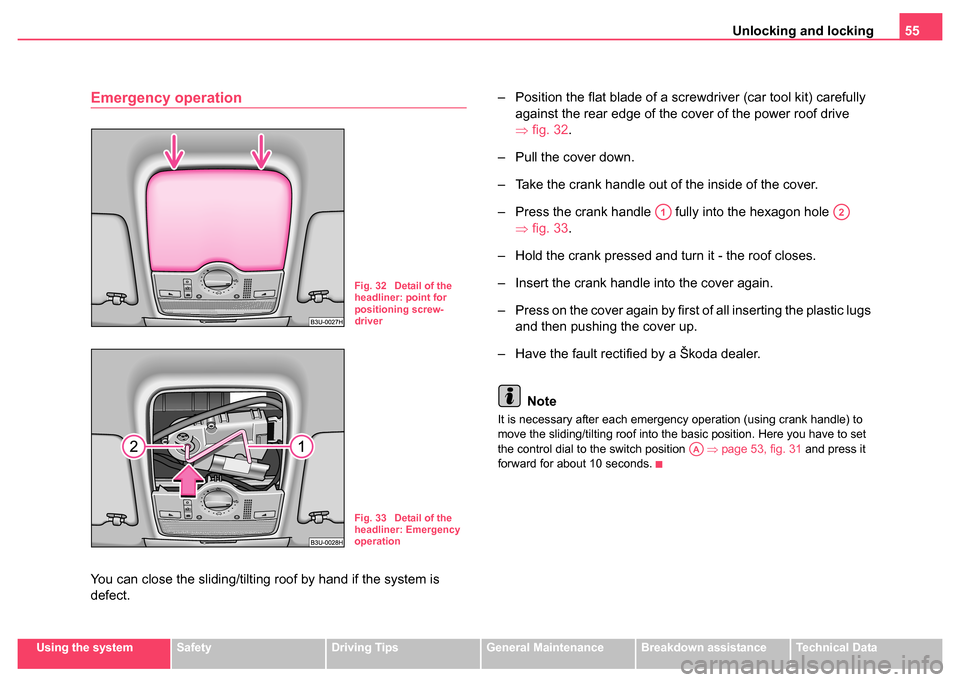
Emergency operation
You can close the sliding/tilting roof by hand if the system is
defect. – Position the flat blade of a screwdriver (car tool kit) carefully
against the rear edge of the cover of the power roof drive
⇒fig. 32 .
– Pull the cover down.
– Take the crank handle out of the inside of the cover.
– Press the crank handle fully into the hexagon hole ⇒fig. 33 .
– Hold the crank pressed and turn it - the roof closes.
– Insert the crank handle into the cover again.
– Press on the cover again by first of all inserting the plastic lugs and then pushing the cover up.
– Have the fault rectified by a Škoda dealer.
Note
It is necessary after each emergency operation (using crank handle) to
move the sliding/tilting roof into the basic position. Here you have to set
the control dial to the switch position ⇒page 53, fig. 31 and press it
forward for about 10 seconds.
Fig. 32 Detail of the
headliner: point for
positioning screw-
driver
Fig. 33 Detail of the
headliner: Emergency
operation
A1A2
AA
Page 62 of 270

Lights and Visibility61
Using the systemSafetyDriving TipsGeneral MaintenanceBreakdown assistanceTechnical Data
Switching the interior light off
– Press the switch on the symbol O.
Front reading lights
– Press on one of the switches ⇒page 60, fig. 39 in order to
switch the right or left reading light on or off.
Lighting of storage compar tment on the front passenger
side
– Open the flap of the storage compartment on the front passenger side, the lighting of the storage compartment
switches on automatically and switches off when the flap is
closed.
If the interior lighting is fitted with a delayed-off control*, the lighting of the
interior of the car remains on for a few seconds after the doors are closed.
The interior light comes on as soon as you unlock the car or open a door
or when the ignition key has been removed. The light goes out again
about 30 seconds after all the doors have been closed. The interior
lighting is switched off when you lock the car or switch the ignition on. This
only applies when the switch for the corresponding interior lights is
standing n the door contact setting.
The interior lighting goes off after about 60 minutes when a door has been
left open in order to avoid discharging the battery of the vehicle.
Two LEDs are integrated in the interior lighting, which illuminates the shift
lever and the middle of the dash panel. They are switched on automati-
cally when switching on the parking light.
In addition, the lighting of the door handle is switched on after the ignition
is switched on when the side lights are switched on.
Rear interior lighting
The lights with interior monitoring sensors ⇒fig. 40 are actuated by
moving the switch to the symbol , O or to the middle position .
AA
AB
Fig. 40 The roof light
at the rear with interior
monitoring sensors
Fig. 41 The interior
light at the rear without
interior monitoring
sensors
Page 91 of 270

Seats and Stowage
90
– Close the lid in direction of arrow 2.
– Press on the button marked “PUSH” ⇒page 89, fig. 77
and push the folding box into the secured middle position.
– Once again press on the button marked “PUSH” and push the folding box carefully into the secured position against the
partition of the luggage compartment in direction of arrow
(ready position). If correctly locked, the button marked “PUSH” is moved back into its initial position.
You can leave the folding box in the ready position for use, or lower it into
the transport position ⇒page 87.
Caution
•The parts of the folding box can be damaged if handled roughly or in
an unprofessional way.
•First check for yourself whether the cover for the through-loading bag*
is closed before you lower the folding box into the ready position on the
partition of the luggage compartment ⇒page 83.
The roof luggage rack system
Description
Pay attention to the following points if you wish to transport luggage or
other items on the roof of your vehicle:
•Your car has streamlined rain channels integrated into the roof. For
this reason, it is not possible to use conventional roof racks. We therefore recommend that you only use base roof bars from the Škoda Genuine
Accessories.
•These base roof bars are the supporting elements for a complete roof
bar system. Separate additional components are required for safety
reasons for transporting luggage, bikes, surfboards, skis and boats. All
these system components are available from Škoda Dealers.
Caution
•If you use other roof rack systems or if the roof bars are not properly
fitted, then any damage which may result to your car is not covered by the
warranty agreements. It is therefore essential to pay attention to the fitting
instructions supplied with the roof luggage rack system.
•On models fitted with a power sliding/tilting roof, ensure that the
opened sliding/tilting roof does not strike any items of luggage transported
on the roof.
For the sake of the environment
The increased aerodynamic drag results in a higher fuel consumption.
One should therefore take off the roof bar system after use.
AB
AB
A3
AB
Page 92 of 270

Seats and Stowage91
Using the systemSafetyDriving TipsGeneral MaintenanceBreakdown assistanceTechnical Data
Attachment points
Installing
When fitting on the feet of the roof bars, ensure that they are positioned
exactly between the arrow markings in the sealing strip on the roof
⇒fig. 78 . The markings are visible only when the doors are open.
Roof load
Distribute weight evenly over the roof luggage rack system. The maximum
permissible roof load (including roof rack system) of 100 kg and the
maximum permissible total weight of the vehicle should not be exceeded.
You cannot make full use of the permissible roof load if you use a roof
luggage rack system with a lower load carrying capacity. The load trans-
ported on the roof luggage rack system must not exceed the weight limit
which is stated in the fitting instructions.
WARNING
•The items which you transport on the roof bar system must be
reliably attached - risk of accident!
•You must on no account exceed the permissible roof load, the
permissible axle loads and the permissible gross weight of your
vehicle - risk of accident!
•Please note that the handling properties of your vehicle change
when you transport heavy or bulky items on the roof bar system as
a result of the displacement of the centre of gravity and the
increased wind attack area - risk of accident! You must absolutely
adapt your style of driving and the speed of the vehicle to the
specific circumstances.
Fig. 78 Attachment
points for roof bars
Page 105 of 270

Heating and air conditioning system
104
Heating and air conditioning system
The air conditioning system
Description
The air conditioning system is a combined cooling and
heating system. It makes it possible to optimally control
the air temperature at any season of the year.
Description of the air conditioning system
It is important for your safety and for your driving comfort that the air condi-
tioning system is operating properly.
The air conditioning system operates when switch ⇒page 105,
fig. 100 is pressed and the following conditions are met:
•engine running
•outside temperature above +5 °C
•blower switch switched on (positions 1 to 4)
If the air conditioning system is switched on, the temperature and air
humidity drops in the vehicle. The wellbeing of the occupants of the car is
enhanced as a result of this particularly at high outside temperatures and
a high air humidity. The system prevents the windows misting up during
the cold season of the year.
The heating effect is dependent upon the coolant temperature, thus full
heat output only occurs when the engine has reached its operating
temperature.
It is possible to briefly activate recirculated air mode in order to enhance
the cooling effect ⇒. Air at a temperature of about 5°C may flow out of the vents under certain
circumstances when the air conditioning system is operating. Lengthy and
uneven distribution of the air flow out of the vents (in particular at the leg
area) and large differences in temperature, for example when getting out
of the vehicle, can result in chills in sensitive persons.
The air inlet in front of the windscreen must be free of ice, snow or leaves
in order to ensure that the heating and ventilation systems operate prop-
erly.
After switching on the air conditioning
Condensation from the evaporator
of the air conditioning may drip down and form a puddle below the vehicle.
This is quite normal and not an indication of a leak!
Aeration of the vehicle when ignition is switched off*
On models fitted with power sliding/tilting roof with sollar cells, the fresh
air blower is automatically switched over to “solar mode ” if the sun ray's
are sufficient after switching off the ignition. The solar cells on the
sliding/tilting roof deliver power for the fresh air blower. This supplies the
interior of the car with fresh air.
For an optimum ventilation, the air outlet vents 3 and 4 must be opened
⇒ page 108.
The ventilation functions only when the sliding/tilting roof is closed.
WARNING
•For your own safety and that of other road users, ensure that all
the windows are free of ice, snow and misting. Please familiarize
yourself about how to correctly op erate the heating and ventilation
systems, how to demist and defrost the windows, as well as with
the cooling mode.
ACAE
Page 107 of 270

Heating and air conditioning system
106
Note
•The whole heat output will be needed to unfrost the windscreen and
side windows. No warm air will be fed to the footwell. This can lead to
restriction of the heating comfort.
•If the air conditioning system has not been switched on for a lengthy
period, odours may be produced at the evaporator because of deposits.
Switch the air conditioning system on at least once a month for approxi-
mately 5 minutes at the highest blower stage - also during the cold season
of the year - in order to remove such odours. Also open a window for a
short time.
•Please refer to the information regarding recirculated air mode
⇒ page 107.
Setting air conditioning system
Recommended settings of air conditioning controls:
Defrosting the windscreen and side windows
•Turn control dial ⇒page 105, fig. 100 to the right up to the stop
•Blower switch in position 4
•Turn the air distribution control into the position
•Close the air outlet vents 3
•Open air outlet vents 4 ⇒ page 108, fig. 101 and point towards the
side window.
Keeping winscreen demisted
We recommend that you use the following setting in cases where the
windows are misted up more than usual (e.g. when it is raining):
•Blower switch in position 2
•Turn the air distribution control into the position between and
•Close the air outlet vents 3
•Open air outlet vents 4 and point towards the side window
•Switch on the air conditioning system using switch
Warming up the inside of the ve hicle as rapidly as possible
•Turn control dial to the right up to the stop
•Blower switch in position 3 or 4
•Turn the air distribution control into the position
•Open the air outlet vents 3 and 4
•we recommend that you press the switch - recirculated air
mode - for a short time
Heating the vehicle to a comfortable temperature
We recommend the following setting once the windows are no longer
misted up and the desired teperature has been reached:
•Control dial at the desired heat output
•Blower switch in position 1 or 2
•Turn the air distribution control into the position
•Close the air outlet vents 3
•Open the air outlet vents 4
•Set the air distribution regulator between positions and , if the
windscreen gets misted up again, as required.
Cooling down the inside of the vehicle as rapidly as possible
•Close all windows and the sliding/tilting roof
•Turn the control dial to the left up to the stop
•Blower switch in position 3 or 4
•Turn the air distribution control into the position
•Open the air outlet vents 3 and 4
•Switch on the air conditioning system using switch
AA
AB
AC
AB
AC
ACAE
AA
AB
AC
AD
AA
AB
AC
AC
AA
AB
AC
ACAE
Page 111 of 270

Heating and air conditioning system
110
An acoustic signal for depressed buttons
Simultaneous pressing of buttons and can be used to de-acti-
vate or activate this function.
A higher tone is heard when switching on this function, when increasing
the blower speed or when increasing the temperature.
A lower tone is heard when switching off this function, when decreasing
the blower speed or when decreasing the temperature.
Aeration of the vehicle when ignition is switched off*
On models fitted with power sliding/tilting roof with sollar cells, the fresh
air blower is automatically switched over to “solar mode ” if the sun ray's
are sufficient after switching off the ignition. The solar cells on the
sliding/tilting roof deliver power for the fresh air blower. This supplies the
interior of the car with fresh air.
For an optimum ventilation, the air outlet vents 3 and 4 must be opened
⇒ page 114.
The ventilation functions only when the sliding/tilting roof is closed.
WARNING
•For your own safety and that of other road users, ensure that all
the windows are free of ice, snow and misting. Please familiarize
yourself about how to correctly operate the heating and ventilation
systems, how to demist and defrost the windows, as well as with
the cooling mode.
•You should not leave recirculated air mode on over a longer
period of time. “Stale air” may result in fatigue in the driver and
passengers, reduce attention levels and also cause the windows to
mist up. The risk of having an accident increases. Switch recircu-
lated air mode off as soon as the windows begin misting up.
Note
•If the air conditioning system has not been switched on for a lengthy
period, odours may be produced at the evaporator because of deposits.
Switch the air conditioning system on at least once a month for approxi-
mately 5 minutes at the highest blower stage - also during the cold season
of the year - in order to remove such odours. Also open a window for a
short time.
•We recommend that you do not smoke in the vehicle when the recir-
culating air mode is operating since the smoke which is drawn at the evap-
orator from the interior of the vehicle forms deposits in the evaporator of
the air conditioning system. This produces a permanent odour when the
air conditioning system is operating which can only be eliminated through
considerable effort and expense (replacement of compressor).
•Using the air conditioning economically ⇒page 108.
•Operational problems ⇒page 109.
Overview of the controls
Fig. 103 Climatronic: Controls
ECON
Page 189 of 270

Driving and the Environment
188
Avoid driving short distances
Short distances result in an above-average high fuel
consumption.
– Avoid driving a distance of no more than 4 km if the engine is
cold.
The engine and catalytic converter must first have reached their optimal
operating temperature in order to effectively reduce fuel consumption
and pollutant emissions.
The cold engine vehicle consumes approx. 20 - 30 litres/100 km of fuel
immediately after starting. Fuel consumption drops to 15 litres/100 km
after just 1 kilometre. The engine reaches its operating temperature
(outside temperature and engine dependent) only after about 4 to 10 kilo-
metres and the fuel consumption then stabilizes. You should therefore
avoid driving short distances whenever possible. An important factor in this connection is also the
ambient temperature.
The ⇒fig. 154 shows the different fuel consumptions for the same
distance, on the one hand at +20°C and on the other hand at -10°C. Your
vehicle has a higher fuel consumption in winter than in summer.
Checking tyre inflation pressures
Tyres which are correctly inflated save fuel.
Always ensure that your tyres are inflated to the correct pressure at all
times. The rolling resistance will be increased if the tyre filling pressure is
too low. This will not only increase fuel consumption but also tyre wear
and the driving behaviour will worsen.
Always check the inflation pressure of the tyres when cold.
Do not drive with winter tyres all year round for this costs about 10 %
more fuel. Winter tyres are also louder.
No unnecessary ballast
Transporting ballast costs fuel.
The fact that every kilogram of extra weight increases your fuel consump-
tion means that it is worth taking a look in the luggage compartment to
avoid transporting any unnecessary ballast.
It is particularly in town trafffic, when one is accelerating quite often, that
the vehicle weight will have a significant effect upon the fuel consumption.
A rule of thumb here is that an increase in weight of 100 kilograms will
cause an increase in fuel consumption of about 1 litre/100 kilometres.
You may frequently also leave a roof rack fitted on just out of conven-
ience, although you no longer need it. The increased aerodynamic drag of
Fig. 154 Fuel
consumption in
litres/100 km at
different temperatures