2004 SAAB 9-3 instrument panel
[x] Cancel search: instrument panelPage 104 of 288
104 Instruments and controlsTemperature controlThe cabin is divided into two temperature
zones:
1 Driver’s zone.
2 Passenger zone.
The temperature in the rear seat will be a
mixture of the two zones.
If you choose the single zone setting, the
entire cabin is treated as one zone. If you
choose the dual zone setting, settings can
be made separately for the driver’s zone
and passenger zone.
Select between single and dual zone set-
tings under Profiler (see page 112).
The cabin temperature can be set to
between 58–82°F (15–27°C). In addition, HI
(maximum heating and high fan speed) and
LO (maximum cooling and maximum fan
speed) can be selected. HI and LO can only
be selected for the passenger zone if the
driver has selected the same setting.The displayed temperature is not the actual
air temperature but corresponds to the
comfort level normally experienced at that
temperature after allowance has been
made for the airflow, relative humidity, solar
radiation, and so on, currently prevailing
inside the car.
The most usual temperature setting is
between 66–74°F (19–23°C), depending
on personal preference and what clothing
is worn.
Change the temperature setting in 2°F
(1°C) steps.
Make sure the air vents are open when
cooling the cabin in warm weather.
Settings when HI is selected:
Maximum heat
Air distribution to windshield and floor
High fan speed (6 bars on the fan display).
Settings when LO is selected:
Maximum cooling
Air distribution to air vents in fascia
Maximum fan speed (8 bars on the fan
display).
Recirculation ON (depending on outside
temperature).
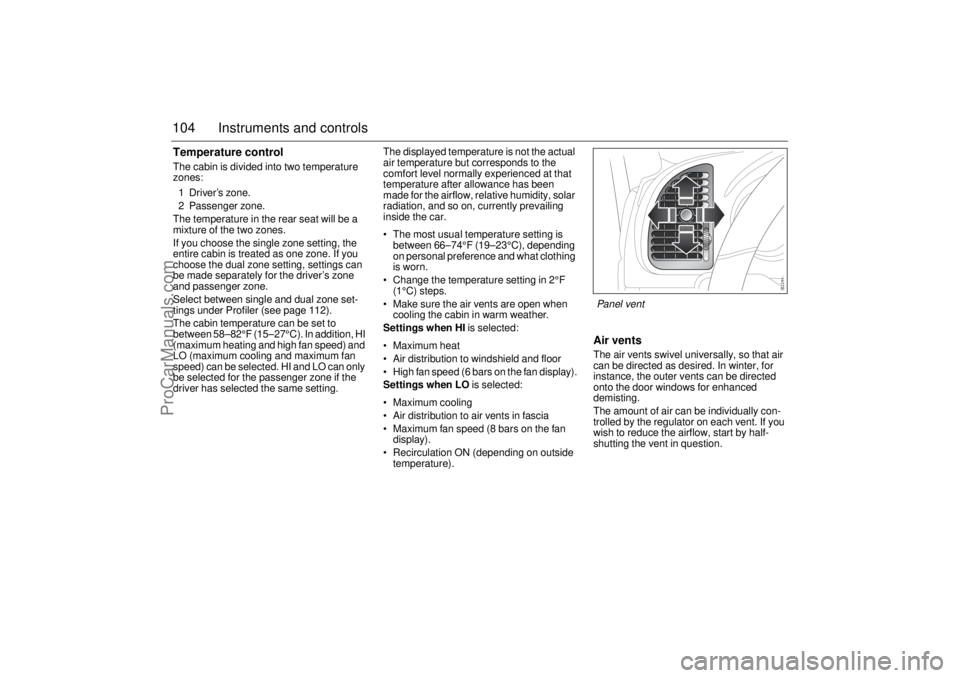
Air ventsThe air vents swivel universally, so that air
can be directed as desired. In winter, for
instance, the outer vents can be directed
onto the door windows for enhanced
demisting.
The amount of air can be individually con-
trolled by the regulator on each vent. If you
wish to reduce the airflow, start by half-
shutting the vent in question.Panel vent
ProCarManuals.com
Page 105 of 288

105 Instruments and controls
The system uses four sensors:
Outside air temperature sensor
Cabin air temperature sensor
Sun sensor
Blended air temperature sensors (located
in the heater unit and the outer panel vent
duct).
The sun sensor is located centrally on the
top of the fascia.
Note:
If the sun sensor is covered, the ACC
system will not be able to regulate the cabin
climate as intended, especially in strong
sunshine.Condensation waterWhen the A/C compressor is on, the incom-
ing air is dehumidified. The resulting con-
densation water is drained away through an
outlet under the car.
It is therefore perfectly normal for water to
be seen dripping from this outlet when the
car is parked. The warmer the ambient air
and the higher the humidity, the more con-
densation will form.
Sun- and cabin sensor, Sport Sedan1 Sun sensor
2 Cabin temperature sensor
Sun- and cabin sensor, Convertible1 Sun sensor
2 Cabin temperature sensor
ProCarManuals.com
Page 109 of 288

109 Instruments and controls
Shown below are several examples of air distribution.
Windshield
Panel
Floor, front and rear
Windshield – floor (front and rear)
ProCarManuals.com
Page 110 of 288

110 Instruments and controls
Formation of ice and mist in extreme weather conditionsIt is only in the most extreme conditions that icing and misting of
window glass are likely to be a problem, such as in torrential rain or
severe cold coupled with high relative humidity, or when passengers
are perspiring heavily or wearing wet clothes. The following mea-
sures are recommended if such problems should occur:
1 Select and set the temperature to 70°F (21°C)
2 Select . If this is not enough...
3 Increase the fan speed. If this is not enough...
4 Select a higher temperature.
Panel – floor (front and rear)
Windshield – panel – floor (front and rear)
ProCarManuals.com
Page 113 of 288

113 Instruments and controls
Explanation of how the ACC system can be
customized under Profiler.
Climate System
Rear Defroster
AutoManual
Heated Seats
AutoManual
Fan Settings
High speedMedium speedLow speed
Air Distribution
AutoManual
WindshieldPanelFloor
A/C Mode
AutoA/C off
Dual/Single Zone
Dual zoneSingle zone
Default Settings
Are you sure?Ye s N o
Rear Defroster
Auto:The rear window and door mirror
heating is controlled automatically.
This is one of the Default Settings.
Manual:
The rear window and door mirror
heating is switched on with
the button on ACC panel.
Convertible: The rear window heating
cannot be turned on when the soft top is
folded.
Heated Seats
Auto:
The front seat heating is controlled
automatically.
Select the level by repeatedly
pressing the appropriate button on
the ACC panel: 2 arrows on symbol
= standard; 3 arrows = high; 1 arrow
= low. The selected heating setting
is saved when the engine is
switched off. Note: The symbol on
the ACC panel goes out if the heat-
ing is turned off automatically by the
system.
Manual:
See Electric heating, front seats
(option) on page 111
.
This is one of the Default Settings.
ProCarManuals.com
Page 114 of 288

114 Instruments and controlsFan Settings
High speed:
This selection give a slightly higher
fan speed than Medium speed
though with continued automatic
regulation.
Medium speed:
Normal automatic fan speed. This is
one of the Default Settings.
Low speed:
This selection give a slightly lower
fan speed than Medium speed
though with continued automatic
regulation.
Convertible: Fan speed is not regulated
automatically when the soft top is open.
Air Distribution
Auto:
The ACC system adapts air tem-
perature and distribution to the pre-
vailing conditions. This is one of the
Default Settings
.
Manual:
Windshield:
The ACC system directs almost
all air to the windshield.
Panel:
The ACC system directs almost
all air to air vents in the fascia.
Floor:
The ACC system directs almost
all air to the floor.
A/C Mode
Auto:
Automatic engagement and disen-
gagement of the A/C. This is one of
the Default Settings.
A/C off:
A/C compressor OFF (see also
page 106). The A/C compressor
can be activated temporarily by
pressing the AC or AUTO button
while on the road and if the outside
temperature is above 41°F (+5°C).
The A/C will be off the next time the
engine is started, if the engine has
been switched off for more than
2hours.
Convertible: The A/C compressor is
switched off when the soft top is folded
down.
Further customizations to this function can
be made at a Saab dealer.
The A/C compressor can be on even
when the soft top is folded down.
The A/C compressor can be set to
operate as when the soft top was last
folded down.Dual/Single Zone
Dual zone:
Individual temperature setting for
each zone (see page 104). The sys-
tem saves the settings when the
engine is switched off. This is one of
the Default Settings.
Single zone:
Common temperature setting when
the engine is started. If the temper-
ature setting for the passenger zone
is changed, the system will switch to
Dual zone control. Single zone con-
trol will return the next time the
engine is started having been
switched off for more than 2 hours.
ProCarManuals.com
Page 141 of 288

141 Starting and driving
To allow the various systems in the car time
to register that the remote control has been
inserted into the ignition switch, do not turn
the remote control for roughly half a second. LOCK position
The position lights, hazard warning lights and interior lighting can be
turned on.
Cars with automatic transmission: Move the gear lever to P.
The gear lever is locked in position. This is the only position in which the
remote control can be removed.
Cars with manual transmission: The remote control can be removed
regardless of the position of the gear lever.
OFF position
Parts of the electrical system are operative.
Do not leave the remote control in the OFF position with the engine
not running as this could cause the battery to run flat in a matter of
hours.
Cars with automatic transmission: The gear lever is not locked. See
also page 154.
ON position
The entire electrical system is operative.
Do not leave the remote control in the ON position when the engine
is not running.
Turn the remote control to the OFF position to disconnect the electrical
system.
When you turn the remote control to ON, some indicator and warning lights
will come on in the main instrument panel. These should go out after about
3 seconds.
ST - starter position
The starter motor operates (automatic transmission: selector lever must
be in P or N) when the remote control is turned to this position. When
released, the remote control will spring back to the ON position.
The car has an electronic restart lock. If the engine fails to start, the remote
control must first be turned back to a position between OFF and LOCK
before the starter motor can be operated again.
ProCarManuals.com
Page 145 of 288

145 Starting and driving
If the diagnosis function detects a fault in the
engine management system, the light
"Engine malfunction (CHECK ENGINE)" in
the instrument panel will come on (see page
75). Have the car checked at a Saab dealer
as soon as possible.
The following message is shown on the SID:
Important considerations with
catalytic convertersThe catalytic converter is an emission con-
trol device incorporated in the car’s exhaust
system. It consists of a metal canister with a
honeycomb insert, the cells of which have
walls coated in a catalytic layer (precious
metal alloy).
To ensure that the catalytic converter con-
tinues to function properly, and also to avoid
damage to the converter and its associated
components, the following points must be
observed: Have the car serviced regularly in accord-
ance with the service program.
Always be alert to any misfiring of the
engine (not running on all cylinders) and
any loss of power or performance. At the
first sign of a malfunction, reduce speed
and take the car to a Saab dealer.
If the engine fails to start (in severe cold
or if the battery is flat), the car can be
bump started (manual transmission only)
or started using jump leads to a donor
battery. However, as soon as you have
started the engine, it is important that it
runs on all cylinders. If it is misfiring, allow
it to idle for up to 5 minutes to give it time
to settle and run smoothly. If, after this
time, the engine still fails to run properly,
switch off the engine to avoid serious
damage to the catalytic converter.
Contact a Saab dealer for advice. Reduced engine power.
Contact Saab dealer.
NOTICEIf "Engine malfunction (CHECK
ENGINE)" warning light starts to flash
(indicating that the engine is misfiring and
the catalytic converter can be damaged),
ease off the accelerator slightly. The light
should go out or start to shine constantly.
If the light continues to flash despite
easing off the accelerator, you may
continue to drive the car but at the mini-
mum throttle permitted by the current traf-
fic situation. Have the car checked as
soon as possible at a Saab dealer.
NOTICEUse only unleaded gasoline. Leaded
gasoline is detrimental to the catalyst and
oxygen sensor and will seriously impair
the function of the catalytic converter.
ProCarManuals.com