2004 PORSCHE CAYENNE wheel
[x] Cancel search: wheelPage 279 of 379

Minor Repairs
279 Minor Repairs
Exercise Extreme Caution
when Working on your Vehicle ..................... 280
Tires/Wheels ............................................. 281
Jack .......................................................... 291
Tool Kit ..................................................... 292
Compressor .............................................. 292
Spacers .................................................... 293
Wheel Bolts ............................................... 293
Changing Wheels........................................ 294
Flat Tire ..................................................... 295
Lifting the Vehicle
with a Lifting Platform or Garage lift ............. 298
Electrical System ....................................... 312
Battery ...................................................... 320
Replacing the remote control battery ........... 322
Emergency Starting with Jumper Cables ...... 323
Replacing Bulbs ......................................... 326
Headlights ................................................. 327
Tail light .................................................... 336
License Plate Lights................................... 338
Headlight Adjustment.................................. 339
Changing headlights
from left to right-hand traffic ....................... 340
Bulb Chart ................................................. 342
Towing ...................................................... 342
10_Cayenne_21_KW17.book Seite 279 Donnerstag, 9. April 2009 3:33 15
Page 280 of 379

280
Minor Repairs
Exercise Extreme Caution when
Working on your Vehicle
Danger!
Ignoring the following instructions may cau-
se serious personal injury or death.
fThe engine compartment of any motor vehicle
is a potentially hazardous area. If you are not
fully familiar with proper repair procedures, do
not attempt the adjustments described on the
following pages.
This caution applies to the entire vehicle.
fO n l y w o r k o n y o u r v e h i c l e o u t d o o r s o r i n a w e l l
ventilated area.
fEnsure that there are no open flames in the
area of your vehicle at any time when fuel
fumes might be present. Be especially
cautious of such devices such as hot water
heaters which ignite a flame intermittently.
fBefore working on any part in the engine com-
partment, turn the engine off and let it cool
down sufficiently. Hot engine compartment
components can burn skin on contact.
fBe alert and cautious around engine at all
times while the engine is running.
If you have to work on the engine while it is run-
ning, always put the parking brake on and put
the gearshift lever in neutral or the Tiptronic
selector lever in position P or N.fIn particular, be very careful to ensure that
items of clothing (ties, shirt, sleeves etc.),
jewelry, long hair, hand or fingers cannot get
caught in the engine-compartment blower, fan,
belts or other moving parts.
The radiator and radiator fans are in the front
of the car.
The fans can start or continue running as a
function of temperature, even with the engine
switched off.
Carry out work in these areas only with the
engine off and exercise extreme caution.
fYour Porsche is equipped with an electronic
ignition system. When the ignition is on, high
voltage is present in all wires connected with
the ignition system; therefore, exercise
extreme caution when working on any part of
the engine while the ignition is on or the engine
is running.
fAlways support your car with safety stands if it
is necessary to work under the car. The jack
supplied with the car is not adequate for this
purpose.
For vehicles with air suspension with level
control and height adjustment:
Please see the chapter “RAISING VEHICLE
WITH THE JACK” on Page 192.fWhen working under the car without safety
stands but with the wheels on the ground,
make sure the car is on level ground, the
wheels are blocked, and that the engine can-
not be started.
Remove the ignition key.
fDo not smoke or allow an open flame around
the battery or fuel.
Keep a fire extinguisher close at hand.
fIncomplete or improper servicing may cause
problems in the operation of the car. If in doubt
about any servicing, have it done by your
authorized Porsche dealer.
Improper maintenance during the warranty
period may affect your Porsche warranty
coverage.
fSupplies of fluids, e.g. engine oil, brake fluid or
coolant, are hazardous to your health. Keep
these fluids out of children's reach and dispose
of them in accordance with the appropriate
regulations.
fSome countries require additional tools and
special spare parts to be carried in your vehi-
cle.
Please make enquiries before driving abroad.
10_Cayenne_21_KW17.book Seite 280 Donnerstag, 9. April 2009 3:33 15
Page 281 of 379

Minor Repairs
281
Notes on minor repairsTool kit
The tool kit is accommodated in the spare-wheel
well under the cover of the loadspace floor.
Note
The tools required for changing a wheel (e.g. jack,
wheel bolt wrench, assembly aids, folding
wedges) are only supplied with the vehicle if the
vehicle comes with a collapsible spare wheel or
full-size spare wheel as standard. Your authorized
Porsche dealer will be pleased to advise you.
Tires/WheelsThe original equipment tires and wheel rims on
your Porsche comply with all applicable Federal
Motor Vehicle Safety Standards.For your safety remember the following:– Wheel rims and wheel bolts are matched to fit
your Porsche.
– If you intend to use other than original equip-
ment wheels, be sure that they conform to
Porsche specifications for your model. Only
tires with the same make and with the same
specification code (e.g. “N0”, “N1”...) can be
mounted.
– The use of wheel rims and wheel bolts that do
not meet specifications of the original factory
installed equipment will affect the safe opera-
tion of your vehicle and affect warranty
coverage.
– Before you plan on exchanging wheels, or
snow tires already mounted on the wheel rims,
consult your authorized Porsche dealer.
Your dealer has the technical information
necessary to advise you which wheel rims and
wheel bolts are compatible with the original
factory installations.
Danger!
Risk of loss of control and serious personal
injury or death.
fIf while driving, your vehicle experiences a sud-
den vibration or ride disturbance, and/or you
suspect that possible damage to your tires or
vehicle has occurred, you should immediately
reduce your speed without excessive use of
the brakes.
fStop the vehicle as soon as possible, and
inspect the tires.
If you cannot determine the cause for the
disturbance, have your vehicle towed to the
nearest Porsche or tire dealer to have your
vehicle or tire(s) inspected.
fContinuing to operate the vehicle without
correction could result in a loss of control and serious personal injury.
10_Cayenne_21_KW17.book Seite 281 Donnerstag, 9. April 2009 3:33 15
Page 282 of 379
282
Minor Repairs
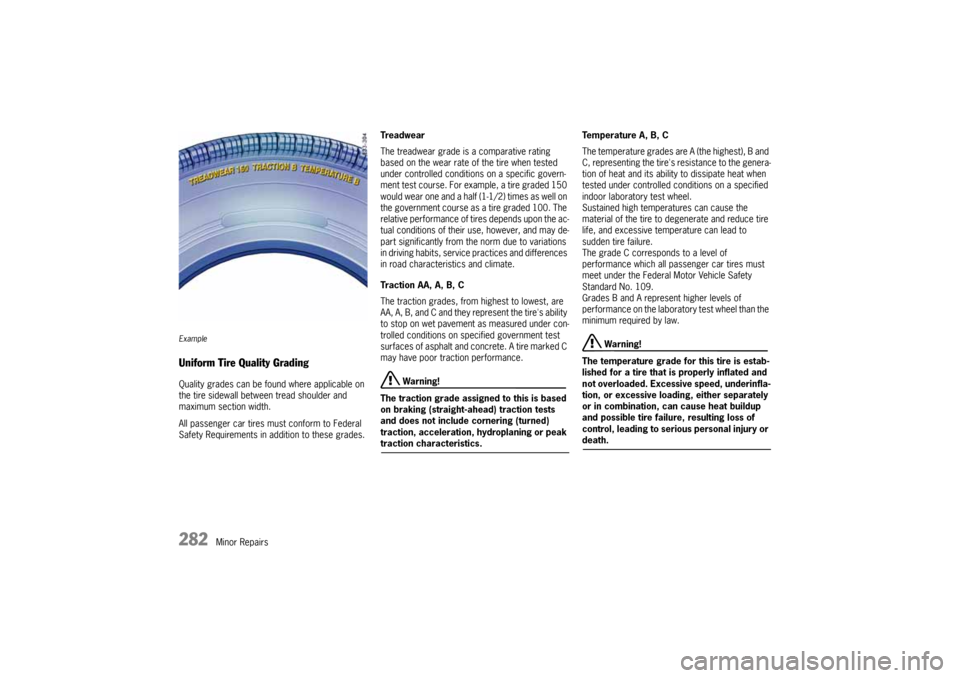
ExampleUniform Tire Quality GradingQuality grades can be found where applicable on
the tire sidewall between tread shoulder and
maximum section width.
All passenger car tires must conform to Federal
Safety Requirements in addition to these grades.Treadwear
The treadwear grade is a comparative rating
based on the wear rate of the tire when tested
under controlled conditions on a specific govern-
ment test course. For example, a tire graded 150
would wear one and a half (1-1/2) times as well on
the government course as a tire graded 100. The
relative performance of tires depends upon the ac-
tual conditions of their use, however, and may de-
part significantly from the norm due to variations
in driving habits, service practices and differences
in road characteristics and climate.
Traction AA, A, B, C
The traction grades, from highest to lowest, are
AA, A, B, and C and they represent the tire's ability
to stop on wet pavement as measured under con-
trolled conditions on specified government test
surfaces of asphalt and concrete. A tire marked C
may have poor traction performance.
Warning!
The traction grade assigned to this is based
on braking (straight-ahead) traction tests
and does not include cornering (turned)
traction, acceleration, hydroplaning or peak
traction characteristics.Temperature A, B, C
The temperature grades are A (the highest), B and
C, representing the tire's resistance to the genera-
tion of heat and its ability to dissipate heat when
tested under controlled conditions on a specified
indoor laboratory test wheel.
Sustained high temperatures can cause the
material of the tire to degenerate and reduce tire
life, and excessive temperature can lead to
sudden tire failure.
The grade C corresponds to a level of
performance which all passenger car tires must
meet under the Federal Motor Vehicle Safety
Standard No. 109.
Grades B and A represent higher levels of
performance on the laboratory test wheel than the
minimum required by law.
Warning!
The temperature grade for this tire is estab-
lished for a tire that is properly inflated and
not overloaded. Excessive speed, underinfla-
tion, or excessive loading, either separately
or in combination, can cause heat buildup
and possible tire failure, resulting loss of
control, leading to serious personal injury or
death.
10_Cayenne_21_KW17.book Seite 282 Donnerstag, 9. April 2009 3:33 15
Page 284 of 379

284
Minor Repairs Overloading
Danger!
Risk of damage to vehicle parts, loss of con-
trol and serious personal injury or death.
fDo not overload your vehicle. Be careful about
the roof load.
fIf loading the vehicle also correct the tire pres-
sure. Tire pressure for loaded vehicle can be
found on the tire pressure plate and in the
chapter technical data.
fNever exceed the specified axle load.
Overloading can shorten the service life of the
tires and car, as well as lead to dangerous
vehicle reactions and long braking distances.
Damage due to overloading is not covered by the vehicle warranty.
fPlease see the chapter “LOADING
INFORMATION” on Page 231.
Example of a tire pressure plateTire Pressure plateInformation on the tire pressure plate
A Seating capacity
Maximum number of vehicle occupants,
including the driver.B Vehicle load limit
Is the maximum total weight limit specified of
the load (passengers and cargo) for the vehi-
cle. This is the maximum weight of passengers
and cargo that can be loaded into the vehicle.
If a trailer is being towed, the trailer tongue
weight must be included as part of the cargo
load.
Please see the chapter “LOADING
INFORMATION” on Page 231.
C Original tire size
Size of tires mounted at the factory.
D Recommended cold tire inflation pressure
These values are for cold tires (68 °F/20 °C).
E Approved tire sizes
F Size and tire pressure for the collapsible spare
wheel
Tire traction
Warning!
When driving on wet or slushy roads, a
wedge of water may build up between the
tires and the road. This phenomenon is
known as “hydroplane“ and may cause par-
tial or complete loss of traction, vehicle con-
trol or stopping ability.
fReduce speed on wet surfaces to prevent this.
10_Cayenne_21_KW17.book Seite 284 Donnerstag, 9. April 2009 3:33 15
Page 285 of 379

Minor Repairs
285
Tire lifeTire life depends on various factors, i.e., road sur-
faces, traffic and weather conditions, driving
habits, type of tires and tire care.
fInspect your tires for wear and damage before
driving off. If you notice uneven or substantial
wear, wheels might need alignment or tires
should be balanced or replaced.Tire wearThe original equipment tires on your Porsche have
built-in tire wear indicators. They are molded into
the bottom of the tread grooves and will appear as
approximately 1/2 in. (12 mm) bands when the
tire tread depth is down to 1/16 of an in (1.6 mm).
When the indicators appear in two or more adja-
cent grooves, it is time to replace the tires. We
recommend, however, that you do not let the tires
wear down to this extent.
Worn tires cannot grip the road surface properly
and are even less effective on wet roads.
In the United States, state laws may govern the
minimum tread depth permissible. Follow all such
laws.
Danger!
Driving on worn tires can result in loss of con-
trol of the vehicle and could cause serious
personal injuries or death.
fDo not drive with worn tires or tires showing
cuts or bruises as they may lead to sudden
deflation and loss of control which could cause
severe personal injury.
fSpecialized high performance tires on high
performance sport utility vehicles exhibit more
wear than those on a family sedan, or even a
high performance sedan.
Therefore, it is important to check your tire
pressure and condition at least every two weeks.
fIf you notice that tires are wearing unevenly,
consult your Porsche dealer.
Uneven wear may not always be due to improper
wheel alignment. It can be the result of individual
driving habits such as cornering at high speeds. If
the tire pressure is not checked and adjusted
regularly, abnormal tire wear can also occur.
Tire carefAvoid damaging tires and wheel rims.
fIf you must drive over a curb or other obstacle,
drive slowly and at an obtuse angle.
fCheck tires for uneven wear and damage
before driving off.
fRemove imbedded material.
fReplace worn or damaged tires immediately.
fKeep oil, fuel, brake fluid, etc. away from tires.
fReplace missing valve stem caps.
fKeep tires inflated correctly.
fWash tires when washing the vehicle. Also
clean inner side of wheels.
fDo not use abrasive cleaners when washing
the wheels.
fCheck wheel rims for corrosion.
fRemove road salt, if driving in winter.
10_Cayenne_21_KW17.book Seite 285 Donnerstag, 9. April 2009 3:33 15
Page 286 of 379

286
Minor Repairs
Tire damage, puncturefPlease see the chapter “HIGH-PRESSURE
CLEANING EQUIPMENT, STEAM CLEANERS”
on Page 271.
Danger!
Risk of serious personal injury or death.
Driving the vehicle with low tire pressure
increases risk of a tire failure and resulting
loss of control. Furthermore, low tire pres-
sure increases rate of wear of the affected
tires.
fCheck tires – including sidewalls – regularly for
foreign bodies, nicks, cuts, cracks and bulges.
fAfter driving off road, examine tires for signs
of damage such as cuts, tears, bulges or
foreign objects stuck in the tread. Replace a
damaged tire if necessary.
fCross curb edges slowly and at right angles if
possible.
Avoid driving over steep or sharp curbs.
fIn cases of doubt, have the wheel (particularly
the inner side) checked by an authorized Porsche dealer.In case of tire damage, where it is uncertain
whether there is a break in the ply with all its con-
sequences or tire damage caused by thermal or
mechanical overloading due to loss of pressure or
any other prior damage, we recommend that the
tire be replaced for safety reasons.
I f o n e f a u l t y t i re i s re p l a c e d i t s h o u l d b e n o t e d t h a t
the difference in tread depth on one axle must not
exceed 30%. Handling inconsistencies may result.
fPerform a visual inspection if necessary.
Tire replacementsfUse only tire makes and types tested by
Porsche.
If you do not use a Porsche recommended
replacement tire, make sure that you
purchase your new tires from a reputable tire
dealer and that the dealer complies with all
manufacturers warnings for those tires.
Only tires with the same manufacturer and
with the same specification code (e.g. “N0”,
“N1”...) should be mounted on the vehicle.
Before mounting new tires, check with your
Porsche dealer about the current release
status.
Tires should be replaced no less than on one axle
at the time. Only tires of the same make and type
must be used. Mixed tires are not permissible and
will affect vehicle performance, safety, and can
affect vehicle warranty.Porsche dealers can recommend the most current
replacement tire options for your vehicle.
Initially, new tires do not have their full traction.
You should therefore drive at moderate speeds
during the first 60 - 120 miles (100 - 200 km).
Tires must always remain on the same side of
the vehicle.
When wheels are removed, the direction of rota-
tion and position of each wheel should be marked.
If new tires are installed only on one axle, a notice-
able change in handling occurs due to the different
tread depth of the other tires. This happens espe-
cially if only rear tires are replaced. However, this
condition disappears as the new tires are broken
in.
fPlease adjust your driving style accordingly.
Installation of new tires should only be done by a
qualified tire technician.
Valves
fUse only plastic valve caps.
fThe rubber valves must be replaced whenever
the tires are changed.
fThe fitting and replacement specifications
must be observed for metal valves.
fOnly use Original Porsche metal valves.
fProtect the valve inserts against soiling with
valve caps.
Soiled valve inserts can cause a gradual loss
of air.
10_Cayenne_21_KW17.book Seite 286 Donnerstag, 9. April 2009 3:33 15
Page 287 of 379

Minor Repairs
287
Parking at the curb
Danger!
Hard impacts against curbs (or traffic
islands) are dangerous and may cause hid-
den tire damage which is not noticeable until
later. Such damage can result in accidents at
high speeds causing serious personal injury
or death. Depending on the force of impact,
the edge of the rim can also be damaged.
fIf you are in doubt, have the wheel checked by
an expert, particularly if you suspect damage
on the inside.
fIf you must drive over a curb or other obstacle,
drive slowly and at an obtuse angle. Exercise care when parking along curbs.
Maintenance Note
Tire repairs are not permissible under any circum-
stances.
Wheel alignment, wheel balancingAs a precaution, have wheels with summer tires
balanced in the spring, and those with mud and
snow tires before winter. Unbalanced wheels may
affect car handling and tire life.
Only the specified weights may be used for wheel
balancing. Self-adhesive weights must not come into contact
with cleaning agents, since they could drop off.
Uneven tread wear indicates wheel imbalance. In
this event, the vehicle should be checked at an
authorized Porsche dealer.
Danger!
If, during a trip, uneven running or vibrations
occur that could be caused by damage to
tires or the car, the speed must be reduced
immediately, but without braking sharply. If
you continue your trip without having the
cause of the fault remedied, you might lose
control of your vehicle which could cause
serious personal injury or death.
fStop the vehicle and check the tires.
fIf no cause for the fault can be found, drive ca-
refully to the nearest authorized Porsche dea-ler.
Wheels with Tire Pressure Monitoring
(TPM) sensorsBefore changing wheels, make sure that the
wheels are compatible with your vehicle’s TPM.
fCheck this with your authorized Porsche dea-
ler.
Removing and storing tiresfAfter changing, adjust tire pressure and torque
wheel bolts diagonally.
Please see the chapter “CHANGING WHEELS”
on Page 294.
fStore tires in a cool and dry place. Rotate peri-
odically to avoid flat spots.
fAvoid contact with petrol, oil and grease.
Tires must always remain on the same side of
the vehicle.
When wheels are removed, the direction of
rotation and position of each wheel should be
marked.
Example
FR (front right), FL, RR and RL.
Wheels must always be fitted in accordance with
their marking.
The perception that tire durability and perfor-
mance are not affected by storage and age is
unfounded.
Chemical additives, which make the rubber elas-
tic, lose their effectiveness over the course of
time and the rubber becomes brittle and cracks.
Therefore, the tires, especially the spare tire,
should be inspected from time to time.
10_Cayenne_21_KW17.book Seite 287 Donnerstag, 9. April 2009 3:33 15