2004 PORSCHE 911 GT3 lock
[x] Cancel search: lockPage 32 of 195

B-Fore andaft
I>
Raise locking lever.
Move seattodesired position andrelease
lever. Ensure thattheseat engages correctly.
C -
Backrest angle
I>
Operate switchuntilthedesired backrest
angle isreached.
Seat backrest
Folding forward
I>
Pull uplever Dinthe side partofthe backrest
and fold thebackrest forward.
Folding back
I>
Tilt back andengage thebackrest sothat it
cannot tipforward whenthecar isbraked.
Steering
WheelAdjustment
A
Warning!
Risk ofaccident.
The steering wheelmaymove further than
desired ifyou attempt toadjust itwhile driv-
ing.
You may losecontrol ofthe vehicle.
I>
Donot adjust thesteering wheelwhiledriving.
Longitudinal adjustment
1. Push locking leverdownwards.
2. Adjust steering wheelto
fit
the chosen back-
rest angle andseat position bymoving the
steering wheellongitudinally.
3. Swivel locking leverbackuntilyoufeel it
engage.
If
necessary, movesteering wheelslightly lon-
gitudinally, toensure engagement.
Controls, Instruments
Page 33 of 195

SafetyBelts
/!\
Warning!
Always makesureyour andyour passenger's
safety beltsareproperly fastened whilethe
vehicle isin motion.
Failure tofollow safety beltwarnings mayre-
sult inserious personal injury.
I>
For your andyour passenger's protection,use
safety beltsatall times whilethevehicle isin
motion.
I>
Use appropriate childrestraint systemsforall
small children.
Proper wearing ofsafety belts
I>
Safety beltsmust bepositioned onthe body as
to restrain theupper bodyandlapfrom sliding
forward. Improperly positionedsafetybelts
can cause serious personal injuryincase ofan
accident.
I>
The shoulder beltshould always restonyour
upper body.Theshoulder beltshould neverbe
worn behind yourback orunder yourarm.
I>
For maximum effectiveness, thelapbelt
should beworn lowacross thehips.
I>
Pregnant womenshouldposition thebelt as
low aspossible acrossthepelvis. Makesureit
is not pressing againsttheabdomen.
Controls, Instruments
I>
Belts should notbeworn twisted.
I>
Donot wear beltsoverrigidorbreakable ob-
jects inor on your clothing, suchaseye glass-
es, pens, keys,etc.asthese maycause injury.
I>
Several layersofheavy clothing mayinterfere
with proper positioning ofbelts.
I>
Belts mustnotrub against sharpobjects or
damage mayoccur tothe belt.
I>
Two occupants shouldneversharethesame
belt atthe same time.
Care andmaintenance
I>
Keep beltbuckles freeofany obstruction that
may prevent asecure locking.
I>
Belts thathave been subjected toexcessive
stretch forcesinan accident mustbeinspect-
ed orreplaced toensure theircontinued effec-
tiveness inrestraining you.
The same applies tobelt tensioner systems
which havebeen triggered.
In addition, theanchor pointsofthe belts
should bechecked.
I>
Ifsafety beltsdonot work properly, seeyour
authorized Porschedealerimmediately.
I>
Ifthe belts show damage towebbing, bindings,
buckles orretractors, theyshould bereplaced
to ensure safeoperation.
I>
Donot modify ordisassemble thesafety belts
in your vehicle.
I>
The belts must bekept clean orthe retractors
may notwork properly
Please observe thechapter "CARCARE IN-
STRUCTIONS" onPage 130.
I>
Never bleach ordye safety belts.
I>
Donot allow safety beltstoretract untilthey
are completely dryafter cleaning orthis may
cause damage tothe belt.
Belt tensioner
Depending onthe force ofan impact, fastened
seat belts aretightened inan accident.
The belttensioners aretriggered in:
- Frant andrear impacts
The belttensioners arenottriggered in:
- Side impacts
- Vehicle overturning
Note
The belttensioner systemcanbetriggered only
once; thesystem mustbereplaced afterward.
Work maybeperformed onthe belt-tensioner sys-
tem only byanauthorized Porschedealer.
Smoke isreleased whenthebelt tensioners are
triggered. Thisdoes notindicate afire inthe
vehicle.
Page 34 of 195

o
SafetyBeltWarning System
An audio-visual warning
systemisinterconnect-
ed with thedriver's safetybelt.
Every timetheignition isturned on,the gong will
sound forabout 6seconds toremind driverand
passenger tobuckle up.
The safety beltwarning lightsinthe instrument
panel andon-board computer willgooffassoon
as the driver hasbuckled up.
Inertiareelretractor
The combination lap/shoulder beltwith inertia reel
locking mechanism adjustsautomatically toyour
size andmovements aslong asthe pull onthe belt
is slow.
Rapid deceleration duringhardbraking oracolli-
sion locks thebelt. Thebeltwillalso lockwhen you
drive upordown asteep hillorinasharp curve,
otherwise, theshoulder beltwillnotinhibit your
upper bodymovement. ~
Assume acomfortable sittingposition.
The shoulder beltshould always restonyour
upper body.Theshoulder beltshould neverbe
worn behind yourback orunder yourarm.
~ Tofasten, graspbeltandpullthebelt inacon-
tinuous slowmotion acrossyourchest andlap.
~ Insert belttongue intobuckle oninboard side
of seat. Pushdown until
it
securely lockswith
an audible click.Pullthebelt tocheck.
~ Pull shoulder sectiontomake surebeltfits
snugly across thepelvis.
~ Belts should fitsnugly across thepelvis and
chest. Makesurethere isno slack inthe belt.
~ Tounfasten belt,push inrelease button
(ar-
row)
onbuckle. Belttongue willspring outof
buckle.
~ Torelease alatched belt,leanback totake the
body pressure offthe belt.
~ Tostore lap/shoulder belt,allow thebelt tore-
tract asyou guide thelatch toits stowed posi-
tion.
~ Please observe thechapter "AUTOMATIC
LOCKING RETRACTOR" onPage 34.
~ ~~
Controls, Instruments
Page 35 of 195

Safetybeltheight adjustment
Adjust theheight ofthe safety beltsothat itruns
across themiddle ofthe shoulder, notagainst the
neck.
Adjusting beltheight
I>
Up-push beltdeflector.
I>
Down -press button
(arrow)
andmove belt
deflector.
34
Controls, Instruments
Automatic
lockingretractor
The safety beltforthe passenger seatisequipped
with anautomatic lockingretractor forsecuring
the child restraint system.
When activated, thisretractor allowsyoutose-
curely fasten thechild restraint systeminplace so
that inadvertent movements willnot occur.
Activating theautomatic lockingretractor
1. Pull thesafety beltretractor
completely
out.
At this point thelocking mechanism isacti-
vated.
2. Insert thesafety belttongue intothebuckle
and make certain thatitis properly latched.
3. Allow thesafety belttoretract untilitis tight on
the child restraint system.Youmay further
tighten thebelt bypulling onitto allow more of
it to retract.
Releasing thesafety belt
1. Unbuckle thesafety beltlatch.
2. Then make certain thatthebelt hasfully
retracted.
At this point theautomatic lockingfeature will
be disengaged.
Page 36 of 195

ChildRestraint Anchorages
~ Please observe thechapter "AUTOMATIC
LOCKING RETRACTOR" onPage 34.
If your child restraint seatrequire theuse ofateth-
er strap, youwillwant touse theanchor pointpro-
vided behind theseat backrests underthecarpet.
To ensure properinstallation, seeyour authorized
Porsche dealer.
A
Warning!
Child restraint anchorages aredesigned to
withstand onlythose loadsimposed bycor-
rectly fittedchildrestraints. Undernocir-
cumstances arethey tobe used foradults
safety beltsorharnesses. Suchusecould re-
sult inserious personal injuryordeath.
~ Donot misuse thechild restraint anchorages.
They arenotdesigned towithstand loadsim-
posed byadults.
Controls,Instruments
Page 45 of 195

ABSBrake System
(Antilock BrakeSystem)
The ABS system represents amajor contribution
to the enhancement ofactive safety inyour vehi-
cle. This system prevents thewheels fromlocking
in apanic stoponalmost allroad surfaces.
Controls, Instruments
With
theASS system inyour vehicle, the
following areasareenhanced:
Steering,
vehicleremains steerable underall
braking forceswhenABSisengaged.
Good directional control,
noswerving caused
by locking ofwheels underbraking conditions.
Shorter stopping distance,
stoppingdistances
are usually reduced because controlled brakingis
maximized.
Prevention of
wheel lock
up,
nobrake- induced
sliding andthus nolocalized tirewear fromemer-
gency braking.
The crucial advantage ofthe ABS system overa
conventional brakesystem isinthe area ofmain-
taining directional controlandmaneuverability of
the car inemergency situationsduringnormal
driving, including panicbraking inturns.
A
Warning!
The increased controlthatisprovided should
not induce youtotake greater riskswithyour
safety. Thelimits dictated bythe laws of
physics cannotbeovercome, evenwithASS.
The riskofaccidents duetoinappropriate
speed cannot bereduced, evenbythe ASS.
The driver bearstheresponsibility forall
driving maneuvers.
t>
Adapt yourdriving styletothe prevailing road
and weather conditions.
t> Obey alltraffic laws.
Other vehicles notequipped withtheASS
system maynotbeable tomaintain control,
especially onwet orpoor roadsurfaces and
thus maybemore likelytoimpact youfrom
behind.
t>
Tominimize thatrisk, useyour ABSsystem to
increase yourability tomaneuver toavoid dan-
gerous situations andnotmerely totry tostop
in the shortest distance possible.
Page 46 of 195

Operation ofthe ABS system
A wheel speed sensor ismounted toeach ofthe
four wheels. Ifwheel lock-up ofeither ofthe front
wheels orthe rear wheels issensed duringbrak-
ing, thebrake pressure isadjusted automatically
until thewheel nolonger slips.Thebrake pressure
is regulated foreach frontwheel individually and
for both ofthe rear wheels together.
On aroad surface whichisslippery ononly one
side, therear wheel whichisbraking onthe slip-
pery surface determines thebrake pressure which
will beapplied equallytoboth rearwheels. Thisen-
sures thatdirectional stabilityismaintained. How-
ever, ifbraking forcesapproach thewheel lock-up
point forallwheels (panicbraking) theABS system
will intervene toprovide arapid rythmic braking.
The proper operation ofABS isperceived bythe
driver asapulsating brakepedalinconjunction
with audible noiseandperhaps somevibration.
I>
Ifyou experience thesesensations whiledriv-
ing oraroad surface withquestionable trac-
tion, reduce vehicle speedappropriate forthe
prevailing roadconditions.
The functional readinessofall the main electrical
components ofthe ABS ischecked byan
electronic monitoring systembothbefore and
while youdrive. •
Warning lightUSA
• Warning lightCanada
When theignition isswitched onthe ABS warning
light willlight upwhile thesystem iselectronically
interrogated andgoes outwhen theengine is
started ifthe check isnot yetcomplete.
If the ABS warning lampfailstogo out, thisindi-
cates thatABS hasbeen deactivated duetoa
fault. Ifthe warning lightsinthe instrument panel
and on-board computer lightupwhile youaredriv-
ing, this indicates thatafault hasoccurred. Inboth
cases, normal braking, asinvehicles withoutABS,
is still retained.
The ABS system should,however, beexamined at
an authorized Porschedealerimmediately topre-
vent theoccurrence offurther faults.
I>
Ifthe ABS system becomes inoperative, take
your vehicle toyour authorized Porschedealer
immediately.
A
Warning!
The control unitofthe ABS brake system is
set forstandard tiresize. Ifnon-standard
tires areinstalled, thecontrol unitmay mis-
interpret thespeed ofthe vehicle, because of
the variant dataitreceives fromthesensors
on the axles.
I>
Use only tiremakes andtypes tested by
Porsche.
Controls,Instruments
Page 47 of 195
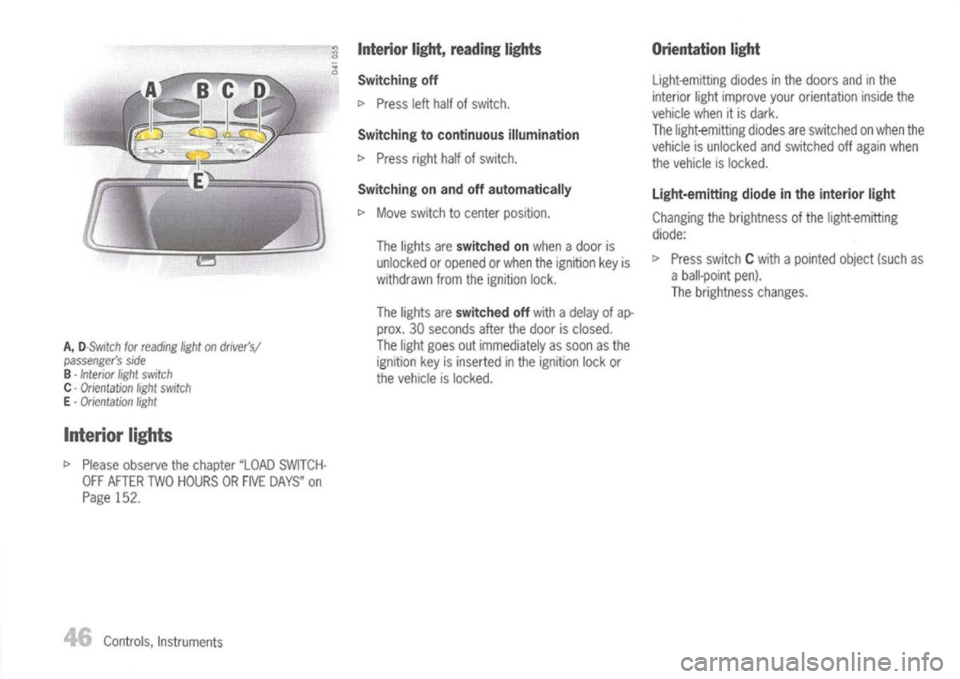
A,
D-$witch forreading light
on
driver's/
passenger's side
B -
Interior lightswitch
C -
Orientation lightswitch
E -
Orientation light
Interior lights
l>
Please observe thechapter "LOADSWITCH-
OFF AFTER TWOHOURS ORFIVE DAYS" on
Page 152.
46
Controls, Instruments
Interior
light,reading lights
Switching off
l>
Press lefthalf ofswitch.
Switching tocontinuous illumination
l>
Press righthalfofswitch_
Switching onand offautomatically
l>
Move switch tocenter position.
The lights are
switched on
when adoor is
unlocked oropened orwhen theignition keyis
withdrawn fromtheignition lock.
The lights are
switched off
with adelay ofap-
prox. 30seconds afterthedoor isclosed.
The light goes outimmediately assoon asthe
ignition keyisinserted inthe ignition lockor
the vehicle islocked.
Orientation
light
Light-emitting diodesinthe doors andinthe
interior lightimprove yourorientation insidethe
vehicle whenitis dark.
The light-emitting diodesareswitched onwhen the
vehicle isunlocked andswitched offagain when
the vehicle islocked.
Light-emitting diodeinthe interior light
Changing thebrightness ofthe light-emitting
diode:
l>
Press switch Cwith apointed object(suchas
a ball-point pen).
The brightness changes.