Page 296 of 432
Engine Oil
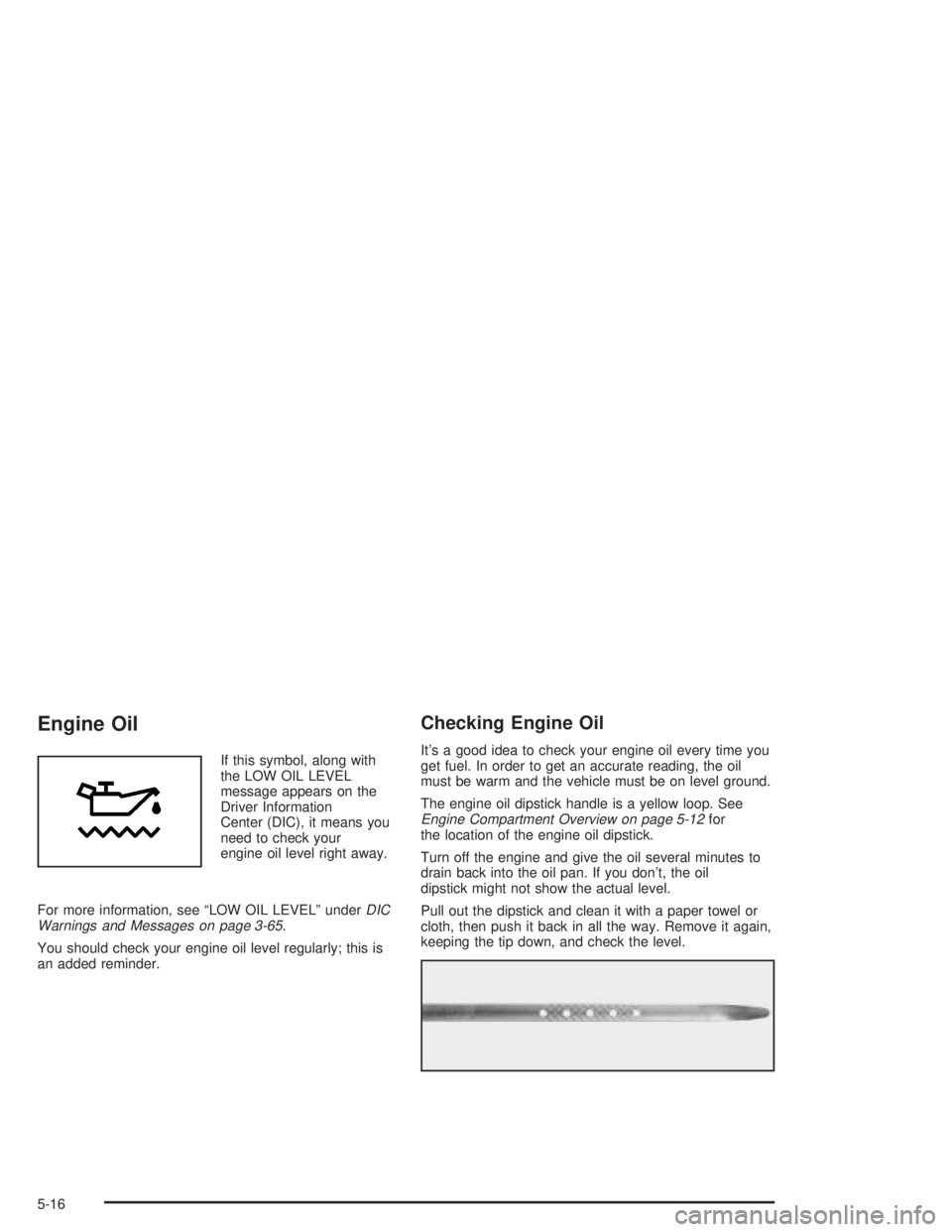
If this symbol, along with
the LOW OIL LEVEL
message appears on the
Driver Information
Center (DIC), it means you
need to check your
engine oil level right away.
For more information, see ªLOW OIL LEVELº under
DIC
Warnings and Messages on page 3-65.
You should check your engine oil level regularly; this is
an added reminder.
Checking Engine Oil
It's a good idea to check your engine oil every time you
get fuel. In order to get an accurate reading, the oil
must be warm and the vehicle must be on level ground.
The engine oil dipstick handle is a yellow loop. See
Engine Compartment Overview on page 5-12for
the location of the engine oil dipstick.
Turn off the engine and give the oil several minutes to
drain back into the oil pan. If you don't, the oil
dipstick might not show the actual level.
Pull out the dipstick and clean it with a paper towel or
cloth, then push it back in all the way. Remove it again,
keeping the tip down, and check the level.
5-16
Page 301 of 432
What to Do with Used Oil
Used engine oil contains certain elements that may be
unhealthy for your skin and could even cause cancer.
Don't let used oil stay on your skin for very long. Clean
your skin and nails with soap and water, or a good
hand cleaner. Wash or properly dispose of clothing or
rags containing used engine oil. See the manufacturer's
warnings about the use and disposal of oil products.
Used oil can be a threat to the environment. If you
change your own oil, be sure to drain all the oil from
the ®lter before disposal. Never dispose of oil by putting
it in the trash, pouring it on the ground, into sewers,
or into streams or bodies of water. Instead, recycle it by
taking it to a place that collects used oil. If you have
a problem properly disposing of your used oil, ask your
dealer, a service station or a local recycling center
for help.
Supercharger Oil
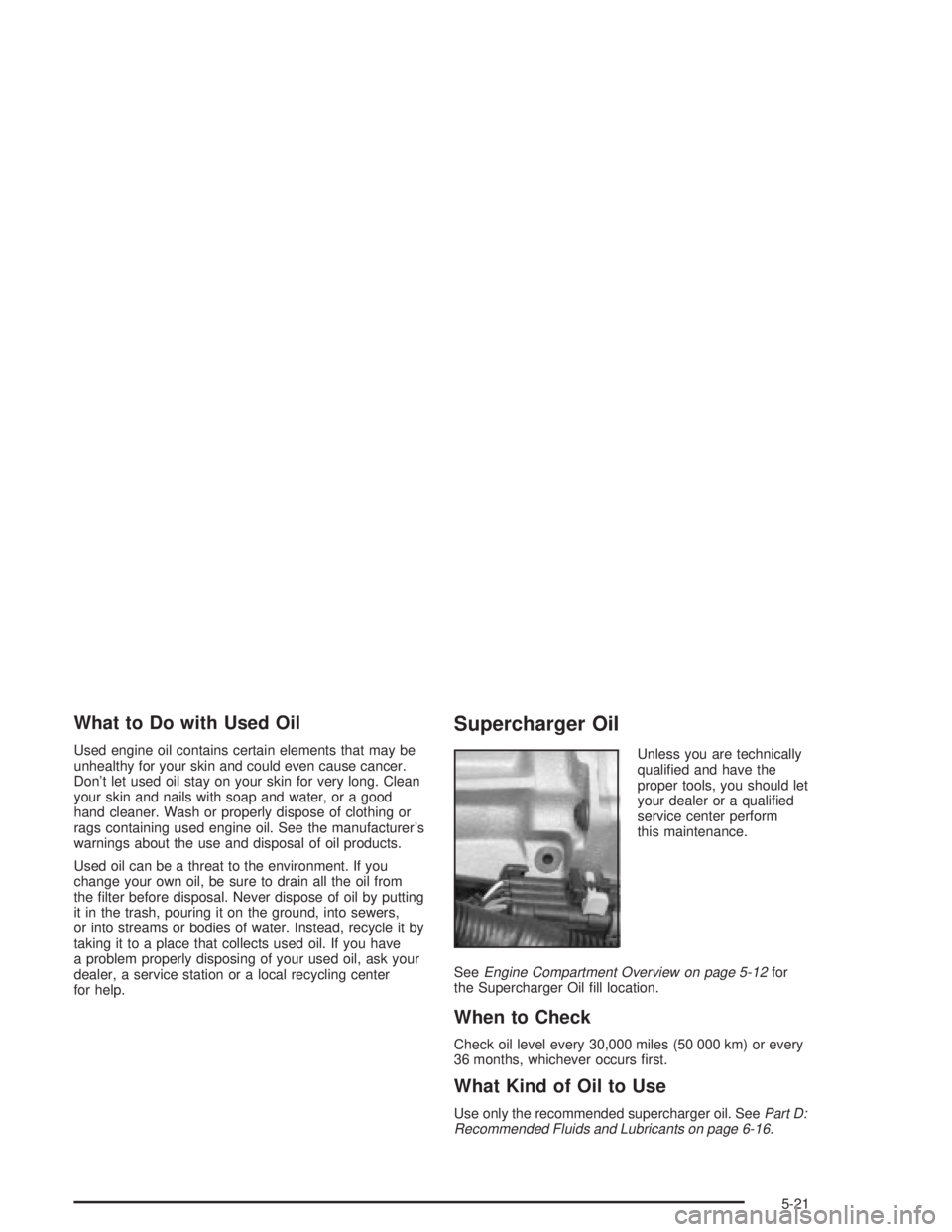
Unless you are technically
quali®ed and have the
proper tools, you should let
your dealer or a quali®ed
service center perform
this maintenance.
See
Engine Compartment Overview on page 5-12for
the Supercharger Oil ®ll location.
When to Check
Check oil level every 30,000 miles (50 000 km) or every
36 months, whichever occurs ®rst.
What Kind of Oil to Use
Use only the recommended supercharger oil. SeePart D:
Recommended Fluids and Lubricants on page 6-16.
5-21
Page 307 of 432
A 50/50 mixture of clean, drinkable water and
DEX-COOLžengine coolant will:
·Give freezing protection down to-34ÉF (-37ÉC).
·Give boiling protection up to 265ÉF (129ÉC).
·Protect against rust and corrosion.
·Help keep the proper engine temperature.
·Let the warning lights and gages work as they
should.
Notice:When adding coolant, it is important that
you use only DEX-COOLž(silicate-free) coolant.
If coolant other than DEX-COOLžis added to
the system, premature engine, heater core or
radiator corrosion may result. In addition, the engine
coolant will require change sooner ± at 30,000 miles
(50,000 km) or 24 months, whichever occurs ®rst.
Damage caused by the use of coolant other
than DEX-COOL
žis not covered by your new vehicle
warranty.
What to Use
Use a mixture of one-half clean, drinkable water and
one-half DEX-COOLžengine coolant which won't
damage aluminum parts. If you use this coolant mixture,
you don't need to add anything else.
{CAUTION:
Adding only plain water to your cooling system
can be dangerous. Plain water, or some other
liquid such as alcohol, can boil before the
proper coolant mixture will. Your vehicle's
coolant warning system is set for the proper
coolant mixture. With plain water or the wrong
mixture, your engine could get too hot but you
wouldn't get the overheat warning. Your engine
could catch ®re and you or others could be
burned. Use a 50/50 mixture of clean, drinkable
water and DEX-COOL
žcoolant.
Notice:If you use an improper coolant mixture,
your engine could overheat and be badly damaged.
The repair cost wouldn't be covered by your
warranty. Too much water in the mixture can freeze
and crack the engine, radiator, heater core and
other parts.
If you have to add coolant more than four times a year,
have your dealer check your cooling system.
Notice:If you use the proper coolant, you don't
have to add extra inhibitors or additives which claim
to improve the system. These can be harmful.
5-27
Page 308 of 432
Checking Coolant
The coolant recovery tank is located in the engine
compartment toward the rear of the engine on
the passenger's side of the vehicle. See
Engine
Compartment Overview on page 5-12for more
information on location.
The vehicle must be on a level surface when checking
the coolant level.
When your engine is cold,
the coolant level should be
at the COLD mark or a
little higher.
When your engine is warm, the level should be up to
the HOT mark or a little higher.
Adding Coolant
This symbol, along with
the LOW COOLANT
LEVEL warning message
will appear in the Driver
Information Center
(DIC) when coolant needs
to be added to the
coolant recovery tank.
See
DIC Controls and Displays on page 3-45for more
information.
If you need more coolant, add the proper DEX-COOL
ž
coolant mixture at the coolant recovery tank, but be
careful not to spill it.
If the coolant recovery tank is completely empty,
add coolant to the radiator. See
Engine Overheating on
page 5-29.
5-28
Page 309 of 432
{CAUTION:
Turning the radiator pressure cap when the
engine and radiator are hot can allow steam
and scalding liquids to blow out and burn you
badly. With the coolant recovery tank, you will
almost never have to add coolant at the
radiator. Never turn the radiator pressure
cap -- even a little -- when the engine and
radiator are hot.
{CAUTION:
You can be burned if you spill coolant on hot
engine parts. Coolant contains ethylene glycol,
and it will burn if the engine parts are hot
enough. Don't spill coolant on a hot engine.
Occasionally check the coolant level in the radiator.
For information on how to add coolant to the radiator,
see
Cooling System on page 5-32.
Radiator Pressure Cap
Notice:Your radiator cap is a pressure-type cap
and must be tightly installed to prevent coolant loss
and possible engine damage from overheating.
Be sure the arrows on the cap line up with the
over¯ow tube on the radiator ®ller neck.
The radiator pressure cap is located in the front of the
engine compartment on the passenger's side, near
the diagonal cross brace. See
Engine Compartment
Overview on page 5-12for more information on location.
Engine Overheating
You will ®nd a coolant temperature gage and a warning
light concerning an overheated engine condition on
the instrument panel cluster. See
Engine Coolant
Temperature Gage on page 3-39andEngine Coolant
Temperature Warning Light on page 3-39.
5-29
Page 311 of 432

CAUTION: (Continued)
down. Wait until there is no sign of steam or
coolant before you open the hood.
If you keep driving when your engine is
overheated, the liquids in it can catch ®re.
You or others could be badly burned.
Stop your engine if it overheats, and get out
of the vehicle until the engine is cool.
See ªOverheated Engine Protection Operating
Modeº in the Index for information on driving
to a safe place in an emergency.
Notice:If your engine catches ®re because you
keep driving with no coolant, your vehicle can
be badly damaged. The costly repairs would not
be covered by your warranty. See ªOverheated
Engine Protection Operating Modeº in the Index
for information on driving to a safe place in an
emergency.
If No Steam is Coming From Your
Engine
An overheat warning can indicate a serious problem.
If you get an engine overheat warning, but see or hear
no steam, the problem may not be too serious.
Sometimes the engine can get a little too hot when you:
·Climb a long hill on a hot day.
·Stop after high-speed driving.
·Idle for long periods in traffic.
·Tow a trailer.
If you get the overheat warning with no sign of steam,
try this for a minute or so:
1. In heavy traffic let the engine idle in NEUTRAL (N)
while stopped. If it's safe to do so, pull off the road,
shift to PARK (P) or NEUTRAL (N) and let the
engine idle.
2. Turn on your heater to full hot at the highest fan
speed and open the windows as necessary.
5-31
Page 312 of 432
If you no longer have the overheat warning, you can
drive. Just to be safe, drive slower for about 10 minutes.
If the warning doesn't come back on, you can drive
normally.
If the warning continues, and you have not stopped,
pull over, stop, and park your vehicle right away.
If there's still no sign of steam, you can idle the engine
for three minutes while you're parked. If you still
have the warning, turn off the engine and get everyone
out of the vehicle until it cools down. Also, see
ªOverheated Engine Protection Operating Modeº listed
previously in this section.
You may decide not to lift the hood but to get service
help right away.Cooling System
When you decide it's safe to lift the hood, here's what
you'll see:
3800 V6 Engine
5-32
Page 315 of 432
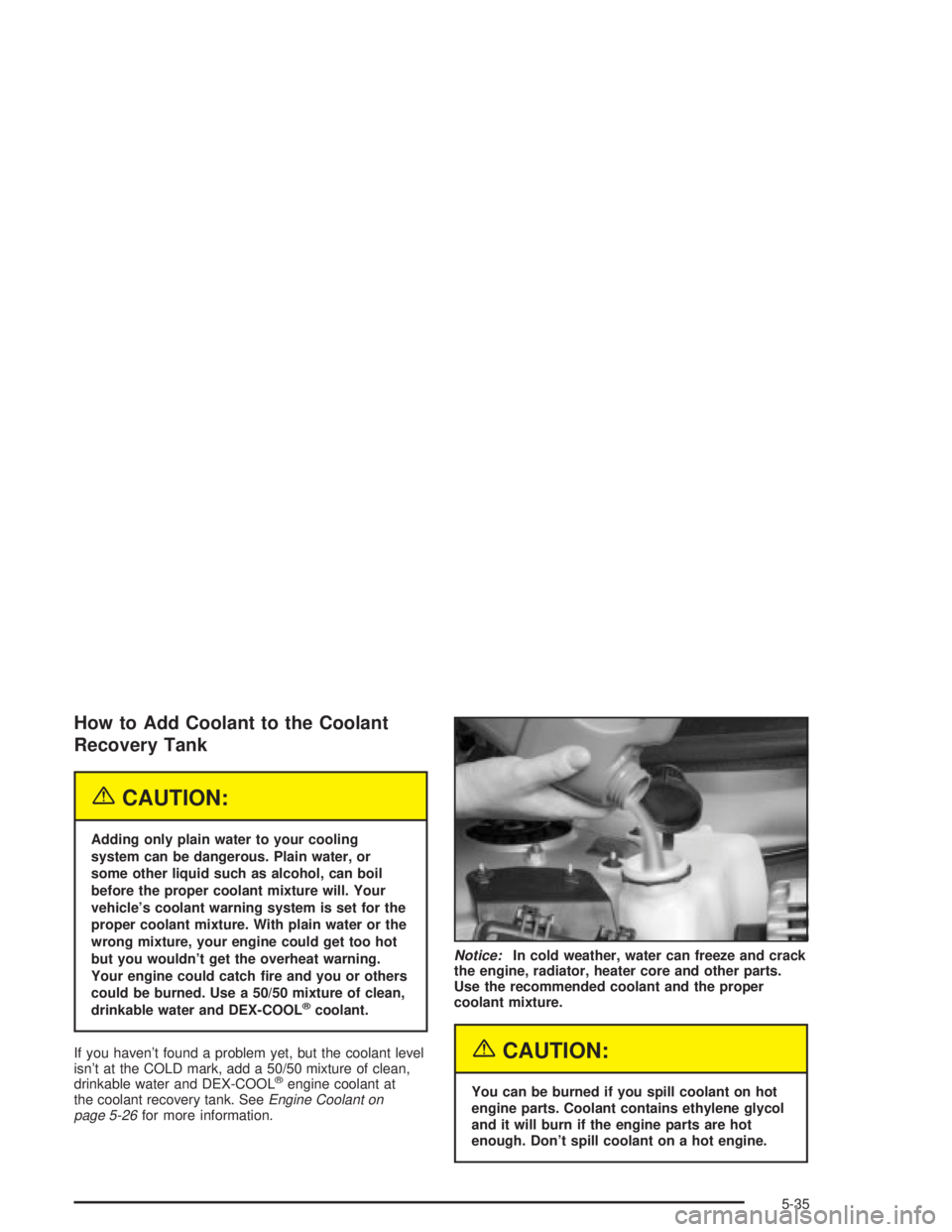
How to Add Coolant to the Coolant
Recovery Tank
{CAUTION:
Adding only plain water to your cooling
system can be dangerous. Plain water, or
some other liquid such as alcohol, can boil
before the proper coolant mixture will. Your
vehicle's coolant warning system is set for the
proper coolant mixture. With plain water or the
wrong mixture, your engine could get too hot
but you wouldn't get the overheat warning.
Your engine could catch ®re and you or others
could be burned. Use a 50/50 mixture of clean,
drinkable water and DEX-COOL
žcoolant.
If you haven't found a problem yet, but the coolant level
isn't at the COLD mark, add a 50/50 mixture of clean,
drinkable water and DEX-COOL
žengine coolant at
the coolant recovery tank. SeeEngine Coolant on
page 5-26for more information.
Notice:In cold weather, water can freeze and crack
the engine, radiator, heater core and other parts.
Use the recommended coolant and the proper
coolant mixture.
{CAUTION:
You can be burned if you spill coolant on hot
engine parts. Coolant contains ethylene glycol
and it will burn if the engine parts are hot
enough. Don't spill coolant on a hot engine.
5-35