Page 221 of 283
Contact your NISSAN dealer if checking or
replacement is required.
CAUTION
�Use only Genuine NISSAN CVT Fluid
NS-2. Do not mix with other fluids.
�Using transmission fluid other than
Genuine NISSAN CVT Fluid NS-2 will
damage the CVT transmission, which
is not covered by the NISSAN new
vehicle limited warranty.
The specified CVT fluid is also described on
caution labels located in the engine compart-
ment.Check the fluid level in the reservoir tank.
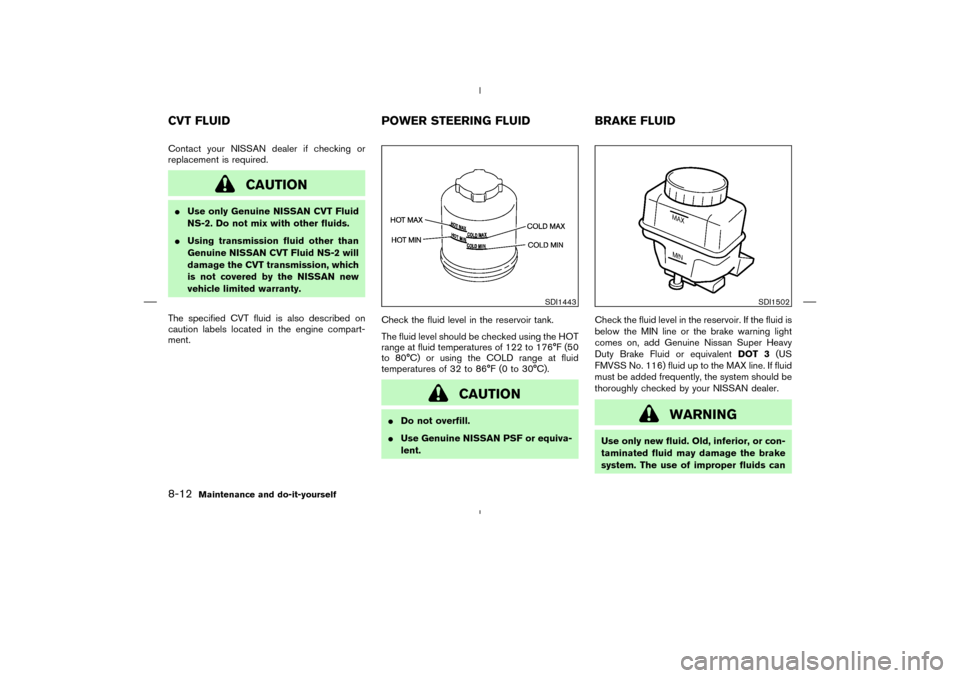
The fluid level should be checked using the HOT
range at fluid temperatures of 122 to 176°F (50
to 80°C) or using the COLD range at fluid
temperatures of 32 to 86°F (0 to 30°C).
CAUTION
�Do not overfill.
�Use Genuine NISSAN PSF or equiva-
lent.Check the fluid level in the reservoir. If the fluid is
below the MIN line or the brake warning light
comes on, add Genuine Nissan Super Heavy
Duty Brake Fluid or equivalentDOT 3(US
FMVSS No. 116) fluid up to the MAX line. If fluid
must be added frequently, the system should be
thoroughly checked by your NISSAN dealer.
WARNING
Use only new fluid. Old, inferior, or con-
taminated fluid may damage the brake
system. The use of improper fluids can
SDI1443
SDI1502
CVT FLUID POWER STEERING FLUID BRAKE FLUID8-12
Maintenance and do-it-yourself
�
04.4.5/Z50-D/V5.0
�
Page 223 of 283
�Keep the battery surface clean and dry. Any
corrosion should be washed off with a solu-
tion of baking soda and water.
�Make certain the terminal connections are
clean and securely tightened.
�If the vehicle is not to be used for 30 days or
longer, disconnect the (—) negative battery
terminal cable to prevent discharging it.
WARNING
�Do not expose the battery to flames
or electrical sparks. Hydrogen gas
generated by battery action is explo-
sive. Do not allow battery fluid to
contact your skin, eyes, fabrics, or
painted surfaces. After touching a
battery or battery cap, do not touch
or rub your eyes. Thoroughly wash
your hands. If the acid contacts your
eyes, skin or clothing, immediately
flush with water for at least 15 min-
utes and seek medical attention.
�Battery posts, terminals and related
accessories contain lead and leadcompounds. Wash hands after han-
dling.
�Do not operate the vehicle if the fluid
in the battery is low. Low battery fluid
can cause a higher load on the bat-
tery which can generate heat, reduce
battery life, and in some cases lead
to an explosion.
�When working on or near a battery,
always wear suitable eye protection
and remove all jewelry.
�Battery posts, terminals and related
accessories contain lead and lead
compounds. Wash hands after han-
dling.
�Keep the battery out of the reach of
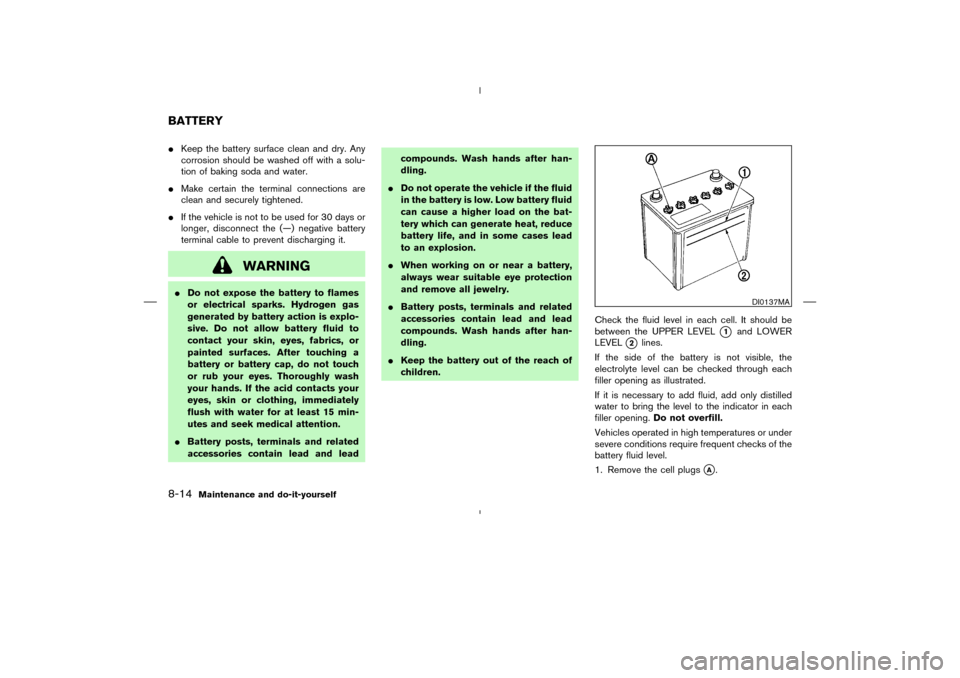
children.Check the fluid level in each cell. It should be
between the UPPER LEVEL
�1
and LOWER
LEVEL
�2
lines.
If the side of the battery is not visible, the
electrolyte level can be checked through each
filler opening as illustrated.
If it is necessary to add fluid, add only distilled
water to bring the level to the indicator in each
filler opening.Do not overfill.
Vehicles operated in high temperatures or under
severe conditions require frequent checks of the
battery fluid level.
1. Remove the cell plugs
�A.
DI0137MA
BATTERY8-14
Maintenance and do-it-yourself
�
04.4.5/Z50-D/V5.0
�
Page 225 of 283
WARNING
Be sure the engine and ignition switch
are off and that the parking brake is
engaged securely.
CAUTION
Be sure to use the correct socket to
remove the spark plugs. An incorrect
socket can damage the spark plugs.
REPLACING SPARK PLUGS
Platinum-tipped spark plugsIt is not necessary to replace the platinum-tipped
spark plugs as frequently as the conventional
type spark plugs since they will last much longer.
Follow the maintenance log, but do not reuse
them by cleaning or regapping.
If replacement is required, see your NISSAN
dealer for servicing.
Always replace with recommended
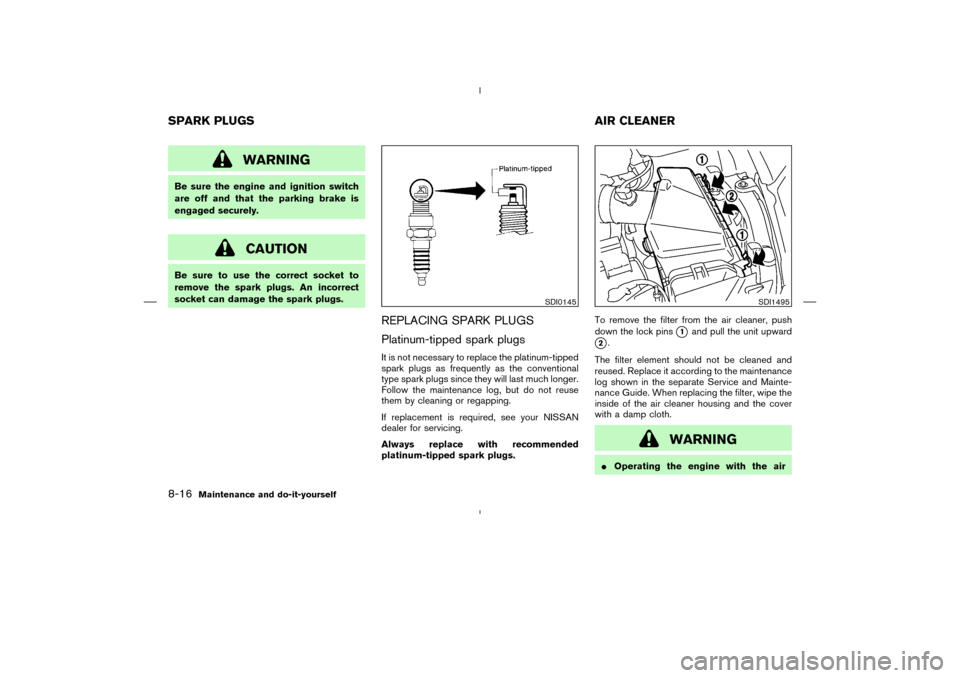
platinum-tipped spark plugs.To remove the filter from the air cleaner, push
down the lock pins
�1
and pull the unit upward
�2.
The filter element should not be cleaned and
reused. Replace it according to the maintenance
log shown in the separate Service and Mainte-
nance Guide. When replacing the filter, wipe the
inside of the air cleaner housing and the cover
with a damp cloth.
WARNING
�Operating the engine with the air
SDI0145
SDI1495
SPARK PLUGS AIR CLEANER8-16
Maintenance and do-it-yourself
�
04.4.5/Z50-D/V5.0
�
Page 226 of 283
cleaner removed can cause you or
others to be burned. The air cleaner
not only cleans the air, it stops flame
if the engine backfires. If it is not
there, and the engine backfires, you
could be burned. Do not drive with
the air cleaner removed and be care-
ful when working on the engine with
the air cleaner removed.
�Never pour fuel into the throttle body
or attempt to start the engine with
the air cleaner removed. Doing so
could result in serious injury.
CAUTION
�After wiper blade replacement, return
the wiper arm to its original position.
Otherwise it may be damaged when
the engine hood is opened.
�Make sure the wiper blade contacts
the glass, otherwise the arm may be
damaged from wind pressure.
�Worn windshield wiper blades can
damage the windshield and impair
driver vision.CLEANINGIf your windshield is not clear after using the
windshield washer or if a wiper blade chatters
when running, wax or other material may be on
the blade or windshield.
Clean the outside of the windshield with a
washer solution or a mild detergent. Your wind-
shield is clean if beads do not form when rinsing
with clear water.
Clean the blade by wiping it with a cloth soaked
in a washer solution or a mild detergent. Thenrinse the blade with clear water. If your wind-
shield is still not clear after cleaning the blades
and using the wiper, replace the blades.WINDSHIELD WIPER BLADES
Maintenance and do-it-yourself
8-17
�
04.4.5/Z50-D/V5.0
�
Page 232 of 283
Make sure that the
⊕
side faces the
bottom case.
3. Close the lid securely.
4. Push the keyfobbutton two or three times to
check its operation.
See your NISSAN dealer if you need any assis-
tance for replacement.
If the battery is removed for any reason
other than replacement, perform step 4
above.
�Be careful not to touch a circuit board
and a battery terminal.
�An improperly disposed battery can
harm the environment. Always confirm
local regulations for battery disposal.
�The keyfob is water-resistant; however,
if it does get wet, immediately wipe
completely dry.
�When changing batteries, do not let
dust or oil get on the keyfob.
FCC Notice:
Changes or modifications not expressly
approved by the manufacturer compliance
could void the user’s authority to operate
the equipment. This device complies with
Part 15 of the FCC Rules and RSS-210 ofIndustry Canada. Operation is subject to
the following two conditions: (1) This de-
vice may not cause harmful interference,
and (2) this device must accept any inter-
ference received, including interference
that may cause undesired operation of the
device.
Maintenance and do-it-yourself
8-23
�
04.4.5/Z50-D/V5.0
�
Page 233 of 283
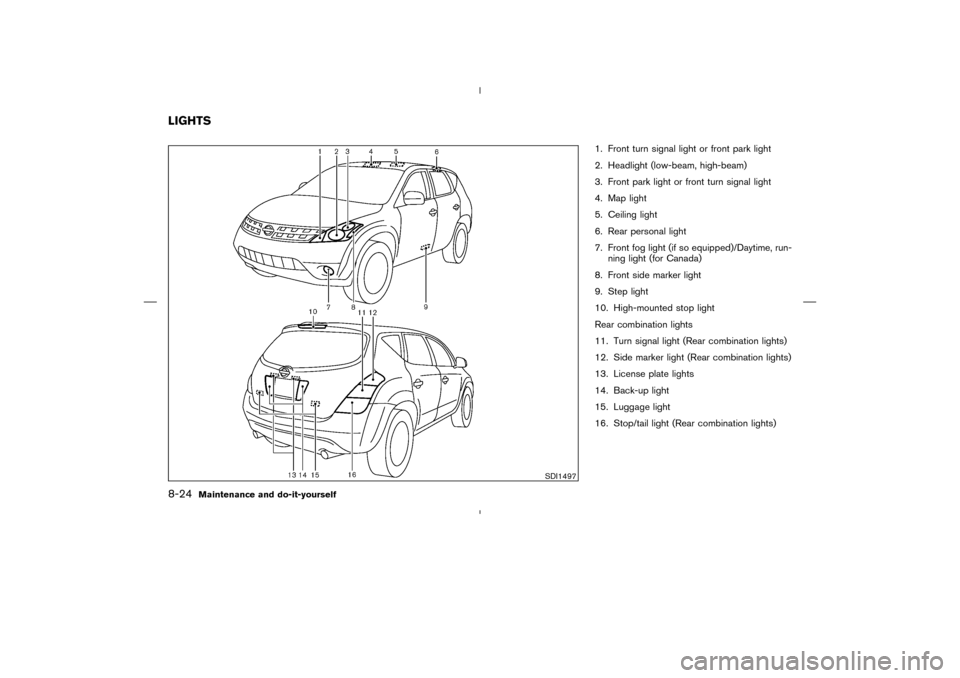
1. Front turn signal light or front park light
2. Headlight (low-beam, high-beam)
3. Front park light or front turn signal light
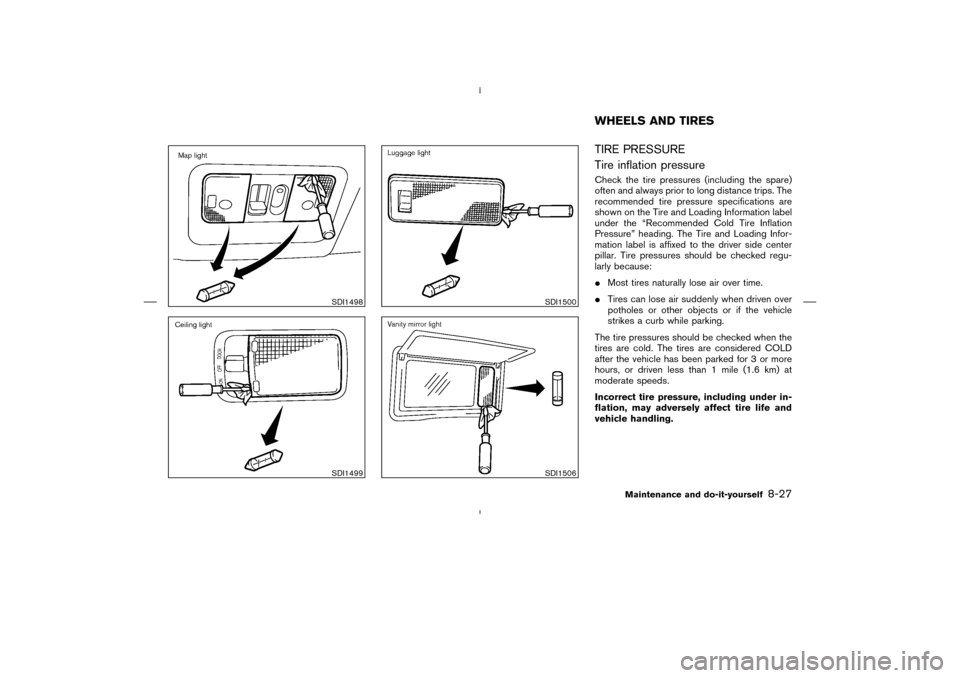
4. Map light
5. Ceiling light
6. Rear personal light
7. Front fog light (if so equipped)/Daytime, run-
ning light (for Canada)
8. Front side marker light
9. Step light
10. High-mounted stop light
Rear combination lights
11. Turn signal light (Rear combination lights)
12. Side marker light (Rear combination lights)
13. License plate lights
14. Back-up light
15. Luggage light
16. Stop/tail light (Rear combination lights)
SDI1497
LIGHTS8-24
Maintenance and do-it-yourself
�
04.4.5/Z50-D/V5.0
�
Page 236 of 283
TIRE PRESSURE
Tire inflation pressureCheck the tire pressures (including the spare)
often and always prior to long distance trips. The
recommended tire pressure specifications are
shown on the Tire and Loading Information label
under the “Recommended Cold Tire Inflation
Pressure” heading. The Tire and Loading Infor-
mation label is affixed to the driver side center
pillar. Tire pressures should be checked regu-
larly because:
�Most tires naturally lose air over time.
�Tires can lose air suddenly when driven over
potholes or other objects or if the vehicle
strikes a curbwhile parking.
The tire pressures should be checked when the
tires are cold. The tires are considered COLD
after the vehicle has been parked for 3 or more
hours, or driven less than 1 mile (1.6 km) at
moderate speeds.
Incorrect tire pressure, including under in-
flation, may adversely affect tire life and
vehicle handling.
SDI1498SDI1499
SDI1500SDI1506
WHEELS AND TIRES
Maintenance and do-it-yourself
8-27
�
04.4.5/Z50-D/V5.0
�
Page 237 of 283
WARNING
�Improperly inflated tires can fail sud-
denly and cause an accident.
�The vehicle weight capacity is indi-
cated on the Tire and Loading Infor-
mation label. Do not load your ve-
hicle beyond this capacity.
Overloading your vehicle may result
in reduced tire life, unsafe operating
conditions due to premature tire fail-
ure, or unfavorable handling charac-
teristics and could also lead to a
serious accident. Loading beyond the
specified capacity may also result in
failure of other vehicle components.
�Before taking a long trip, or when-
ever you heavily load your vehicle,
use a tire pressure gauge to ensure
that the tire pressures are at the
specified level.
�Do not drive your vehicle over 85
MPH (137 km/h) unless it is equipped
with high speed rated tires. Driving
faster than 85 MPH (137 km/h) mayresult in tire failure, loss of control
and possible injury.
�For additional information regarding
tires, refer to “Important Tire Safety
Information” (US) or “Tire Safety In-
formation” (Canada) in the Warranty
Information Booklet.
Low tire pressure warning system (if
so equipped)The low tire pressure warning system displays
the tire pressure of all tires (except the spare tire)
on the display screen by sending a signal from a
sensor that is installed in each wheel. For more
details, refer to “Low tire pressure warning light”
in the “2. Instruments and controls” section,
“Low tire pressure warning system” in the “5.
Starting and driving” section, and “Flat tire” in
the “6. In case of emergency” section. If the tire
pressure displayed on the display screen is
lower than the COLD tire pressure shown on the
Tire and Loading Information label, check the
pressure of all four tires and adjust them to the
COLD tire pressure as indicated above. The low
tire pressure warning system will activate only
when the vehicle is driven at speeds above 20
MPH (32 km/h).
8-28
Maintenance and do-it-yourself
�
04.4.5/Z50-D/V5.0
�