2004 NISSAN MAXIMA weight
[x] Cancel search: weightPage 3 of 280
Your new NISSAN is the result of our dedication to
produce the finest in safe, reliable and economical
transportation. Your vehicle is the product of a suc-
cessful worldwide company that manufactures cars
and trucks in over 17 countries and distributes them
in 170 nations.
NISSAN vehicles are designed and manufactured
by Nissan Motor Co., Ltd. which was founded in
Tokyo, Japan in 1933, and NISSAN affiliates world-
wide, collectively growing to become the fifth largest
automaker in the world. In addition to cars and
trucks, NISSAN also makes forklift trucks, marine
engines, boats and other diversified products.
NISSAN has made a substantial and growing in-
vestment in North America. NISSAN’s commitment
is over $6 billion dollars in capital investments in
facilities across the continent. Some of the facilities
include the Nissan Manufacturing facilities in Can-
ton, Mississippi and in Smyrna, Tennessee, vehiclestyling design at Nissan Design America, Inc. in San
Diego, California, and engineering at Nissan Tech-
nical Center North America in Farmington Hills,
Michigan. Additionally, NISSAN employs more than
21,000 people throughout the United States,
Canada, and Mexico. An additional 60,000 people
work for the 1,250 NISSAN and INFINITI dealers
across North America.
NISSAN is also a substantial contributor to the
Canadian economy. Nissan Canada Inc., its suppli-
ers and over 150 dealers employ approximately
4,500 people. These include company employees
and the staffs of NISSAN dealers all across Canada.
In addition, many Canadians work for companies
that supply NISSAN and NISSAN dealers with ma-
terials and services ranging from the operation of
port facilities and transportation services, to the
supply of lubricants, parts and accessories.NISSAN pioneered the use of electronics and com-
puters in automobiles, and has led the industry in
improving both performance and fuel efficiency
through new engine designs and the use of syn-
thetic materials to reduce vehicle weight. The com-
pany has also developed ways to build quality into its
vehicles at each stage of the production process,
both through extensive use of automation and —
most importantly — through an awareness that
people
are the central element in quality control.
From the time the parts arrived from our suppliers
until you took delivery of your new NISSAN, dozens
of checks were made to ensure that only the best job
was being done in producing and delivering your
vehicle. NISSAN also takes great care to ensure that
when you take your NISSAN to your dealer for
maintenance, the service technician will perform his
work according to the quality standards that have
been established by NISSAN.
Safety has also been built into your NISSAN. As you
know, seat belts are an integral part of the safety
systems that will help protect you and your passen-
gers in the event of a sudden stop or an accident.
We urge you to use the seat belts every time you
drive the vehicle.
The NISSAN story of growth and achievement re-
flects our major goal: to provide you, our customer,
with a vehicle that is built with quality and craftsman-
ship — a product that we can be proud to build and
you can be proud to own.
WFW0002
WELCOME TO THE WORLD OF NISSAN
ZREVIEW COPY:Ð2004 Maxima(max)
Owners Manual(owners)ÐUSA English(nna)
10/07/03Ðtbrooks
X
Page 237 of 280
If you have a flat tire, see the “In case of
emergency” section of this manual.
TIRE PRESSURE
Tire inflation pressure
Check the tire pressures (including the spare)
often and always prior to long distance trips. The
recommended tire pressure specifications are
shown on the Tire and Loading Information label
(this label is also known as the tire placard) under
the9Recommended Cold Tire Inflation Pressure9
heading. The Tire and Loading Information label
is affixed to the driver side center pillar. Tire
pressures should be checked regularly because:
cMost tires naturally lose air over time.
cTires can lose air suddenly when driven over
potholes or other objects or if the vehicle
strikes a curb while parking.
The tire pressures should be checked when the
tires are cold. The tires are considered COLD
after the vehicle has been parked for 3 or more
hours, or driven less than 1 mile (1.6 km) at
moderate speeds.
Incorrect tire pressure, including under in-
flation, may adversely affect tire life and
vehicle handling.
WARNING
cImproperly inflated tires can fail sud-
denly and cause an accident.
cThe vehicle weight capacity is indicated
on the Tire and Loading Information
label. Do not load your vehicle beyond
this capacity. Overloading your vehicle
may result in reduced tire life, unsafe
operating conditions due to premature
tire failure, or unfavorable handling
characteristics and could also lead to a
serious accident. Loading beyond the
specified capacity may also result in
failure of other vehicle components.
cBefore taking a long trip, or whenever
you heavily load your vehicle, use a tire
pressure gauge to ensure that the tire
pressures are at the specified level.
cDo not drive your vehicle over 85 MPH
(137 km/h) unless it is equipped with
high speed rated tires. Driving faster
than 85 MPH (137 km/h) may result in
tire failure, loss of control and possible
injury.cFor additional information regarding
tires, refer to “Important Tire Safety In-
formation” (US) or “Tire Safety Informa-
tion” (Canada) in the Warranty Informa-
tion Booklet.
WHEELS AND TIRES
Maintenance and do-it-yourself8-33
ZREVIEW COPY:Ð2004 Maxima(max)
Owners Manual(owners)ÐUSA English(nna)
10/20/03Ðarosenma
X
Page 241 of 280
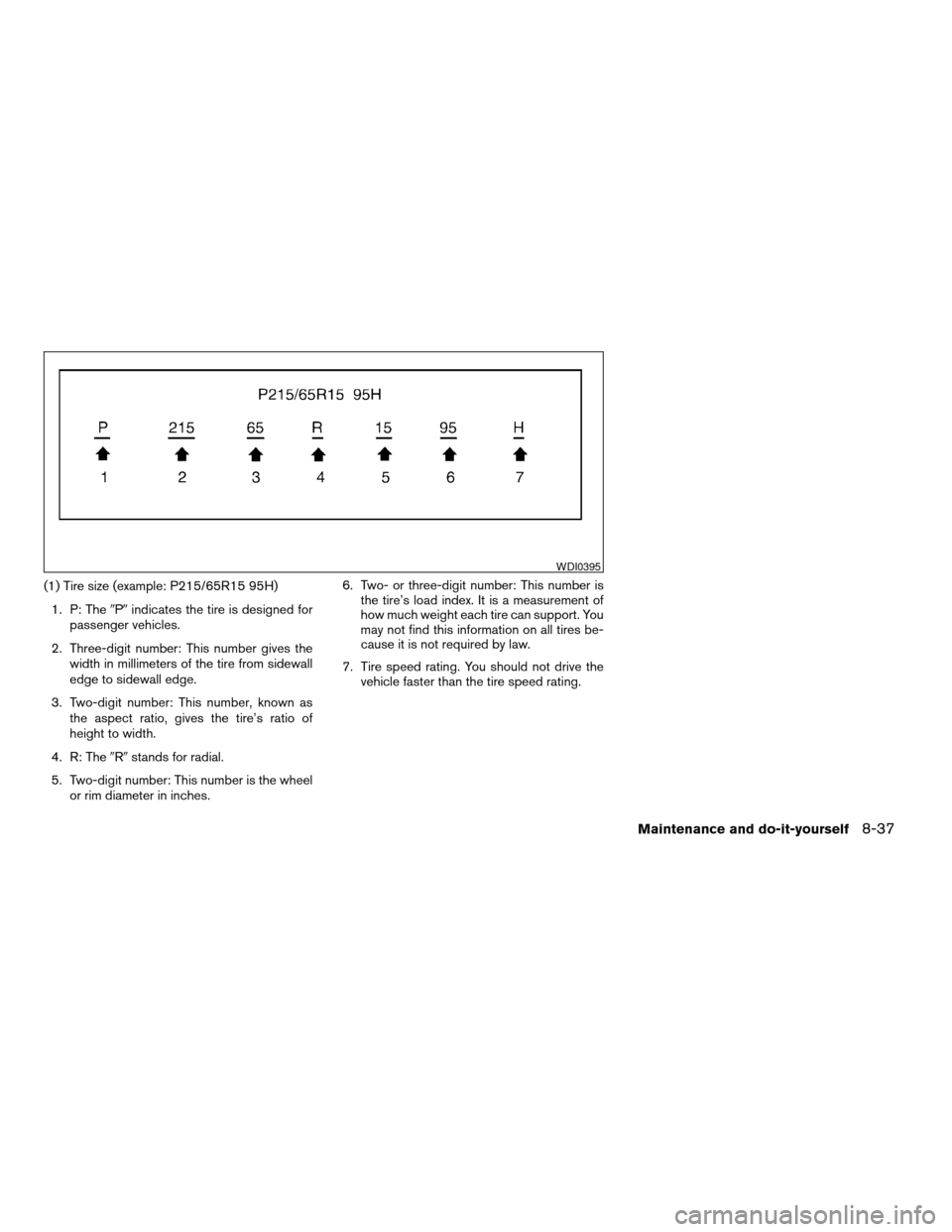
(1) Tire size (example: P215/65R15 95H)
1. P: The9P9indicates the tire is designed for
passenger vehicles.
2. Three-digit number: This number gives the
width in millimeters of the tire from sidewall
edge to sidewall edge.
3. Two-digit number: This number, known as
the aspect ratio, gives the tire’s ratio of
height to width.
4. R: The9R9stands for radial.
5. Two-digit number: This number is the wheel
or rim diameter in inches.6. Two- or three-digit number: This number is
the tire’s load index. It is a measurement of
how much weight each tire can support. You
may not find this information on all tires be-
cause it is not required by law.
7. Tire speed rating. You should not drive the
vehicle faster than the tire speed rating.
WDI0395
Maintenance and do-it-yourself8-37
ZREVIEW COPY:Ð2004 Maxima(max)
Owners Manual(owners)ÐUSA English(nna)
10/20/03Ðarosenma
X
Page 249 of 280
9 Technical and consumer information
Capacities and recommended fuel/lubricants.........9-2
Fuel recommendation...........................9-3
Engine oil and oil filter recommendation...........9-5
Recommended SAE viscosity number............9-6
Air conditioner system refrigerant and
lubricant recommendations......................9-6
Specifications.....................................9-7
Engine........................................9-7
Wheels and tires...............................9-8
Dimensions and weights........................9-8
When traveling or registering your vehicle in
another country...................................9-9
Vehicle identification...............................9-9
Vehicle identification number (VIN) plate..........9-9
Vehicle identification number
(chassis number)...............................9-9
Engine serial number...........................9-10
F.M.V.S.S. certification label....................9-10
Emission control information label...............9-10Tire placard...................................9-11
Air conditioner specification label................9-11
Installing front license plate........................9-11
Vehicle loading information........................9-12
Terms........................................9-12
Determining vehicle load capacity...............9-12
Loading tips..................................9-13
Towing a trailer...................................9-13
Maximum load limits...........................9-13
Towing load/specification chart.................9-15
Towing safety.................................9-15
Flat towing....................................9-17
Uniform tire quality grading........................9-17
Emission control system warranty..................9-18
Reporting safety defects (US only).................9-19
Readiness for inspection/maintenance (I/M) test.....9-19
Owner’s Manual/Service Manual order information . . . 9-20
In the event of a collision.......................9-21
ZREVIEW COPY:Ð2004 Maxima(max)
Owners Manual(owners)ÐUSA English(nna)
10/20/03Ðarosenma
X
Page 256 of 280
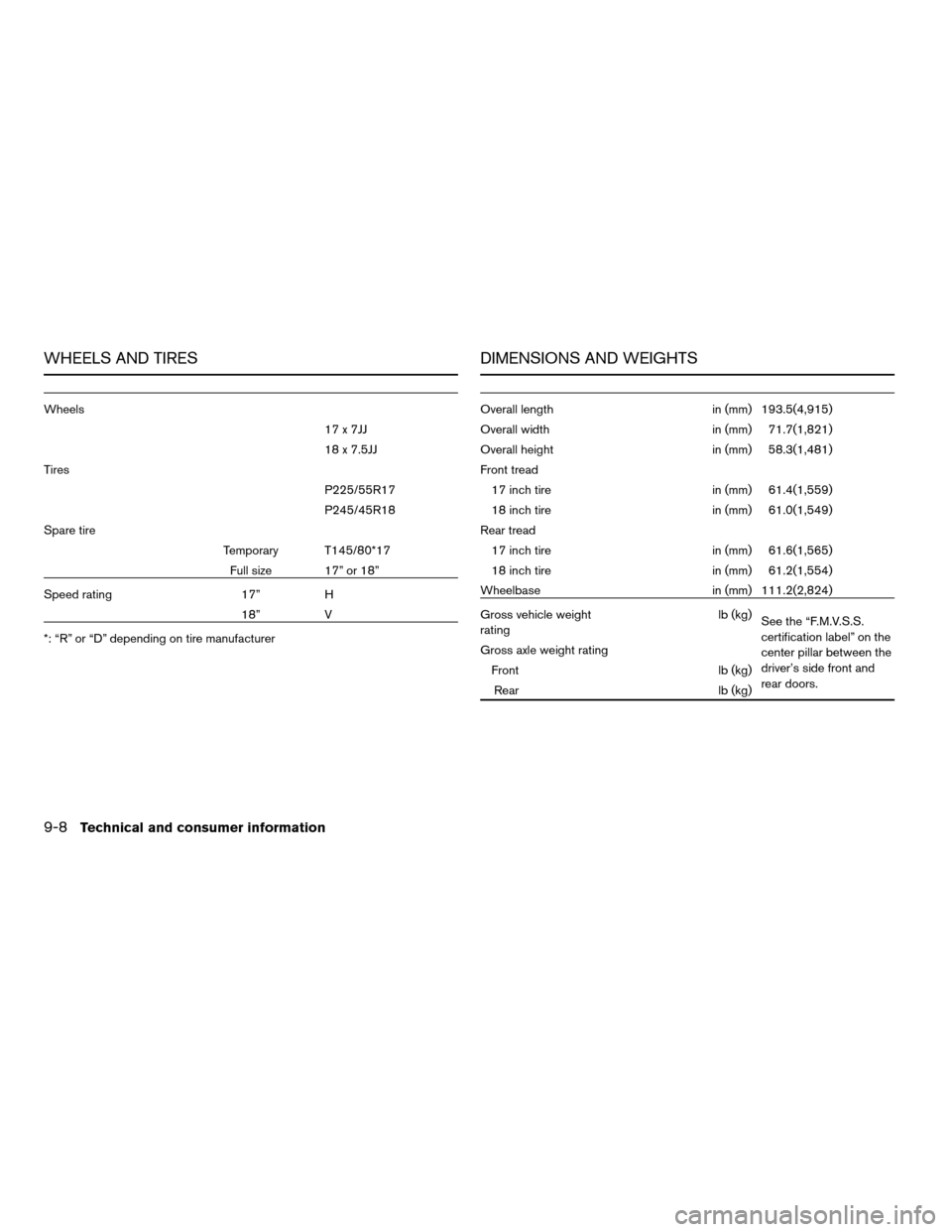
WHEELS AND TIRES
Wheels
17 x 7JJ
18 x 7.5JJ
Tires
P225/55R17
P245/45R18
Spare tire
Temporary T145/80*17
Full size 17” or 18”
Speed rating 17” H
18” V
*: “R” or “D” depending on tire manufacturer
DIMENSIONS AND WEIGHTS
Overall length in (mm) 193.5(4,915)
Overall width in (mm) 71.7(1,821)
Overall height in (mm) 58.3(1,481)
Front tread
17 inch tire in (mm) 61.4(1,559)
18 inch tire in (mm) 61.0(1,549)
Rear tread
17 inch tire in (mm) 61.6(1,565)
18 inch tire in (mm) 61.2(1,554)
Wheelbase in (mm) 111.2(2,824)
Gross vehicle weight
ratinglb (kg)
See the “F.M.V.S.S.
certification label” on the
center pillar between the
driver’s side front and
rear doors. Gross axle weight rating
Front lb (kg)
Rear lb (kg)
9-8Technical and consumer information
ZREVIEW COPY:Ð2004 Maxima(max)
Owners Manual(owners)ÐUSA English(nna)
10/20/03Ðarosenma
X
Page 258 of 280
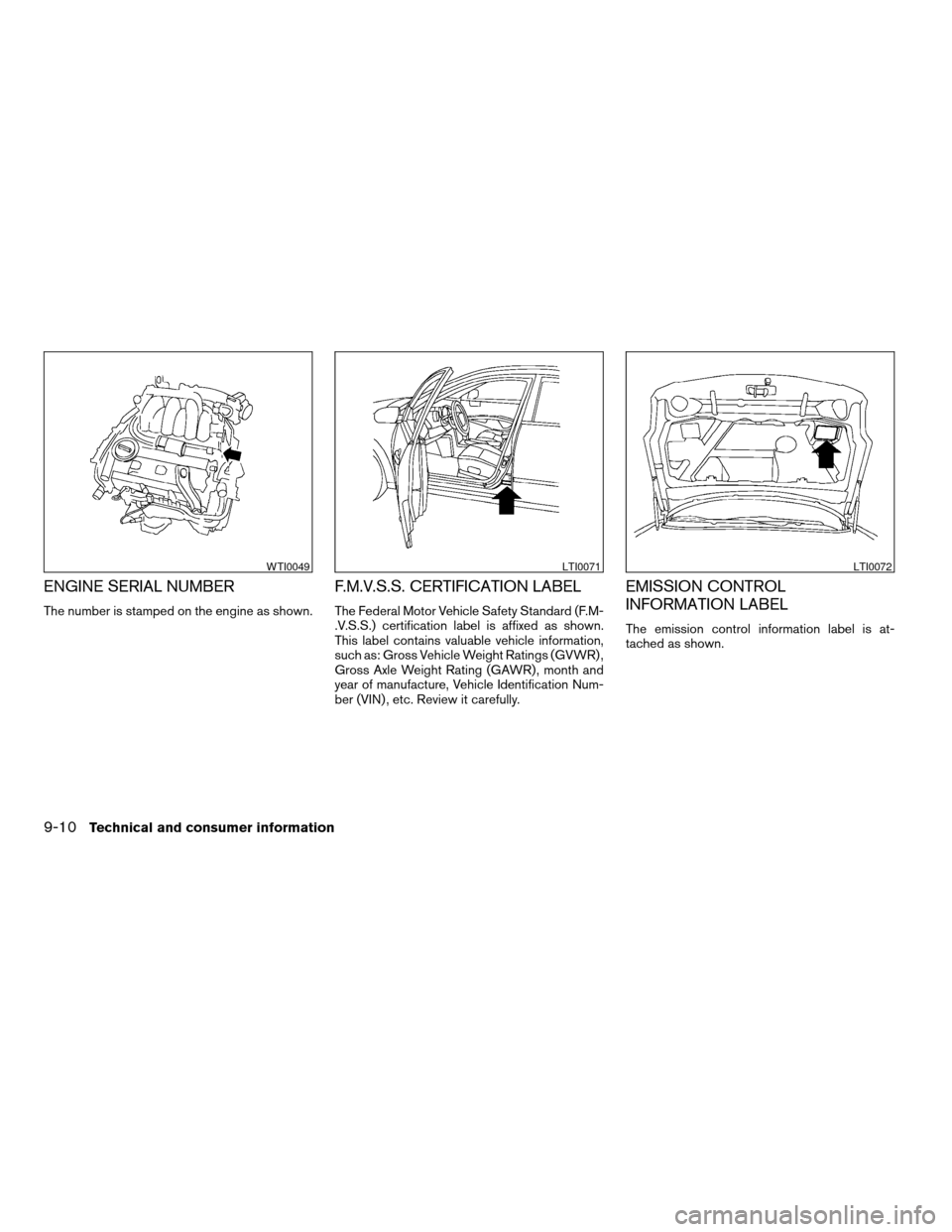
ENGINE SERIAL NUMBER
The number is stamped on the engine as shown.
F.M.V.S.S. CERTIFICATION LABEL
The Federal Motor Vehicle Safety Standard (F.M-
.V.S.S.) certification label is affixed as shown.
This label contains valuable vehicle information,
such as: Gross Vehicle Weight Ratings (GVWR) ,
Gross Axle Weight Rating (GAWR) , month and
year of manufacture, Vehicle Identification Num-
ber (VIN) , etc. Review it carefully.
EMISSION CONTROL
INFORMATION LABEL
The emission control information label is at-
tached as shown.
WTI0049LTI0071LTI0072
9-10Technical and consumer information
ZREVIEW COPY:Ð2004 Maxima(max)
Owners Manual(owners)ÐUSA English(nna)
10/20/03Ðarosenma
X
Page 260 of 280
Use the following steps to mount the front license
plate:
Before mounting the license plate, confirm that
the following parts are enclosed in the plastic
bag:
cLicense plate bracket
cLicense plate bracket screws x 2
cLicense plate screws x 2
cScrew grommets x 2
1. Make a shallow hole in the bumper fascia at
the location marks (small dimples) using a
0.39 in (10 mm) drill. To avoid damaging the
area behind the fascia, apply only light pres-
sure to the drill.
2. Insert the grommets into the holes in the
bumper fascia.
3. Insert a small flat-bladed screwdriver into
the grommet hole to turn the threaded part of
the grommet 90°.
4. Mount the license plate bracket using the
two longer screws.
5. Use the two shorter hex head screws to
mount the license plate to the license plate
bracket.WARNING
cIt is extremely dangerous to ride in a
cargo area inside a vehicle. In a colli-
sion, people riding in these areas are
more likely to be seriously injured or
killed.
cDo not allow people to ride in any area
of your vehicle that is not equipped with
seats and seat belts.
cBe sure everyone in your vehicle is in a
seat and using a seat belt properly.
TERMS
It is important to familiarize yourself with the fol-
lowing terms before loading your vehicle:
cCurb Weight (actual weight of your vehicle)
- vehicle weight including: standard and op-
tional equipment, fluids, emergency tools,
and spare tire assembly. This weightdoes
notinclude passengers and cargo.
cGVW (Gross Vehicle Weight) - curb weight
plus the combined weight of passengers
and cargo.
cGVWR (Gross Vehicle Weight Rating) -
maximum total weight (load) limit specified
for the vehicle.cGAWR (Gross Axle Weight Rating) - maxi-
mum weight (load) limit specified for the
front or rear axle.
DETERMINING VEHICLE LOAD
CAPACITY
The load capacity of this vehicle is determined by
weight, not by available cargo space. For ex-
ample, a luggage rack, bike carrier, cartop carrier
or similar equipment does not increase load car-
rying capacity of your vehicle.
To determine vehicle load capacity:
Vehicle weight can be determined by using a
commercial-grade scale, found at places such as
a truck stop, gravel quarry, grain elevator, or a
scrap metal recycling facility.
1. Determine the curb weight of your vehicle.
2. Compare the curb weight amount to the
GVWR specified for your vehicle to deter-
mine how much more weight your vehicle
can carry.
VEHICLE LOADING INFORMATION
9-12Technical and consumer information
ZREVIEW COPY:Ð2004 Maxima(max)
Owners Manual(owners)ÐUSA English(nna)
10/20/03Ðarosenma
X
Page 261 of 280
3. After loading (cargo and passengers) , re-
weigh your vehicle to determine if either
GVWR or GAWR for your vehicle is ex-
ceeded. If GVWR is exceeded, remove
cargo as necessary. If either the front or rear
GAWR is exceeded, shift the load or remove
cargo as necessary.
LOADING TIPS
cThe GVW must not exceed GVWR or
GAWR as specified on the F.M.V.S.S. certi-
fication label.
cDo not load the front and rear axle to the
GAWR. Doing so will exceed the GVWR.
WARNING
cProperly secure all cargo with ropes or
straps to help prevent it from sliding or
shifting. Do not place cargo higher than
the seatbacks. In a sudden stop or col-
lision, unsecured cargo could cause
personal injury.cDo not load your vehicle any heavier
than the GVWR or the maximum front
and rear GAWRs. If you do, parts of your
vehicle can break, tire damage could
occur, or it can change the way your
vehicle handles. This could result in
loss of control and cause personal
injury.
cOverloading not only can shorten the
life of your vehicle and the tire, but can
also cause unsafe vehicle handling and
longer braking distances. This may
cause a premature tire failure which
could result in a serious accident and
personal injury. Failures caused by
overloading are not covered by the ve-
hicle’s warranty.Your new vehicle was designed to be used pri-
marily to carry passengers and cargo. Remember
that towing a trailer places additional loads on
your vehicle’s engine, drive train, steering, brak-
ing and other systems.
ANissan Trailer Towing Guide (U.S. only)is
available from a NISSAN dealer. This guide in-
cludes information on trailer towing ability and the
special equipment required for proper towing.
MAXIMUM LOAD LIMITS
Maximum trailer loads
Never allow the total trailer load to exceed the
value specified in the Towing Load/Specification
Chart found later in this section. The total trailer
load equals trailer weight plus its cargo weight.
Towing loads greater than specified or using
improper towing equipment could adversely af-
fect vehicle handling, braking and performance.
The ability of your vehicle to tow a trailer is not
only related to the maximum trailer loads, but also
the places you plan to tow. Tow weights appro-
priate for level highway driving may have to be
reduced on very steep grades or in low traction
situations (for example, on slippery boat ramps) .
TOWING A TRAILER
Technical and consumer information9-13
ZREVIEW COPY:Ð2004 Maxima(max)
Owners Manual(owners)ÐUSA English(nna)
10/20/03Ðarosenma
X