2004 NISSAN MAXIMA washer fluid
[x] Cancel search: washer fluidPage 208 of 280
Windshield wiper and washer*Check that
the wipers and washer operate properly and that
the wipers do not streak.
Windshield defrosterCheck that the air
comes out of the defroster outlets properly and in
sufficient quantity when operating the heater or
air conditioner.
Under the hood and vehicle
The maintenance items listed here should be
checked periodically (for example, each time you
check the engine oil or refuel) .
Automatic transmission fluid level*Check
the level after putting the selector lever in P with
the engine idling at operating temperature.
Battery*Check the fluid level in each cell. It
should be between the MAX and MIN lines. Ve-
hicles operated in high temperatures or under
severe conditions require frequent checks of the
battery fluid level.
Brake and clutch fluid levels*Make sure that
the brake and clutch fluid level is between the
MIN and MAX lines on the reservoir.
Engine coolant level*Check the coolant level
when the engine is cold.
Engine drive belts*Make sure the drive belts
are not frayed, worn, cracked or oily.Engine oil level*Check the level after parking
the vehicle on a level surface with the engine off.
Wait more than 10 minutes for the oil to drain
back into the oil pan.
Exhaust systemMake sure there are no loose
supports, cracks or holes. If the sound of the
exhaust seems unusual or there is a smell of
exhaust fumes, immediately have the exhaust
system inspected by a NISSAN dealer. See the
carbon monoxide warning in the “Starting and
driving” section of this manual.
Fluid leaksCheck under the vehicle for fuel, oil,
water or other fluid leaks after the vehicle has
been parked for a while. Water dripping from the
air conditioner after use is normal. If you should
notice any leaks or if gasoline fumes are evident,
check for the cause and have it corrected imme-
diately.
Power steering fluid level* and linesCheck
the level when the fluid is cold, with the engine
off. Check the lines for proper attachment, leaks,
cracks, etc.
Radiator and hosesCheck the front of the
radiator and clean off any dirt, insects, leaves,
etc., that may have accumulated. Make sure the
hoses have no cracks, deformation, rot or loose
connections.UnderbodyThe underbody is frequently ex-
posed to corrosive substances such as those
used on icy roads or to control dust. It is very
important to remove these substances from the
underbody, otherwise rust may form on the floor
pan, frame, fuel lines and exhaust system. At the
end of winter, the underbody should be thor-
oughly flushed with plain water, in those areas
where mud and dirt may have accumulated. See
the “Appearance and care” section of this
manual.
Windshield washer fluid*Check that there is
adequate fluid in the reservoir.
8-4Maintenance and do-it-yourself
ZREVIEW COPY:Ð2004 Maxima(max)
Owners Manual(owners)ÐUSA English(nna)
10/20/03Ðarosenma
X
Page 210 of 280
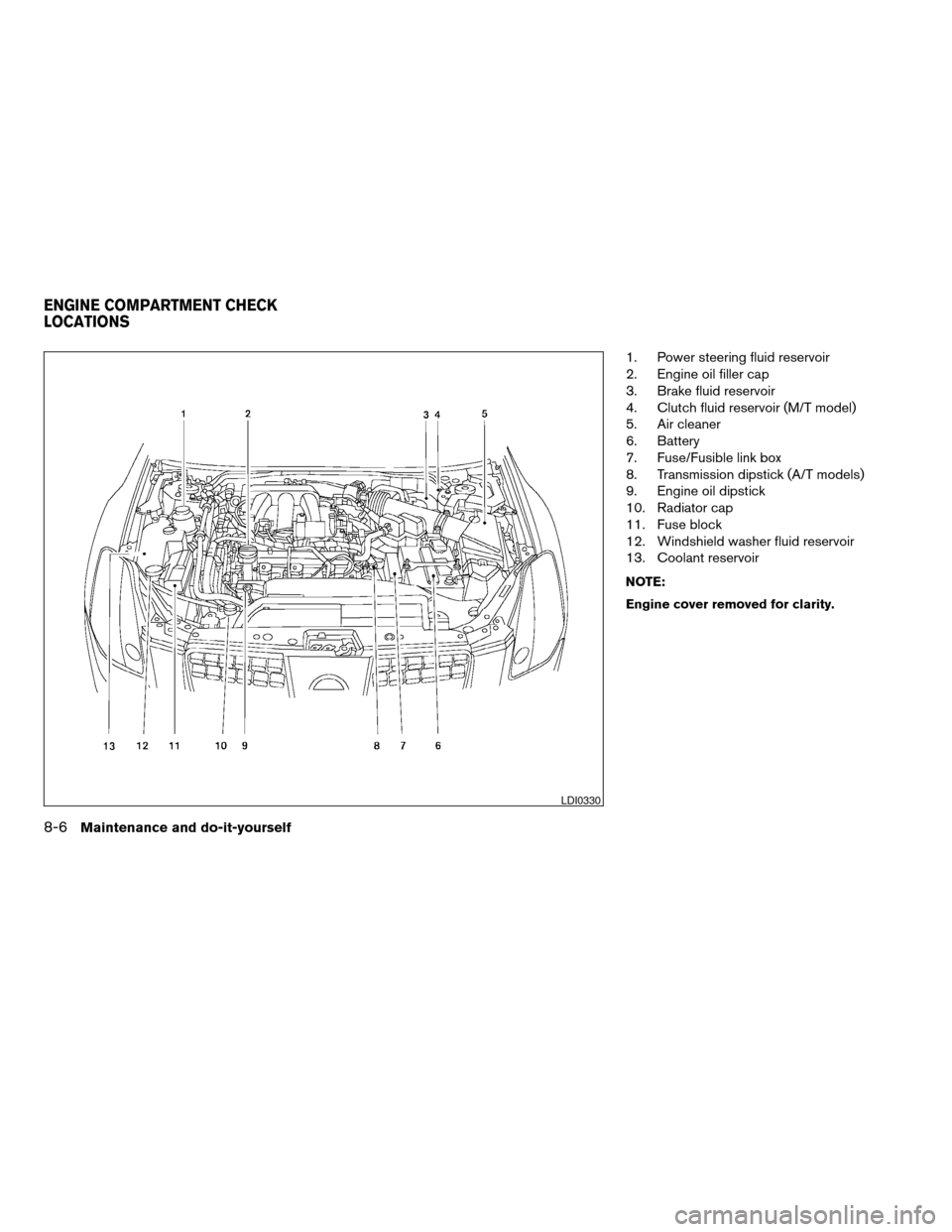
1. Power steering fluid reservoir
2. Engine oil filler cap
3. Brake fluid reservoir
4. Clutch fluid reservoir (M/T model)
5. Air cleaner
6. Battery
7. Fuse/Fusible link box
8. Transmission dipstick (A/T models)
9. Engine oil dipstick
10. Radiator cap
11. Fuse block
12. Windshield washer fluid reservoir
13. Coolant reservoir
NOTE:
Engine cover removed for clarity.
LDI0330
ENGINE COMPARTMENT CHECK
LOCATIONS
8-6Maintenance and do-it-yourself
ZREVIEW COPY:Ð2004 Maxima(max)
Owners Manual(owners)ÐUSA English(nna)
10/20/03Ðarosenma
X
Page 218 of 280
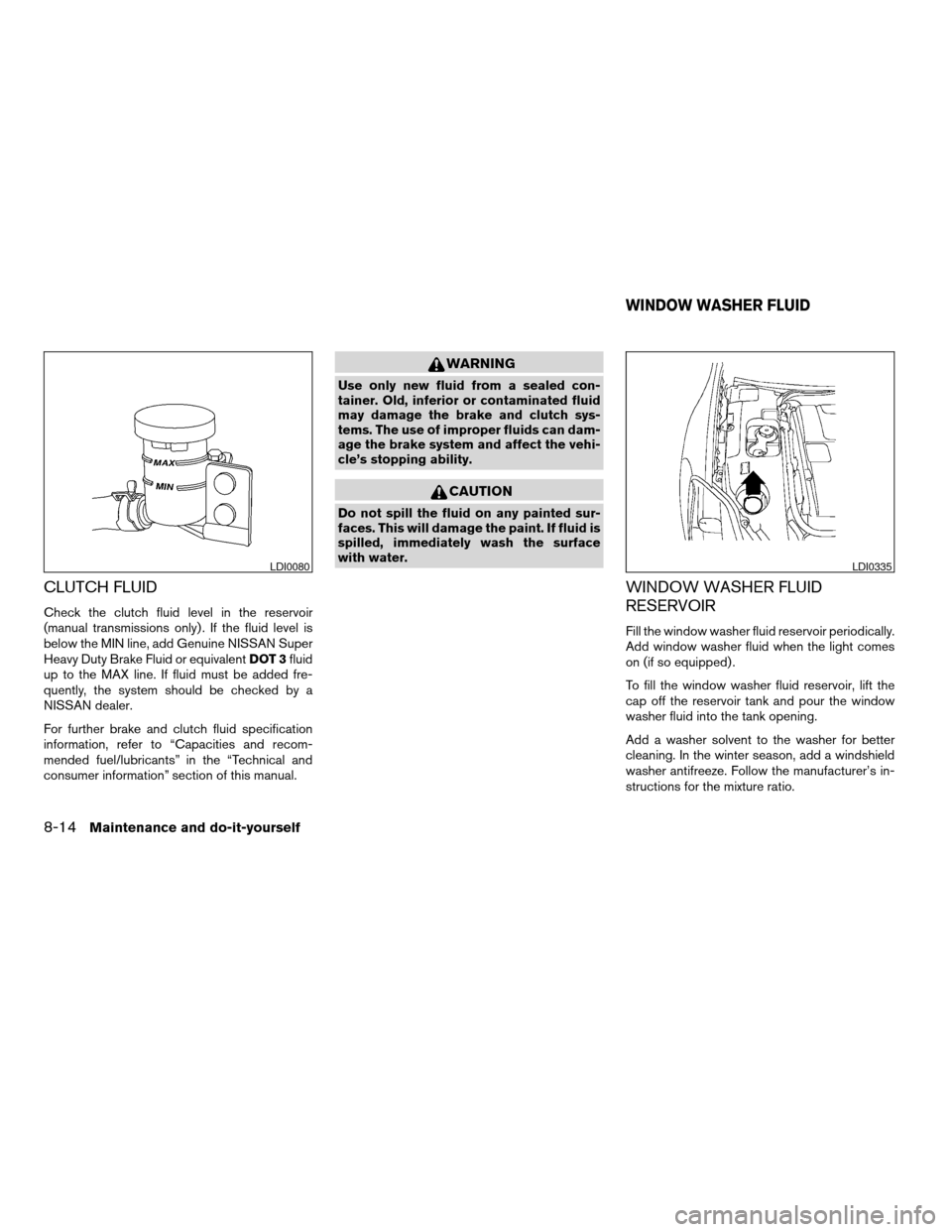
CLUTCH FLUID
Check the clutch fluid level in the reservoir
(manual transmissions only) . If the fluid level is
below the MIN line, add Genuine NISSAN Super
Heavy Duty Brake Fluid or equivalentDOT 3fluid
up to the MAX line. If fluid must be added fre-
quently, the system should be checked by a
NISSAN dealer.
For further brake and clutch fluid specification
information, refer to “Capacities and recom-
mended fuel/lubricants” in the “Technical and
consumer information” section of this manual.
WARNING
Use only new fluid from a sealed con-
tainer. Old, inferior or contaminated fluid
may damage the brake and clutch sys-
tems. The use of improper fluids can dam-
age the brake system and affect the vehi-
cle’s stopping ability.
CAUTION
Do not spill the fluid on any painted sur-
faces. This will damage the paint. If fluid is
spilled, immediately wash the surface
with water.
WINDOW WASHER FLUID
RESERVOIR
Fill the window washer fluid reservoir periodically.
Add window washer fluid when the light comes
on (if so equipped) .
To fill the window washer fluid reservoir, lift the
cap off the reservoir tank and pour the window
washer fluid into the tank opening.
Add a washer solvent to the washer for better
cleaning. In the winter season, add a windshield
washer antifreeze. Follow the manufacturer’s in-
structions for the mixture ratio.
LDI0080LDI0335
WINDOW WASHER FLUID
8-14Maintenance and do-it-yourself
ZREVIEW COPY:Ð2004 Maxima(max)
Owners Manual(owners)ÐUSA English(nna)
10/20/03Ðarosenma
X
Page 219 of 280
Refill the reservoir more frequently when driving
conditions require an increased amount of win-
dow washer fluid.
Recommended fluid is Genuine NISSAN Wind-
shield Washer Concentrate Cleaner & Anti-
freeze or equivalent.
CAUTION
cDo not substitute engine anti-freeze
coolant for window washer solution.
This may result in damage to the paint.
cDo not fill the window washer reservoir
tank with washer fluid concentrates at
full strength. Some methyl alcohol
based washer fluid concentrates may
permanently stain the grille if spilled
while filling the window washer reser-
voir tank.
cPre-mix washer fluid concentrates with
water to the manufacturer’s recom-
mended levels before pouring the fluid
into the window washer reservoir tank.
Do not use the window washer reservoir
tank to mix the washer fluid concen-
trate and water.cKeep the battery surface clean and dry. Any
corrosion should be washed off with a solu-
tion of baking soda and water.
cMake certain the terminal connections are
clean and securely tightened.
cIf the vehicle is not to be used for 30 days or
longer, disconnect the negative (-) battery
terminal cable to prevent discharge.
WARNING
cDo not expose the battery to flames or
electrical sparks. Hydrogen gas gener-
ated by the battery is explosive. Do not
allow battery fluid to contact your skin,
eyes, fabrics or painted surfaces. After
touching a battery or battery cap, do not
touch or rub your eyes. Thoroughly
wash your hands. If the acid contacts
your eyes, skin or clothing, immediately
flush with water for at least 15 minutes
and seek medical attention.
cDo not operate the vehicle if the fluid in
the battery is low. Low battery fluid can
cause a higher load on the battery
which can generate heat, reduce bat-
tery life, and in some cases lead to an
explosion.cWhen working on or near a battery, al-
ways wear suitable eye protection and
remove all jewelry.
cBattery posts, terminals and related ac-
cessories contain lead and lead com-
pounds. Wash hands after handling.
cKeep battery out of the reach of
children.
BATTERY
Maintenance and do-it-yourself8-15
ZREVIEW COPY:Ð2004 Maxima(max)
Owners Manual(owners)ÐUSA English(nna)
10/20/03Ðarosenma
X
Page 250 of 280
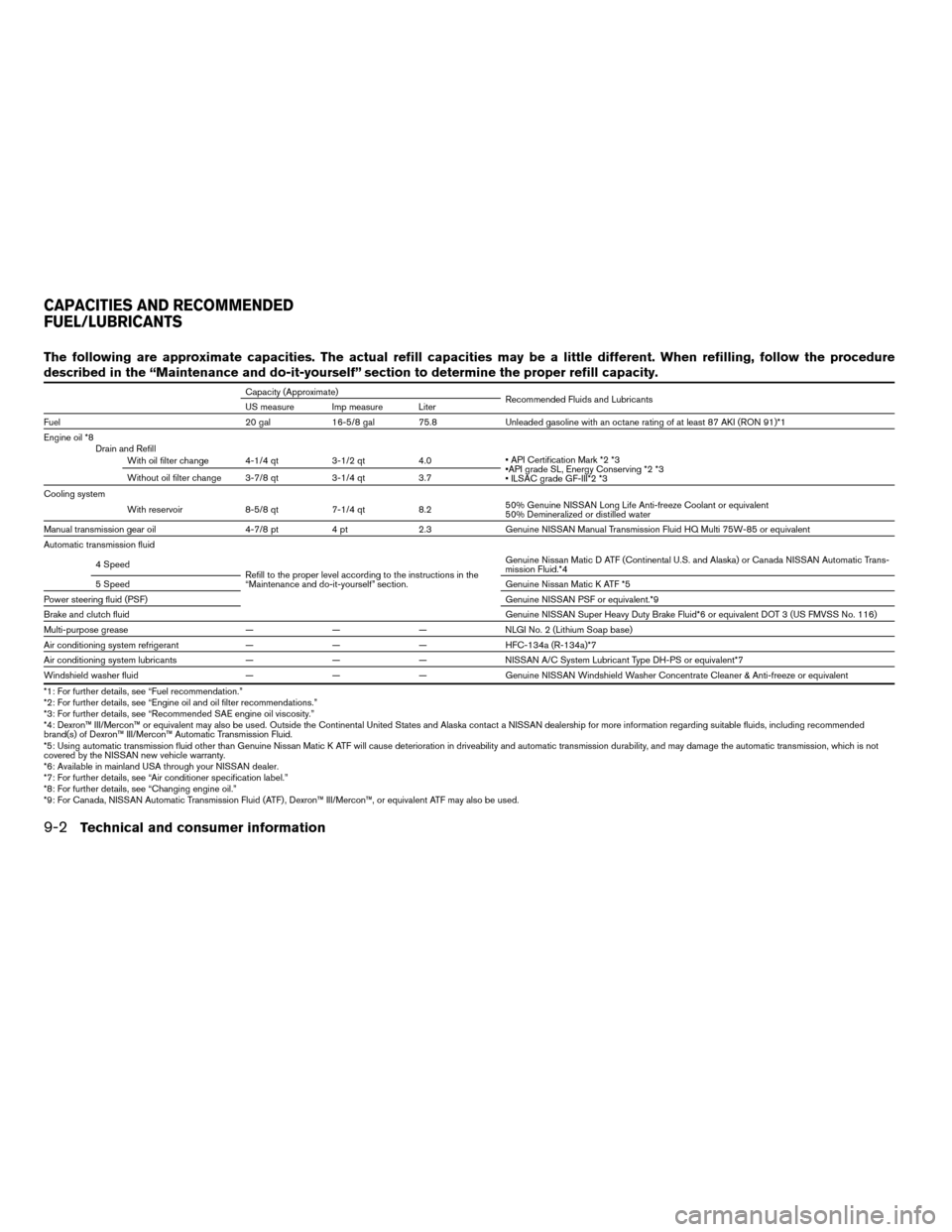
The following are approximate capacities. The actual refill capacities may be a little different. When refilling, follow the procedure
described in the “Maintenance and do-it-yourself” section to determine the proper refill capacity.
Capacity (Approximate)
Recommended Fluids and Lubricants
US measure Imp measure Liter
Fuel 20 gal 16-5/8 gal 75.8 Unleaded gasoline with an octane rating of at least 87 AKI (RON 91)*1
Engine oil *8
Drain and Refill
With oil filter change 4-1/4 qt 3-1/2 qt 4.0• API Certification Mark *2 *3
•API grade SL, Energy Conserving *2 *3
• ILSAC grade GF-III*2 *3 Without oil filter change 3-7/8 qt 3-1/4 qt 3.7
Cooling system
With reservoir 8-5/8 qt 7-1/4 qt 8.250% Genuine NISSAN Long Life Anti-freeze Coolant or equivalent
50% Demineralized or distilled water
Manual transmission gear oil 4-7/8 pt 4 pt 2.3 Genuine NISSAN Manual Transmission Fluid HQ Multi 75W-85 or equivalent
Automatic transmission fluid
Refill to the proper level according to the instructions in the
“Maintenance and do-it-yourself” section. 4 SpeedGenuine Nissan Matic D ATF (Continental U.S. and Alaska) or Canada NISSAN Automatic Trans-
mission Fluid.*4
5 SpeedGenuine Nissan Matic K ATF *5
Power steering fluid (PSF)Genuine NISSAN PSF or equivalent.*9
Brake and clutch fluidGenuine NISSAN Super Heavy Duty Brake Fluid*6 or equivalent DOT 3 (US FMVSS No. 116)
Multi-purpose grease———NLGINo.2(Lithium Soap base)
Air conditioning system refrigerant— — — HFC-134a (R-134a)*7
Air conditioning system lubricants— — — NISSAN A/C System Lubricant Type DH-PS or equivalent*7
Windshield washer fluid— — — Genuine NISSAN Windshield Washer Concentrate Cleaner & Anti-freeze or equivalent
*1: For further details, see “Fuel recommendation.”
*2: For further details, see “Engine oil and oil filter recommendations.”
*3: For further details, see “Recommended SAE engine oil viscosity.”
*4: Dexron™ III/Mercon™ or equivalent may also be used. Outside the Continental United States and Alaska contact a NISSAN dealership for more information regarding suitable fluids, including recommended
brand(s) of Dexron™ III/Mercon™ Automatic Transmission Fluid.
*5: Using automatic transmission fluid other than Genuine Nissan Matic K ATF will cause deterioration in driveability and automatic transmission durability, and may damage the automatic transmission, which is not
covered by the NISSAN new vehicle warranty.
*6: Available in mainland USA through your NISSAN dealer.
*7: For further details, see “Air conditioner specification label.”
*8: For further details, see “Changing engine oil.”
*9: For Canada, NISSAN Automatic Transmission Fluid (ATF) , Dexron™ III/Mercon™, or equivalent ATF may also be used.
CAPACITIES AND RECOMMENDED
FUEL/LUBRICANTS
9-2Technical and consumer information
ZREVIEW COPY:Ð2004 Maxima(max)
Owners Manual(owners)ÐUSA English(nna)
10/20/03Ðarosenma
X
Page 272 of 280
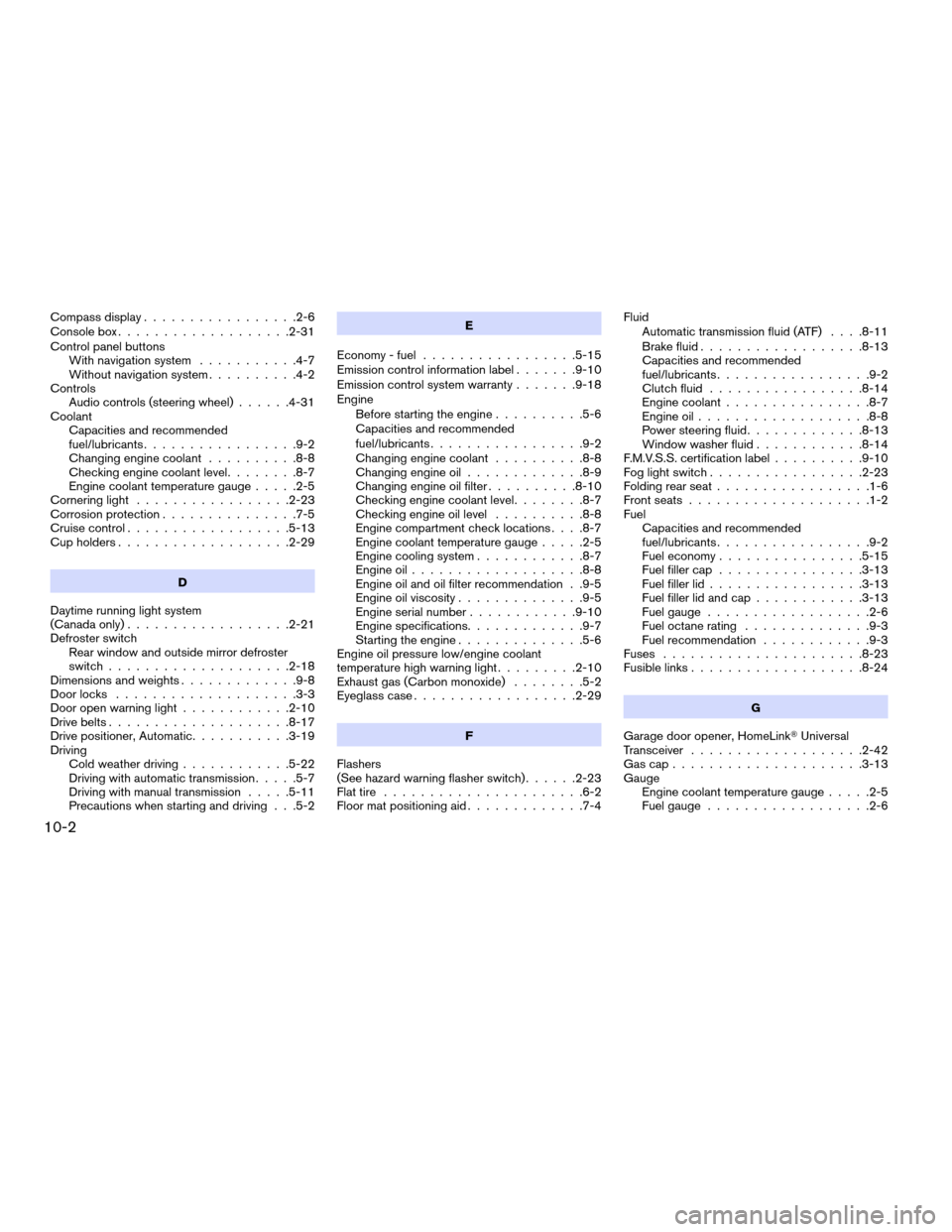
Compass display.................2-6
Console box...................2-31
Control panel buttons
With navigation system...........4-7
Without navigation system..........4-2
Controls
Audio controls (steering wheel)......4-31
Coolant
Capacities and recommended
fuel/lubricants.................9-2
Changing engine coolant..........8-8
Checking engine coolant level........8-7
Engine coolant temperature gauge.....2-5
Cornering light.................2-23
Corrosion protection...............7-5
Cruise control..................5-13
Cup holders...................2-29
D
Daytime running light system
(Canada only)..................2-21
Defroster switch
Rear window and outside mirror defroster
switch....................2-18
Dimensions and weights.............9-8
Door locks....................3-3
Door open warning light............2-10
Drive belts....................8-17
Drive positioner, Automatic...........3-19
Driving
Cold weather driving............5-22
Driving with automatic transmission.....5-7
Driving with manual transmission.....5-11
Precautions when starting and driving . . .5-2E
Economy - fuel.................5-15
Emission control information label.......9-10
Emission control system warranty.......9-18
Engine
Before starting the engine..........5-6
Capacities and recommended
fuel/lubricants.................9-2
Changing engine coolant..........8-8
Changing engine oil.............8-9
Changing engine oil filter..........8-10
Checking engine coolant level........8-7
Checking engine oil level..........8-8
Engine compartment check locations. . . .8-7
Engine coolant temperature gauge.....2-5
Engine cooling system............8-7
Engine oil...................8-8
Engine oil and oil filter recommendation . .9-5
Engine oil viscosity..............9-5
Engine serial number............9-10
Engine specifications.............9-7
Starting the engine..............5-6
Engine oil pressure low/engine coolant
temperature high warning light.........2-10
Exhaust gas (Carbon monoxide)........5-2
Eyeglass case..................2-29
F
Flashers
(See hazard warning flasher switch)......2-23
Flat tire......................6-2
Floor mat positioning aid.............7-4Fluid
Automatic transmission fluid (ATF). . . .8-11
Brake fluid..................8-13
Capacities and recommended
fuel/lubricants.................9-2
Clutch fluid.................8-14
Engine coolant................8-7
Engine oil...................8-8
Power steering fluid.............8-13
Window washer fluid............8-14
F.M.V.S.S. certification label..........9-10
Fog light switch.................2-23
Folding rear seat.................1-6
Front seats....................1-2
Fuel
Capacities and recommended
fuel/lubricants.................9-2
Fuel economy................5-15
Fuel filler cap................3-13
Fuel filler lid.................3-13
Fuel filler lid and cap............3-13
Fuel gauge..................2-6
Fuel octane rating..............9-3
Fuel recommendation............9-3
Fuses......................8-23
Fusible links...................8-24
G
Garage door opener, HomeLinkTUniversal
Transceiver...................2-42
Gascap.....................3-13
Gauge
Engine coolant temperature gauge.....2-5
Fuel gauge..................2-6
10-2
ZREVIEW COPY:Ð2004 Maxima(max)
Owners Manual(owners)ÐUSA English(nna)
10/20/03Ðarosenma
X
Page 273 of 280
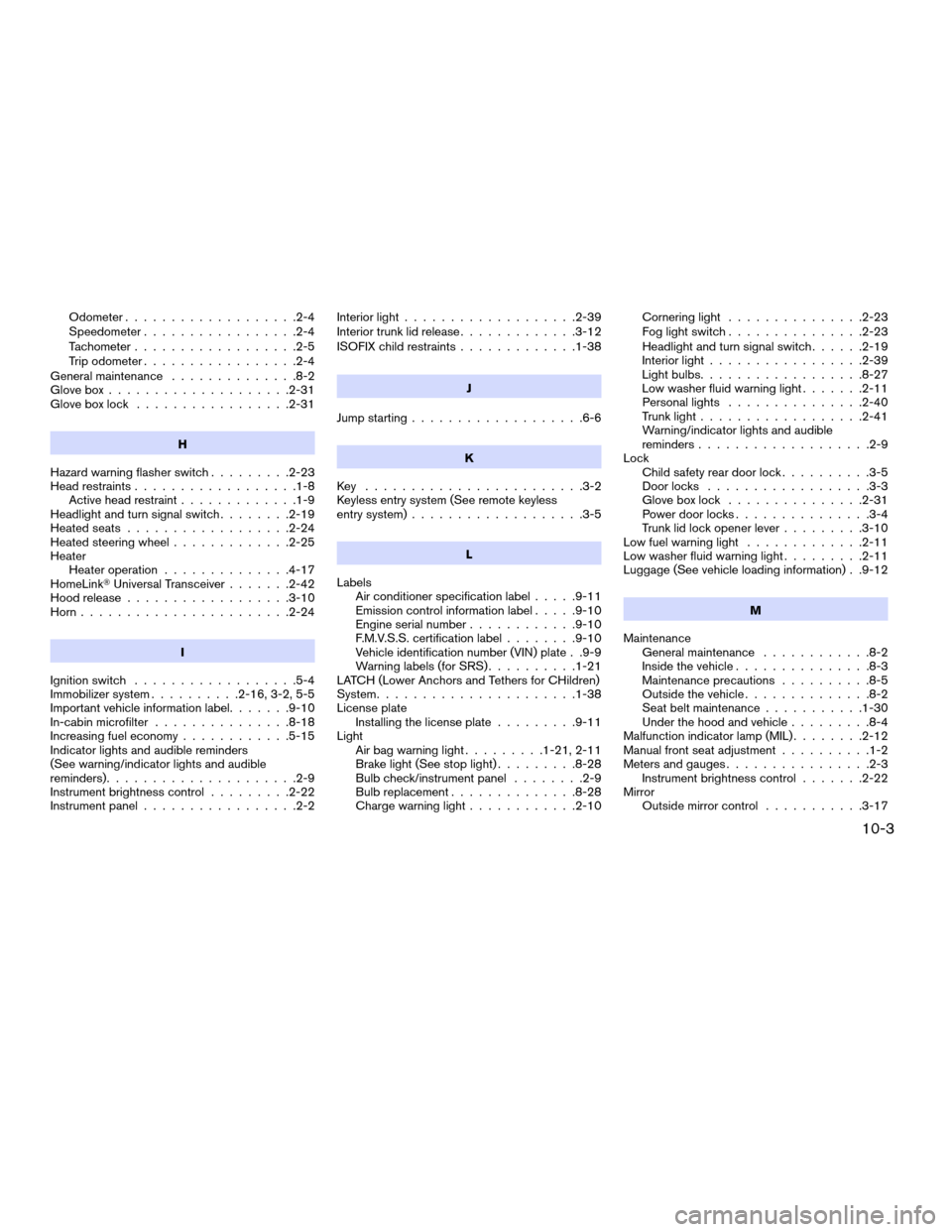
Odometer...................2-4
Speedometer.................2-4
Tachometer..................2-5
Trip odometer.................2-4
General maintenance..............8-2
Glove box....................2-31
Glove box lock.................2-31
H
Hazard warning flasher switch.........2-23
Head restraints..................1-8
Active head restraint.............1-9
Headlight and turn signal switch........2-19
Heated seats..................2-24
Heated steering wheel.............2-25
Heater
Heater operation..............4-17
HomeLinkTUniversal Transceiver.......2-42
Hood release..................3-10
Horn.......................2-24
I
Ignition switch..................5-4
Immobilizer system..........2-16, 3-2, 5-5
Important vehicle information label.......9-10
In-cabin microfilter...............8-18
Increasing fuel economy............5-15
Indicator lights and audible reminders
(See warning/indicator lights and audible
reminders).....................2-9
Instrument brightness control.........2-22
Instrument panel.................2-2Interior light...................2-39
Interior trunk lid release.............3-12
ISOFIX child restraints.............1-38
J
Jump starting...................6-6
K
Key ........................3-2
Keyless entry system (See remote keyless
entry system)...................3-5
L
Labels
Air conditioner specification label.....9-11
Emission control information label.....9-10
Engine serial number............9-10
F.M.V.S.S. certification label........9-10
Vehicle identification number (VIN) plate . .9-9
Warning labels (for SRS)..........1-21
LATCH (Lower Anchors and Tethers for CHildren)
System......................1-38
License plate
Installing the license plate.........9-11
Light
Air bag warning light.........1-21, 2-11
Brake light (See stop light).........8-28
Bulb check/instrument panel........2-9
Bulb replacement..............8-28
Charge warning light............2-10Cornering light...............2-23
Fog light switch...............2-23
Headlight and turn signal switch......2-19
Interior light.................2-39
Light bulbs..................8-27
Low washer fluid warning light.......2-11
Personal lights...............2-40
Trunk light..................2-41
Warning/indicator lights and audible
reminders...................2-9
Lock
Child safety rear door lock..........3-5
Door locks..................3-3
Glove box lock...............2-31
Power door locks...............3-4
Trunk lid lock opener lever.........3-10
Low fuel warning light.............2-11
Low washer fluid warning light.........2-11
Luggage (See vehicle loading information) . .9-12
M
Maintenance
General maintenance............8-2
Inside the vehicle...............8-3
Maintenance precautions..........8-5
Outside the vehicle..............8-2
Seat belt maintenance...........1-30
Under the hood and vehicle.........8-4
Malfunction indicator lamp (MIL)........2-12
Manual front seat adjustment..........1-2
Meters and gauges................2-3
Instrument brightness control.......2-22
Mirror
Outside mirror control...........3-17
10-3
ZREVIEW COPY:Ð2004 Maxima(max)
Owners Manual(owners)ÐUSA English(nna)
10/20/03Ðarosenma
X
Page 275 of 280
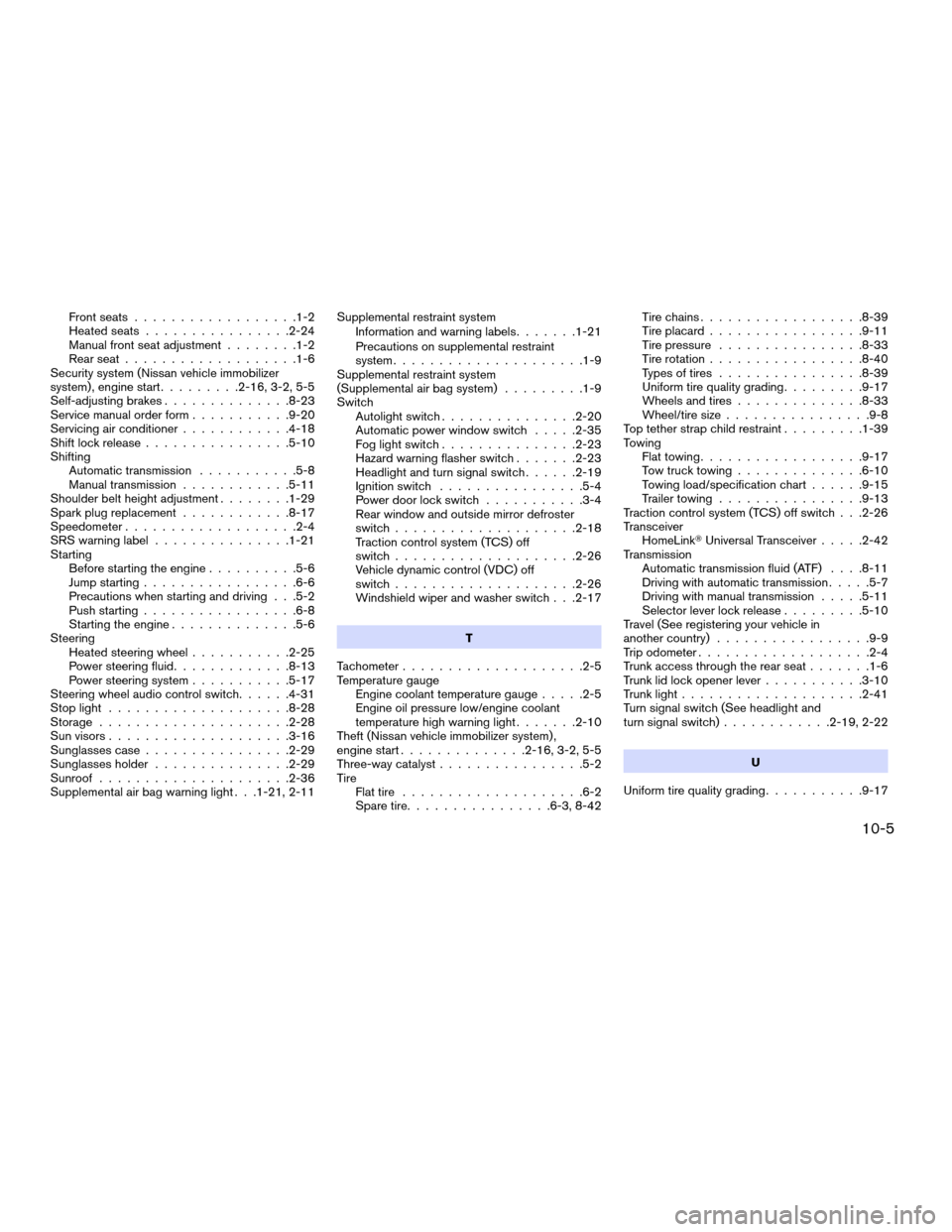
Front seats..................1-2
Heated seats................2-24
Manual front seat adjustment........1-2
Rear seat...................1-6
Security system (Nissan vehicle immobilizer
system) , engine start.........2-16, 3-2, 5-5
Self-adjusting brakes..............8-23
Service manual order form...........9-20
Servicing air conditioner............4-18
Shift lock release................5-10
Shifting
Automatic transmission...........5-8
Manual transmission............5-11
Shoulder belt height adjustment........1-29
Spark plug replacement............8-17
Speedometer...................2-4
SRS warning label...............1-21
Starting
Before starting the engine..........5-6
Jump starting.................6-6
Precautions when starting and driving . . .5-2
Push starting.................6-8
Starting the engine..............5-6
Steering
Heated steering wheel...........2-25
Power steering fluid.............8-13
Power steering system...........5-17
Steering wheel audio control switch......4-31
Stop light....................8-28
Storage.....................2-28
Sun visors....................3-16
Sunglasses case................2-29
Sunglasses holder...............2-29
Sunroof.....................2-36
Supplemental air bag warning light . . .1-21, 2-11Supplemental restraint system
Information and warning labels.......1-21
Precautions on supplemental restraint
system.....................1-9
Supplemental restraint system
(Supplemental air bag system).........1-9
Switch
Autolight switch...............2-20
Automatic power window switch.....2-35
Fog light switch...............2-23
Hazard warning flasher switch.......2-23
Headlight and turn signal switch......2-19
Ignition switch................5-4
Power door lock switch...........3-4
Rear window and outside mirror defroster
switch....................2-18
Traction control system (TCS) off
switch....................2-26
Vehicle dynamic control (VDC) off
switch....................2-26
Windshield wiper and washer switch . . .2-17
T
Tachometer....................2-5
Temperature gauge
Engine coolant temperature gauge.....2-5
Engine oil pressure low/engine coolant
temperature high warning light.......2-10
Theft (Nissan vehicle immobilizer system) ,
engine start..............2-16, 3-2, 5-5
Three-way catalyst................5-2
Tire
Flat tire....................6-2
Spare tire................6-3, 8-42Tire chains..................8-39
Tire placard.................9-11
Tire pressure................8-33
Tire rotation.................8-40
Types of tires................8-39
Uniform tire quality grading.........9-17
Wheels and tires..............8-33
Wheel/tire size................9-8
Top tether strap child restraint.........1-39
Towing
Flat towing..................9-17
Tow truck towing..............6-10
Towing load/specification chart......9-15
Trailer towing................9-13
Traction control system (TCS) off switch . . .2-26
Transceiver
HomeLinkTUniversal Transceiver.....2-42
Transmission
Automatic transmission fluid (ATF). . . .8-11
Driving with automatic transmission.....5-7
Driving with manual transmission.....5-11
Selector lever lock release.........5-10
Travel (See registering your vehicle in
another country).................9-9
Trip odometer...................2-4
Trunk access through the rear seat.......1-6
Trunk lid lock opener lever...........3-10
Trunk light....................2-41
Turn signal switch (See headlight and
turn signal switch)............2-19, 2-22
U
Uniform tire quality grading...........9-17
10-5
ZREVIEW COPY:Ð2004 Maxima(max)
Owners Manual(owners)ÐUSA English(nna)
10/20/03Ðarosenma
X