Page 153 of 434
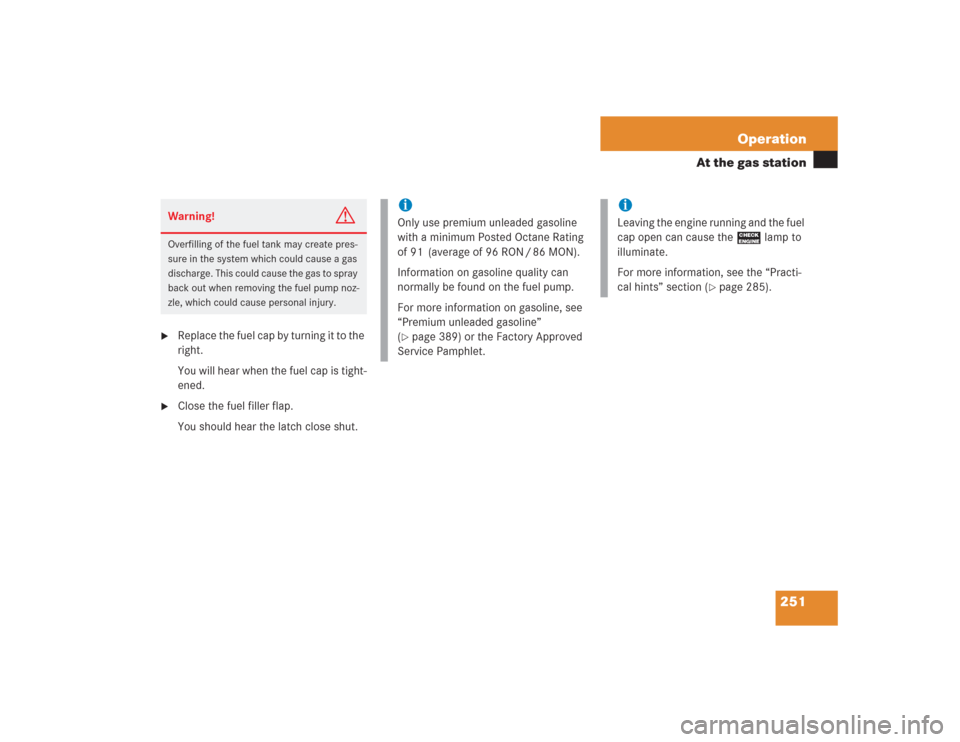
152 Controls in detailControl systemCall up range (distance to empty)�
Press button ÿ or è repeatedly
until you see the first function of the
Trip computer menu.
�
Press button j or k repeatedly
until you see this message in the left
display:
Range
.
In the right display you will see the cal-
culated range based on the current fuel
tank level.
TEL menu*
You can use the functions in the
TEL
menu
to operate your telephone, provided it is
connected to a hands-free system and
switched on.
�
Switch on the telephone and COMAND.
�
Press button ÿ or è on the
steering wheel repeatedly until you see
the
TEL
menu in the left display.
Warning!
G
A driver’s attention to the road must always
be his/her primary focus when driving. For
your safety and the safety of others, we rec-
ommend that you pull over to a safe location
and stop before placing or taking a tele-
phone call. If you choose to use the tele-
phone while driving, please use the
hands-free device and only use the tele-
phone when weather, road, and traffic con-
ditions permit.
Some jurisdictions prohibit the driver from
using a cellular telephone while driving a ve-
hicle.
Bear in mind that at a speed of just 30 mph
(approximately 50 km/h), your vehicle is
covering a distance of 44 feet (approximate-
ly 14 m) every second.
Never operate radio transmitters equipped
with a built-in or attached antenna (i.e. with-
out being connected to an external antenna)
from inside the vehicle while the engine is
running. Doing so could lead to a malfunc-
tion of the vehicle’s electronic system, pos-
sibly resulting in an accident and/or
personal injury.
Page 251 of 434
250 OperationAt the gas station
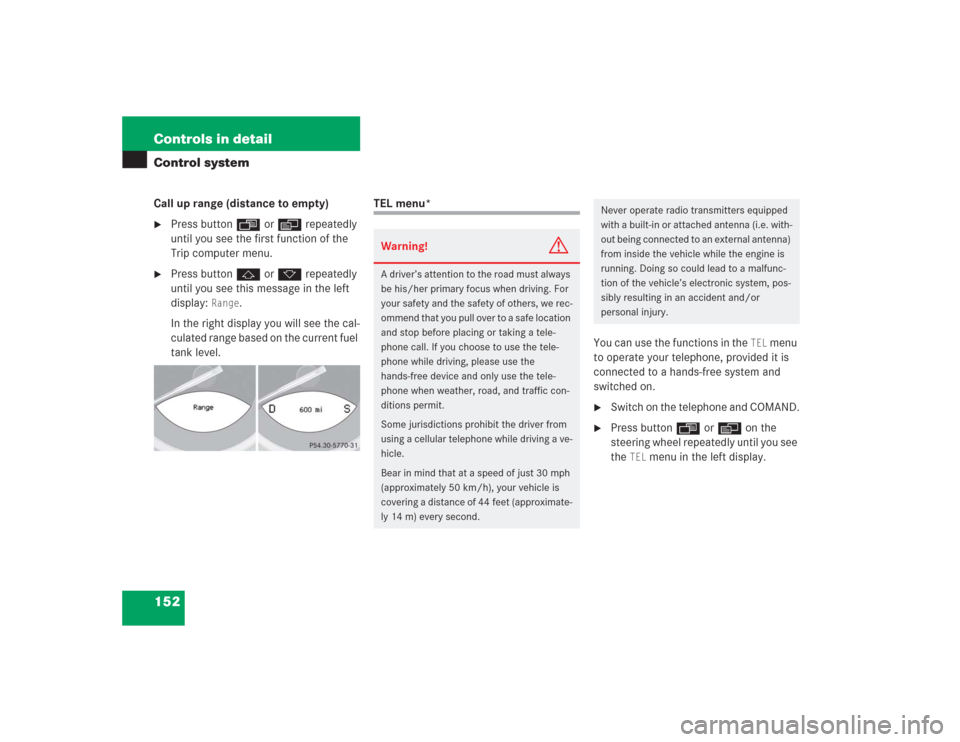
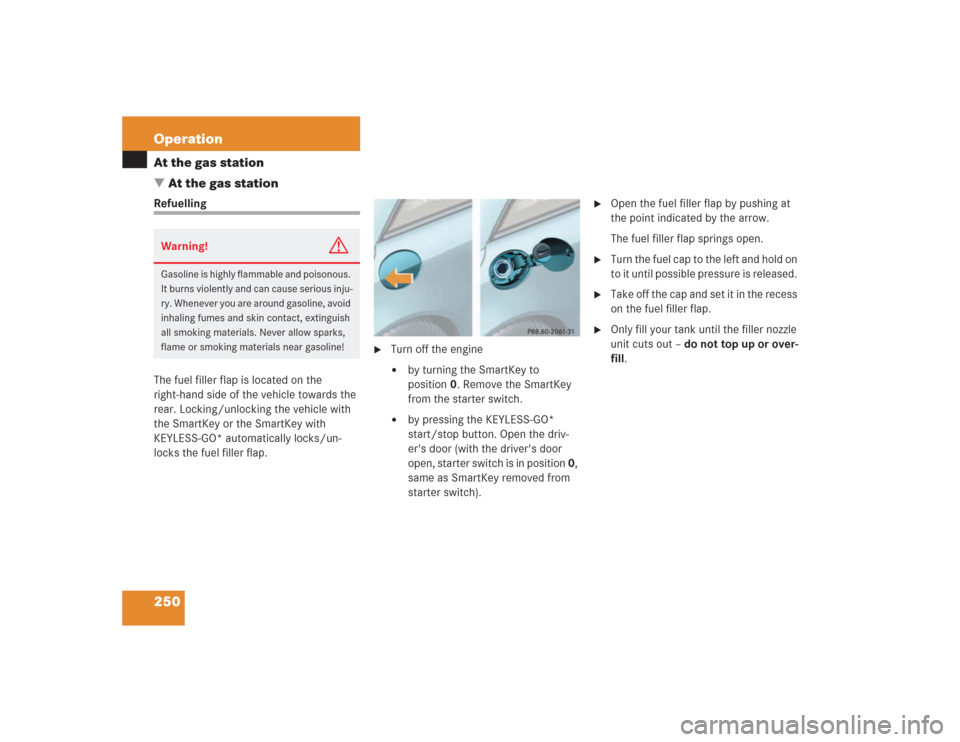
�At the gas stationRefuelling
The fuel filler flap is located on the
right-hand side of the vehicle towards the
rear. Locking/unlocking the vehicle with
the SmartKey or the SmartKey with
KEYLESS-GO* automatically locks/un-
locks the fuel filler flap.
�
Turn off the engine�
by turning the SmartKey to
position0. Remove the SmartKey
from the starter switch.
�
by pressing the KEYLESS-GO*
start/stop button. Open the driv-
er's door (with the driver's door
open, starter switch is in position 0,
same as SmartKey removed from
starter switch).
�
Open the fuel filler flap by pushing at
the point indicated by the arrow.
The fuel filler flap springs open.
�
Turn the fuel cap to the left and hold on
to it until possible pressure is released.
�
Take off the cap and set it in the recess
on the fuel filler flap.
�
Only fill your tank until the filler nozzle
unit cuts out – do not top up or over-
fill.
Warning!
G
Gasoline is highly flammable and poisonous.
It burns violently and can cause serious inju-
ry. Whenever you are around gasoline, avoid
inhaling fumes and skin contact, extinguish
all smoking materials. Never allow sparks,
flame or smoking materials near gasoline!
Page 252 of 434
251 Operation
At the gas station
�
Replace the fuel cap by turning it to the
right.
You will hear when the fuel cap is tight-
ened.
�
Close the fuel filler flap.
You should hear the latch close shut.Warning!
G
Overfilling of the fuel tank may create pres-
sure in the system which could cause a gas
discharge. This could cause the gas to spray
back out when removing the fuel pump noz-
zle, which could cause personal injury.
iOnly use premium unleaded gasoline
with a minimum Posted Octane Rating
of 91 (average of 96 RON / 86 MON).
Information on gasoline quality can
normally be found on the fuel pump.
For more information on gasoline, see
“Premium unleaded gasoline”
(�page 389) or the Factory Approved
Service Pamphlet.
iLeaving the engine running and the fuel
cap open can cause the ? lamp to
illuminate.
For more information, see the “Practi-
cal hints” section (
�page 285).
Page 286 of 434
285 Practical hints
What to do if …
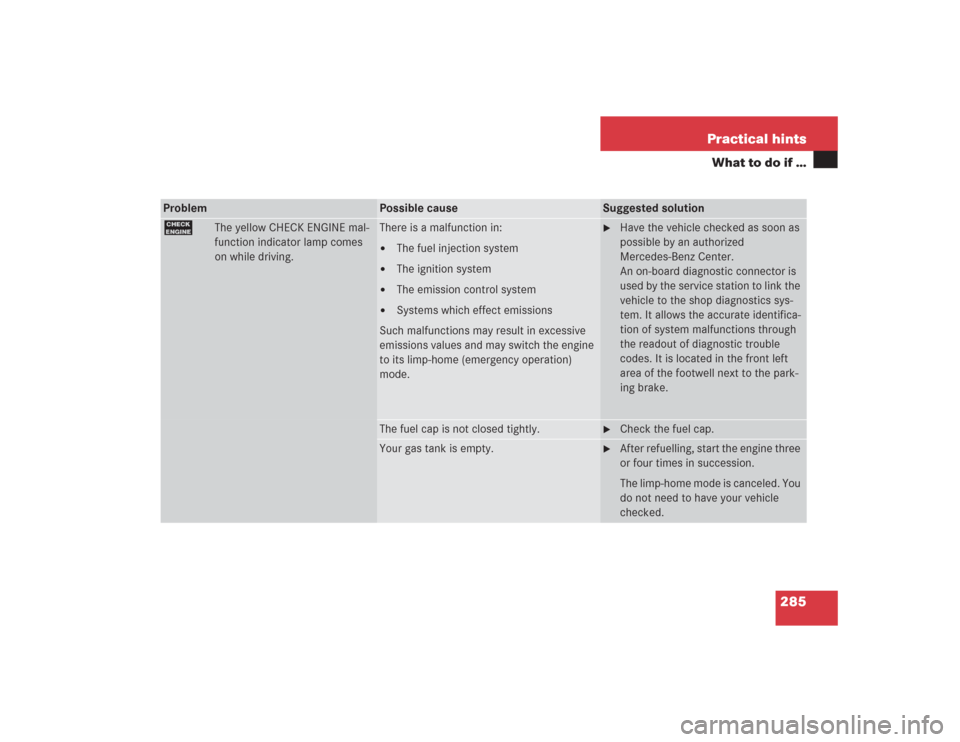
Problem
Possible cause
Suggested solution
?
The yellow CHECK ENGINE mal-
function indicator lamp comes
on while driving.
There is a malfunction in:�
The fuel injection system
�
The ignition system
�
The emission control system
�
Systems which effect emissions
Such malfunctions may result in excessive
emissions values and may switch the engine
to its limp-home (emergency operation)
mode.
�
Have the vehicle checked as soon as
possible by an authorized
Mercedes-Benz Center.
An on-board diagnostic connector is
used by the service station to link the
vehicle to the shop diagnostics sys-
tem. It allows the accurate identifica-
tion of system malfunctions through
the readout of diagnostic trouble
codes. It is located in the front left
area of the footwell next to the park-
ing brake.
The fuel cap is not closed tightly.
�
Check the fuel cap.
Your gas tank is empty.
�
After refuelling, start the engine three
or four times in succession.
The limp-home mode is canceled. You
do not need to have your vehicle
checked.
Page 288 of 434

287 Practical hints
What to do if …
Problem
Possible cause
Suggested solution
E
The red DTR indicator lamp
comes on while driving.
You are too close to the vehicle in front of you
to maintain selected speed.
�
Apply the brakes immediately to in-
crease the following distance.
E
The red DTR indicator lamp
comes on while driving and you
hear a warning sound.
�
You are gaining too rapidly on the vehicle
ahead of you.
�
The distance warning system has recog-
nized a stationary obstacle on your prob-
able line of travel.
�
Apply the brakes immediately.
�
Carefully observe the traffic situation.
You may need to brake or maneuver
to avoid hitting an obstacle.
E
The white DTR indicator lamp
comes on while driving.
The Distronic* distance sensor has recog-
nized a vehicle in front of you.
A
The yellow fuel tank reserve
warning lamp lights while driv-
ing.
The fuel level has dropped below the reserve
mark.
�
Refuel at the next gas station
(�page 250).
The fuel cap is not closed tight.
�
Check the fuel cap (
�page 250).
Page 388 of 434
387 Technical data
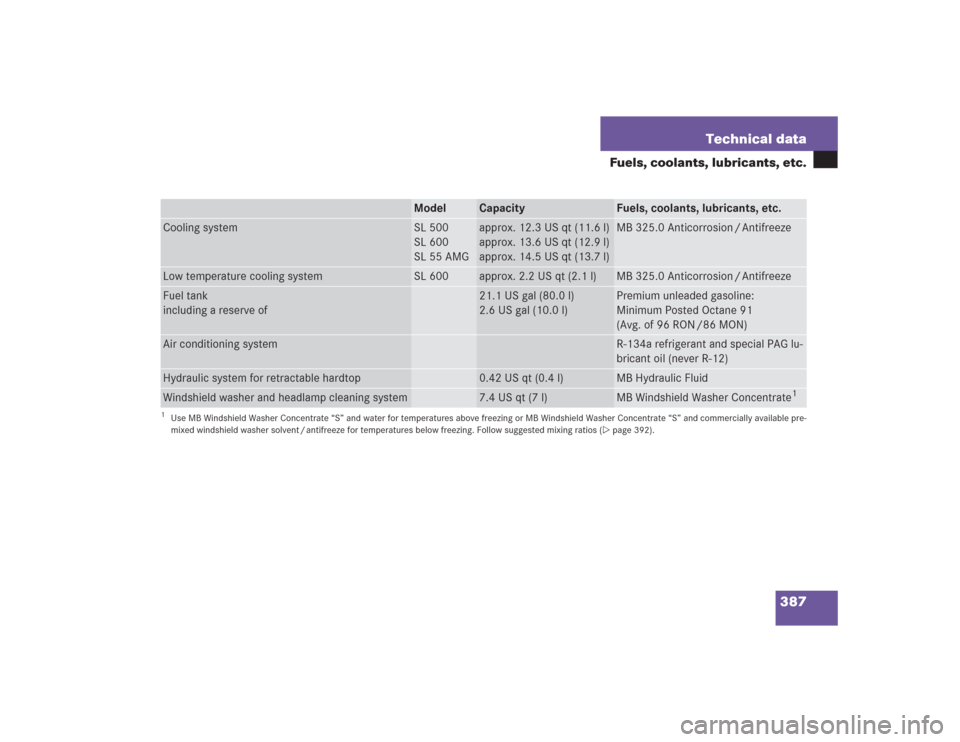
Fuels, coolants, lubricants, etc.
Model
Capacity
Fuels, coolants, lubricants, etc.
Cooling system
SL 500
SL 600
SL 55 AMG
approx. 12.3 US qt (11.6 l)
approx. 13.6 US qt (12.9 l)
approx. 14.5 US qt (13.7 l)
MB 325.0 Anticorrosion / Antifreeze
Low temperature cooling system
SL 600
approx. 2.2 US qt (2.1 l)
MB 325.0 Anticorrosion / Antifreeze
Fuel tank
including a reserve of
21.1 US gal (80.0 l)
2.6 US gal (10.0 l)
Premium unleaded gasoline:
Minimum Posted Octane 91
(Avg. of 96 RON /86 MON)
Air conditioning system
R-134a refrigerant and special PAG lu-
bricant oil (never R-12)
Hydraulic system for retractable hardtop
0.42 US qt (0.4 l)
MB Hydraulic Fluid
Windshield washer and headlamp cleaning system
7.4 US qt (7 l)
MB Windshield Washer Concentrate
1
1Use MB Windshield Washer Concentrate “S” and water for temperatures above freezing or MB Windshield Washer Concentrate “S” and commercially available pre-
mixed windshield washer solvent / antifreeze for temperatures below freezing. Follow suggested mixing ratios (�page 392).
Page 390 of 434
389 Technical data
Fuels, coolants, lubricants, etc.
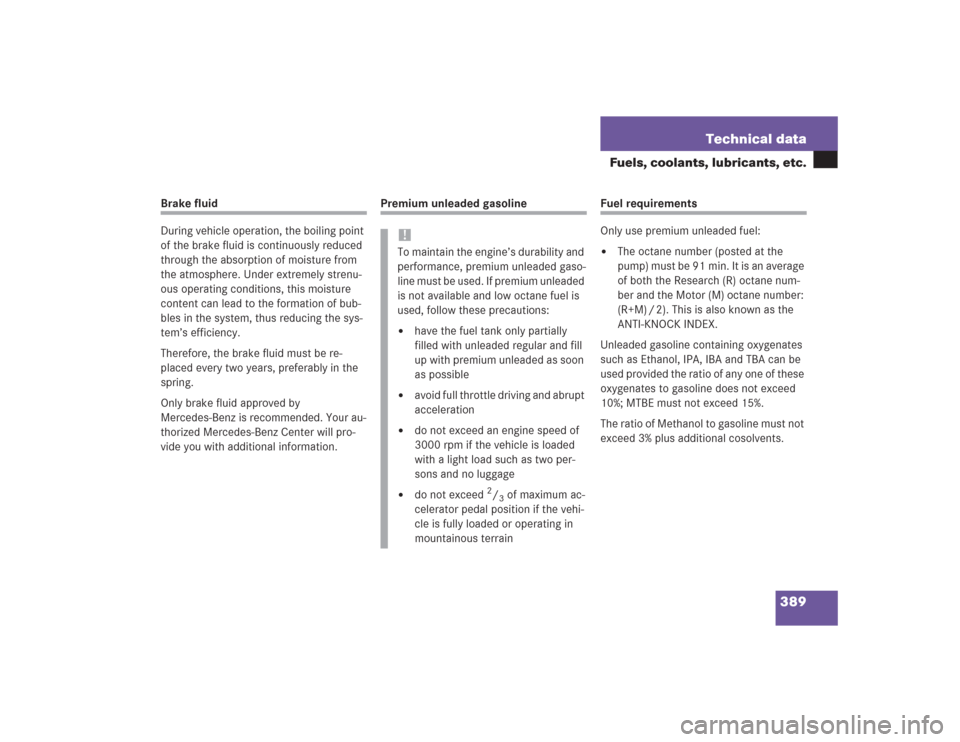
Brake fluid
During vehicle operation, the boiling point
of the brake fluid is continuously reduced
through the absorption of moisture from
the atmosphere. Under extremely strenu-
ous operating conditions, this moisture
content can lead to the formation of bub-
bles in the system, thus reducing the sys-
tem’s efficiency.
Therefore, the brake fluid must be re-
placed every two years, preferably in the
spring.
Only brake fluid approved by
Mercedes-Benz is recommended. Your au-
thorized Mercedes-Benz Center will pro-
vide you with additional information.
Premium unleaded gasoline
Fuel requirements
Only use premium unleaded fuel:�
The octane number (posted at the
pump) must be 91 min. It is an average
of both the Research (R) octane num-
ber and the Motor (M) octane number:
(R+M) / 2). This is also known as the
ANTI-KNOCK INDEX.
Unleaded gasoline containing oxygenates
such as Ethanol, IPA, IBA and TBA can be
used provided the ratio of any one of these
oxygenates to gasoline does not exceed
10%; MTBE must not exceed 15%.
The ratio of Methanol to gasoline must not
exceed 3% plus additional cosolvents.
!To maintain the engine’s durability and
performance, premium unleaded gaso-
line must be used. If premium unleaded
is not available and low octane fuel is
used, follow these precautions:�
have the fuel tank only partially
filled with unleaded regular and fill
up with premium unleaded as soon
as possible
�
avoid full throttle driving and abrupt
acceleration
�
do not exceed an engine speed of
3000 rpm if the vehicle is loaded
with a light load such as two per-
sons and no luggage
�
do not exceed
2/3 of maximum ac-
celerator pedal position if the vehi-
cle is fully loaded or operating in
mountainous terrain
Page 411 of 434
410 IndexEngine oil 255, 388
Adding 257
Additives 388
Checking level 255
Consumption 255
Display messages 307
Filler neck 257
Messages in display 256
Engine oil level see Oil level
ESP 75, 78, 398
Control switch 26
Switching off 79
Switching on 80
Synchronizing 295
Warning lamp 78
ESP/ABS warning lamp 23
ETD see Emergency Tensioning Device
Express-close front side windows 182
Express-open front side windows 182F
Fahrenheit
Setting temperature units 140
Fastening the seat belts 40
Fine adjustment
Cruise control 195
First aid kit 323
Flat tire 339
Spare wheel 350
TIREFIT kit 340, 345
Flexible Service System (FSS) 271
Fluid level 258
Fog lamp, rear 120, 332
Replacing bulb 335
Fog lamps, front 120
Replacing bulbs 332
Front airbags 64
Front lamps 332
Replacing bulbs 334
FSS (Flexible Service System) 271, 399Fuel 250
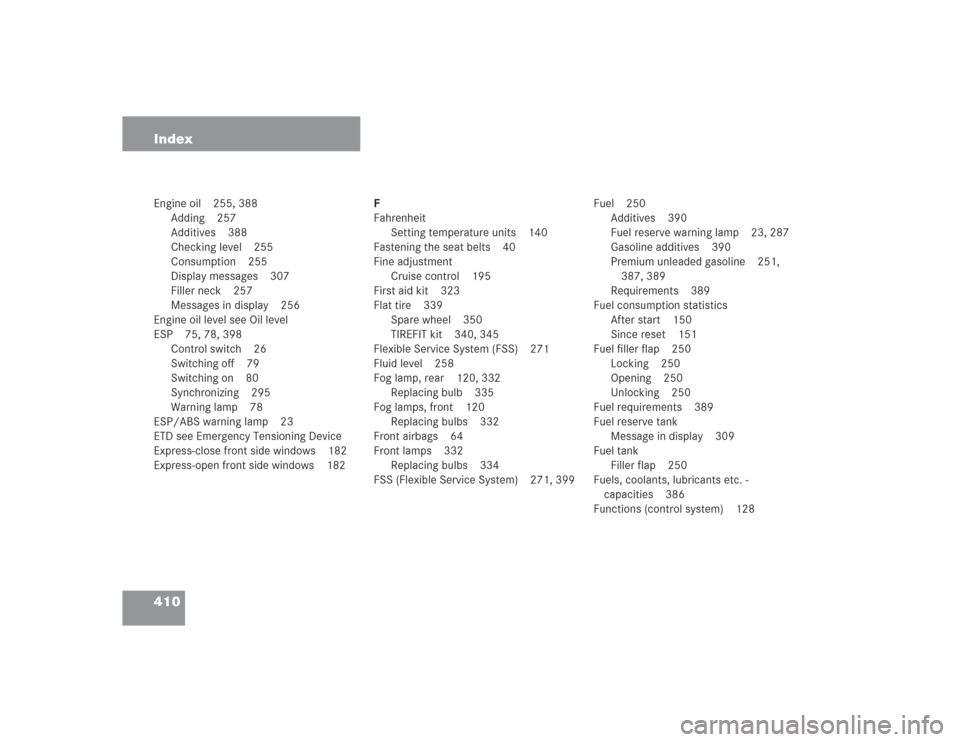
Additives 390
Fuel reserve warning lamp 23, 287
Gasoline additives 390
Premium unleaded gasoline 251,
387, 389
Requirements 389
Fuel consumption statistics
After start 150
Since reset 151
Fuel filler flap 250
Locking 250
Opening 250
Unlocking 250
Fuel requirements 389
Fuel reserve tank
Message in display 309
Fuel tank
Filler flap 250
Fuels, coolants, lubricants etc. -
capacities 386
Functions (control system) 128