Page 286 of 344
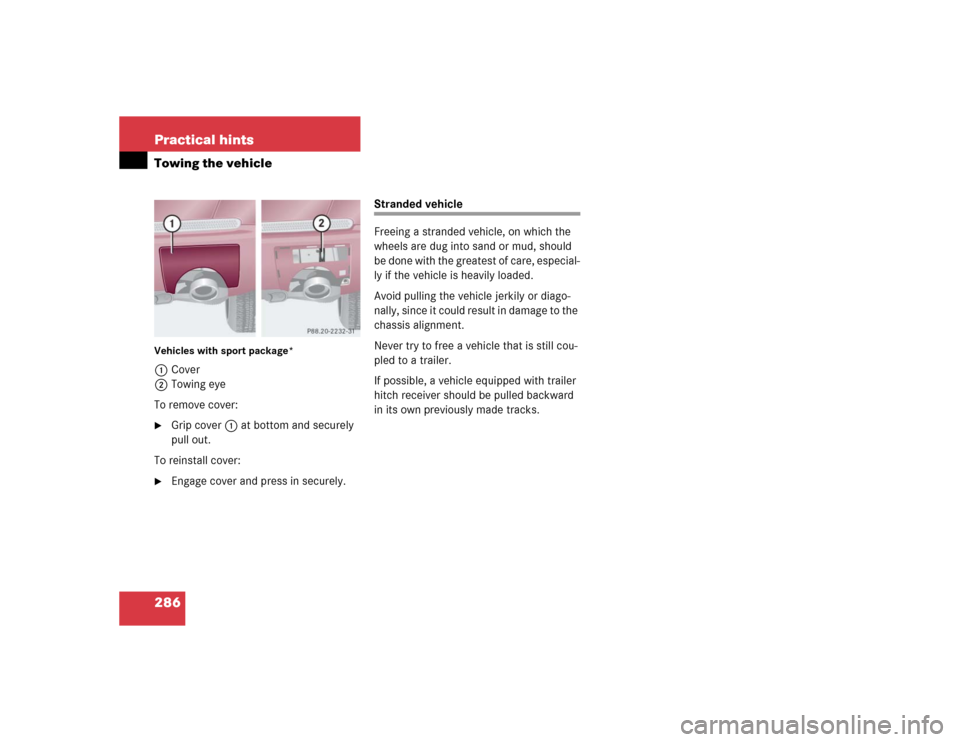
286 Practical hintsTowing the vehicleVehicles with sport package*1Cover
2Towing eye
To remove cover:�
Grip cover1 at bottom and securely
pull out.
To reinstall cover:
�
Engage cover and press in securely.
Stranded vehicle
Freeing a stranded vehicle, on which the
wheels are dug into sand or mud, should
be done with the greatest of care, especial-
ly if the vehicle is heavily loaded.
Avoid pulling the vehicle jerkily or diago-
nally, since it could result in damage to the
chassis alignment.
Never try to free a vehicle that is still cou-
pled to a trailer.
If possible, a vehicle equipped with trailer
hitch receiver should be pulled backward
in its own previously made tracks.
Page 294 of 344
294 Technical dataEngine
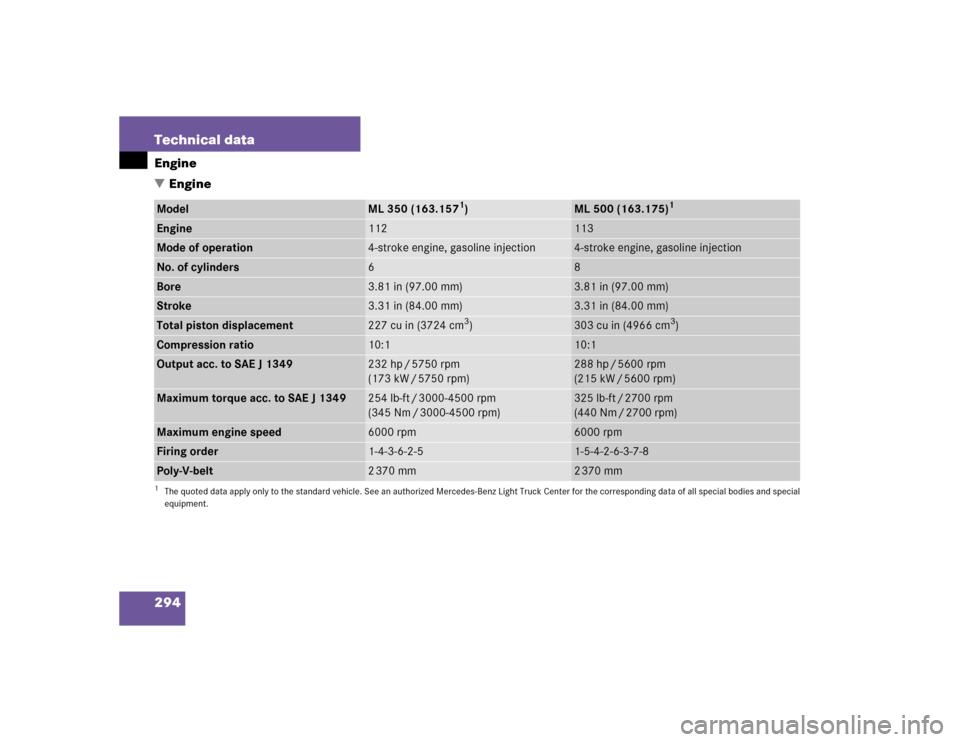
�EngineModel
ML 350 (163.157
1)
1The quoted data apply only to the standard vehicle. See an authorized Mercedes-Benz Light Truck Center for the corresponding data of all special bodies and special
equipment.
ML 500 (163.175)
1
Engine
112
113
Mode of operation
4-stroke engine, gasoline injection
4-stroke engine, gasoline injection
No. of cylinders
6
8
Bore
3.81 in (97.00 mm)
3.81 in (97.00 mm)
Stroke
3.31 in (84.00 mm)
3.31 in (84.00 mm)
Total piston displacement
227 cu in (3724 cm
3)
303 cu in (4966 cm
3)
Compression ratio
10:1
10:1
Output acc. to SAE J 1349
232 hp / 5750 rpm
(173 kW / 5750 rpm)
288 hp / 5600 rpm
(215 kW / 5600 rpm)
Maximum torque acc. to SAE J 1349
254 lb-ft / 3000-4500 rpm
(345 Nm / 3000-4500 rpm)
325lb-ft/2700rpm
(440 Nm / 2700 rpm)
Maximum engine speed
6000 rpm
6000 rpm
Firing order
1-4-3-6-2-5
1-5-4-2-6-3-7-8
Poly-V-belt
2370 mm
2370 mm
Page 300 of 344
300 Technical dataFuels, coolants, lubricants etc.
�Fuels, coolants, lubricants etc.Capacities
Vehicle components and their respective
lubricants must match.Therefore use only brands tested and
approved by Mercedes-Benz.Please refer to the Factory Approved
Service Products pamphlet, or inquire at
your Mercedes-Benz Light Truck Center.
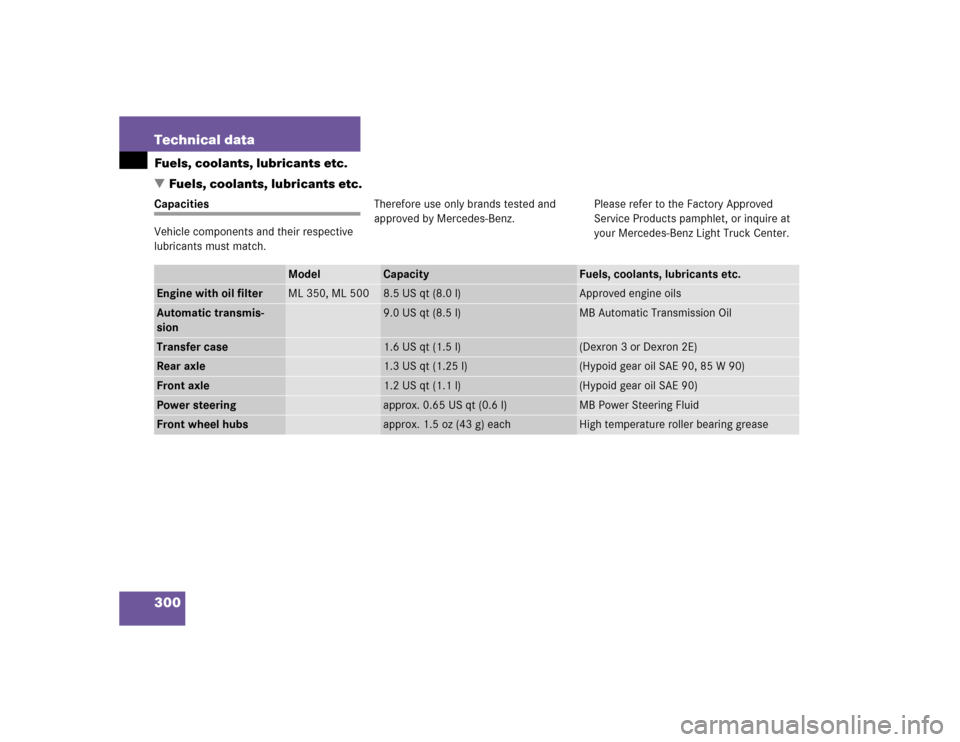
Model
Capacity
Fuels, coolants, lubricants etc.
Engine with oil filter
ML 350, ML 500
8.5 US qt (8.0 l)
Approved engine oils
Automatic transmis-
sion
9.0 US qt (8.5 l)
MB Automatic Transmission Oil
Transfer case
1.6 US qt (1.5 l)
(Dexron 3 or Dexron 2E)
Rear axle
1.3 US qt (1.25 l)
(Hypoid gear oil SAE 90, 85 W 90)
Front axle
1.2 US qt (1.1 l)
(Hypoid gear oil SAE 90)
Power steering
approx. 0.65 US qt (0.6 l)
MB Power Steering Fluid
Front wheel hubs
approx. 1.5oz (43g) each
High temperature roller bearing grease
Page 303 of 344

303 Technical data
Fuels, coolants, lubricants etc.
Premium unleaded gasoline
Fuel requirements
Use only premium unleaded meeting
ASTM standard D 439:�
The octane number (posted at the
p um p) m us t be 91 mi n. It i s an a vera ge
of both the Research (R) octane num-
ber and the Motor (M) octane number:
(R+M) / 2). This is also known as the
ANTI-KNOCK INDEX.
Unleaded gasoline containing oxygenates
such as ethanol, IPA, IBA and TBA can be
used provided the ratio of any one of these
oxygenates to gasoline does not exceed
10%; MTBE must not exceed 15%.
The ratio of methanol to gasoline must not
exceed 3% plus additional cosolvents.
Using mixtures of ethanol and methanol is
not allowed. Gasohol, which contains 10%
ethanol and 90% unleaded gasoline, can be
used.
These blends must also meet all other fuel
requirements, such as resistance to spark
knock, boiling range, vapor pressure, etc.
Gasoline additives
A major concern among engine manufac-
turers is carbon build-up caused by gaso-
line. Mercedes-Benz recommends only the
use of quality gasoline containing additives
that prevent the build-up of carbon depos-
its.
After an extended period of using fuels
without such additives, carbon deposits
can build up especially on the intake valves
and in the combustion area, leading to en-
gine performance problems such as:�
Warm-up hesitation
�
Unstable idle
�
Knocking / pinging
�
Misfire
�
Power loss
Do not blend other specific fuel additives
with fuel. This only results in unnecessary
costs and may be harmful to the engine
operation.
!To maintain the engine’s durability and
performance, premium unleaded gaso-
l i n e m u s t b e u s e d . I f p r e m i u m u n l e a d e d
is not available and low octane fuel is
used, follow these precautions:�
Have the fuel tank only partially
filled with unleaded regular and fill
up with premium unleaded as soon
as possible.
�
Avoid full throttle driving and abrupt
acceleration.
�
Do not exceed an engine speed of
3000 rpm if the vehicle is loaded
with a light load such as two per-
sons and no luggage.
�
Do not exceed
2/3 of maximum ac-
celerator pedal position if the vehi-
cle is fully loaded or operating in
mountainous terrain.
Page 309 of 344
309 Technical data
Consumer information
Temperature
The temperature grades are A (the high-
est), B, and C, representing the tire’s resis-
tance to the generation of heat and its
ability to dissipate heat when tested under
controlled conditions on a specified indoor
laboratory test wheel. Sustained high tem-
perature can cause the material of the tire
to degenerate and reduce tire life, and ex-
cessive temperature can lead to sudden
tire failure. The grade C corresponds to a
level of performance which all passenger
car tires must meet under the Federal Mo-
tor Vehicle Safety Standard No. 109.
Grades B and A represent higher levels of
performance on the laboratory test wheel
than the minimum required by law.
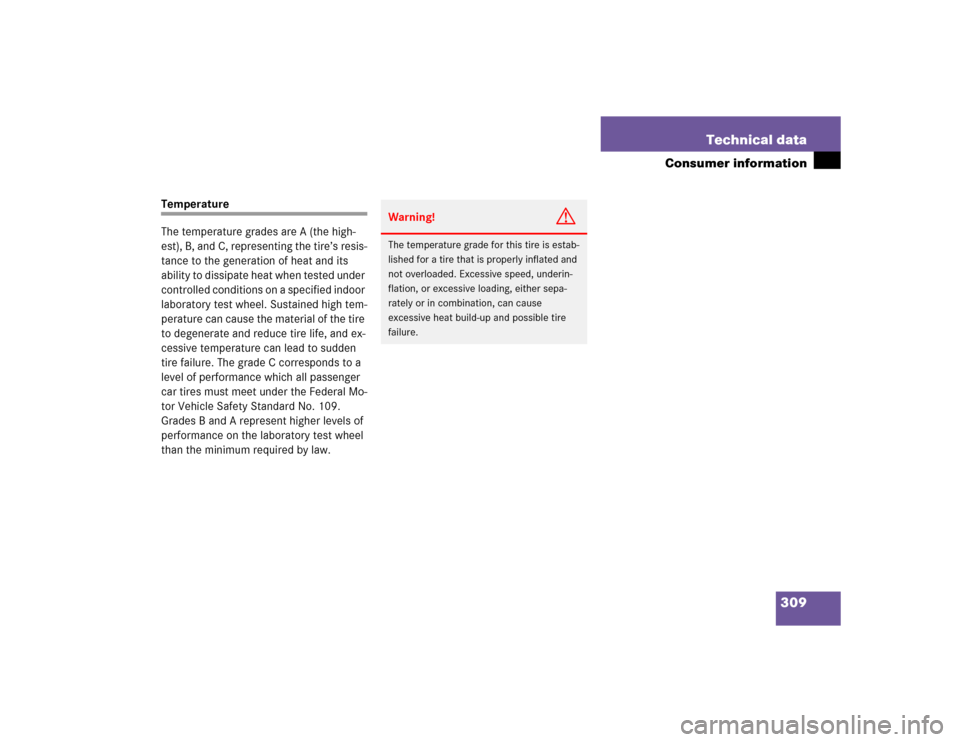
Warning!
G
The temperature grade for this tire is estab-
lished for a tire that is properly inflated and
not overloaded. Excessive speed, underin-
flation, or excessive loading, either sepa-
rately or in combination, can cause
excessive heat build-up and possible tire
failure.
Page 312 of 344

312 Technical termsEngine oil viscosity
Measurement for the inner friction (vis-
cosity) of the oil at different tempera-
tures. The higher the temperature an
oil can tolerate without becoming thin,
or the lower the temperature it can tol-
erate without becoming viscous, the
better the viscosity.
ESP
(E
lectronic S
tability Pr
ogram)
Improves vehicle handling and direc-
tional stability.
ETD
(E
mergency T
ensioning D
evice)
Device which deploys in certain frontal
and rear collisions exceeding the sys-
tem's threshold to tighten the seat
belts.
->SRSFSS
(F
lexible S
ervice S
ystem)
Service indicator in the speedometer
display that informs the driver when
the next vehicle maintenance service is
due.
Gear range
Number of gears which are available to
the automatic transmission for shifting.
The automatic gear shifting process
can be adapted to specific operating
conditions using the gear selector
lever.
GPS
(G
lobal P
ositioning S
ystem)
Satellite-based system for relaying
geographic location information to and
from vehicles equipped with special re-
ceivers. Employs CD or DVD digital
maps for navigation.GAWR
(G
ross A
xle W
eight R
ating)
The GAWR is the maximum permissible
axle weight. The gross vehicle weight
on each axle must never exceed the
GAWR for the front and rear axle indi-
cated on the certification label located
on the driver’s door pillar.
GVW
(G
ross V
ehicle W
eight)
The GVW comprises the weight of the
vehicle including fuel, tools, spare
wheel, installed accessories, passen-
gers and cargo. The GVW must never
exceed the GVWR, indicated on the
certification label located on the driv-
er’s door pillar.
Page 315 of 344

315 Technical terms
Tele Aid System*
(T
elematic A
larm I
dentification on
D
emand)
The Tele Aid system consists of three
types of response: automatic and man-
ual emergency, roadside assistance
and information. Tele Aid is initially ac-
tivated by completing a subscriber
agreement and placing an acquain-
tance call.
The Tele Aid system is operational pro-
vided that the vehicle’s battery is
charged, properly connected, not dam-
aged and cellular and GPS coverage is
available.
Telematics*
A combination of the terms “telecom-
munications” and “informatics”.
Tightening torque
Force times lever arm (e.g. a lug
wrench) with which threaded fasteners
such as wheel bolts are tightened.Tire speed rating
Part of tire designation; indicates the
speed range for which a tire is ap-
proved.
Traction
Force exerted by the vehicle on the
road via the tires.
Transfer case
Speed of rotation / torque converter
that works together with the ->auto-
matic transmission. In the LOW mode
off-road position, the transfer case de-
creases the output rotational speed of
the ->automatic transmission by ap-
proximately half. This results in a corre-
sponding increase of torque on the
drive axles.
The vehicle then has nearly double the
driving force but drives only approxi-
mately half as fast.TWR
(T
ongue W
eight R
ating)
The TWR is the maximum permissible
weight on the trailer tongue.
VIN
(V
ehicle I
dentification N
umber)
The number set by the manufacturer
and placed on the body to uniquely
identify each vehicle produced.
Voice control system*
Voice control system for car phones,
portable cell phones and audio sys-
tems (radio, CD, etc.).
Page 317 of 344

317 Index
A
ABS 25, 76, 311
ABS control 76
LOW RANGE mode 77
Malfunction indicator lamp 242
Warning lamp 242
Accelerator position, automatic
transmission 123
Accident
In case of 52
Activating
Air circulation mode 139
Air recirculation mode 139
Anti-theft alarm system 83
Automatic climate control 135
ESP 82
Exterior headlamps 48
Hazard warning flasher 112
Headlamps 48
High beams 110
Ignition 33Immobilizer 54, 83
Rear passenger compartment ventila-
tion and climate control 141
Rear window defroster 133
Rear window wiper 51
Residual heat 140
Seat heater* 98
Tow-away alarm 85
Warning indicators (Parktronic*) 155
Windshield wipers 50
Activating automatic central locking 93
Adding
Coolant 223
Engine oil 221
Additional turn signals 266
Adjustable steering column
Indicator lamp 253
Adjusting 34
Backrest tilt 36, 38
Exterior rear view mirror 40
Head restraint height 36, 38Head restraint tilt 37, 39
Headlamp aim 272
Instrument cluster illumination 116
Manual seat 35
Mirrors 40
Power seats* 37
Seat cushion tilt 38
Seat fore and aft 35
Seat fore and aft adjustment 37
Seat height 36, 38
Seats 34
Steering wheel 39
Adjusting air distribution
Automatic climate control 137
Adjusting air volume
Automatic climate control 137
Air conditioner (cooling)
Turning on 139
Air conditioning
Cooling 139