Page 76 of 376

76 Safety and SecurityDriving and safety systems
BAS
The Brake Assist System (BAS) operates in
emergency situations. If you apply the
brakes very quickly, the BAS automatically
provides full brake boost, thereby poten-
tially reducing braking distance. Apply con-
tinuous full braking pressure until the
emergency braking situation is over. The
ABS will prevent the wheels from locking.
When you release the brake pedal the
brakes function again as normal. The BAS
is then deactivated.
With the BAS malfunctioning, the ABS, ESP
and 4-ETS are also switched off.
For more information, see “Practical hints”
(
�page 261).
Warning!
G
The ABS cannot prevent the natural laws of
physics from acting on the vehicle, nor can
it increase braking or steering efficiency be-
yond that afforded by the condition of the
vehicle brakes and tires or the traction af-
forded. The ABS cannot prevent accidents,
including those resulting from excessive
speed in turns, following another vehicle too
closely, or aquaplaning. Only a safe, atten-
tive, and skillful driver can prevent acci-
dents. The capabilities of an ABS equipped
vehicle must never be exploited in a reck-
less or dangerous manner which could jeop-
ardize the user’s safety or the safety of
others.
Warning!
G
The BAS cannot prevent the natural laws of
physics from acting on the vehicle, nor can
it increase braking efficiency beyond that af-
forded by the condition of the vehicle brakes
and tires or the traction afforded. The BAS
cannot prevent accidents, including those
resulting from excessive speed in turns, fol-
lowing another vehicle too closely, or aqua-
planing. Only a safe, attentive, and skillful
driver can prevent accidents. The capabili-
ties of a BAS equipped vehicle must never
be exploited in a reckless or dangerous
manner which could jeopardize the user’s
safety or the safety of others.
Page 77 of 376
77 Safety and Security
Driving and safety systems
4-ETS
The 4-ETS improves vehicle’s ability to uti-
lize available traction, especially under
slippery road conditions. The brakes are
applied to the spinning wheel and power is
allowed to flow to the wheel(s) with trac-
tion.
The 4-ETS function is available between ve-
hicle speeds of 0 mph (km/h) and 37 mph
(60 km/h).
The ESP warning lampv in the instru-
ment cluster (
�page 24) comes on when
you turn the SmartKey to position2. It
goes out when the engine is running.
The ESP warning lampv starts to flash
at any vehicle speed, as soon as the tires
lose traction and the wheels begin to spin.For more information, see “Practical hints”
(
�page 257).
Warning!
G
When you see the ESP warning lamp
v
flashing in the instrument cluster, then pro-
ceed as follows:
�
While driving off, apply as little throttle
as possible.
�
While driving ease up on the accelera-
tor.
�
Adapt your speed and driving style to
the prevailing road conditions.
Failure to observe these guidelines could
cause the vehicle to skid.
The 4-ETS cannot prevent accidents result-
ing from excessive speed.
!The engine must be shut off when�
the parking brake is being tested on
a brake test dynamometer.
�
the vehicle is being towed with one
axle raised.
Otherwise, the 4-ETS will engage the
brakes and seriously damage the brake
system.
Page 78 of 376

78 Safety and SecurityDriving and safety systemsEBB
The EBB enhances braking effectiveness
by allowing the rear brakes to supply a
greater proportion of the braking effort in
straight line braking circumstances with-
out a loss of vehicle stability.
ESP
The Electronic Stability Program (ESP)
monitors the vehicle’s traction (force of ad-
hesive friction between the tires and the
road surface) and handling.
The ESP recognizes when a wheel is spin-
ning or if the vehicle starts to skid. By ap-
plying brakes to the appropriate wheel and
by limiting engine output, the ESP works to
stabilize the vehicle.
The ESP warning lampv in the instru-
ment cluster (
�page 24) flashes when the
ESP is engaged.
The ESP warning lampv comes on
when you turn the SmartKey to position2.
It goes out when the engine is running.
Warning!
G
Never switch off the ESP when you see the
ESP warning lamp v flashing in the in-
strument cluster. In this case proceed as fol-
lows:�
While driving off, apply as little throttle
as possible.
�
While driving ease up on the accelera-
tor.
�
Adapt your speed and driving style to
the prevailing road conditions.
Failure to observe these guidelines could
cause the vehicle to skid.
The ESP cannot prevent accidents resulting
from excessive speed.
Page 79 of 376

79 Safety and Security
Driving and safety systems
Switching off the ESP
To improve the vehicle’s traction, turn off
the ESP in driving situations where it would
be advantageous to have the drive wheels
spin and thus cut into surfaces for better
grip such as:�
starting out on slippery surfaces and in
deep snow in conjunction with snow
chains.
�
sand or gravel.
�
when driving off-road.
When the ESP is turned off
�
engine torque is not limited.
�
the drive wheels can spin.
Warning!
G
The ESP cannot prevent the natural laws of
physics from acting on the vehicle, nor can
it increase the traction afforded. The ESP
cannot prevent accidents, including those
resulting from excessive speed in turns, fol-
lowing another vehicle too closely, or aqua-
planing. Only a safe, attentive, and skillful
driver can prevent accidents. The capabili-
ties of a ESP equipped vehicle must never be
exploited in a reckless or dangerous manner
which could jeopardize the user’s safety or
the safety of others.!Driving the vehicle with varied size tires
will cause the wheels to rotate at differ-
ent speeds, possibly causing the ESP to
activate. For this reason, all wheels, in-
cluding the spare wheel, must have the
same tire outside diameter.
!The engine must be shut off when�
the parking brake is being tested on
a brake test dynamometer.
�
the vehicle is being towed with one
axle raised.
Otherwise, the ESP will engage the
brakes and seriously damage the brake
system.
iThe ABS, BAS and ESP are automatical-
ly switched off when the differential
locks are switched on (
�page 150).
Warning!
G
The ESP should not be switched off during
normal driving other than in the circum-
stances described below. Disabling of the
system will reduce vehicle stability in stan-
dard driving maneuvers.
Page 80 of 376
80 Safety and SecurityDriving and safety systems
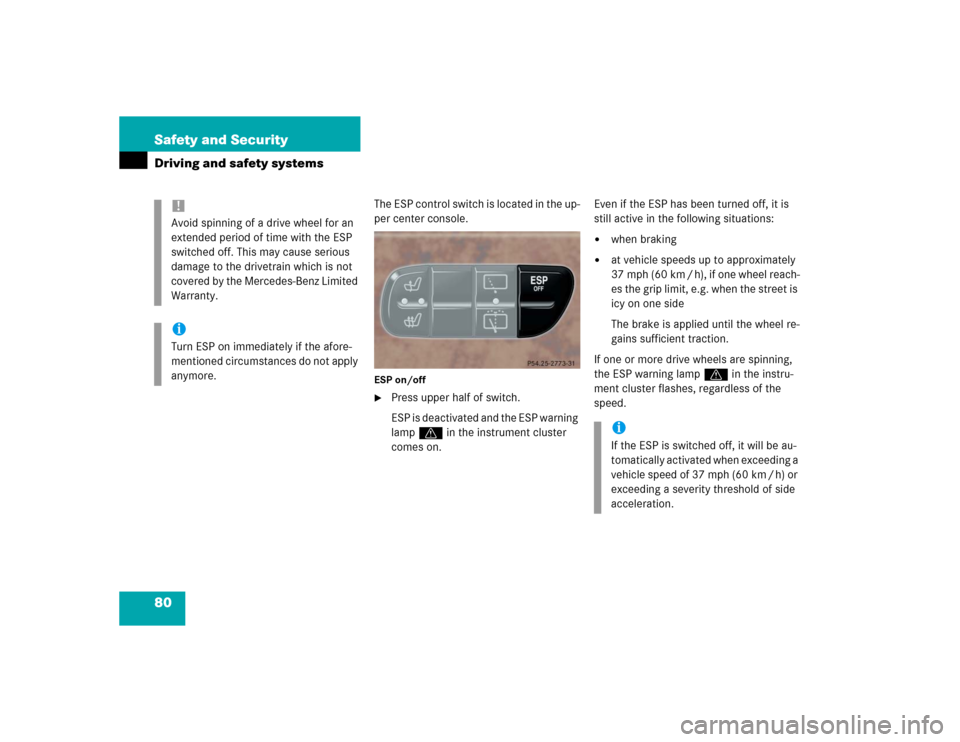
The ESP control switch is located in the up-
per center console.ESP on/off�
Press upper half of switch.
ESP is deactivated and the ESP warning
lamp v in the instrument cluster
comes on.Even if the ESP has been turned off, it is
still active in the following situations:
�
when braking
�
at vehicle speeds up to approximately
37 mph (60 km / h), if one wheel reach-
es the grip limit, e.g. when the street is
icy on one side
The brake is applied until the wheel re-
gains sufficient traction.
If one or more drive wheels are spinning,
the ESP warning lampv in the instru-
ment cluster flashes, regardless of the
speed.
!Avoid spinning of a drive wheel for an
extended period of time with the ESP
switched off. This may cause serious
damage to the drivetrain which is not
covered by the Mercedes-Benz Limited
Warranty.iTurn ESP on immediately if the afore-
mentioned circumstances do not apply
anymore.
iIf the ESP is switched off, it will be au-
tomatically activated when exceeding a
vehicle speed of 37 mph (60 km / h) or
exceeding a severity threshold of side
acceleration.
Page 91 of 376
91 Controls in detail
Locking and unlocking
�
Close the tailgate (
�page 90).
�
Pull the mechanical key out of the
SmartKey (
�page 287).
�
Insert the mechanical key in the lock
cylinder.
�
Turn the mechanical key clockwise to
position2.
The tailgate remains locked even when the
vehicle is centrally unlocked.
Separately unlocking the tailgate�
Pull the mechanical key out of the
SmartKey (
�page 287).
�
Insert the mechanical key in the lock
cylinder.
�
Turn the mechanical key to neutral
position1 (
�page 90).
You can now open the tailgate
(
�page 89).
Automatic central locking
The doors and the tailgate automatically
lock when the ignition is switched on and
the wheels are turning at vehicle speeds of
approximately 9 mph (15 km/h) or more.
You can open a locked door from the in-
side. Open door only when conditions are
safe to do so.
iYou can only cancel the separate tail-
gate locking mode by means of the me-
chanical key.
Warning!
G
Only drive with the tailgate closed as other-
wise exhaust fumes may enter the vehicle
interior.
Page 92 of 376
92 Controls in detailLocking and unlockingYou can deactivate the automatic locking
using the control system (
�page 133).
For information on towing the vehicle, see
“Towing the vehicle” (
�page 315).
Locking and unlocking from the inside
You can lock or unlock the vehicle from in-
side using the central locking switches.
This can be useful, for example, if you want
to unlock the passenger door from the in-
side or want to lock the vehicle before
starting to drive.
The fuel filler flap cannot be locked or un-
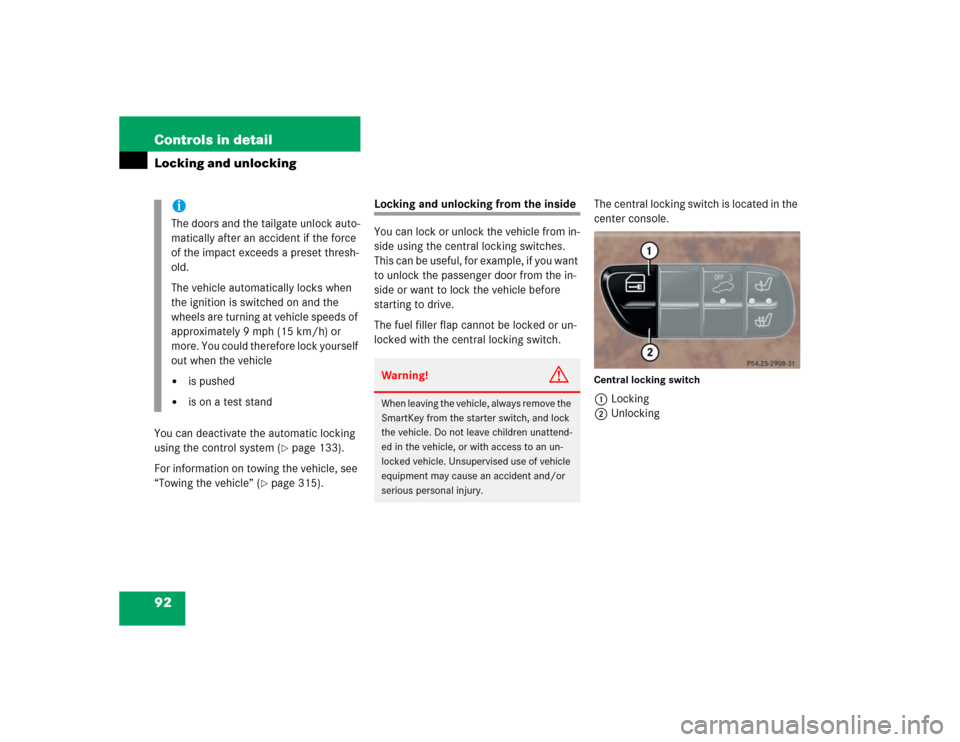
locked with the central locking switch.The central locking switch is located in the
center console.
Central locking switch1Locking
2Unlocking
iThe doors and the tailgate unlock auto-
matically after an accident if the force
of the impact exceeds a preset thresh-
old.
The vehicle automatically locks when
the ignition is switched on and the
wheels are turning at vehicle speeds of
approximately 9 mph (15 km/h) or
more. You could therefore lock yourself
out when the vehicle�
is pushed
�
is on a test stand
Warning!
G
When leaving the vehicle, always remove the
SmartKey from the starter switch, and lock
the vehicle. Do not leave children unattend-
ed in the vehicle, or with access to an un-
locked vehicle. Unsupervised use of vehicle
equipment may cause an accident and/or
serious personal injury.
Page 94 of 376
94 Controls in detailSeats
�SeatsFor more information on seat adjustment,
see the “Getting started” section
(�page 34).
Easy-entry/exit feature
With the easy-entry/exit feature activated
the steering wheel tilts upwards.
This allows easier entry into and exit from
the vehicle when the driver’s door is
opened. However, the engine must be
turned off.
When the SmartKey is inserted in the start-
er switch and the driver’s door is closed,
the steering wheel returns to the last set
position.The easy-entry/exit feature can be
switched on or off in the individual setting
menu
CONVENIENCE
- EASY-ENTRY FEATURE
ACTIVATE
(�page 133).
Warning!
G
You must ensure no one can become
trapped or injured by the moving steering
wheel when the easy-entry/exit feature is
activated, the driver’s door is being opened
and the engine is turned off.
Do not leave children unattended in the ve-
hicle, or with access to an unlocked vehicle.
Children could open the driver’s door and
unintentionally activate the easy-entry/exit
feature, which could result in an accident
and/or serious personal injury.
iTo cancel steering wheel movement,
do one the following:�
Move the steering column stalk
(�page 22)
�
Press the memory button
(�page 102)