Page 335 of 442
335 Practical hints
What to do if …
Display symbol
Display messages
Possible cause
Possible solution
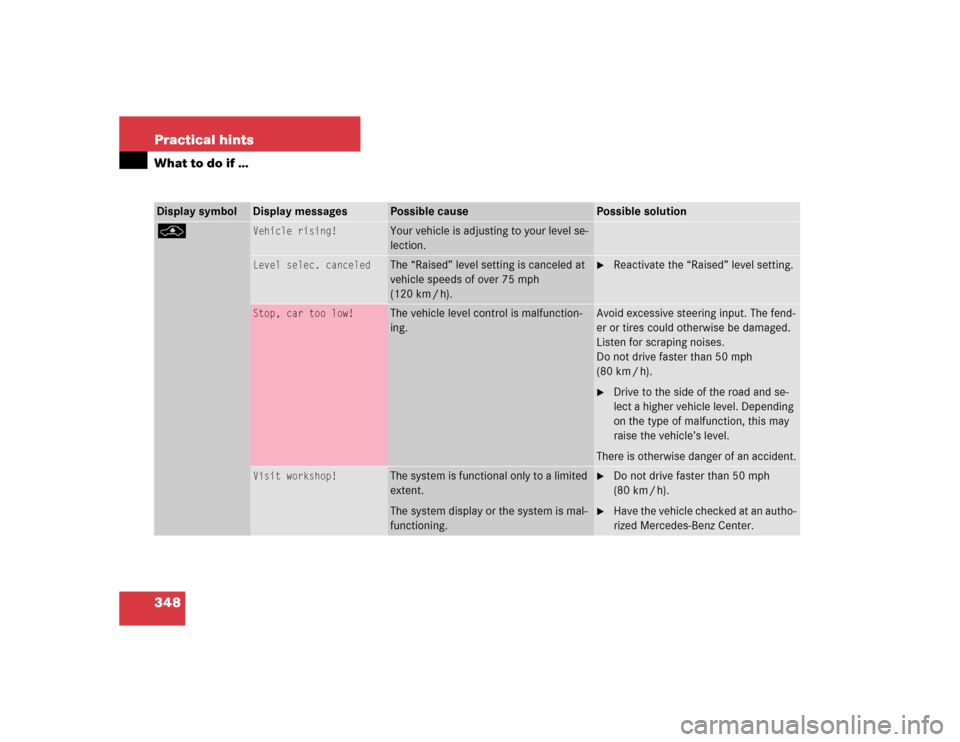
A
Reserve fuel
The fuel level has dropped below the re-
serve mark.
�
Refuel at the next gas station
(�page 278).
Y
Hood open!
You are driving with the hood open.
�
Close the hood (
�page 281).
F
Key
Check battery!
The SmartKey with KEYLESS-GO* batter-
ies are discharged.
�
Change the batteries (
�page 355).
Key
not recognized!
The SmartKey with KEYLESS-GO* is not
recognized while the engine is running
because�
the SmartKey with KEYLESS-GO* is
not in the vehicle
�
there is strong radio-frequency inter-
ference
�
Stop the vehicle as soon as it is safe
to do so.
�
Search for the SmartKey.
Otherwise the vehicle cannot be cen-
trally locked nor can the engine be
started again after the engine is
stopped.
The SmartKey with KEYLESS-GO* is mo-
mentarily not recognized.
�
Change the position of the SmartKey
in the vehicle.
�
Operate the vehicle with the Smart-
Key in the starter switch if necessary.
Page 347 of 442
347 Practical hints
What to do if …
Display symbol
Display messages
Possible cause
Possible solution
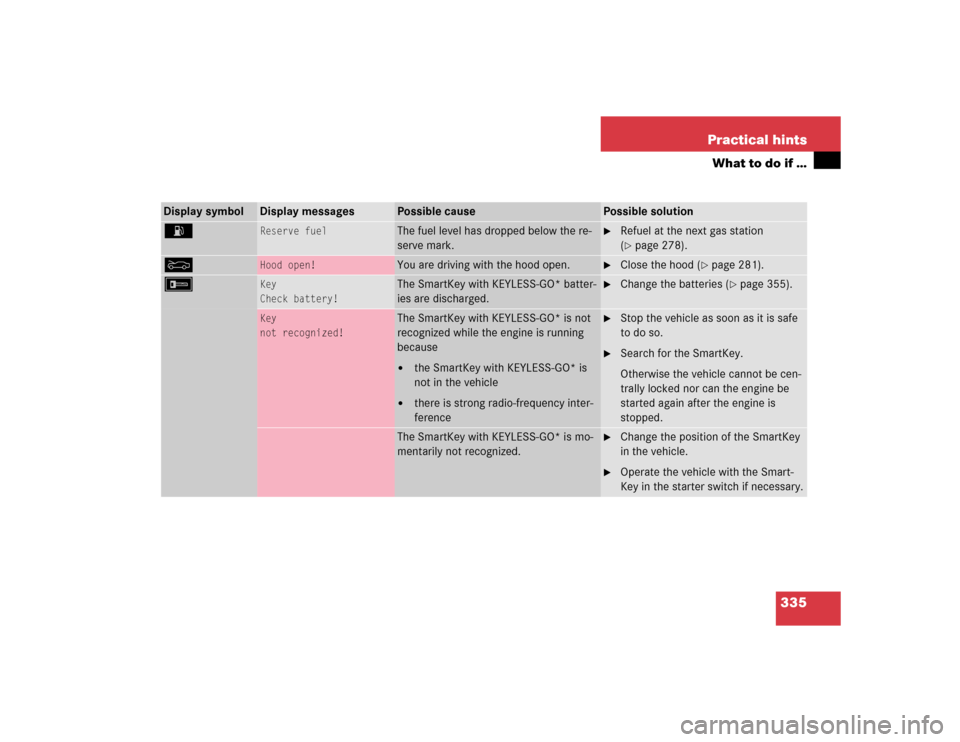
_
Steering oil
Visit workshop!
The steering gear oil level is too low.
There is a danger of steering gear dam-
age.
�
Have the system checked by an au-
thorized Mercedes-Benz Center.
Entry position
Do not drive!
Seat, mirrors and steering wheel have not
yet moved to their preset driving posi-
tions.
�
Wait until the seat, mirrors and steer-
ing wheel have moved to their driving
positions.
The message disappears.
Ê
Trunk open!
This message will appear whenever the
trunk lid is open.
�
Close the trunk lid.
W
Washer fluid
Check level!
The fluid level has dropped to about
1/3
of total reservoir capacity.�
Add washer fluid (
�page 288).
Warning!
G
If the level of steering gear oil in reservoir is
too low, the steering power assistance could
fail. Much greater effort will then be needed
to turn the steering wheel.
Do not add steering oil without checking the
steering system.
Do not drive the vehicle. Have the system
checked at your authorized Mercedes-Benz
Center as soon as possible.
Page 348 of 442
348 Practical hintsWhat to do if …Display symbol
Display messages
Possible cause
Possible solution
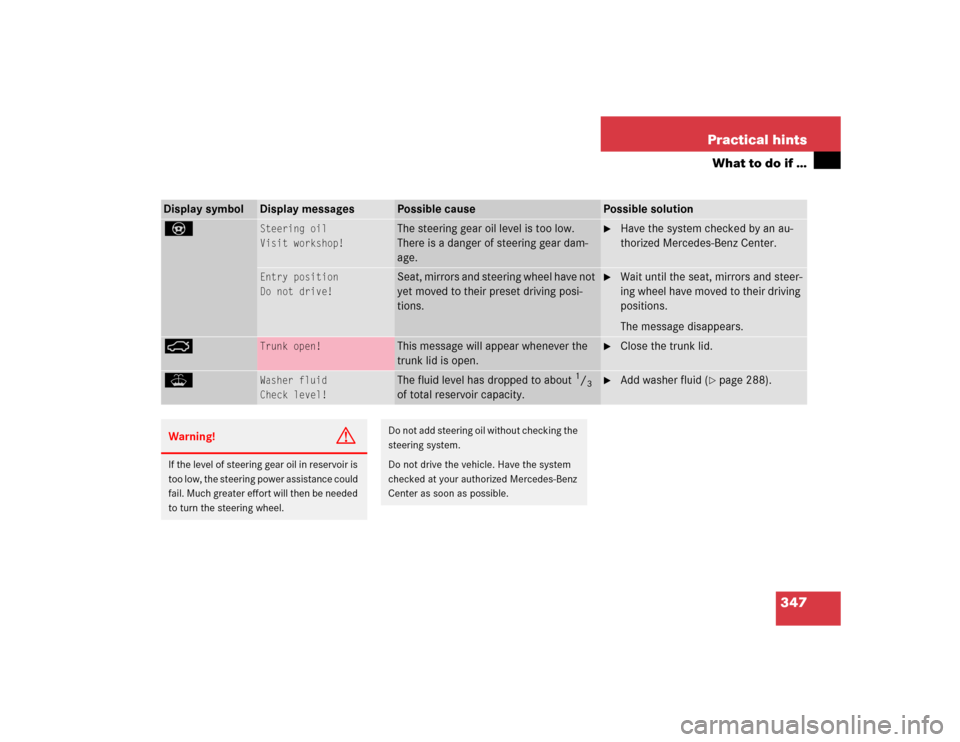
@
Vehicle rising!
Your vehicle is adjusting to your level se-
lection.
Level selec. canceled
The “Raised” level setting is canceled at
vehicle speeds of over 75 mph
(120 km / h).
�
Reactivate the “Raised” level setting.
Stop, car too low!
The vehicle level control is malfunction-
ing.
Avoid excessive steering input. The fend-
er or tires could otherwise be damaged.
Listen for scraping noises.
Do not drive faster than 50 mph
(80 km / h).�
Drive to the side of the road and se-
lect a higher vehicle level. Depending
on the type of malfunction, this may
raise the vehicle’s level.
There is otherwise danger of an accident.
Visit workshop!
The system is functional only to a limited
extent.
The system display or the system is mal-
functioning.
�
Do not drive faster than 50 mph
(80 km / h).
�
Have the vehicle checked at an autho-
rized Mercedes-Benz Center.
Page 370 of 442
370 Practical hintsFlat tire
�
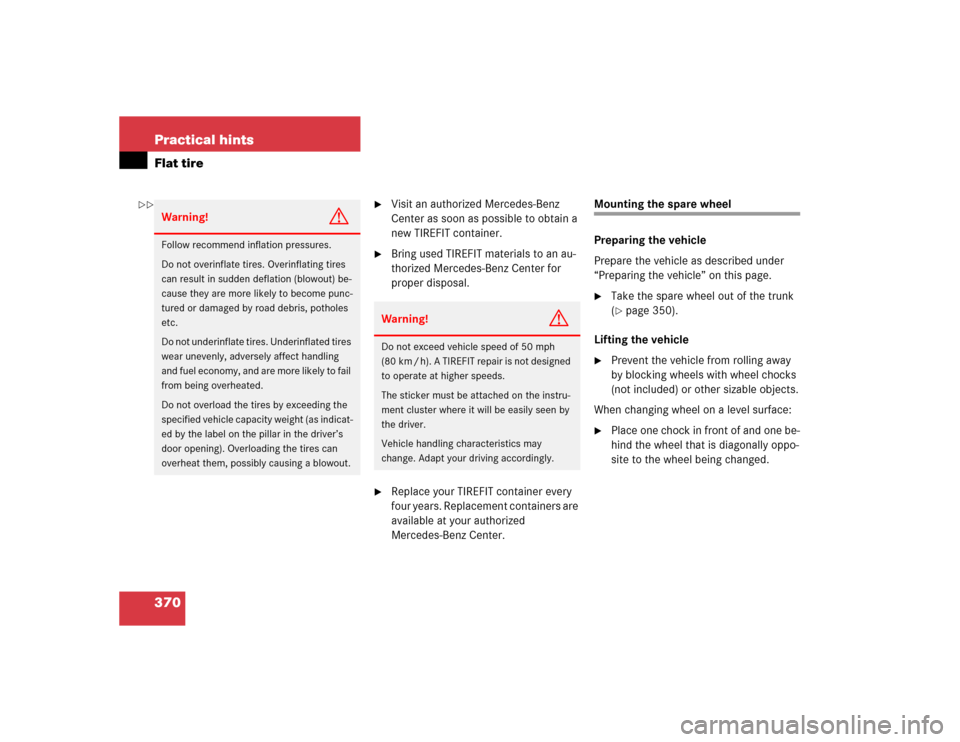
Visit an authorized Mercedes-Benz
Center as soon as possible to obtain a
new TIREFIT container.
�
Bring used TIREFIT materials to an au-
thorized Mercedes-Benz Center for
proper disposal.
�
Replace your TIREFIT container every
four years. Replacement containers are
available at your authorized
Mercedes-Benz Center.
Mounting the spare wheel
Preparing the vehicle
Prepare the vehicle as described under
“Preparing the vehicle” on this page.�
Take the spare wheel out of the trunk
(�page 350).
Lifting the vehicle
�
Prevent the vehicle from rolling away
by blocking wheels with wheel chocks
(not included) or other sizable objects.
When changing wheel on a level surface:
�
Place one chock in front of and one be-
hind the wheel that is diagonally oppo-
site to the wheel being changed.
Warning!
G
Follow recommend inflation pressures.
Do not overinflate tires. Overinflating tires
can result in sudden deflation (blowout) be-
cause they are more likely to become punc-
tured or damaged by road debris, potholes
etc.
Do not underinflate tires. Underinflated tires
wear unevenly, adversely affect handling
and fuel economy, and are more likely to fail
from being overheated.
Do not overload the tires by exceeding the
specified vehicle capacity weight (as indicat-
ed by the label on the pillar in the driver’s
door opening). Overloading the tires can
overheat them, possibly causing a blowout.
Warning!
G
Do not exceed vehicle speed of 50 mph
(80 km / h). A TIREFIT repair is not designed
to operate at higher speeds.
The sticker must be attached on the instru-
ment cluster where it will be easily seen by
the driver.
Vehicle handling characteristics may
change. Adapt your driving accordingly.
��
Page 371 of 442
371 Practical hints
Flat tire
When changing wheel on a hill:�
Place chocks on the downhill side
blocking both wheels of the other axle.
�
Take the two-piece wheel wrench and
the jack out of the trunk (
�page 352).
Assemble wheel wrench.
�
On wheel to be changed, loosen but do
not yet remove the wheel bolts (ap-
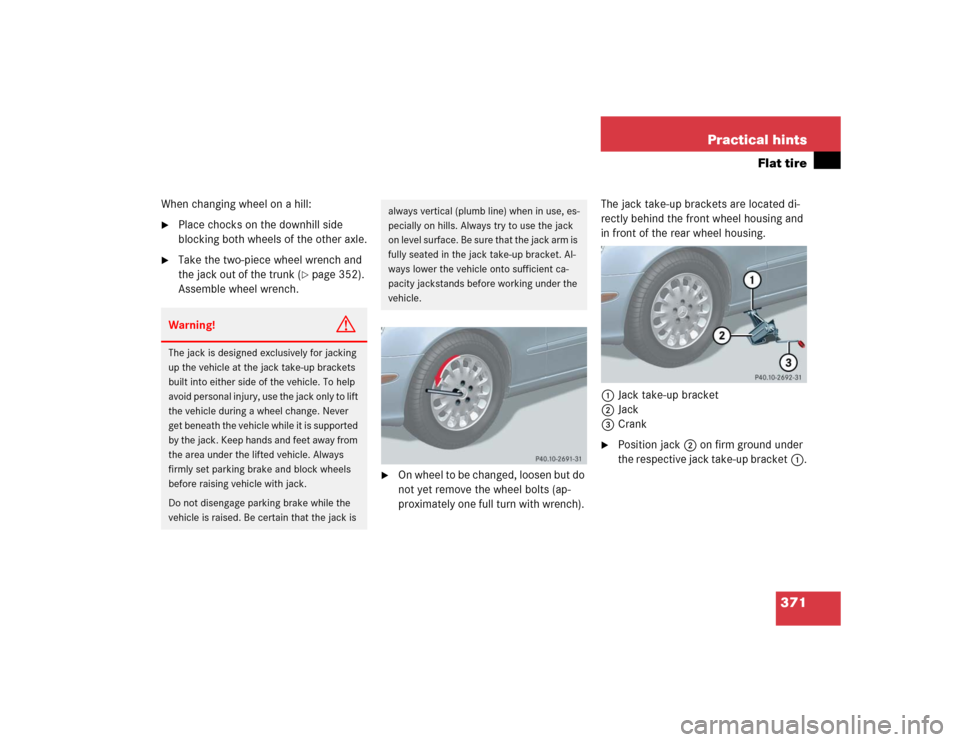
proximately one full turn with wrench). The jack take-up brackets are located di-
rectly behind the front wheel housing and
in front of the rear wheel housing.
1Jack take-up bracket
2Jack
3Crank
�
Position jack2 on firm ground under
the respective jack take-up bracket1.
Warning!
G
The jack is designed exclusively for jacking
up the vehicle at the jack take-up brackets
built into either side of the vehicle. To help
avoid personal injury, use the jack only to lift
the vehicle during a wheel change. Never
get beneath the vehicle while it is supported
by the jack. Keep hands and feet away from
the area under the lifted vehicle. Always
firmly set parking brake and block wheels
before raising vehicle with jack.
Do not disengage parking brake while the
vehicle is raised. Be certain that the jack is
always vertical (plumb line) when in use, es-
pecially on hills. Always try to use the jack
on level surface. Be sure that the jack arm is
fully seated in the jack take-up bracket. Al-
ways lower the vehicle onto sufficient ca-
pacity jackstands before working under the
vehicle.
Page 405 of 442

405 Technical data
Fuels, coolants, lubricants etc.
Damage or malfunctions resulting from
poor fuel quality or from blending specific
fuel additives are not covered by the
Mercedes-Benz Limited Warranty.Coolants
The engine coolant is a mixture of water
and anticorrosion / antifreeze, which pro-
vides:�
Corrosion protection
�
Freeze protection
�
Boiling protection (by increasing the
boiling point)
The cooling system was filled at the factory
with a coolant providing freeze protection
to approximately -22°F (-30°C) and corro-
sion protection.If the antifreeze mixture is effective to
-22°F (-30°C), the boiling point of the cool-
ant in the pressurized cooling system is
reached at approximately 266°F (130°C).
The coolant solution must be used
year-round to provide the necessary corro-
sion protection and increase boil-over pro-
tection. Refer to Service Booklet for
replacement interval
Coolant system design and coolant used
stipulate the replacement interval. The re-
placement interval published in the Ser-
vice Booklet is only applicable if MB 325.0
anticorrosion/antifreeze solution or other
Mercedes-Benz approved products of
equal specification (see Factory Approved
Service Products pamphlet) are used to re-
new the coolant concentration or bring it
back up to the proper level. To provide important corrosion protection,
the solution must be at least 45%
anticorrosion / antifreeze [equivalent to
freeze protection to approximately - 22°F
(-30°C)]. If you use a solution that is more
than 55% anticorrosion / antifreeze [freeze
protection to approximately - 49°F
(-45°C)], the engine temperature will in-
crease due to the lower heat transfer capa-
bility of the solution. Therefore, do not use
more than this amount of
anticorrosion / antifreeze.
Page 406 of 442
406 Technical dataFuels, coolants, lubricants etc.If the coolant level is low, water and MB
Anticorrosion / Antifreeze should be used
to bring it up to the proper level (have cool-
ing system checked for signs of leakage).
Please make sure the mixture is in accor-
dance with label instructions.
The water in the cooling system must meet
minimum requirements, which are usually
satisfied by normal drinking water. If you
are not sure about the water quality, con-
sult your authorized Mercedes-Benz
Center.Anticorrosion / antifreeze
Your vehicle contains a number of alumi-
num parts. The use of aluminum compo-
nents in motor vehicle engines
necessitates that
anticorrosion / antifreeze coolant used in
such engines be specifically formulated to
protect the aluminum parts. (Failure to use
such anticorrosion / antifreeze coolant will
result in a significantly shortened service
life.)Therefore, the following product is strongly
recommended for use in your vehicle:
Mercedes-Benz 325.0
Anticorrosion / Antifreeze Agent.
Before the start of the winter season (or
once a year in hot southern regions), you
should have the anticorrosion / antifreeze
concentration checked. The coolant is also
regularly checked each time you bring your
vehicle to your authorized Mercedes-Benz
Center for service.
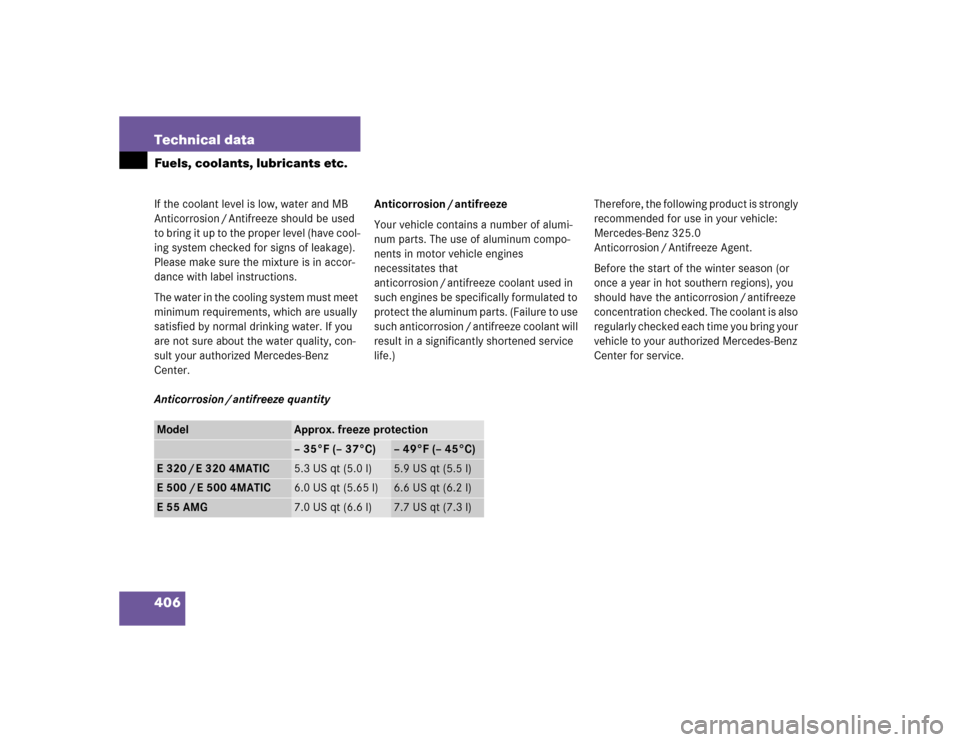
Anticorrosion / antifreeze quantityModel
Approx. freeze protection– 35°F (– 37°C)
– 49°F (– 45°C)
E320/E3204MATIC
5.3 US qt (5.0 l)
5.9 US qt (5.5 l)
E500/E5004MATIC
6.0 US qt (5.65 l)
6.6 US qt (6.2 l)
E55AMG
7.0 US qt (6.6 l)
7.7 US qt (7.3 l)
Page 409 of 442
409 Technical data
Consumer information
Temperature
The temperature grades are A (the high-
est), B, and C, representing the tire’s resis-
tance to the generation of heat and its
ability to dissipate heat when tested under
controlled conditions on a specified indoor
laboratory test wheel. Sustained high tem-
perature can cause the material of the tire
to degenerate and reduce tire life, and ex-
cessive temperature can lead to sudden
tire failure. Grade C corresponds to a level
of performance which all passenger car
tires must meet under the Federal Motor
Vehicle Safety Standard No. 109. Grades B
and A represent higher levels of perfor-
mance on the laboratory test wheel than
the minimum required by law.
Warning
G
The temperature grade for this tire is estab-
lished for a tire that is properly inflated and
not overloaded. Excessive speed, underin-
flation, or excessive loading, either sepa-
rately or in combination, can cause
excessive heat build-up and possible tire
failure.