Page 226 of 442
226 Controls in detailDriving systemsAirmatic DC (Dual Control)*
Airmatic automatically selects the opti-
mum suspension tuning and ride height for
your vehicle. The Airmatic consists of two
components:�
Adaptive Damping System (ADS)
�
Vehicle level control
The ADS automatically selects the opti-
mum damping for the respective driving
conditions. At the same time the suspen-
sion is set to either sporty or comfort.
Suspension tuning
The suspension tuning is set according to:
�
Your driving style
�
Road surface conditions
�
Your choice of suspension style,
“sporty I”, “sporty II” or “comfortable”,
which you select using the damping
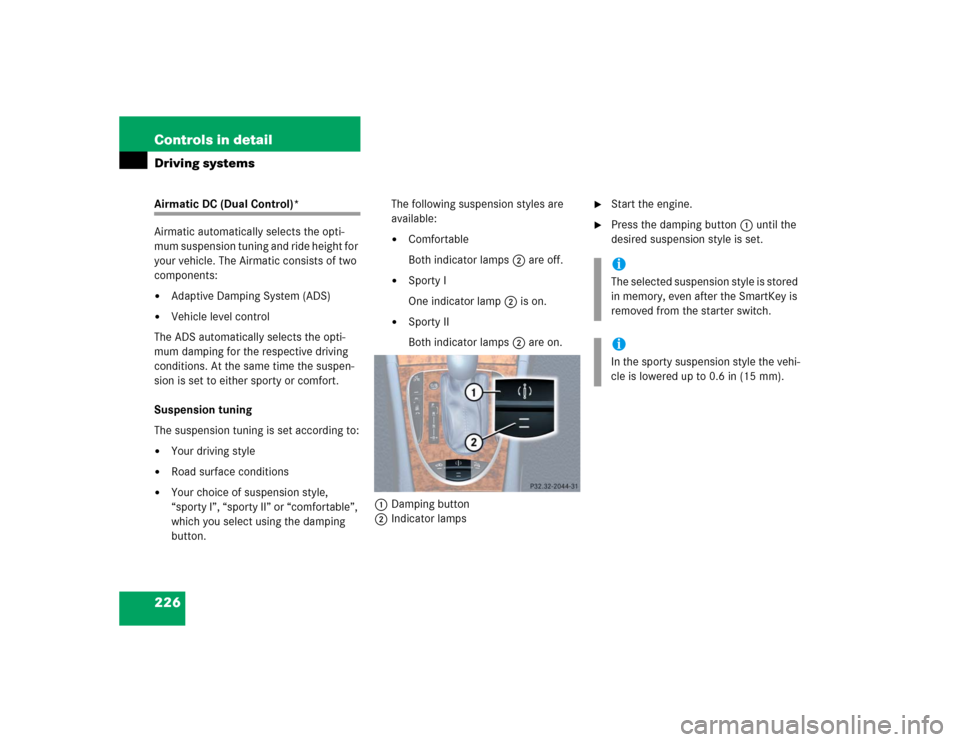
button.The following suspension styles are
available:
�
Comfortable
Both indicator lamps2 are off.
�
Sporty I
One indicator lamp2 is on.
�
Sporty II
Both indicator lamps2 are on.
1Damping button
2Indicator lamps
�
Start the engine.
�
Press the damping button1 until the
desired suspension style is set.iThe selected suspension style is stored
in memory, even after the SmartKey is
removed from the starter switch.iIn the sporty suspension style the vehi-
cle is lowered up to 0.6 in (15 mm).
Page 290 of 442
290 OperationTires and wheelsLife of tire
The service life of a tire is dependent upon
varying factors including but not limited to:�
Driving style
�
Tire pressure
�
Distance driven
Direction of rotation
Unidirectional tires offer added advantag-
es, such as better hydroplaning perfor-
mance. To benefit, however, you must
ensure that the tires rotate in the direction
specified.
An arrow on the sidewall indicates the in-
tended direction of tire rotation.Checking tire inflation pressure
Regularly check your tire pressure at inter-
vals of no more than 14 days.
Correct the tire pressure only when tires
are cold.If the tires are warm, you should only cor-
rect the tire pressure if it is too low for cur-
rent operating conditions.
A table on the fuel filler flap lists the spec-
ified tire inflation pressures for warm and
cold tires as well as for various operating
conditions.
Warning!
G
Tires and spare tire should be replaced after
six years, regardless of the remaining tread.!Keep unmounted tires in a cool, dry
place with as little exposure to light as
possible. Protect tires from contact
with oil, grease and gasoline.
Warning!
G
If the tire pressure drops repeatedly:�
Check the tires for punctures from for-
eign objects.
�
Check to see whether air is leaking from
the valves or from around the rim.
iThe pressures listed for light loads are
minimum values offering high driving
comfort.
Increased inflation pressures listed for
heavier loads may also be used for light
loads. These higher pressures produce
favorable handling characteristics. The
ride of the vehicle, however, will be
somewhat harder. Never exceed the
maximum values or inflate tires below
the minimum values listed in the fuel
filler flap.
Page 414 of 442

414 Technical termsMultifunction display
The display field in the instrument clus-
ter used to present information provid-
ed by the control system.
Multifunction steering wheel
Steering wheel with buttons for operat-
ing the control system.
Overspeed range
Engine speeds within the red marking
on the tachometer dial. Avoid this en-
gine speed range, as it may result in se-
rious engine damage that is not
covered by the Mercedes-Benz Limited
Warranty.
Poly-V-belt drive
Drives engine-components (alternator,
AC compressor, etc.) from the engine.Power train
Collective term designating all compo-
nents used to generate and transmit
motive power to the drive axles, includ-
ing:
�
Engine
�
Clutch/torque converter
�
Transmission
�
Transfer case*
�
Drive shaft
�
Axle shafts/axles
Program mode selector switch
Used to switch the automatic transmis-
sion between standard operationS and
operationC.
E 55 AMG with steering wheel gearshift
control and manual shift program: in
addition to S and C (for sporty S or
comfortable C operation), you can use
M for manual shift program.Remote Vehicle Diagnostics
Transmission of vehicle data and cur-
rent location to the Mercedes-Benz
Customer Assistance Center for sub-
scribers to the Tele Aid service.
Restraint systems
Seat belts, belt tensioners, airbags and
child restraint systems. As indepen-
dent systems, their protective func-
tions complement one another.
RON
(R
esearch O
ctane N
umber)
The Research Octane Number for gaso-
line as determined by a standardized
method. It is an indication of a gaso-
line's ability to resist undesired detona-
tion (knocking). The average of both
the ->MON (Motor Octane Number)
and RON (Research Octane Number) is
posted at the pump, also known as
ANTI-KNOCK INDEX.
Page 415 of 442

415 Technical terms
SBC
(S
ensotronic B
rake C
ontrol)
Electronically controlled hydraulic
braking system for increased braking
safety and comfort.
Shift lock
When the vehicle is parked, this lock
prevents the transmission selector le-
ver from being moved out of positionP
without SmartKey turned and brake
pedal depressed.
SRS
(S
upplemental R
estraint S
ystem)
Seat belts, emergency tensioning de-
vice and airbags. Though independent
systems, they are closely interfaced to
provide effective occupant protection.Tele Aid System
(T
elematic A
larm I
dentification on D
e-
mand)
The Tele Aid system consists of three
types of response: automatic and man-
ual emergency, roadside assistance
and information. Tele Aid is initially ac-
tivated by completing a subscriber
agreement and placing an acquain-
tance call.
The Tele Aid system is operational pro-
vided that the vehicle’s battery is
charged, properly connected, not dam-
aged and cellular and GPS coverage is
available.
Telematics*
A combination of the terms “telecom-
munications” and “informatics”.
Tightening torque
Force times lever arm (e.g. a lug
wrench) with which threaded fasteners
such as wheel bolts are tightened.Tire speed rating
Part of a tire designation; indicates the
speed range for which a tire is ap-
proved.
Traction
Force exerted by the vehicle on the
road via the tires.
Vehicle level control
The ground clearance of the vehicle is
automatically controlled according to a
selected setting and speed.The driver
can set the ground clearance manually
for example on very rough roads.
VIN
(V
ehicle I
dentification N
umber)
The number set by the manufacturer
and placed on the body to uniquely
identify each vehicle produced.
Voice control system*
Voice control system for car phones,
portable cell phones and audio sys-
tems (radio, CD, etc.).
Page 437 of 442

437 Index
Submenus
Convenience 150
For settings 131
In control system 133
Instrument cluster 141, 143
Lighting 146
Resetting functions in Control
system 139
Selecting 139
Settings menu 139
Vehicle 149
Sun visors 170
Supplemental Restraint System
(SRS) 415
Suspension tuning
For comfortable driving style 226
For sporty driving style 226
Switching off
Automatic central locking (control
system) 149
Engine 52
ESP 78
Hazard warning flasher 124
Headlamps 52
Seat heating* 114Switching on
Automatic central locking (control
system) 149
ESP 79
Front fog lamps 122
Hazard warning flasher 124
Headlamps 47
High beams 123
Parking lamps 119
Rear fog lamp 122
Seat heating* 114
Windshield wipers 48
Symbol (Distronic*)
Distance warning function* 136
Synchronizing
ESP 323
Panorama sliding/pop-up roof* 209
Power windows 200
Sliding/pop-up roof* 204
Time 144
T
Tachometer 128
Displaying gear range 160
Overspeed range 128
Tail lamps 360, 363
Tar stains 303Tele Aid
Messages in display 345, 346
Tele Aid System 415
Tele Aid* 250
Emergency calls 252
Information 255
Initiating an emergency call
manually 253
Remote door unlock 257
Roadside Assistance 254
SOS button 253
Stolen vehicle tracking services 258
System self-check 251
Tele Aid System 250
Upgrade signals 256
Telematics* 415
Telephone* 24, 249
Answering a call 156
Dialing a number from the phone
book 156
Ending a call 156
Loading phone book* 156
Messages in the display 346
Operating 155
Redialing 157