Page 119 of 368
A third auxiliary power point is
located on the right rear quarter
panel. The power point is accessible
from the liftgate.
POWER WINDOWS
When closing the power windows, you should verify they are free
of obstructions and ensure that children and/or pets are not in
the proximity of the window openings.
The power window switches located
on the center console are called
push-pull switches.
A. Drivers side
B. Window lock
C. Front passenger side
D. Left and right rear passenger
2004 Navigator (nav)
Owners Guide (post-2002-fmt)
USA English (fus) Driver Controls
119
Page 120 of 368
The following views are the driver ’ s side switches:
Normal operation
• Push down (to the first detent)
and hold the top portion of the
switch to open.
• Pull up (to the first detent) and
hold the top portion of the switch
to close.
The following view is the power
window switch on the rear door trim
panels.
• Press and hold the top or bottom
of the rear rocker switches to
open or close.
2004 Navigator (nav)
Owners Guide (post-2002-fmt)
USA English (fus)Driver Controls
120
Page 122 of 368

Security Override
If during a bounce-back condition, the switch is released to the neutral
position, then held in the one touch up position within two seconds after
the window reaches the bounce-back position, the window will travel
up with no bounce-back protection. If the switch is released before
the window reaches fully closed or the ignition is turned OFF (without
accessory delay being active), the window will stop. Security override
can be used if there is ice on the window or seals, causing a restriction.
Window lock
The window lock feature allows only
the driver to operate the rear power
windows.
To lock out the rear window
controls push the control down. To
restore the rear window controls,
push the control down. The control
will spring back up to the neutral
position.
Accessory delay
With accessory delay, the radio, windows, and moonroof operate for up
to ten minutes after the ignition switch is turned from the ON to the
OFF position or until any door is opened.
MIRRORS
Automatic dimming rear view mirror
Your vehicle is equipped with an inside rear view mirror with an
auto-dimming function. The electronic day/night mirror will change from
the normal state to the non-glare state when bright lights (glare) reach
the inside rear view mirror. When the inside rear view mirror detects
bright light from in front of or behind the vehicle, the inside rear view
mirror will automatically adjust (darken) to minimize glare.
Do not block the sensor on the backside of the inside rear view mirror
since this may impair proper system performance.
2004 Navigator (nav)
Owners Guide (post-2002-fmt)
USA English (fus)Driver Controls
122
Page 123 of 368
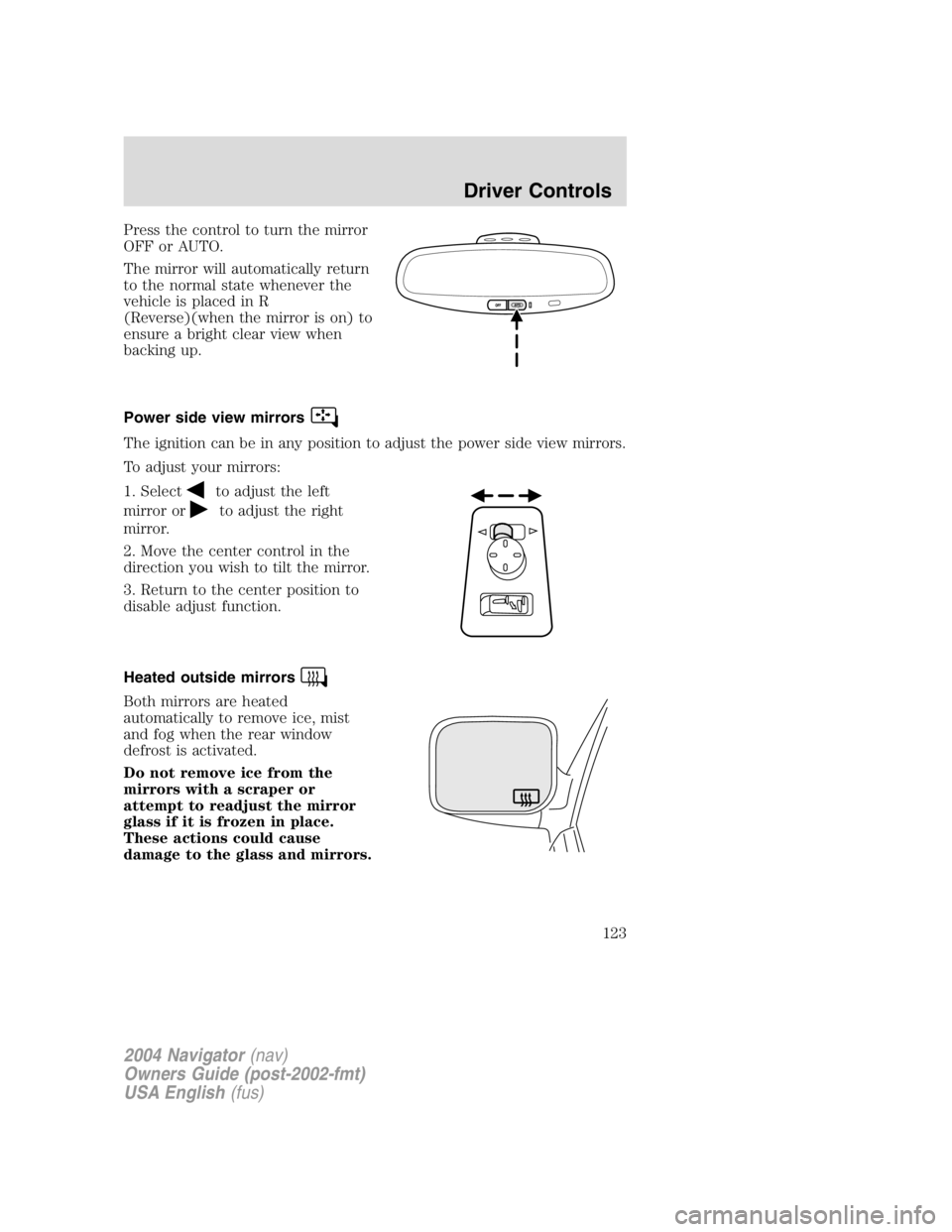
Press the control to turn the mirror
OFF or AUTO.
The mirror will automatically return
to the normal state whenever the
vehicle is placed in R
(Reverse)(when the mirror is on) to
ensure a bright clear view when
backing up.
Power side view mirrors
The ignition can be in any position to adjust the power side view mirrors.
To adjust your mirrors:
1. Select
to adjust the left
mirror or to adjust the right
mirror.
2. Move the center control in the
direction you wish to tilt the mirror.
3. Return to the center position to
disable adjust function.
Heated outside mirrors
Both mirrors are heated
automatically to remove ice, mist
and fog when the rear window
defrost is activated.
Do not remove ice from the
mirrors with a scraper or
attempt to readjust the mirror
glass if it is frozen in place.
These actions could cause
damage to the glass and mirrors.
2004 Navigator (nav)
Owners Guide (post-2002-fmt)
USA English (fus) Driver Controls
123
Page 154 of 368

Childproof door locks
When these locks are set, the rear
doors cannot be opened from the
inside. The rear doors can be
opened from the outside when the
doors are unlocked.
The childproof locks are located on
rear edge of each rear door and
must be set separately for each
door. Setting the lock for one door
will not automatically set the lock
for both doors.
Move lock control up to engage the childproof lock. Move control down
to disengage childproof locks.
REMOTE ENTRY SYSTEM
This device complies with part 15 of the FCC rules and with RS-210 of
Industry Canada. Operation is subject to the following two conditions:
(1) This device may not cause harmful interference, and (2) This device
must accept any interference received, including interference that may
cause undesired operation.
Changes or modifications not expressly approved by the party
responsible for compliance could void the user ’ s authority to
operate the equipment.
The remote entry system allows you to lock or unlock all vehicle doors
and liftgate and open the liftgate window without a key.
The remote entry lock/unlock feature operates in any ignition position.
The liftgate glass features operate as long as the vehicle ’ s speed is less
than 5 km/h (3 mph). The panic feature operates with the key in the
OFF or ACC position.
If there is any potential remote keyless entry problem with your vehicle,
ensure ALL remote entry transmitters are brought to the dealership, to
aid in troubleshooting.
Unlocking the doors/liftgate
Press this control to unlock the driver ’ s door. The interior lamps will
illuminate with the ignition OFF.
2004 Navigator (nav)
Owners Guide (post-2002-fmt)
USA English (fus)Locks and Security
154
Page 201 of 368

• Two crash sensors mounted in the front doors (one on each side).
• Two crash sensors located at the c-pillar behind the rear doors (one
on each side).
• Rollover sensor in the restraints control module (RCM).
The Safety Canopy � system, in combination with seat belts, can help
reduce the risk of severe injuries in the event of a significant side impact
collision or rollover event.
Children 12 years old and under should always be properly restrained in
the second or third row seats. The Safety Canopy � will not interfere
with children restrained using a properly installed child or booster seat
because it is designed to inflate downward from the headliner above the
doors along the side window opening.
The Safety Canopy � system is designed to activate when the vehicle
sustains lateral deceleration sufficient to cause the side crash sensor to
close an electrical circuit that initiates Safety Canopy � inflation or when
a certain likelihood of a rollover event is detected by the rollover sensor.
The Safety Canopy � is mounted to roof side-rail sheet metal, behind the
headliner, above the first and second row seats. In certain lateral
collisions or rollover events, the Safety Canopy � system will be
activated, regardless of which seats are occupied. In certain rollover
events, the Safety Canopy � on both sides of the vehicle will be inflated,
regardless of which seats are occupied. The Safety Canopy � is designed
to inflate between the side window area and occupants to further
enhance protection provided in side impact collisions and rollover events.
The fact that the Safety Canopy � did not activate in a collision does not
mean that something is wrong with the system. Rather, it means the
forces were not of the type sufficient to cause activation. The Safety
Canopy � is designed to inflate in certain side impact collisions or
rollover events, not in rear impact, frontal or near-frontal collisions,
unless the collision causes sufficient lateral deceleration or rollover
likelihood.
2004 Navigator (nav)
Owners Guide (post-2002-fmt)
USA English (fus) Seating and Safety Restraints
201
Page 269 of 368

Fuse/Relay
Location Fuse Amp
Rating Passenger Compartment Fuse Panel
Description
5 7.5A* Brake On/Off (stoplamp) switch, Powertrain
Control Module (PCM) (keep alive power),
EATC control head, Body Security Module
(BSM) (keep alive power), Speed control
deactivation switch, Speed control servo,
SecuriLock LED, 3rd row seat relay coils,
Power liftgate module, Clock, Brake Shift
Interlock (BSI) solenoid
6 15A* Headlamp switch (parklamps and switch
backlighting feed), Parklamps, License
lamps, Foglamp relay coil, Trailer tow
electric brake controller (illumination), BSM
(autolamp parklamps), Floor console gear
selector lighting, Switch backlighting
module, Foglamp indicator
7 7.5A* Radio (Start signal)
8 10A* Rear window defroster switch, Heated
outside mirrors, Rear window defroster
indicator (climate control head)
9 — Not used
10 20A* Trailer tow back-up lamps relay, Trailer tow
7 – wire connector (back-up lamps), Trailer
tow parklamps relay, Trailer tow 7 – and
4 – wire connectors (parklamps)
11 10A* A/C compressor clutch relay, A/C
compressor clutch solenoid, Air suspension
compressor relay, 4x4 Integrated Wheel
Ends (IWE) solenoid
12 10A* Speed control relay, Speed control servo
2004 Navigator (nav)
Owners Guide (post-2002-fmt)
USA English (fus) Roadside Emergencies
269
Page 270 of 368
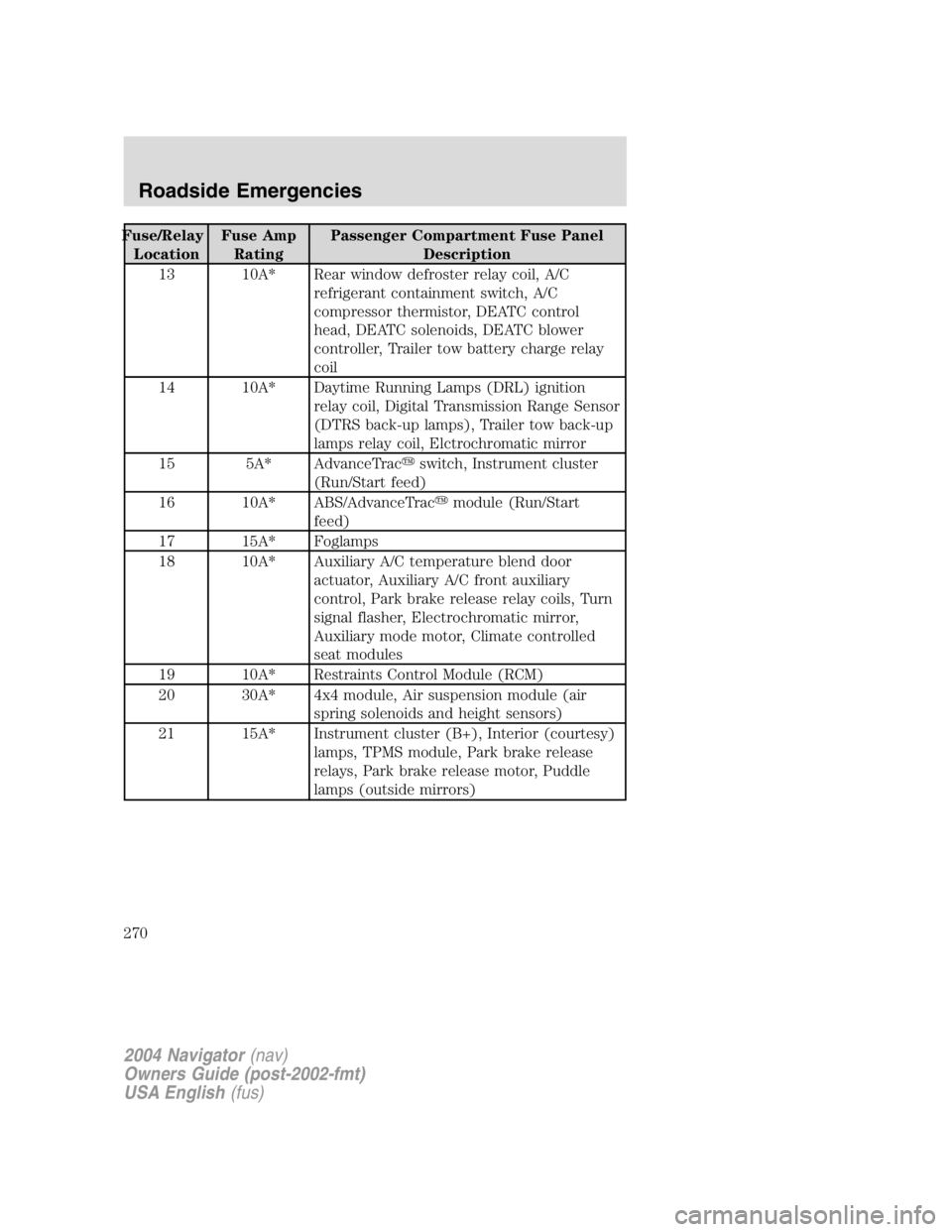
Fuse/Relay
Location Fuse Amp
Rating Passenger Compartment Fuse Panel
Description
13 10A* Rear window defroster relay coil, A/C
refrigerant containment switch, A/C
compressor thermistor, DEATC control
head, DEATC solenoids, DEATC blower
controller, Trailer tow battery charge relay
coil
14 10A* Daytime Running Lamps (DRL) ignition
relay coil, Digital Transmission Range Sensor
(DTRS back-up lamps), Trailer tow back-up
lamps relay coil, Elctrochromatic mirror
15 5A* AdvanceTrac � switch, Instrument cluster
(Run/Start feed)
16 10A* ABS/AdvanceTrac � module (Run/Start
feed)
17 15A* Foglamps
18 10A* Auxiliary A/C temperature blend door
actuator, Auxiliary A/C front auxiliary
control, Park brake release relay coils, Turn
signal flasher, Electrochromatic mirror,
Auxiliary mode motor, Climate controlled
seat modules
19 10A* Restraints Control Module (RCM)
20 30A* 4x4 module, Air suspension module (air
spring solenoids and height sensors)
21 15A* Instrument cluster (B+), Interior (courtesy)
lamps, TPMS module, Park brake release
relays, Park brake release motor, Puddle
lamps (outside mirrors)
2004 Navigator (nav)
Owners Guide (post-2002-fmt)
USA English (fus)Roadside Emergencies
270