2004 KIA Opirus lock
[x] Cancel search: lockPage 30 of 296

319
1
2
3
4
5
6
7
8
9
Knowing your vehicle
WARNING
- Driver’s seat
Never attempt to adjust seat
while the vehicle is moving.
This could result in loss of
control, and an accident caus-
ing death, serious injury, or
property damage.
Do not allow anything to inter- fere with the normal position
of the seatback. Storing items
against a seatback or in any
other way interfering with
proper locking of a seatback
could result in serious or fatal
injury in a sudden stop or col-
lision.
(Continued)
For a seating position more comfort-
able to the driver and front passen-
ger, adjust the seat forward, back-
ward, up and down.✽ ✽NOTICE• Power seats are driven by the elec-
tric motor. Stop operating if the
adjustment is completed. Excessive
operation may damage the electri-
cal equipment.
• When in operation, the power seats consume large amounts of
electrical power. To prevent unnec-
essary charging system drain,
don’t adjust the power seats longer
than necessary while the engine is
not running.
• Do not operate two or more power seat control buttons at the same
time. Doing so may result in power
seat motor or electrical component
malfunction.
WARNING
Loose objects in the driver ’s
foot area could interfere with
the operation of the foot ped-
als, possibly causing an acci-
dent. Loose objects might
interfere with the seat slide
mechanism. Do not place any-
thing under the front seats.
The power seats are operable
with the ignition OFF.
Therefore, children should
never be left unattended in the
car.
Opirus-ENG (CAN) 3.qxd 7/8/03 1:56 PM Page 19
Page 31 of 296

Knowing your vehicle20
3
1
2
3
4
5
6
7
8
9
Driver’ s seat adjustmentForward/backward position and
height adjustmentAdjusting the seat forward and back-
ward
Push the control button forward or
backward to move the seat to the
desired position. Release the knob
and the seat will lock in the selected
position. Adjust the seat before driving, and
make sure the seat is locked secure-
ly by trying to move forward and
backward without using the control
knob. If the seat moves, it is not
locked properly.
(Continued)
Always drive and ride with
your seatback upright and the
lap portion of the safety belt,
or lap belt, snug and low
across the hips. This position
puts your safety belts in the
best position to protect you in
case of an accident.
In order to avoid unnecessary
airbag injuries including the
possibility of severe injury or
death, always sit as far back
as possible from the steering
wheel while still being able to
maintain comfortable control
of your vehicle.
The Canadian Motor Vehicle
Safety Standards (CMVSS)
recommends that the driver
sit at least 10 inches (250 mm)
away from the steering wheel
to avoid the risk of serious
injury or death due to the
deployment of the driver’ s
airbag.
2GHA2238
Opirus-ENG (CAN) 3.qxd 7/8/03 1:56 PM Page 20
Page 33 of 296

Knowing your vehicle22
3
1
2
3
4
5
6
7
8
9
Adjusting the driver ’s seatback
reclinerMove the lever forward or backward
to the desired angle and release the
lever. If the lever is released, seat-
back will lock in place. After adjust-
ment, make sure that the lever has
returned to its original locked posi-
tion.
Warming the driver ’s seats
(if equipped)The front seats can be electrically
heated individually when the ignition
switch is ON. When the switch is ON,
a number ranging from 1 to 5 is dis-
played on the switch (5 = warmest
setting).
To turn off the seat warmer, set the
switch to 0.
The seat warmer turns off automati-
cally when the seat temperature
reaches the selected range and will
turn on again if the temperature
drops below the selected range.
2GHA2242
WARNING
Driving or riding in a vehicle
with a front seatback reclined
could lead to serious or fatal
injury in an accident. If a front
seat is reclined during an acci-
dent, the occupant’ s hips may
slide under the lap portion of
the safety belt applying great
force to the unprotected
abdomen or neck. Serious or
fatal internal injuries could
result. Keep the seatbacks in a
comfortably upright position
whenever the vehicle is in
motion.
TCS
2GHA2051A
Opirus-ENG (CAN) 3.qxd 7/8/03 1:56 PM Page 22
Page 36 of 296

325
1
2
3
4
5
6
7
8
9
Knowing your vehicle
Removal
To remove the headrest, raise it as
far as it can go then press the
release lever (
➀) while pulling
upward (
➁).
Adjusting the front passenger
seatForward/backward position
adjustmentPush the control knob forward or
backward to move the seat to the
desired position. Release the knob
and the seat will lock in the selected
position.
Adjust the seat before driving, and
make sure the seat is locked secure-
ly by trying to move forward and
backward without using the control
knob. If the seat moves, it is not
locked properly.
1GHA2247
WARNING
To reduce the risk of head and
neck injuries, do not drive the
vehicle with the headrest
removed or improperly posi-
tioned.
Do not adjust the driver ’s head-
rest while driving.
1GHA2248
Opirus-ENG (CAN) 3.qxd 7/8/03 1:56 PM Page 25
Page 37 of 296
Knowing your vehicle26
3
1
2
3
4
5
6
7
8
9
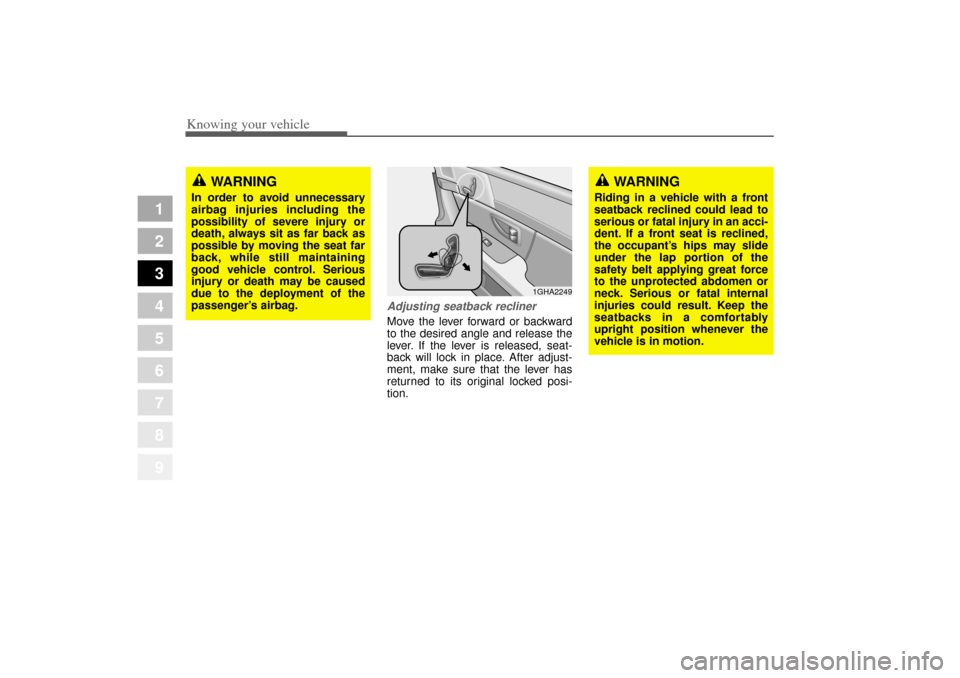
Adjusting seatback reclinerMove the lever forward or backward
to the desired angle and release the
lever. If the lever is released, seat-
back will lock in place. After adjust-
ment, make sure that the lever has
returned to its original locked posi-
tion.
WARNING
In order to avoid unnecessary
airbag injuries including the
possibility of severe injury or
death, always sit as far back as
possible by moving the seat far
back, while still maintaining
good vehicle control. Serious
injury or death may be caused
due to the deployment of the
passenger’ s airbag.
WARNING
Riding in a vehicle with a front
seatback reclined could lead to
serious or fatal injury in an acci-
dent. If a front seat is reclined,
the occupant’ s hips may slide
under the lap portion of the
safety belt applying great force
to the unprotected abdomen or
neck. Serious or fatal internal
injuries could result. Keep the
seatbacks in a comfortably
upright position whenever the
vehicle is in motion.
1GHA2249
Opirus-ENG (CAN) 3.qxd 7/8/03 1:56 PM Page 26
Page 46 of 296

335
1
2
3
4
5
6
7
8
9
Knowing your vehicle
Recalling positions from memory1. Shift the transaxle lever into Pwhile the ignition switch is ON.
2. To recall the position in memory, press the desired memory button
(1 or 2) the system will beep once,
then seat and outside rearview
mirror will automatically adjust to
the stored positions.
Adjusting one of the control knobs for
the seat or outside rearview mirror
while the system is recalling the
stored positions will cause the move-
ment for that component to stop and
move in the direction that the control
knob is moved. Other components
will continue position recalling.
To stop the position recall at any
point in the recall process, press the
STOP button once. Seat and outside
rearview mirror position recalling will
stop.
Storing and recalling with
transmitterStoring with the transmitterTurn the ignition switch to LOCK from
ON and lock all the doors using the
transmitter. The seat and outside
rearview mirror positions will be
stored in the system memory.
Driver’ s position recalling with
transmitterUnlock the door with the transmitter,
positions stored in the system mem-
ory will be recalled automatically.
If using two transmitters, recalling
times may vary because stored posi-
tions in each transmitter may be dif-
ferent.
Example) If doors are locked with
transmitter A and unlocked with
transmitter B, the positions memo-
rized when unlocked with transmitter
B will be recalled and may take
slightly longer than if unlocked with
transmitter A.
CAUTION
Use caution when recalling adjustment memory while sittingin the vehicle. Press the STOPbutton immediately if the seatmoves too far in any direction.
Opirus-ENG (CAN) 3.qxd 7/8/03 1:56 PM Page 35
Page 50 of 296

339
1
2
3
4
5
6
7
8
9
Knowing your vehicle
Safety belt restraint system
We strongly recommend that the
driver and all passengers be proper-
ly restrained at all times by using the
safety belts provided with the vehi-
cle. Proper use of the safety belts
decreases the risk of severe injury or
death in accidents or sudden stops.
In most states, and in Canada, the
law requires their use.
All seats have lap/shoulder belts.
Inertial locks in the safety belt retrac-
tors allow all of the lap/shoulder safe-
ty belts to remain unlocked during
normal vehicle operation. This allows
the occupants some freedom of
movement and increased comfort
while using the safety belts. If a force
is applied to the vehicle, such as a
strong stop, a sharp turn, or a colli-
sion, the safety belt retractors will
automatically lock the safety belts.Since the inertial locks do not require
a collision in order to lock up, you
may become aware of the safety
belts locking while braking or going
around sharp corners.
Always use the rear seat position(s)
to install your child restraint(s).
Never install a child restraint system
in the front passenger position, as an
inflating airbag could cause serious
or fatal injury to a child in that posi-
tion.
WARNING
- Safety belts
To minimize the risk of serious
or fatal injury in an accident, the
driver and all passengers
should use the appropriate
safety restraints for their age
and size. The presence of
airbags does not change the
need to be properly restrained
by a safety belt or size-appropri-
ate child restraint. In fact,
airbags are designed to work
the best when passengers are
correctly restrained in the vehi-
cle. Be sure you are familiar
with the information in this sec-
tion, including the information
on infant and child restraints.
Read the safety warnings on the
sun visors of your vehicle also.
Opirus-ENG (CAN) 3.qxd 7/8/03 1:56 PM Page 39
Page 51 of 296

Knowing your vehicle40
3
1
2
3
4
5
6
7
8
9
The rear safety belts use a special
auto-lock feature designed to allow a
child restraint to be used in these
positions without an added locking
clip. They normally lock only under
extreme or emergency conditions
(emergency lock mode). However
they can be adjusted so that they
remain in fixed and locked when a
child restraint system is placed in
these positions. (Use this auto-lock
mode only to secure a child restraint,
never for passengers restrained by
the safety belts.) Page 3-53 gives
instructions on placing the safety belt
in the auto lock mode.
The drivers safety belt can only oper-
ate in the emergency lock mode. Safety belts provide the best restraint
when:
The seatback is upright.
The occupant is sitting upright (not
slouched).
The lap belt is snug across the hips.
The shoulder belt is snug across the chest.
The knees are straight forward.
To help you remember to fasten your
safety belt, a warning light will come
on and a chime will sound. See
Safety Belt Warning Light and Chime
on page 3-42.
WARNING
- After a colli- sion
Lap/shoulder belt assemblies
may be stretched or damaged
when subjected to the stress
and forces of a collision.
The entire restraint system
should be inspected following
any collision. All belts, retrac-
tors, anchors and hardware
damaged by a collision should
be replaced before the vehicle
is operated again.
Opirus-ENG (CAN) 3.qxd 7/8/03 1:56 PM Page 40