2004 KIA Opirus seats
[x] Cancel search: seatsPage 59 of 296
Knowing your vehicle48
3
1
2
3
4
5
6
7
8
9
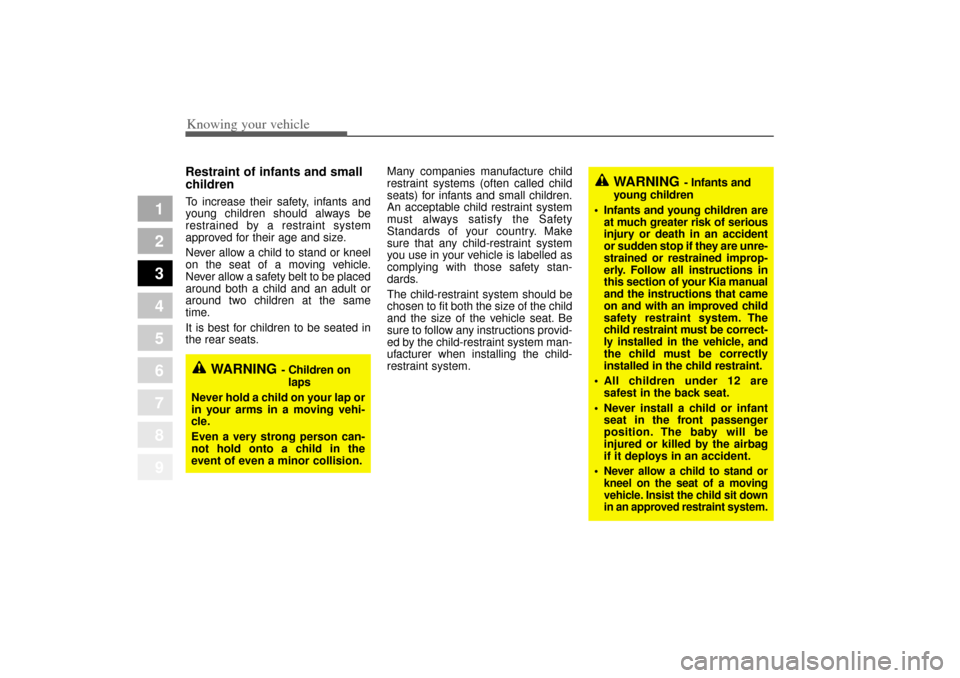
Restraint of infants and small
children To increase their safety, infants and
young children should always be
restrained by a restraint system
approved for their age and size.
Never allow a child to stand or kneel
on the seat of a moving vehicle.
Never allow a safety belt to be placed
around both a child and an adult or
around two children at the same
time.
It is best for children to be seated in
the rear seats. Many companies manufacture child
restraint systems (often called child
seats) for infants and small children.
An acceptable child restraint system
must always satisfy the Safety
Standards of your country. Make
sure that any child-restraint system
you use in your vehicle is labelled as
complying with those safety stan-
dards.
The child-restraint system should be
chosen to fit both the size of the child
and the size of the vehicle seat. Be
sure to follow any instructions provid-
ed by the child-restraint system man-
ufacturer when installing the child-
restraint system.
WARNING
- Children on
laps
Never hold a child on your lap or
in your arms in a moving vehi-
cle.
Even a very strong person can-
not hold onto a child in the
event of even a minor collision.
WARNING
- Infants and
young children
Infants and young children are
at much greater risk of serious
injury or death in an accident
or sudden stop if they are unre-
strained or restrained improp-
erly. Follow all instructions in
this section of your Kia manual
and the instructions that came
on and with an improved child
safety restraint system. The
child restraint must be correct-
ly installed in the vehicle, and
the child must be correctly
installed in the child restraint.
All children under 12 are
safest in the back seat.
Never install a child or infant
seat in the front passenger
position. The baby will be
injured or killed by the airbag
if it deploys in an accident.
Never allow a child to stand or
kneel on the seat of a moving
vehicle. Insist the child sit down
in an approved restraint system.
Opirus-ENG (CAN) 3.qxd 7/8/03 1:56 PM Page 48
Page 60 of 296

349
1
2
3
4
5
6
7
8
9
Knowing your vehicle
Restraint of larger children As children grow, they may need to
use new child-restraint systems,
including larger child seats or boost-
er seats, which are appropriate for
their increased size.
A child who has outgrown available
child-restraint systems should use
the belts provided in the vehicle.
When seated in the rear outboard
seats, the child should be restrained
by the lap/shoulder belt.
If the shoulder belt portion slightly
touches the child’s neck or face, try
placing the child closer to the center
of the vehicle. If the shoulder belt still
touches their face or neck they may
need to be returned to a child
restraint system. In addition, after-
market devices are available from
independent manufacturers which
help pull the shoulder belt down and
away from the child’s face or neck.
Larger children should use one of
the seat belts provided.
WARNING
- Shoulder
belts on small children
Never allow a shoulder belt to
be in contact with a child’ s
neck or face while the vehicle
is in motion.
A child too large for a child
restraint but too small for the
vehicle safety belts should
use an approved belt-position-
ing booster seat. This is safer
than allowing a child to ride
with a shoulder belt that
touches their face or neck.
If safety belts are not properly
worn and adjusted, there is a
risk of death or serious injury
to such a child.
CAUTION
- Hot metal
parts
Safety belts and seats canbecome hot in a vehicle that hasbeen closed during warm/hotweather; they could burn achild. Check seat covers andbuckles before you place a childanywhere near them.
Opirus-ENG (CAN) 3.qxd 7/8/03 1:56 PM Page 49
Page 61 of 296
Knowing your vehicle50
3
1
2
3
4
5
6
7
8
9
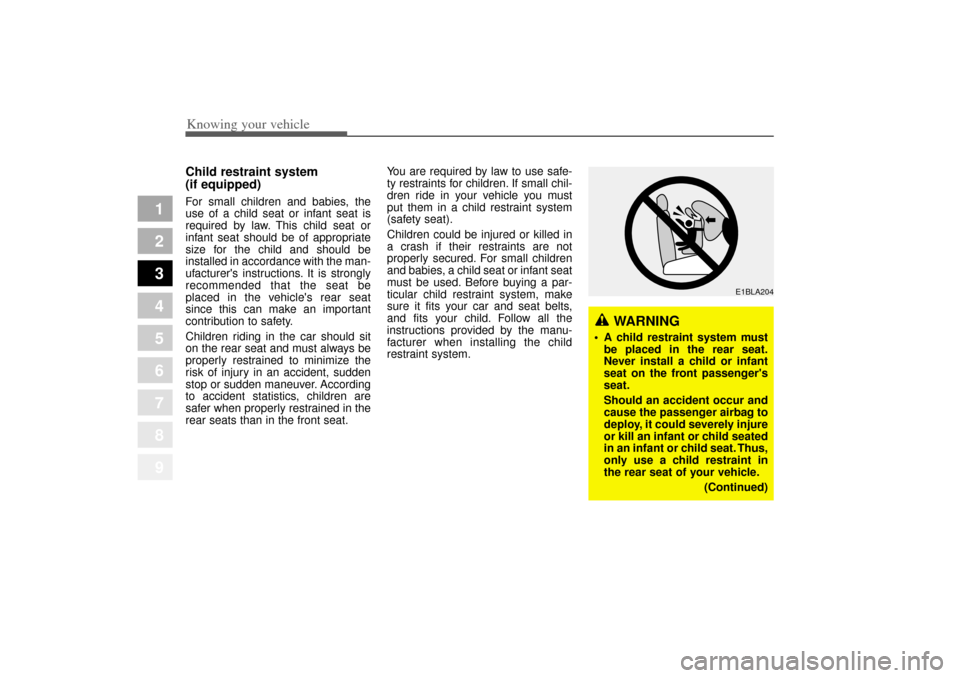
Child restraint system
(if equipped)For small children and babies, the
use of a child seat or infant seat is
required by law. This child seat or
infant seat should be of appropriate
size for the child and should be
installed in accordance with the man-
ufacturer's instructions. It is strongly
recommended that the seat be
placed in the vehicle's rear seat
since this can make an important
contribution to safety.
Children riding in the car should sit
on the rear seat and must always be
properly restrained to minimize the
risk of injury in an accident, sudden
stop or sudden maneuver. According
to accident statistics, children are
safer when properly restrained in the
rear seats than in the front seat. You are required by law to use safe-
ty restraints for children. If small chil-
dren ride in your vehicle you must
put them in a child restraint system
(safety seat).
Children could be injured or killed in
a crash if their restraints are not
properly secured. For small children
and babies, a child seat or infant seat
must be used. Before buying a par-
ticular child restraint system, make
sure it fits your car and seat belts,
and fits your child. Follow all the
instructions provided by the manu-
facturer when installing the child
restraint system.
E1BLA204
WARNING
A child restraint system must
be placed in the rear seat.
Never install a child or infant
seat on the front passenger's
seat.
Should an accident occur and
cause the passenger airbag to
deploy, it could severely injure
or kill an infant or child seated
in an infant or child seat. Thus,
only use a child restraint in
the rear seat of your vehicle.
(Continued)
Opirus-ENG (CAN) 3.qxd 7/8/03 1:56 PM Page 50
Page 63 of 296

Knowing your vehicle52
3
1
2
3
4
5
6
7
8
9
Installing a child restraint system For safety reasons, we recommend
that the child restraint system be
used in the rear seats.
Never place a rear-facing child
restraint in the front passenger
seat, because of the danger that
an inflating passenger side air bag
could impact the rear-facing child
restraint and kill the child.
Since all passenger’s (except dri-
ver’s) safety belts move freely under
normal conditions and only lock
under extreme or emergency condi-
tions (emergency lock mode), you
must manually change these safety
belts to the auto lock mode to secure
a child restraint.✽ ✽
NOTICEThe driver’s safety belt incorporates
the emergency lock mode only.
WARNING
Do not install any child
restraint system in the front
passenger seat. Should an
accident occur and cause the
passenger airbag to deploy, it
could severely injure or kill an
infant or child seated in an
infant or child seat. Therefore,
only use a child restraint sys-
tem in the rear seat of your
vehicle.
If the child restraint seat is not
anchored properly, the risk of
a child being seriously injured
or killed in a collision greatly
increases.
WARNING
Before installing the child
restraint system, read the
instructions supplied by the
child restraint system manu-
facturer.
If the seat belt does not oper-
ate as described, have the
system checked immediately
by your authorized Kia dealer.
Failure to observe this manual
instructions regarding child
restraint system and the
instructions provided with the
child restraint system could
increase the chance and/or
severity of injury in an acci-
dent.
Opirus-ENG (CAN) 3.qxd 7/8/03 1:56 PM Page 52
Page 64 of 296
353
1
2
3
4
5
6
7
8
9
Knowing your vehicle
Placing a passenger safety
belt into the auto lock modeThe use of the auto lock mode will
ensure that the normal movement of
the child in the vehicle does not
cause the safety belt to be pulled out
and loosen the firmness of its hold
on the child restraint system. To
secure a child restraint system, use
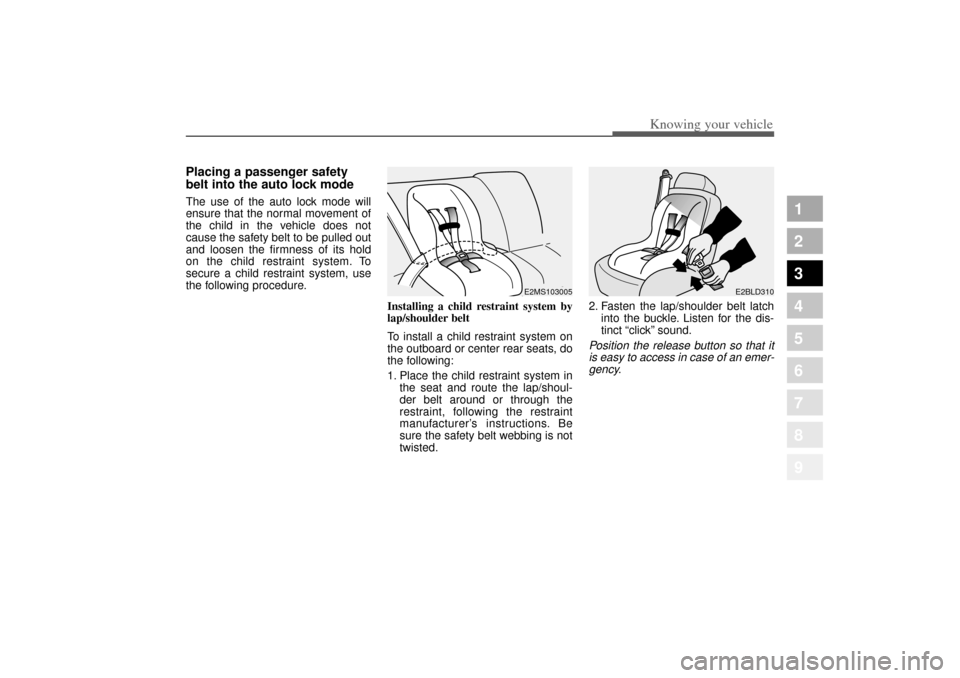
the following procedure.Installing a child restraint system by
lap/shoulder belt
To install a child restraint system on
the outboard or center rear seats, do
the following:
1. Place the child restraint system inthe seat and route the lap/shoul-
der belt around or through the
restraint, following the restraint
manufacturer’s instructions. Be
sure the safety belt webbing is not
twisted. 2. Fasten the lap/shoulder belt latch
into the buckle. Listen for the dis-
tinct “click” sound.
Position the release button so that itis easy to access in case of an emer-gency.
E2MS103005
E2BLD310
Opirus-ENG (CAN) 3.qxd 7/8/03 1:56 PM Page 53
Page 67 of 296

Knowing your vehicle56
3
1
2
3
4
5
6
7
8
9
Securing a child restraint seat
with “Tether Anchor” systemChild restraint hook holders are
located on the shelf behind the rear
seats.
1. Open the tether anchor cover on
the shelf behind the rear seats. 2. Route the child restraint seat strap
over the seatback.
For vehicles with adjustable head-
rest, route the tether strap under
the headrest and between the
headrest posts, otherwise route
the tether strap over the top of the
seatback.
3. Connect the tether strap hook to the correct child restraint hook
holder and tighten to secure the
seat.
WARNING
If the tether strap is secured
incorrectly, the child restraint
seat may not be restrained
properly in the event of a colli-
sion.
2GHA2025
2GHN3300
Opirus-ENG (CAN) 3.qxd 7/8/03 1:56 PM Page 56
Page 68 of 296

357
1
2
3
4
5
6
7
8
9
Knowing your vehicle
Child seat lower anchorsSome child seat manufacturers
make child restraint seats that are
labeled as International Standards
Organization Fixed (ISOFIX) or
ISOFIX-compatible child restraint
seats. These seats include two rigid
or webbing mounted attachments
that connect to two ISOFIX anchors
at specific seating positions in your
vehicle. This type of child restraint
seat eliminates the need to use seat
belts to attach the child seat for for-
ward-facing child restraint seats in
the rear seats.
WARNING
- Childrestraint
Check that the child restraint
system is secure by pushing
and pulling it in different direc-
tions. Incorrectly fitted child
restraints may swing, twist, tip
or come away causing death or
injury.
WARNING - Child restraint anchorage
Child restraint anchorages are
designed to withstand only
those loads imposed by cor-
rectly fitted child restraints.
Under no circumstances are
they to be used for adult seat
belts or harnesses or for
attaching other items or
equipment to the vehicle.
The tether strap may not work
properly if attached some-
where other than the correct
tether anchor.
2GHN2025A
Opirus-ENG (CAN) 3.qxd 7/8/03 1:56 PM Page 57
Page 69 of 296
Knowing your vehicle58
3
1
2
3
4
5
6
7
8
9
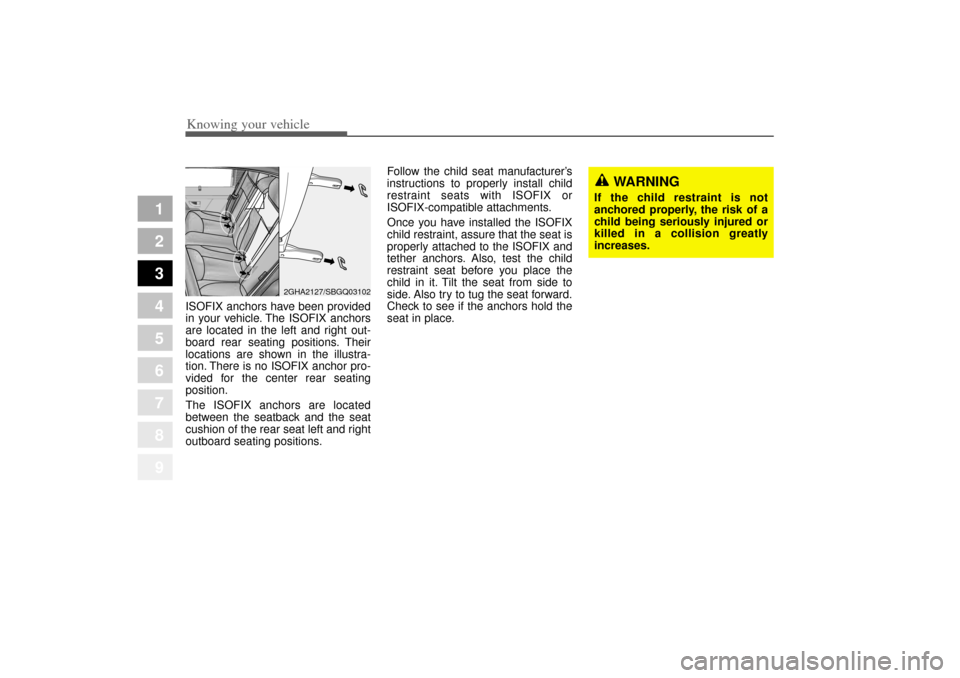
ISOFIX anchors have been provided
in your vehicle. The ISOFIX anchors
are located in the left and right out-
board rear seating positions. Their
locations are shown in the illustra-
tion. There is no ISOFIX anchor pro-
vided for the center rear seating
position.
The ISOFIX anchors are located
between the seatback and the seat
cushion of the rear seat left and right
outboard seating positions. Follow the child seat manufacturer
’s
instructions to properly install child
restraint seats with ISOFIX or
ISOFIX-compatible attachments.
Once you have installed the ISOFIX
child restraint, assure that the seat is
properly attached to the ISOFIX and
tether anchors. Also, test the child
restraint seat before you place the
child in it. Tilt the seat from side to
side. Also try to tug the seat forward.
Check to see if the anchors hold the
seat in place.
WARNING
If the child restraint is not
anchored properly, the risk of a
child being seriously injured or
killed in a collision greatly
increases.
2GHA2127/SBGQ03102
Opirus-ENG (CAN) 3.qxd 7/8/03 1:56 PM Page 58