Page 162 of 296
Driving your vehicle48
4
1
2
3
4
5
6
7
8
9
Daytime running light
(if equipped)Daytime Running Lights (DRL) can
make it easier for others to see the
front of your vehicle during the day.
DRL can be helpful in many different
driving conditions, and it is especial-
ly helpful after dawn and before sun-
set.
The DRL system will make your
low-beam headlights turn OFF
when:
1. The head light switch is ON.
2. The parking brake is engaged.
3. The parklight switch is ON.
4. Engine stops.
Opirus-ENG (CAN) 4.qxd 7/8/03 2:19 PM Page 48
Page 194 of 296
Driving tips85✽
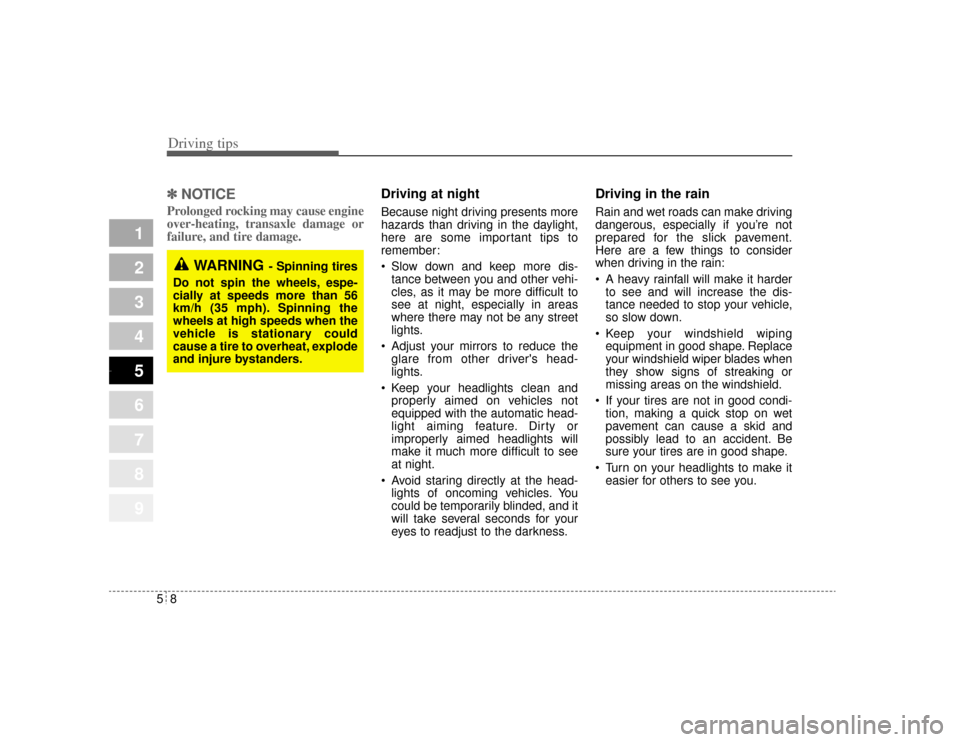
✽NOTICEProlonged rocking may cause engine
over-heating, transaxle damage or
failure, and tire damage.
Driving at night Because night driving presents more
hazards than driving in the daylight,
here are some important tips to
remember:
Slow down and keep more dis-
tance between you and other vehi-
cles, as it may be more difficult to
see at night, especially in areas
where there may not be any street
lights.
Adjust your mirrors to reduce the glare from other driver's head-
lights.
Keep your headlights clean and properly aimed on vehicles not
equipped with the automatic head-
light aiming feature. Dirty or
improperly aimed headlights will
make it much more difficult to see
at night.
Avoid staring directly at the head- lights of oncoming vehicles. You
could be temporarily blinded, and it
will take several seconds for your
eyes to readjust to the darkness.
Driving in the rain Rain and wet roads can make driving
dangerous, especially if you’re not
prepared for the slick pavement.
Here are a few things to consider
when driving in the rain:
A heavy rainfall will make it harderto see and will increase the dis-
tance needed to stop your vehicle,
so slow down.
Keep your windshield wiping equipment in good shape. Replace
your windshield wiper blades when
they show signs of streaking or
missing areas on the windshield.
If your tires are not in good condi- tion, making a quick stop on wet
pavement can cause a skid and
possibly lead to an accident. Be
sure your tires are in good shape.
Turn on your headlights to make it easier for others to see you.
1
2
3
4
5
6
7
8
9
WARNING
- Spinning tires
Do not spin the wheels, espe-
cially at speeds more than 56
km/h (35 mph). Spinning the
wheels at high speeds when the
vehicle is stationary could
cause a tire to overheat, explode
and injure bystanders.
Opirus CAN 5-1.qxd 7/8/03 2:21 PM Page 8
Page 221 of 296
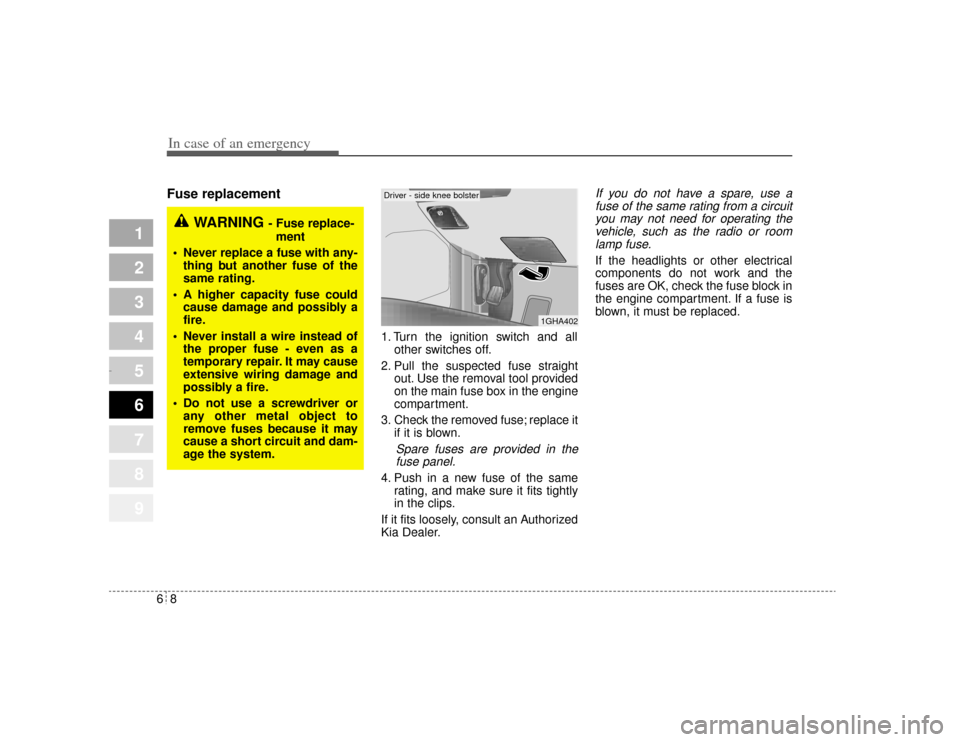
In case of an emergency86Fuse replacement
1. Turn the ignition switch and allother switches off.
2. Pull the suspected fuse straight out. Use the removal tool provided
on the main fuse box in the engine
compartment.
3. Check the removed fuse; replace it if it is blown.
Spare fuses are provided in thefuse panel.
4. Push in a new fuse of the same rating, and make sure it fits tightly
in the clips.
If it fits loosely, consult an Authorized
Kia Dealer.
If you do not have a spare, use a fuse of the same rating from a circuityou may not need for operating thevehicle, such as the radio or roomlamp fuse.If the headlights or other electrical
components do not work and the
fuses are OK, check the fuse block in
the engine compartment. If a fuse is
blown, it must be replaced.
1
2
3
4
5
6
7
8
9
1GHA402
WARNING
- Fuse replace-
ment
Never replace a fuse with any- thing but another fuse of the
same rating.
A higher capacity fuse could cause damage and possibly a
fire.
Never install a wire instead of the proper fuse - even as a
temporary repair. It may cause
extensive wiring damage and
possibly a fire.
Do not use a screwdriver or any other metal object to
remove fuses because it may
cause a short circuit and dam-
age the system.
Driver - side knee bolster
Opirus CAN 6-1.qxd 7/8/03 2:22 PM Page 8
Page 227 of 296
In case of an emergency14
6
1
2
3
4
5
6
7
8
9
Power connectorYour vehicle is equipped with a
power connector to prevent battery
discharge if your vehicle is parked
without being operated for prolonged
periods. Use the following proce-
dures before parking the vehicle for
prolonged period. 1. Turn off the engine.
2. Turn off the headlights and tail
lights.
3. Open the driver-side knee bolster cover and pull up the
“POWER/CONN”.
✽ ✽NOTICE• If the power connector is pulled up
from the fuse panel, the warning
chime, AV system, clock and
intetrior lamps, etc., will not oper-
ate. Some items must be reset after
replacement. (Refer to “Items to
be reset···.” on page 7-33)
• Even though the power connector is pulled up, the battery can still
be discharged by operation of the
headlights or other electrical
devices.
1GHA403
Power
connector
Opirus CAN 6-1.qxd 7/8/03 2:22 PM Page 14
Page 269 of 296

Maintenance32
7
1
2
3
4
5
6
7
8
9
For best battery service : Keep the battery securely mount-
ed.
Keep the battery top clean and dry.
Keep the terminals and connec-
tions clean, tight, and coated with
petroleum jelly or terminal grease.
Rinse any spilled electrolyte from
the battery immediately with a
solution of water and baking soda.
If the vehicle is not going to be
used for an extended time, discon-
nect the battery cables.
Battery recharging Your vehicle has a maintenance-free,
calcium-based battery.
If the battery becomes discharged
in a short time (because, for exam-
ple, the headlights or interior lights
were left on while the vehicle was
not in use), recharge it by slow
charging (trickle) for 10 hours.
If the battery gradually discharges
because of high electric load while
the vehicle is being used, recharge
it at 20-30A for two hours.
CBGQ0705
(Continued)
When lifting a plastic-cased
battery, excessive pressure on
the case may cause battery
acid to leak, resulting in per-
sonal injury. Lift with a battery
carrier or with your hands on
opposite corners.
Never attempt to charge the
battery when the battery
cables are connected.
The electrical ignition system
works with high voltage.
Never touch these compo-
nents with the engine running
or the ignition switched on.
Opirus CAN 7-1.qxd 7/8/03 2:25 PM Page 32
Page 296 of 296

85
1
2
3
4
5
6
7
8
9
Specifications
Light Bulbs
*1)HID(High Intensity Discharge) type
*2)With sunroof
* This mark indicates the filament is not used Capacities
Light Bulb
Wattage
Headlights (High/Low) 55/55 or 35*
1)
Front turn signal lights (LED type) 13.2
Position lights 5
Side mark lights 5
Front fog lights (if equipped) 55
Stop and tail lights 28/8
Rear turn signal lights 28/8*
Back-up lights 16
High mounted stop light (LED type) 2.54
License plate lights 5
Front map lamp 5 or 10*
2)
Center dome lamp 10
Door courtesy lamps 5
Vanity mirror lamps 3
Trunk room lamp 5
Foot lamp 5
Glove box lamp 5
LubricantVolume Classification
Engine oil
*1
4.3 l(4.5 qt.)
API SERVICE SH or above
Transaxle
8.5 l(9.0 qt.) DIAMOND ATF SP-III,
fluid SK ATF SP-III
Power steering 1.0 l(1.1 qt.) PSF-III
Coolant 10.2
l
Ethylene glycol base for
(10.8 qt.
) aluminum radiator
Brake fluid 0.7~0.8
l
FMVSS116 DOT-3
(
0.7~0.8 qt.
) or DOT-4
Fuel 70
l Unleaded gasoline with
(18.5 gal) AKI 87 or higher
*¹Refer to the recommended SAE viscosity numbers on the page 7-49.
Opirus CAN 8-1.qxd 7/8/03 2:31 PM Page 5