2004 KIA Opirus child lock
[x] Cancel search: child lockPage 63 of 296

Knowing your vehicle52
3
1
2
3
4
5
6
7
8
9
Installing a child restraint system For safety reasons, we recommend
that the child restraint system be
used in the rear seats.
Never place a rear-facing child
restraint in the front passenger
seat, because of the danger that
an inflating passenger side air bag
could impact the rear-facing child
restraint and kill the child.
Since all passenger’s (except dri-
ver’s) safety belts move freely under
normal conditions and only lock
under extreme or emergency condi-
tions (emergency lock mode), you
must manually change these safety
belts to the auto lock mode to secure
a child restraint.✽ ✽
NOTICEThe driver’s safety belt incorporates
the emergency lock mode only.
WARNING
Do not install any child
restraint system in the front
passenger seat. Should an
accident occur and cause the
passenger airbag to deploy, it
could severely injure or kill an
infant or child seated in an
infant or child seat. Therefore,
only use a child restraint sys-
tem in the rear seat of your
vehicle.
If the child restraint seat is not
anchored properly, the risk of
a child being seriously injured
or killed in a collision greatly
increases.
WARNING
Before installing the child
restraint system, read the
instructions supplied by the
child restraint system manu-
facturer.
If the seat belt does not oper-
ate as described, have the
system checked immediately
by your authorized Kia dealer.
Failure to observe this manual
instructions regarding child
restraint system and the
instructions provided with the
child restraint system could
increase the chance and/or
severity of injury in an acci-
dent.
Opirus-ENG (CAN) 3.qxd 7/8/03 1:56 PM Page 52
Page 64 of 296
353
1
2
3
4
5
6
7
8
9
Knowing your vehicle
Placing a passenger safety
belt into the auto lock modeThe use of the auto lock mode will
ensure that the normal movement of
the child in the vehicle does not
cause the safety belt to be pulled out
and loosen the firmness of its hold
on the child restraint system. To
secure a child restraint system, use
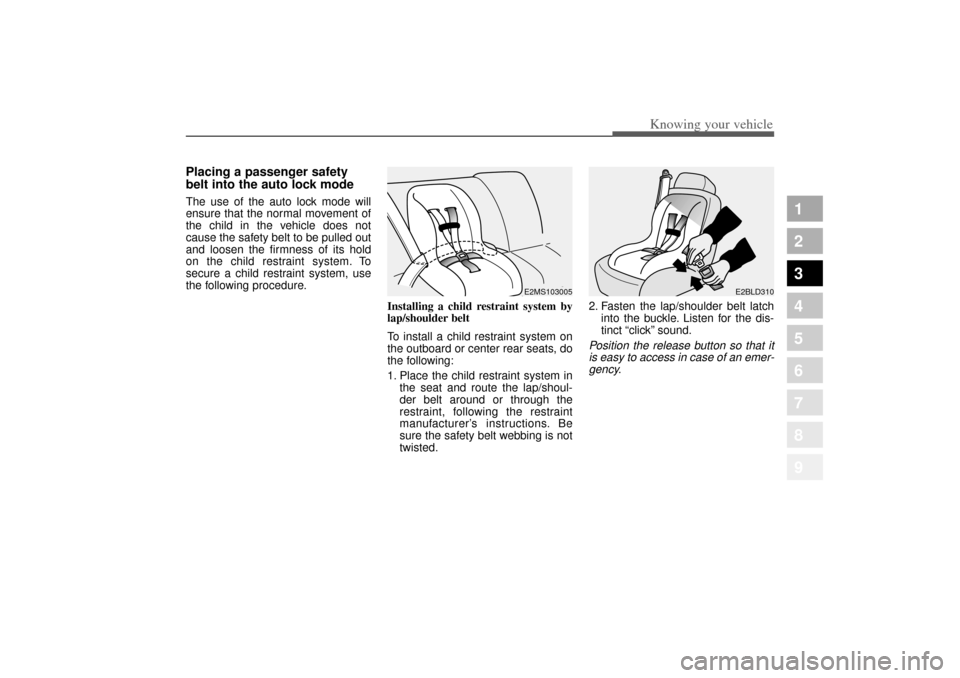
the following procedure.Installing a child restraint system by
lap/shoulder belt
To install a child restraint system on
the outboard or center rear seats, do
the following:
1. Place the child restraint system inthe seat and route the lap/shoul-
der belt around or through the
restraint, following the restraint
manufacturer’s instructions. Be
sure the safety belt webbing is not
twisted. 2. Fasten the lap/shoulder belt latch
into the buckle. Listen for the dis-
tinct “click” sound.
Position the release button so that itis easy to access in case of an emer-gency.
E2MS103005
E2BLD310
Opirus-ENG (CAN) 3.qxd 7/8/03 1:56 PM Page 53
Page 65 of 296
Knowing your vehicle54
3
1
2
3
4
5
6
7
8
9
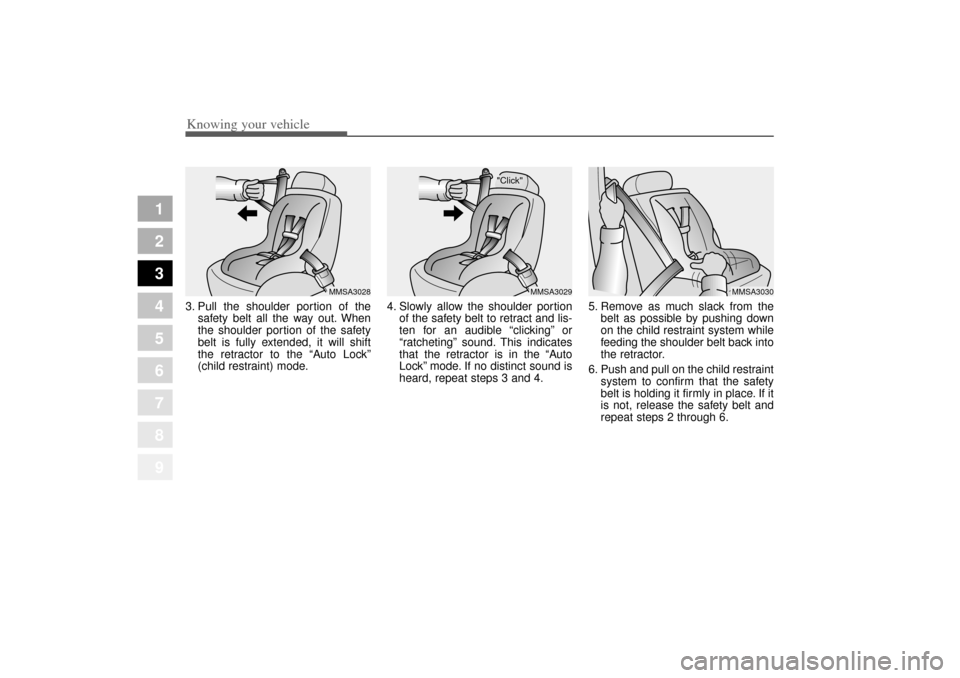
3. Pull the shoulder portion of the
safety belt all the way out. When
the shoulder portion of the safety
belt is fully extended, it will shift
the retractor to the “Auto Lock”
(child restraint) mode. 4. Slowly allow the shoulder portion
of the safety belt to retract and lis-
ten for an audible “clicking” or
“ratcheting” sound. This indicates
that the retractor is in the “Auto
Lock” mode. If no distinct sound is
heard, repeat steps 3 and 4. 5. Remove as much slack from the
belt as possible by pushing down
on the child restraint system while
feeding the shoulder belt back into
the retractor.
6. Push and pull on the child restraint system to confirm that the safety
belt is holding it firmly in place. If it
is not, release the safety belt and
repeat steps 2 through 6.
MMSA3028
"Click"
MMSA3029
MMSA3030
Opirus-ENG (CAN) 3.qxd 7/8/03 1:56 PM Page 54
Page 66 of 296

355
1
2
3
4
5
6
7
8
9
Knowing your vehicle
7. Double check that the retractor isin the “Auto Lock” mode by
attempting to pull more of the safe-
ty belt out of the retractor. If you
cannot, the retractor is in the “Auto
Lock” mode.
To remove the child restraint, press
the release button on the buckle and
then pull the lap/shoulder belt out of
the restraint and allow the safety belt
to retract fully.
✽ ✽ NOTICEWhen the safety belt is allowed to
retract to its fully stowed position,
the retractor will automatically
switch from the “Auto Lock” mode
to the emergency lock mode for nor-
mal adult usage.
WARNING
- Auto lock
mode
The lap/shoulder belt automati-
cally returns to the “emergency
lock mode” whenever the belt is
allowed to retract fully.
Therefore, the preceding seven
steps must be followed each
time a child restraint is
installed.
If the safety belt is not placed in
the “auto lock” mode, severe
injury or death could occur to
the child and/or other occupants
in the vehicle in a collision,
since the child restraint will not
be effectively held in place.
Opirus-ENG (CAN) 3.qxd 7/8/03 1:56 PM Page 55
Page 78 of 296

367
1
2
3
4
5
6
7
8
9
Knowing your vehicle
If the curtain airbag deploys, it
remains inflated for approximately
3 seconds. The curtain airbag
deployment occurs only on the
side of the vehicle affected by the
impact.
The side airbags (side and curtain
airbags) are not designed to
deploy during collisions from the
front or rear of the vehicle or in
most rollover situations.
The curtain airbags are designed
to deploy only during certain side-
impact collisions, depending on the
crash severity, angle, speed and
impact. The curtain airbags are not
designed to deploy in all side
impact situations.
WARNING
In order for side airbags (side
and curtain airbags) to pro-
vide its best protection, both
front seat occupants and both
outboard rear occupants
should sit in an upright posi-
tion with the seat belts proper-
ly fastened. Especially, chil-
dren should sit in a proper
child restraint system.
When children are seated in
the rear outboard seats, they
must be seated in the proper
child restraint system. Make
sure to put the child restraint
system as far away from the
door side as possible, and
secure the child restraint sys-
tem to be locked in position.
(Continued)
(Continued)
Do not allow the passengers
to lean their heads or bodies
onto doors, put their arms on
the doors, stretch their arms
out of the window, or place
objects between the doors
and passengers when they are
seated on the seats where
side airbags are equipped.
Never try to open or repair any
components of the side cur-
tain airbag system. This
should be done only by an
authorized Kia dealer.
Failure to follow the above men-
tioned instructions can result in
injury or death to the vehicle
occupants in an accident.
Opirus-ENG (CAN) 3.qxd 7/8/03 1:56 PM Page 67
Page 86 of 296
375
1
2
3
4
5
6
7
8
9
Knowing your vehicle
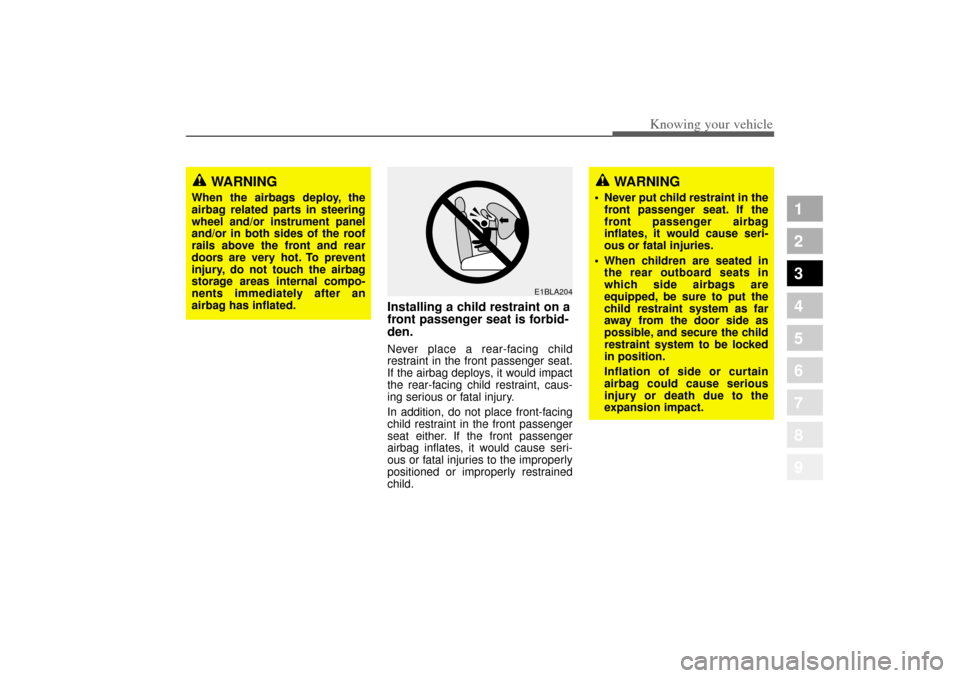
Installing a child restraint on a
front passenger seat is forbid-
den.Never place a rear-facing child
restraint in the front passenger seat.
If the airbag deploys, it would impact
the rear-facing child restraint, caus-
ing serious or fatal injury.
In addition, do not place front-facing
child restraint in the front passenger
seat either. If the front passenger
airbag inflates, it would cause seri-
ous or fatal injuries to the improperly
positioned or improperly restrained
child.
WARNING
Never put child restraint in the
front passenger seat. If the
front passenger airbag
inflates, it would cause seri-
ous or fatal injuries.
When children are seated in
the rear outboard seats in
which side airbags are
equipped, be sure to put the
child restraint system as far
away from the door side as
possible, and secure the child
restraint system to be locked
in position.
Inflation of side or curtain
airbag could cause serious
injury or death due to the
expansion impact.
WARNING
When the airbags deploy, the
airbag related parts in steering
wheel and/or instrument panel
and/or in both sides of the roof
rails above the front and rear
doors are very hot. To prevent
injury, do not touch the airbag
storage areas internal compo-
nents immediately after an
airbag has inflated.
E1BLA204
Opirus-ENG (CAN) 3.qxd 7/8/03 1:56 PM Page 75
Page 92 of 296

381
1
2
3
4
5
6
7
8
9
Knowing your vehicle
Emergency trunk safety
releaseYour vehicle is equipped with an
emergency trunk release cable locat-
ed inside the trunk. The lever glows
in the dark when the trunk lid is
closed. If someone is inadvertently
locked in the trunk, pulling this han-
dle will release the trunk latch mech-
anism and open the trunk.
2GHA2020
WARNING
No one should be allowed to
occupy the trunk of the vehicle
at any time. If the trunk is par-
tially or totally latched and the
person is unable to get out,
severe injury or death could
occur due to lack of ventilation,
exhaust fumes and rapid heat
build-up, or because of expo-
sure to cold weather conditions.
The trunk is also a highly dan-
gerous location in the event of a
crash because it is not a pro-
tected occupant space but
merely a part of the vehicle’s
crush zone.
Pull to open the trunk
CAUTION
If a person is locked in the
trunk, they can pull the emer-gency release to open thetrunk lid.
We recommend that cars be
kept locked and keys be keptout of the reach of children,and that parents teach theirchildren about the dangers ofplaying in trunks.
Opirus-ENG (CAN) 3.qxd 7/8/03 1:56 PM Page 81
Page 121 of 296

47
1
2
3
4
5
6
7
8
9
Driving your vehicle
Transaxle rangesP (park)This position locks the transaxle and
prevents the front wheels from rotat-
ing. Always come to a complete stop
before shifting into this position.
✽ ✽
NOTICEThe transaxle may be damaged if
you shift into P (Park) while the
vehicle is in motion.(Continued)
Before leaving the driver’s
seat, always make sure the
shift lever is in the P (PARK)
position. Set the parking
brake fully, shut the engine off
and take the key with you.
Unexpected and sudden vehi-
cle movement can occur if you
do not follow these precau-
tions in the order specified.
Never leave a child unattend- ed in a vehicle.
WARNING
Shifting into P (Park) while thevehicle is in motion will cause
the drive wheels to lock which
will cause you to lose control
of the vehicle.
Do not use the P (Park) posi- tion in place of the parking
brake. Always make sure the
shift lever is latched in the P
(Park) position so that it can-
not be moved unless the lock
release button is pushed in,
AND set the parking brake
fully.
(Continued)
Opirus-ENG (CAN) 4.qxd 7/8/03 2:19 PM Page 7