2004 KIA Amanti BELTS
[x] Cancel search: BELTSPage 53 of 296

Knowing your vehicle42
3
1
2
3
4
5
6
7
8
9
WARNING
- Safety belt
care
A damaged belt may not give
you the protection you need in
an accident.
Inspect your safety belts peri-
odically for excessive wear or
damage. Pull out each belt
fully and look for fraying, cuts,
burns or other damage. Pull
the safety belt out and let it
retract a number of times.
Make sure that the lap/shoul-
der belts return smoothly and
easily into the retractor.
Check the latches to make
sure they latch and release
without interference or delay.
Never close the doors on any
part of the lap or shoulder
belt.
Any belt not in good condition
or in good working order
should be promptly replaced.
CAUTION
Never close the doors on any
part of the lap or shoulder belt.It can damage the safety belt orbuckle which could increase therisk of injury in case of an acci-dent.
Safety belt warning light and
chimeAs a reminder to the driver and pas-
senger, safety belt warning light will
blink for approximately 6 seconds
each time you turn the ignition switch
ON.
If the driver’s lap/shoulder belt is not
fastened when the key is turned ON,
the safety belt warning chime sounds
and the safety belt warning light
blinks for approximately 6 seconds.
1GQA2083
Opirus-ENG (CAN) 3.qxd 7/8/03 1:56 PM Page 42
Page 58 of 296

347
1
2
3
4
5
6
7
8
9
Knowing your vehicle
Proper use and care of the
safety belt system To ensure that the safety belts pro-
vide the maximum protection, please
follow these instructions:
Use the belts at all times - even onshort trips.
If the safety belt is twisted, straight- en it prior to use.
Keep sharp edges and damaging objects away from the belts.
Periodically inspect belt webbing, anchors, buckles and all other
parts for signs of wear and dam-
age. Replace damaged, excessive-
ly worn or questionable parts
immediately. To clean the belt webbing, use a
mild soap solution recommended
for cleaning upholstery or carpets.
Follow the instructions provided
with the soap.
Do not bleach or dye the webbing
because this may weaken the web-
bing fibers and allow them to fail
when loaded in a collision.
Do not make modifications or addi- tions to the safety belt.
After wearing a safety belt, make sure it fully retracts to the stowed
position. Do not allow the belt to
get caught in the door when you
close it.
Restraint of pregnant women Pregnant women should wear
lap/shoulder belt assemblies when-
ever possible according to specific
recommendations by their doctors.
The lap portion of the belt should be
worn AS SNUGLY AND LOW AS
POSSIBLE.
WARNING
- Pregnant
women
Pregnant women must never
place the lap portion of the safe-
ty belt over the area of the
abdomen where the fetus is
located or above the abdomen
where the belt could crush the
fetus during an impact.
Opirus-ENG (CAN) 3.qxd 7/8/03 1:56 PM Page 47
Page 60 of 296

349
1
2
3
4
5
6
7
8
9
Knowing your vehicle
Restraint of larger children As children grow, they may need to
use new child-restraint systems,
including larger child seats or boost-
er seats, which are appropriate for
their increased size.
A child who has outgrown available
child-restraint systems should use
the belts provided in the vehicle.
When seated in the rear outboard
seats, the child should be restrained
by the lap/shoulder belt.
If the shoulder belt portion slightly
touches the child’s neck or face, try
placing the child closer to the center
of the vehicle. If the shoulder belt still
touches their face or neck they may
need to be returned to a child
restraint system. In addition, after-
market devices are available from
independent manufacturers which
help pull the shoulder belt down and
away from the child’s face or neck.
Larger children should use one of
the seat belts provided.
WARNING
- Shoulder
belts on small children
Never allow a shoulder belt to
be in contact with a child’ s
neck or face while the vehicle
is in motion.
A child too large for a child
restraint but too small for the
vehicle safety belts should
use an approved belt-position-
ing booster seat. This is safer
than allowing a child to ride
with a shoulder belt that
touches their face or neck.
If safety belts are not properly
worn and adjusted, there is a
risk of death or serious injury
to such a child.
CAUTION
- Hot metal
parts
Safety belts and seats canbecome hot in a vehicle that hasbeen closed during warm/hotweather; they could burn achild. Check seat covers andbuckles before you place a childanywhere near them.
Opirus-ENG (CAN) 3.qxd 7/8/03 1:56 PM Page 49
Page 61 of 296
Knowing your vehicle50
3
1
2
3
4
5
6
7
8
9
Child restraint system
(if equipped)For small children and babies, the
use of a child seat or infant seat is
required by law. This child seat or
infant seat should be of appropriate
size for the child and should be
installed in accordance with the man-
ufacturer's instructions. It is strongly
recommended that the seat be
placed in the vehicle's rear seat
since this can make an important
contribution to safety.
Children riding in the car should sit
on the rear seat and must always be
properly restrained to minimize the
risk of injury in an accident, sudden
stop or sudden maneuver. According
to accident statistics, children are
safer when properly restrained in the
rear seats than in the front seat. You are required by law to use safe-
ty restraints for children. If small chil-
dren ride in your vehicle you must
put them in a child restraint system
(safety seat).
Children could be injured or killed in
a crash if their restraints are not
properly secured. For small children
and babies, a child seat or infant seat
must be used. Before buying a par-
ticular child restraint system, make
sure it fits your car and seat belts,
and fits your child. Follow all the
instructions provided by the manu-
facturer when installing the child
restraint system.
E1BLA204
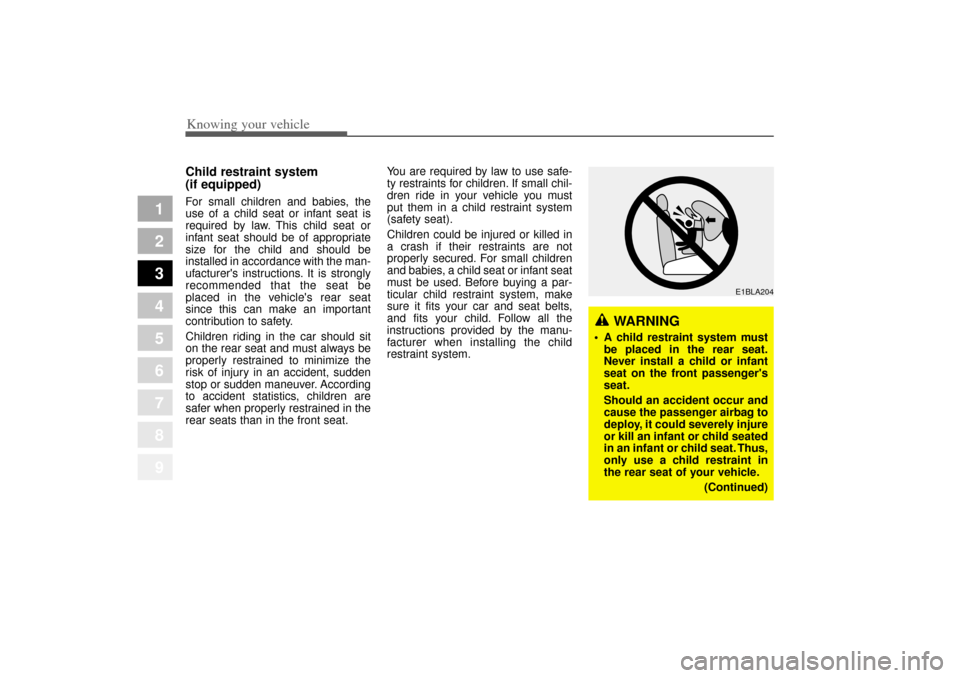
WARNING
A child restraint system must
be placed in the rear seat.
Never install a child or infant
seat on the front passenger's
seat.
Should an accident occur and
cause the passenger airbag to
deploy, it could severely injure
or kill an infant or child seated
in an infant or child seat. Thus,
only use a child restraint in
the rear seat of your vehicle.
(Continued)
Opirus-ENG (CAN) 3.qxd 7/8/03 1:56 PM Page 50
Page 62 of 296
351
1
2
3
4
5
6
7
8
9
Knowing your vehicle
(Continued)
Since a safety belt or child
restraint system can become
very hot if it is left in a closed
vehicle, be sure to check the
seat cover and buckles before
placing a child there.
When the child restraint sys-
tem is not in use, store it in the
trunk or fasten it with a safety
belt so that it will not be
thrown forward in the case of
a sudden stop or an accident.
Children who are too large to
be in a child restraint should
sit in the rear seat and be
restrained with the available
lap/shoulder belts. Never
allow children to ride in the
front passenger seat.
(Continued)
(Continued)
Always make sure that the
shoulder belt portion of the
lap/shoulder belt is positioned
midway over the shoulder,
never across the neck or
behind the back. The lap belt
portion of the lap/shoulder
belt must always be posi-
tioned as low as possible on
the child's hips and as snug
as possible.
If the seat belt will not proper-
ly fit the child the use of an
approved booster seat in the
rear seat must be used in
order to raise the child's seat-
ing height so that the seat belt
will properly fit the child.
(Continued)
(Continued)
Never allow a child to stand up
or kneel on the seat.
Never use an infant carrier or
child safety seat that "hooks"
over a seatback; it may not
provide adequate security in
an accident.
Never allow a child to be held
in a person's arms while they
are in a moving vehicle, as
this could result in serious
injury to the child in the event
of an accident or a sudden
stop. Holding a child in a mov-
ing vehicle does not provide
the child with any means of
protection during an accident,
even if the person holding the
child is wearing a seat belt.
Opirus-ENG (CAN) 3.qxd 7/8/03 1:56 PM Page 51
Page 63 of 296

Knowing your vehicle52
3
1
2
3
4
5
6
7
8
9
Installing a child restraint system For safety reasons, we recommend
that the child restraint system be
used in the rear seats.
Never place a rear-facing child
restraint in the front passenger
seat, because of the danger that
an inflating passenger side air bag
could impact the rear-facing child
restraint and kill the child.
Since all passenger’s (except dri-
ver’s) safety belts move freely under
normal conditions and only lock
under extreme or emergency condi-
tions (emergency lock mode), you
must manually change these safety
belts to the auto lock mode to secure
a child restraint.✽ ✽
NOTICEThe driver’s safety belt incorporates
the emergency lock mode only.
WARNING
Do not install any child
restraint system in the front
passenger seat. Should an
accident occur and cause the
passenger airbag to deploy, it
could severely injure or kill an
infant or child seated in an
infant or child seat. Therefore,
only use a child restraint sys-
tem in the rear seat of your
vehicle.
If the child restraint seat is not
anchored properly, the risk of
a child being seriously injured
or killed in a collision greatly
increases.
WARNING
Before installing the child
restraint system, read the
instructions supplied by the
child restraint system manu-
facturer.
If the seat belt does not oper-
ate as described, have the
system checked immediately
by your authorized Kia dealer.
Failure to observe this manual
instructions regarding child
restraint system and the
instructions provided with the
child restraint system could
increase the chance and/or
severity of injury in an acci-
dent.
Opirus-ENG (CAN) 3.qxd 7/8/03 1:56 PM Page 52
Page 68 of 296

357
1
2
3
4
5
6
7
8
9
Knowing your vehicle
Child seat lower anchorsSome child seat manufacturers
make child restraint seats that are
labeled as International Standards
Organization Fixed (ISOFIX) or
ISOFIX-compatible child restraint
seats. These seats include two rigid
or webbing mounted attachments
that connect to two ISOFIX anchors
at specific seating positions in your
vehicle. This type of child restraint
seat eliminates the need to use seat
belts to attach the child seat for for-
ward-facing child restraint seats in
the rear seats.
WARNING
- Childrestraint
Check that the child restraint
system is secure by pushing
and pulling it in different direc-
tions. Incorrectly fitted child
restraints may swing, twist, tip
or come away causing death or
injury.
WARNING - Child restraint anchorage
Child restraint anchorages are
designed to withstand only
those loads imposed by cor-
rectly fitted child restraints.
Under no circumstances are
they to be used for adult seat
belts or harnesses or for
attaching other items or
equipment to the vehicle.
The tether strap may not work
properly if attached some-
where other than the correct
tether anchor.
2GHN2025A
Opirus-ENG (CAN) 3.qxd 7/8/03 1:56 PM Page 57
Page 72 of 296

361
1
2
3
4
5
6
7
8
9
Knowing your vehicle
➀
Driver’s airbag
(see page 3- 63)
➁
Front passenger’ s airbag
(see page 3- 64)
➂
Side airbag (see page 3- 66)
➃
Curtain Airbag(see page 3- 66)
➄ Front impact sensor
(see page 3- 68)
\b
Side impact sensor(see page 3- 68)
➆
SRS Control Module(see page 3- 68)
Airbag inflation condition(see page 3- 69)
Airbag non-inflation condition(see page 3- 71)
Airbag warning light(see page 3- 76)
Airbag service(see page 3- 76)
Airbag warning label(see page 3- 78)
What your airbag system doesDriver’s airbag and front passenger’ s
airbag are designed to supplement
the protection offered by the safety
belt in certain frontal collisions.
Likewise, side airbag and curtain
airbags are designed to supplement
the protection offered by the safety
belt in side collisions. Safety belts
are designed to reduce the injury of
the driver or passengers in case of
light impact or collision. However, to
help reduce impact on driver or pas-
sengers in a serious collision, seat
belts must also be correctly worn.
What your airbag system does
not doThe air bag system is designed to
supplement the protection offered by
the safety belt system. IT IS NOT A
SUBSTITUTE FOR THE SAFETY
BELT.
Opirus-ENG (CAN) 3.qxd 7/8/03 1:56 PM Page 61