Page 269 of 296

Maintenance32
7
1
2
3
4
5
6
7
8
9
For best battery service : Keep the battery securely mount-
ed.
Keep the battery top clean and dry.
Keep the terminals and connec-
tions clean, tight, and coated with
petroleum jelly or terminal grease.
Rinse any spilled electrolyte from
the battery immediately with a
solution of water and baking soda.
If the vehicle is not going to be
used for an extended time, discon-
nect the battery cables.
Battery recharging Your vehicle has a maintenance-free,
calcium-based battery.
If the battery becomes discharged
in a short time (because, for exam-
ple, the headlights or interior lights
were left on while the vehicle was
not in use), recharge it by slow
charging (trickle) for 10 hours.
If the battery gradually discharges
because of high electric load while
the vehicle is being used, recharge
it at 20-30A for two hours.
CBGQ0705
(Continued)
When lifting a plastic-cased
battery, excessive pressure on
the case may cause battery
acid to leak, resulting in per-
sonal injury. Lift with a battery
carrier or with your hands on
opposite corners.
Never attempt to charge the
battery when the battery
cables are connected.
The electrical ignition system
works with high voltage.
Never touch these compo-
nents with the engine running
or the ignition switched on.
Opirus CAN 7-1.qxd 7/8/03 2:25 PM Page 32
Page 270 of 296

733
Maintenance
1
2
3
4
5
6
7
8
9
Items to be reset after the batteryhas been discharged or the bat-tery has been disconnected. Driver seat position memory sys-
tem (See page 3-25)
Power window (See page 3-69)
Clock (See page 3-74)
Climate control system (See pages
4-86 and 4-88)
Audio (See the audio manual)
Sunroof (See page 3-105)
✽ ✽
NOTICE• Before performing maintenance
or recharging the battery, turn off
all accessories and stop the engine.
• The negative battery cable must be removed first and installed last
when the battery is disconnected.
WARNING
- Recharging
battery
When recharging the battery,
observe the following precau-
tions:
The battery must be removed
from the vehicle and placed in
an area with good ventilation.
Do not allow cigarettes,
sparks, or flame near the bat-
tery.
Watch the battery during
charging, and stop or reduce
the charging rate if the battery
cells begin gassing (boiling)
violently or if the temperature
of the electrolyte of any cell
exceeds 49°C (120°F).
Wear eye protection when
checking the battery during
charging.
(Continued)
(Continued)
Disconnect the battery charg-
er in the following order.
1. Turn off the battery charger main switch.
2. Unhook the negative clamp from the negative battery ter-
minal.
3. Unhook the positive clamp from the positive battery ter-
minal.
Opirus CAN 7-1.qxd 7/8/03 2:25 PM Page 33
Page 279 of 296

Maintenance42
7
1
2
3
4
5
6
7
8
9
1. Open the hood.
2. Remove the engine compartment
shroud.
3. Remove the headlight bulb cover by turning it counterclockwise.
4. Disconnect the headlight bulb socket-connector.
5. Unsnap the headlight bulb retain- ing wire by depressing the end
and pushing it upward.
6. Remove the bulb from the head- light assembly.
WARNING
- Halogen
bulbs
Halogen bulbs contain pres-
surized gas that will produce
flying pieces of glass if bro-
ken.
Always handle them carefully,
and avoid scratches and abra-
sions. If the bulbs are lit, avoid
contact with liquids. Never
touch the glass with bare
hands. Residual oil may cause
the bulb to overheat and burst
when lit. A bulb should be
operated only when installed
in a headlight.
(Continued)
(Continued)
If a bulb becomes damaged or
cracked, replace it immediate-
ly and carefully dispose of it.
Wear eye protection when
changing a bulb. Allow the
bulb to cool down before han-
dling it.
1GHA423
2GHA744
Opirus CAN 7-1.qxd 7/8/03 2:26 PM Page 42
Page 285 of 296

Maintenance48
7
1
2
3
4
5
6
7
8
9
LUBRICANT SPECIFICATIONS Recommended lubricants To help achieve proper engine and
powertrain performance and durabil-
ity, use only lubricants of the proper
quality. The correct lubricants also
help promote engine efficiency that
results in improved fuel economy.
Engine oils labeled Energy
Conserving Oil are now available.
Along with other additional benefits,
they contribute to fuel economy by
reducing the amount of fuel neces-
sary to overcome engine friction.
Often, these improvements are diffi-
cult to measure in everyday driving,
but in a year’ s time, they can offer
significant cost and energy savings.
*¹ Refer to the recommended SAE viscosity numbers on the next page.These lubricants and fluids are recommended for use in your vehicle.
Lubricant Classification
Engine oil *¹
API Service SH or above
Automatic transaxle fluid DIAMOND ATF SP-III or SK ATF SP-III
Power steering fluid PSF-III
Brake fluid FMVSS116 DOT-3 or DOT-4
Opirus CAN 7-1.qxd 7/8/03 2:26 PM Page 48
Page 286 of 296

749
Maintenance
1
2
3
4
5
6
7
8
9
Recommended SAE viscosity
number ✽ ✽NOTICEAlways be sure to clean the area
around any filler plug, drain plug,
or dipstick before checking or
draining any lubricant. This is espe-
cially important in dusty or sandy
areas and when the vehicle is used
on unpaved roads. Cleaning the plug
and dipstick areas will prevent dirt
and grit from entering the engine
and other mechanisms that could be
damaged. Engine oil viscosity (thickness) has
an effect on fuel economy and cold
weather operating (starting and oil
flow). Lower viscosity engine oils can
provide better fuel economy and cold
weather performance, however,
higher viscosity engine oils are
required for satisfactory lubrication in
hot weather. Using oils of any viscos-
ity other than those recommended
could result in engine damage.
Temperature Range for SAE Viscosity Numbers
Temperature
Engine Oil °
C
( ° F)
-30 -20 -10 0 10 20 30 40 50
-20 0 20 40 60 80 100 120
20W-40, 20W-50
10W-30, 10W-40, 10W-50
5W-30, 5W-40
When choosing an oil, consider the range of temperature your vehicle will be
operated in before the next oil change. Proceed to select the recommended
oil viscosity from the chart.
Opirus CAN 7-1.qxd 7/8/03 2:26 PM Page 49
Page 287 of 296
Maintenance50
7
1
2
3
4
5
6
7
8
9
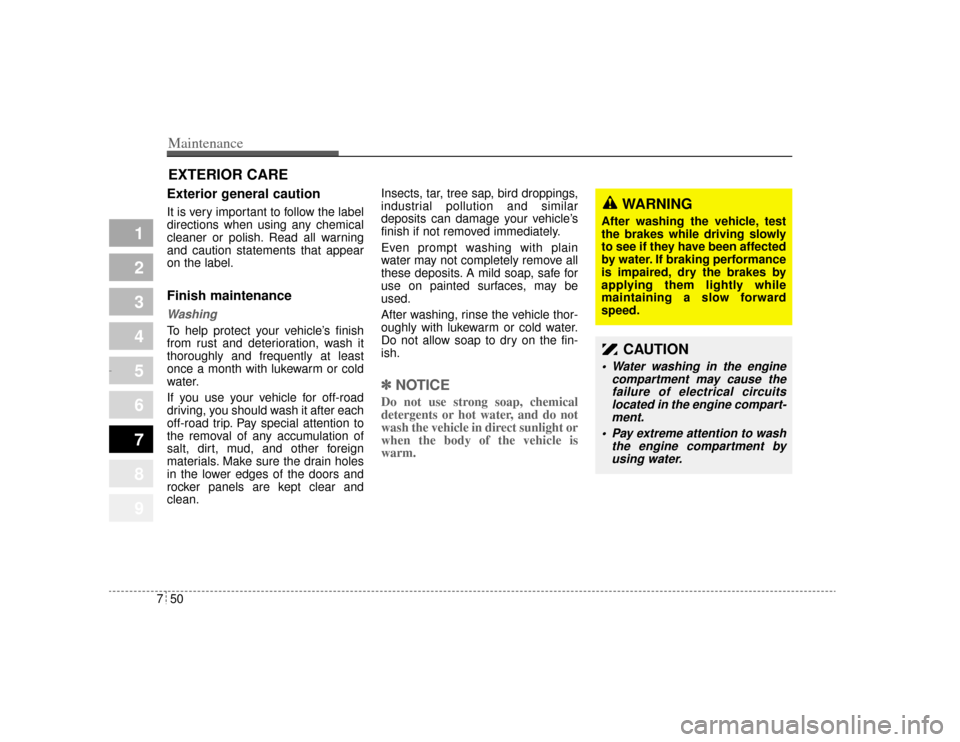
EXTERIOR CARE Exterior general caution It is very important to follow the label
directions when using any chemical
cleaner or polish. Read all warning
and caution statements that appear
on the label.Finish maintenanceWashing To help protect your vehicle’ s finish
from rust and deterioration, wash it
thoroughly and frequently at least
once a month with lukewarm or cold
water.
If you use your vehicle for off-road
driving, you should wash it after each
off-road trip. Pay special attention to
the removal of any accumulation of
salt, dirt, mud, and other foreign
materials. Make sure the drain holes
in the lower edges of the doors and
rocker panels are kept clear and
clean. Insects, tar, tree sap, bird droppings,
industrial pollution and similar
deposits can damage your vehicle’
s
finish if not removed immediately.
Even prompt washing with plain
water may not completely remove all
these deposits. A mild soap, safe for
use on painted surfaces, may be
used.
After washing, rinse the vehicle thor-
oughly with lukewarm or cold water.
Do not allow soap to dry on the fin-
ish.
✽ ✽ NOTICEDo not use strong soap, chemical
detergents or hot water, and do not
wash the vehicle in direct sunlight or
when the body of the vehicle is
warm.
CAUTION
Water washing in the engine
compartment may cause thefailure of electrical circuitslocated in the engine compart-ment.
Pay extreme attention to wash
the engine compartment byusing water.
WARNING
After washing the vehicle, test
the brakes while driving slowly
to see if they have been affected
by water. If braking performance
is impaired, dry the brakes by
applying them lightly while
maintaining a slow forward
speed.
Opirus CAN 7-1.qxd 7/8/03 2:26 PM Page 50
Page 294 of 296
83
1
2
3
4
5
6
7
8
9
Specifications
EngineElectrical system
ItemGasoline Engine
BoreXStroke 93 mm X 85.8 mm (3.66 in X 3.38 in)
Displacement 3497 cc (213.3 cu.in)
Compression Ratio 10.0
SizeGasoline Engine
Battery 12V / 80AH (20HR)
Alternator 13.5V / 120A
Starter 12V-1.2kW
Spark Plug Gap
1.0 mm ~ 1.1 mm
Specification PFR5N-11, RC10PYPB4
Opirus CAN 8-1.qxd 7/8/03 2:31 PM Page 3
Page 295 of 296
Specifications48
1
2
3
4
5
6
7
8
9
Gear ratio
Tires
ItemFrontRear
Tire size 225/60R16 98H 225/60R16 98H
210 (30) 210 (30)
Wheel size 6.5J x 16 6.5J x 16
Wheel lug nut torque 9~11 9~11
kg·m (lb·ft, N·m) (65~79, 88~107) (65~79, 88~107)
Inflation pressure
kPa (psi)
Engine Gasoline
Gear Automatic transmission
1st 3.789
2nd 2.057
3rd 1.421
4th 1.039
5th 0.731
Reverse 3.865
F.G.R 3.333
Opirus CAN 8-1.qxd 7/8/03 2:31 PM Page 4

